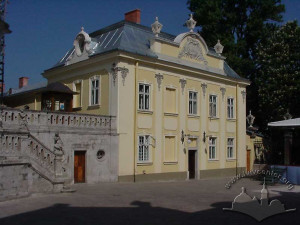
ID:

Related buildings and spaces

  • Vul. Maidanna, 1a – the Holy Trinity Church

    The wooden Holy Trinity Church (Presviatoji Trijtsi) was built in the 17th century in the village of Sykhiv (1683). The 1850 cadaster mentions both the church, a small bell tower and a nearby cemetery. The church was renovated in 1875, and fundamentally restored in 1932–1933, when the new stone foundation was put in place. The parish priest Andriy Ishchak (1887–1941), later beatified by the Pope Jonh Paul II, was murdered near the church by the Soviet soldiers. He is buried in the church cemetery. In 1969 a restoration by Bohdan Kendzielski was undertaken. The church functioned until 1960s, when it was turned into a museum. The local Sykhiv inhabitants opened it again in 1990 as a Greek Catholic church, and in 1994 the interior paintings were restored.

    Read more
  • Vul. Zelena, 385 – St. Michael the Archangel Church (Sykhiv)
    Former Roman Catholic Church of the Blessed Virgin Mary the Queen of Poland was constructed in 1910 in a shape of a small chapel, funded by Sykhiv Roman Catholic parishioners. In 1927, Sykhiv became a separate parish to include also the villages of Vul'ka Sykhivska (Wulka sychowska) and Pasiky Zubrytski (Pasieki Zubrzyckie). In 1936–42, the reconstruction and the enlargement of the church were undertaken, following the design by architect Andrzej Frydecki. After World War II, the church was briefly taken over by the Ukrainian Greek Catholic parish. In 1946-1990, the building was used by the Orthodox Church, and in 1990 it was taken by the Greek Catholic Church. Today (2008) this is the Greek Catholic St. Michael the Archangel Church.
    Read more
  • Vul. Tryliovskoho, 9a – Pentecost Church
    Pentecost church (Tserkva Zislannia Sviatoho Dukha) was founded on the initiative of the local community, mostly inhabitants of the surrounding streets: Trylovskoho and Antonycha Streets. In 1996 the founding stone of the church was blessed, but the actual construction was delayed because of financial reasons. The foundation was laid in September 2006 and the construction continued afterwards at slow pace because it was carried mostly through the voluntary work of its parishioners: one day every three month they came to work on the church construction. At the present (2008), the church functions temporarily in the nearby chapel, which is an improvised construction (a former industrial hangar).
    Read more
  • Prosp. Chervonoi Kalyny – John Paul II Park
    The foundation ceremony for the John Paul II Park in Sykhiv took place on 28 September 2007. The program of the ceremony consisted of religious rites around the Nativity Church and the speeches of local political leaders, some of whom tried to link the visit of the Pope to Sukhiv and the future parliamentary elections in Ukraine. Possibly in connection with the park's foundation, Ukrainian president Viktor Yushchenko visited the Nativity Church, accompanied by the head of the Greek Catholic Church, Cardinal Liubomyr Huzar.
    Read more
  • Pl. Katedralna, 1 – Boim Chapel

    Located near the Latin Cathedral, the chapel was constructed in the Renaissance style between 1609 and 1615 as a family burial chapel commissioned by the Lviv merchant György Boim. It is believed that its builder was the Wrocław architect Andrzej Bemer.

    Read more
  • Pl. Katedralna, 1 – Campian Chapel
    The historic name of the Campian Chapel is connected with the name of its founders, the family of Lviv patricians from the seventeenth century. The entrance to the chapel is from the northern nave of the Latin Cathedral of the Ascension of the Virgin Mary, onto which it is built. The construction dates to the end of the sixteenth – beginning of the seventeenth centuries (the architects are P. Rymlianyn and V. Kapinos). Restoration was completed in 1905-1907 (by the architect W. Sadlowski).
    Read more
  • Prosp. Chervonoi Kalyny, 89 – St. Volodymyr Church

    The church was built between 1991–1993 through the efforts of the Orthodox community led by two priests, Fr. Volodymyr Tsiopka and Fr. Volodymyr Kuzio, former parish priests of St. Michael Church in Sykhiv. Following a split in the community, the church remained with Fr. Kuzio and his parishioners, and now (2008) belongs to the Ukrainian Orthodox Church of Kyiv Patriarchate.

    Read more
  • Vul. Stepana Bandery, 8 – Organ Hall and St. Mary Magdalene Church
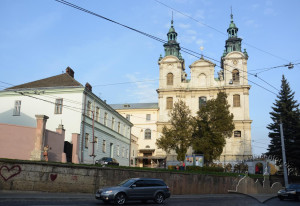
    St. Mary Magdalene Roman Catholic Church (presently the Organ Music Hall). The church was constructed on an elevation far from the Lviv center, in the district of the former southwestern suburb. 
    Read more
  • Vul. Chernecha Hora, 1 – Church of Wisdom of God (former St. Nicholas Church)
    St. Nicholas Church is a valuable monument of the Boyko school of vernacular architecture. It was built in the village of Kryvky in Turkivshchyna region (1763) and, in 1930, it was moved to the territory of the Museum of Vernacular Architecture (skansen).
    Read more
  • Vul. Ivana Franka, 121a – St. Sophia Church
    Former St. Sophia Roman Catholic church was constructed during the 1760s on a hill, on the territory of a former district of Sophiivka. It was reconstructed in 1864. In 1944 it was converted into a storehouse, and in 1994 given to the Greek Catholic parish of St. Sophia.

    Read more
  • Vul. Horodotska, 32 – st. Anne's church
    Former Roman Catholic St. Anne church was built on a plot of land that was located a long distance from the old city walls to the northwest of the historical center of the city. The church is located at the intersection of the current Horodotska and Shevchenka streets. A building housing what used to be monastery chambers is built onto the church’s southern side. The church was built in 1673 with reconstruction taking place in the eighteenth and nineteenth centuries; the dome of the tower was added in 1927 (by the architect Bronisław Wiktor). The building is constructed on the site of an older church that dates back to 1505.
    Read more
  • Vul. Mykhaila Hrushevskoho, 2 – former st. Nicholas' church
    Former St. Nicholas Roman Catholic Church (presently the Greek Catholic Church of the Protection of the Mother of God) was built beyond the limits of the city's center. It is located in the region of a former southern suburb on the site of an old wooden church that dated to the end of the seventeenth century. The main construction periods are 1739–1745 (by the architects F. Placidi or K. Hranatskyi?), and 1924–1926 (partial reconstruction of the cells, by the architect Tadeusz Wróbel).
    Read more
  • Pl. Katedralna, 1 – Cathedral of the Assumption of the Virgin Mary
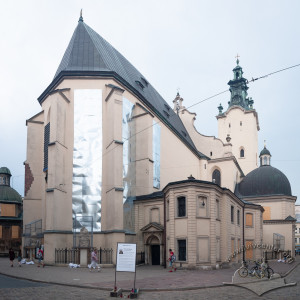
    The Cathedral is the only object of Gothic architecture in Lviv, preserved in its integrity. Its tower, along with the City Hall, the Kornyakt tower, and the bell tower of the former Bernardine church are symbols of the city, dominating in the panorama of its central part.
    At present this is the Roman Catholic Arch-Cathedral of the Assumption of the Blessed Virgin Mary, also known as the Metropolitan Basilica, an architectural monument of national significance (protection number 316/0).

    Read more
  • Vul. Bohdana Khmelnytskoho, 28 – St. Nicholas Church
    In the original variant (the end of the thirteenth century) the church combined the Byzantine-Ruthenian planning structure with western (Roman) construction techniques and was an example of the old Galician architectural school. Later rebuilding occurred in the seventeenth century (the emergence of Baroque elements is connected with the reconstruction of that time), the nineteenth century and in the period of 1924–1925 (restoration).
    Read more
  • Vul. Bohdana Khmelnytskoho, 36 – The St. Onuphrius Church of the Basilian Monastery
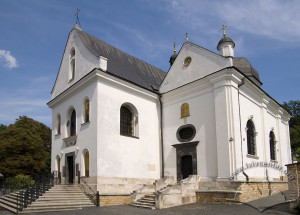
    The St. Onuphrius monastery in Lviv consists of a complex of buildings including a church, a belfry gate and monks' cells which are owned by the Most Holy Saviour Province of the Basilian Order in Ukraine. It is located in the oldest part of the city existing since the times of the Principality of Galicia-Volhynia. The church is one of the oldest monastery churches; it is associated with well-known historical persons (a prince of Moldavia), clerics, members of the Lviv Stauropegion brotherhood, noted architects (Franz Trescher, Edgar Kováts), sculptors, carvers (Andriy Koverko), painters (Luka Dolynsky, Marcin Jabłonski, Modest Sosenko), printing pioneer Ivan Fedorovych (Fedorov). Some prominent figures of the sixteenth-eighteenth centuries from Lviv and Ukraine are buried in the church and near it.

    According to the resolution of the Council of Ministers of the Ukrainian SSR number 970 dated 24 August 1963, the St. Onuphrius church was entered in the National list of monuments under protection number 364/1.

    Read more
  • Vul. Bohdana Khmelnytskoho, 36 – the bell tower of St. Onuphrius Church
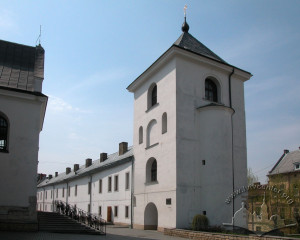
    The St. Onuphrius church belfry is an integral part of the monastery complex situated in the oldest part of the city, existing since the times of the Principality of Galicia-Volhynia, where it plays the dominant role. The church is one of the oldest monastery churches; it is associated with well-known historical persons (a prince of Moldavia), clerics, members of the Lviv Stauropegion brotherhood, noted architects (Franz Trescher, Edgar Kováts), sculptors, carvers (Andriy Koverko), painters (Luka Dolynsky, Marcin Jabłonski, Modest Sosenko), printing pioneer Ivan Fedorovych (Fedorov). Some prominent figures of the sixteenth-eighteenth centuries from Lviv and Ukraine are buried in the church and near it.

    According to the resolution of the Council of Ministers of the Ukrainian SSR number 970 dated 24 August 1963, the St. Onuphrius church belfry was entered in the National list of monuments under protection number 364/3.

    Read more
  • Vul. Bohdana Khmelnytskoho, 36 – St. Onuphrius Monastery
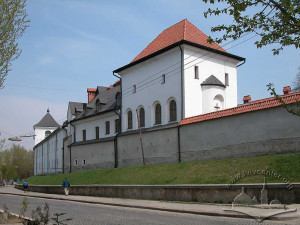
    The monastery building is located on the old territory of Lviv of the princely rule, at the foot of Castle Mountain. It creates a single architectural ensemble with st. Onufriy's Church and bell tower. There are no clear style features, since the construction was underway in different periods. The main construction dates are: 1683, 1693"1698 (building of defence walls), the end of the eighteenth-beginning of the nineteenth centuries (reconstructions) and 1998 (restoration with a partial reconstruction).
    Read more
  • Vul. Bohdana Khmelnytskoho, 77 – St. Paraskeva Church
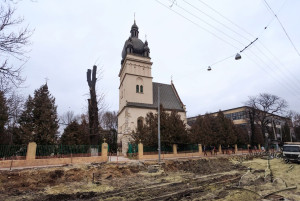
    The late Gothic elements are united with the traditions of Ukrainian and Moldovan-Valakhian sacral building in the architecture of the church. The later additions are connected with the influence of the Revival architecture (the cupola of the tower). The church is constructed in the oldest part of the city on the foundation of a church from the thirteenth-fourteenth centuries. The location of the object outside of the city’s fortifications explains features of a defence building in its architecture. The construction and further reconstructions date back to 1643-1645, 1908 (restoration and the tower's new topping off) and 1950 (restoration).
    Read more
  • Vul. Mykoly Kopernyka, 27 – St. Lazarus Church
    St. Lasarus' Roman Catholic Church with the hospital buildings was constructed beyond the limits of the city fortifications to the south of the Lviv historic center. It is located on the northern slopes of the so-called Kalicha Mountain on a plot of land separated by walls from Copernicus and Grabovskoho Streets. The building has a distinct defensive character. The main dates of the construction chronology include 1634 (construction works were headed by the architects J. Boni and A. Prykhylnyi), 1640 (building expansion by the architect M. Hodnyi) and 1781–1782 (reconstruction of the hospital by the architect F. Grill). The architecture of the church has Renaissance features combined with Gothic elements (the shape of the windows).
    Read more
  • Vul. Mykoly Kopernyka, 40 – "Rusalka Dnistrova" museum (the bell tower of the former Church of the Holy Ghost)
    The bell tower of the former Church of the Holy Ghost was constructed in 1722–1729. The tower served as the bell tower for the former Greek Catholic Seminary Church of the Holy Ghost. The church was destroyed during World War II, and only its bell tower has survived. In 1987, an extension for museum premises was constructed on the western side. Today (as of 2010), the "Rusalka Dnistrova" Museum, a department of the Lviv National Art Gallery, is located in the bell tower.
    Read more
  • Vul. Tarasa Bobanycha "Khammera", 1 – Seventh-day Adventist Church (former Church of the Immaculate Conception)
    The Capuchin monastery and church were built in 1708–1730. The church got its present-day appearance after reconstructions carried out in the 19th and 20th centuries. According to the resolution of the Council of Ministers of the Ukrainian SSR number 442 dated 6 September 1979, the church and monastery were entered into the Register of architecture and urban planning monuments of national significance under protection number 1329. Now the assembly building is occupied by the Russian Cultural Center while the church premises are adapted for a prayer house of the Seventh-Day Adventist Church (architect Mykola Rybenchuk).
    Read more
  • Vul. Tarasa Bobanycha "Khammera", 3 – St. George Church
    The Orthodox Church of St. George was built on a slope of a mound situated between the lower part of the old Lychakivsky district and the base of Castle Hill. The church is located far back in the plot and surrounded by a fence. The administrative eparchy building stands to the east of the church. The church's construction dates to 1897–1901, by the architects G. Sachs and W. Rawski. The church is a witness to the influences of the late nineteenth century Revival architecture movement focusing on Byzantine-Volossia features which was popular in the region of Bukovyna at that time.
    Read more
  • Vul. Krakivska, 21 – Church of the Transfiguration
    Church of the Transfiguration of Our Lord — Preobrazhenska Church (21 Krakivska Street). This sacred building is situated on a separate plot of land in the center of the city. It was constructed on the foundation of a church of the eighteenth century — a former Roman Catholic Church of the Trinity Order; its walls and other constructions that had survived the fire of 1848 were also used for the building. The main construction periods are: 1703–1731 (construction of the Roman Catholic Church of the Trinity Order), 1783 (reconstruction to serve as the University’s library) and 1875–1898 (the modern church, by the architect S. Hawryszkiewicz). In its modern condition, the architecture of the Church of the Transfiguration unites the Revival styles (Classical variant with Ukrainian sacral architecture traditions involved) with remains of Baroque and early Classicism styles (elements of the old building).
    Read more
  • Pl. Marka Kropyvnytskoho, 1 – The SS. Olha and Elizabeth (former St. Elizabeth) church
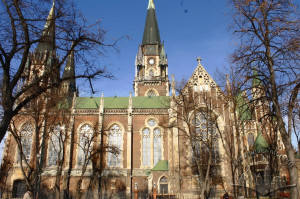
    A Neo-Gothic church, noted for its high towers and pointed spires, is one of  Lviv's trademarks. It  was designed by architect Teodor Talowski. Well-known architects, sculptors and painters took part in the construction of this church. According to the resolution of the Lviv regional executive committee number 130 dated 26 February 1980, the church was entered into the local register of monuments under protection number 146. In 1991 the church was handed over to the local Greek Catholic community.

    Read more
  • Vul. Lychakivska, 49a – St. Anthony Church

    St. Anthony Roman Catholic Church is located to the east of the city center, on the slope of a hill on the upper part of a former Lychakivsky suburb. It stands between Zankovetska and Solodova Streets on a corner plot of land surrounded by a wall. The main dates and periods fixed in the construction chronology are the following: 1718–1739, 1765 (reconstruction, by the architect Franciszek Kulczycki), 1818 (erecting a bell tower, by the architect Józef Markl) and 1899–1901 (restoration, adding a presbytery). This church's architecture is characterized by late Baroque and Rococo forms.

    Read more
  • Vul. Lychakivska, 82 – St. Peter and Paul Church
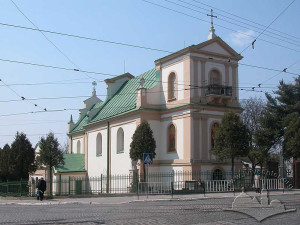
    St. Peter and Paul Church was built on the territory of an former Lychakivsky outer district, to the east of the city center. The church is situated at the intersection of Lychakivska and Mechnikova Streets. Its architecture has Baroque and Classicism elements (the bell tower). The main construction dates are as follows: 1668 (a by-road chapel is built), the middle of the eighteenth century (reconstruction to set up the Roman Catholic Church of the Order of St. Paul the First Hermit), 1798 (reconstruction to erect the church, and a presbytery and a bell tower are built — by the architect K. Fesinger) and 1887 (restoration).

    Read more
  • Pl. Mytna, 2 – former church of the Clares Monastery
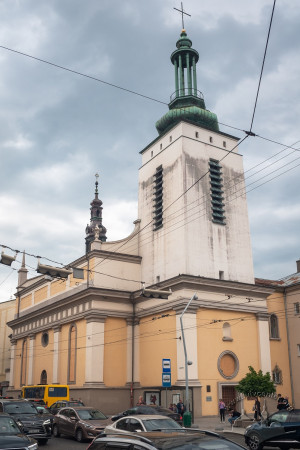
    The former Poor Clares Convent Church is the most prominent accent of the lower vul. Lychakivska development. Built in 1607 (architects Bernard Avelides and Paweł Rzymianin) , its interior was decorated in the 1760s. During 1938–1939, restoration with partial reconstruction was carried out (architect Antoni Lobos). The architectural design of the church's exterior combines Renaissance, Baroque, and Art Deco forms. Today, it houses the Johann Georg Pinsel Museum, a department of the Lviv National Art Gallery.

    Read more
  • Vul. Ruska, 7 – Church of the Assumption

    The Church of the Assumption of the Mother of God — formerly known as Voloska church is the key element of a wonderful architectural ensemble that includes the church, bell tower (it is built onto the church from the north) and the chapel building in the yard. This is the best Lviv Renaissance monument; its architecture unites the West European Renaissance forms with the tradition of the Eastern Christianity sacral construction.  The church stands at the intersection of Pidvalna and Ruska Streets, on the site of an old church of the fifteenth century. In was constructed from 1591 to 1629 (by the architects P. Rymlianyn, V. Kapinos, A. Prykhylnyi) and in 1796 (rebuilt after fire). In the middle of the nineteenth century the church was connected with the Three Prelates Chapel.  

    Read more
  • Vul. Ruska, 7 – Korniakta Tower

    The bell tower of Assumption Church — Korniakta Tower is an element of the Assumption Church ensemble; it is located at the intersection of Pidvalna and Ruska Streets. The tower is connected with the northern façade of the church. The historic name of the Korniakt tower is connected with the name of its founder. The main construction dates are 1572–1578 (by the architects P. Barbon and P. Rymlianyn), 1695 (adding the upper tier by the architect P. Beber), and the 1780's (restoration after fire). The tower has clear style features of the Renaissance as well as Baroque period (top part of the tower). 

    Read more
  • Vul. Ruska, 7 – Chapel of Three Prelates
    The chapel is an element of the architectural ensemble of Assumption Church; it is located at the intersection of Pidvalna and Ruska Streets. It is situated in the inner yard (the entrance is through the gate of the neighboring building) on the plot of land in the corner between the church and the bell tower (Korniakt tower). It is adjacent to the northern façade of the church. The main construction periods are 1584–1591 by the architect A. Pidlisnyi and 1846–1847 (restoration). In the architecture of the chapel western Renaissance forms are combined with the tradition of Ukrainian sacral building.
    Read more
  • Pl. Rynok, 9 – former Archbishops' Townhouse
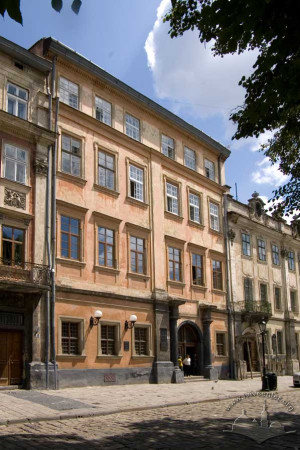
    The building at pl. Rynok 9 (protection No. 326/8, conscription number 178) is located within the territory of the State Historic-Architectural Preserve, set in the row development on the eastern side of the market square. Until 1844, the townhouse served as the residence of the Roman Catholic archbishops. In 1844–1845, the building was partially rebuilt, including the addition of a fourth story.

    Read more
  • Vul. Snizhna, 2 – Church of Our Lady of Perpetual Help (former Church of St. Mary of the Snows)
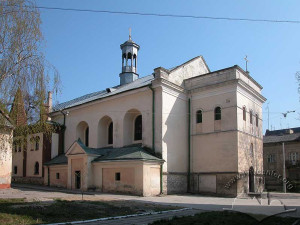
    Former Roman Catholic Church of St. Mary of Snow (presently the Greek Catholic church of the Mother of God) is one of the oldest Christian churches of Lviv; it was founded by German colonists during the late Middle Ages. 

    Read more
  • Pl. Soborna, 3a – St. Andrew Church (former bernardine church)

    Former Bernardine Roman Catholic Church (3 Soborna Square) is a perfect example of the late Renaissance architecture that reflected the spirit and mood of the counter-reformation epoch. The church was built in the course of 1600–1630 by the architects B. Avelides, P. Rymlianyn, A. Prykhylnyi and A. Bemer. It was constructed on the site of an earlier wooden structure from 1460. The Bernardine Church creates a single complex with the adjacent fortified monastery buildings, bell tower, memorial column and rotunda over the well in the yard. 

    Read more
  • Pl. Soborna, 3a – Central State Historical Archive of Ukraine

    Former Bernardine Monastery building (presently the building of the Central State Historical Archive). The monastery building dates to the period around 1620 is an integral part of the architectural complex that also includes the Bernardine Roman Catholic Church. The monastery was built onto the northern wall of the church, and is surrounded by the walls with an entrance tower from the east.

    Read more
  • Pl. Soborna, 3 – The bell tower of the former Bernardine Church

    The bell tower of the Bernardine Roman Catholic Church — erected in 1733–1734 — is a component of the church and monastery ensemble. The architectural outline of the building is typical for the Baroque period.

    Read more
  • Pl. Staryi Rynok – former St. John the Baptist church

    Former St. John the Baptist Roman Catholic Church (currently houses the Museum of Historic Artifacts of Lviv, a branch of the Lviv Art Gallery) is an architectural monument that was built in the earliest period of Lviv's history. The church was built at the foot of Castle Mountain, on its western slope. The main dates of construction and later reconstruction are the end of the thirteenth century, the middle of the fourteenth century, the seventeenth-eighteenth centuries, 1836 (restoration), 1887 (reconstruction by the architect Julian Zachariewicz), and 1989 (restoration with partial reconstruction). 

    Read more
  • Pl. Muzeina, 3 – church of the Blessed Eucharist (former Dominican convent church)
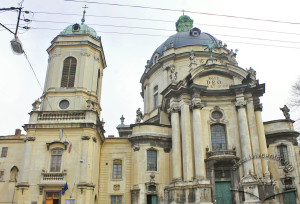
    The former Dominican Roman Catholic Church is the biggest Baroque church in Lviv. This massive monument of the Christian architecture has become the main component of the architectural complex dating to the fifteenth-nineteenth centuries including also the buildings of the monastery cells and the bell tower. The church was built from stone and brick over the course of 1749–1764 (the architects J. de Vitte, M. Urbanik and K. Muradowicz) on the site of a Gothic church of the fifteenth century, on the plot of land bordering the medieval Lviv on the west. In 1792–1798 the church was reconstructed (by the architect K. Fesinger). In 1905–1914 the interior restoration was completed. A square and a garden have been set up in front of the church. Under Socialism, the building housed the Museum of Atheism, later Museum of the History of Religion.

    Read more
  • Pl. Muzeina, 1 – the former Dominican convent bell tower
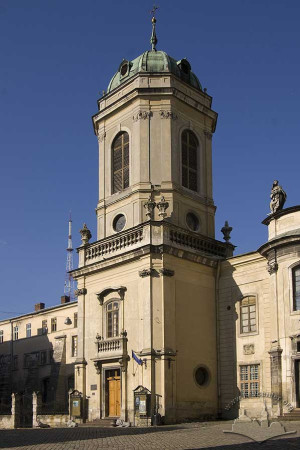
    The bell tower is a component of the architectural ensemble of the Dominican Monastery (dating to the fifteenth-nineteenth centuries), the base of which is formed by the late Baroque church and the cell block. The bell tower was erected in 1865 (by the architect J. Braunzeiss) and built onto the church from the north. 

    Read more
  • Pl. Muzeina, 1 – museum building (former Dominican Monastery)
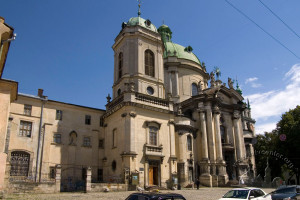
    Presently the building of the Lviv Museum of the History of Religion, 1 Stavropihiyska Street. The monastery building is a component of the architectural ensemble including also the church's building nextdoor and the bell tower. The monastery constructions border on the northern nave of the church. The long chronicle of the monastery's erection covers several periods: the fifteenth century, the years of 1556–1621 (reconstruction by the architect M. Czech) and the end of the eighteenth century (renovation after fire). Correspondingly, the object is rich in features of the Gothic, Renaissance and Baroque periods.

    Read more
  • Pl. Sv. Yura, 5 – St. Yuriy (St. George) Cathedral
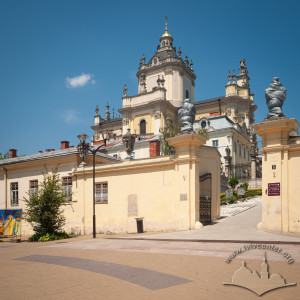
    St. George Cathedral of the Ukrainian Greek Catholic Church is the main building of the Sviatoiurivska Mountain construction complex and is one of the most dominant features of the Lviv panorama. The cathedral was built over the course of 1744–1761 (by the architects B. Meretyn and K. Fesinger) and was restored in 1905–1911, 1933, 1980 and 1999-2001.

    Read more
  • Pl. Sv. Yura, 5 – the Curia building

    Monastery and administrative buildings by St. George Church. The architectural ensemble of the St. George's Hill is complimented with three separate administrative-residential constructions with a bell tower added to them; they surround St. George Church. These buildings form a three-sided structure with Baroque, Rococo, Classicist and Revival architectural features. 

    Read more
  • Vul. Teatralna, 13 – St. Peter and Paul Church (former Jesuit Church)
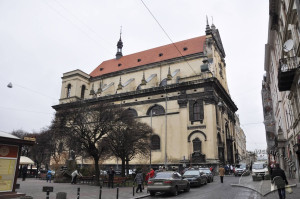
    The Jesuit church is located in the historic center of Lviv, near the former western side of the town fortifications. This is one of the biggest churches of the city, an example of a baroque and Renaissance basilica built upon the pattern of the Il Gesù church in Rome by well-known architects, sculptors, carvers and painters. According to the resolution of the Council of Ministers of the Ukrainian SSR number 970 dated 23 August 1963, the Jesuit church was entered in the National list of monuments under protection number 338.
    Read more
  • Vul. Tershakovtsiv, 9 – The Most Holy Trinity church (the former church of the convent of the Benedictine Sisters of the Blessed Sacrament)
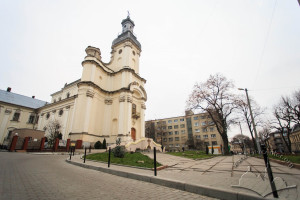
    The construction of a convent for the sisters of the Blessed Sacrament was started in 1739 under a project drawn up by Bernard Meretyn. The church was given its current look after a reconstruction made in 1881–1887 according to a project of architect Adolf Minasiewicz. On the instruction of the head of the Lviv Regional State Administration number 128 dated 2 July 1999 the convent and the church (belonging to the UGCC) on Tershakivtsiv street 9 were entered in the local register of monuments under protection number 245.
    Read more
  • Vul. Vicheva, 2 – Church of All Saints (former Benedictine church)
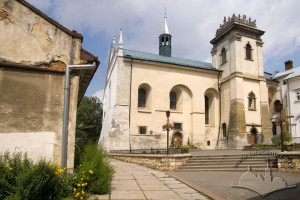
    The former Benedictian Roman Catholic Church (1597–1616, presently the Church of All Saints) with the convent building. The church building is an integral part of the architectural ensemble including the nuns' cells and the entrance gate (the southern façade of the church and the eastern wing of the cells look out on a wide common yard). The architecture of the complex — located outside of the old city walls — had a defense character. According to its style features, it belongs to the late Renaissance/ Mannerism (decoration of the tower's attic) with a later Baroque addition (the cells and the entrance gate). There are several periods in the construction chronology: 1597–1616 (the architect Pavlo Rymlianyn), 1608–1610 (the defensive wall is erected), 1611–1687 (the cells), 1627 (church reconstruction after fire, by the architect Jan Pokorovych).
    Read more
  • Vul. Virmenska, 7 – Cathedral of the Assumption of the Blessed Virgin Mary / Armenian Cathedral
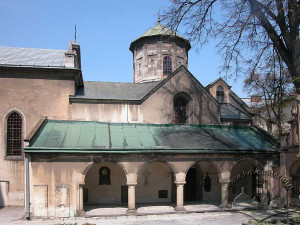
    The monument is located within the old city center — a medieval walled city, on the territory of the Ensemble of the Historic Center, included in the UNESCO World Heritage List. The Armenian Cathedral Ensemble features: the Cathedral itself, the bell tower, the palace of the Armenian archbishop, the Armenian bank, the monastery of the Armenian Benedictines, the memorial column of St. Christopher, and the Golgotha Altar. 

    Read more
  • Vul. Virmenska, 7 – bell tower of the Armenian Cathedral
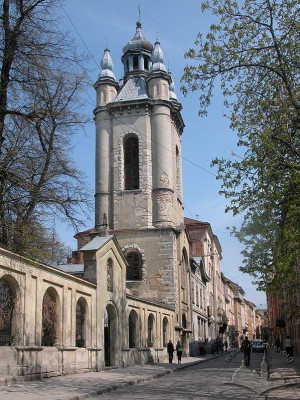
    The bell tower is an integral part of the Armenian Cathedral ensemble. It is built onto the former palace of the Armenian Archbishops. It bears stylistic features of the Renaissance and Baroque styles. The main construction dates are 1571 (the architect P. Krasowski), 1778 (reconstruction) and the beginning of the nineteenth century (completion of the upper part).  
    Read more
  • Vul. Volodymyra Vynnychenka, 22 – St. Michael Church (former church of Discalced Carmelites)
    The Church of the Discalced Carmelites with its monastery was a separate fortified point and was part of the city's overall fortification system. A monument of Baroque architecture in Lviv, it dates back to the first half of the 17th century (protected monument No. 374).
    Read more
  • Vul. Volodymyra Vynnychenka, 30a – Church of the Meeting of the Lord (former Roman Catholic church)
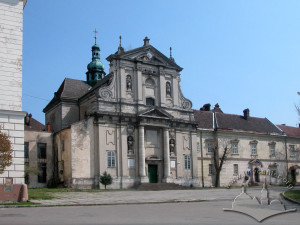
    The former Roman Catholic Church of the Meeting of the Lord (presently the Greek Catholic Church) was constructed on a hill with former monastery cells flanking it on the south. The construction period covers the years from 1642/1644 to the end of the seventeenth century; it is the work of the architect J.B. Jisleni. The cathedral is modeled after San Susanna Church in Rome and is a clear witness to the influence of the Roman Baroque style. 
    Read more
  • Vul. Zamarstynivska, 9 – former church of the Holy Cross
    Former Church of the Holy Cross (currently the building of the Lviv Institute of Internal Affairs) with the adjacent buildings the former monastery is located on a territory between the present Zamarstynivska Street and Chornovola Boulevard. It was built on the territory of the northern district, outside of the early modern defensive city walls, and was an example of a fortified church located in the outlying district of the city. Its construction dates back to the 1630s, followed by 1744 reconstruction (by the architect Bernard Meretini / Meretyn), and over the course of the nineteenth and the twentieth centuries the church remains a monument of sacral architecture of the late Renaissance period which has preserved specific Gothic elements.
    Read more
  • Vul. Zelena, 11b – former st. Ursula's church
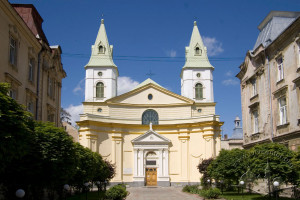
    Former St. Ursula's Church — Protestant Church (currently a House of Prayer of the Baptist Evangelical Christians) was built in the second half of the seventeenth century outside of the limits of the city fortifications in the area of the eastern suburb of Lviv. The major stages of its construction date to 1685 (erection of the church) and 1878 (reconstruction and adaptation to function as a Protestant church by the architect J. Engel). In the architecture of this historic building the forms of Baroque Catholic church are combined with Neoclassicist motifs introduced during the second half of the nineteenth century.
    Read more
  • Vul. Zhovkivska, 8 – Prayer House of Evangelical Christians (Former St. Martin church)
    Former St. Martin's Catholic Church (presently a House of Prayer of Evangelical Christians). The church complex and the monastery adjacent to it were built in the old Zhovkivska suburb on a plot of land located to the north of the center of Lviv. Construction dates back to 1736 and the second half of the eighteenth century (the monastery cells). The monument is a valuable example of late Baroque architecture.
    Read more
  • Vul. Maksyma Kryvonosa, 1 – St. Clement Sheptytskyi Church
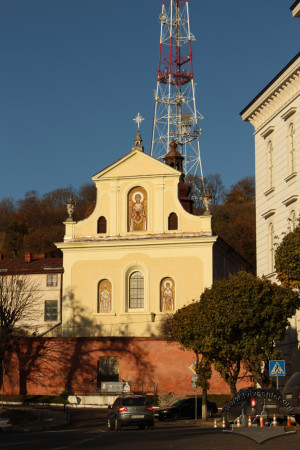
    The complex of the Reformats monastery with the St. Casimir (St. Clement Sheptytsky) church and the hospital of the sisters of charity with the St. Vincent chapel (the academic building of the Lviv State University of Internal Affairs) belong to early examples of Baroque style in Lviv. According to the resolution of the Council of Ministers of the Ukrainian SSR number 442 dated 6 September 1979, the church was entered into the National register of monuments under protection number 1327; according to the resolution of the Regional Executive Committee of the Lviv Region number 130 dated 26 February 1980, the hospital complex was entered into the Register of local monuments under protection number 139-M.
    Read more
  • Vul. Ivana Fedorovycha, 27 – former Golden Rose Synagogue (Taz, Turey Zahav)
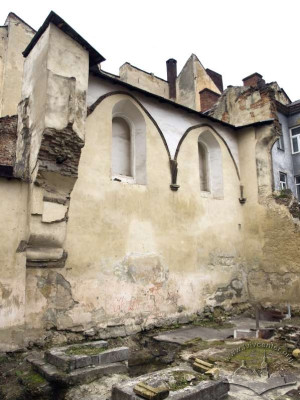
    The synagogue was constructed in Renaissance style in 1582–1595 from brick and stone by architect Paweł Szczęśliwy (Pavlo Shchaslyvyi) and funded by the wealthy Nachmanowicz family. The synagogue would have been one of the oldest within the current borders of Ukraine. Yet in August 1941, all its religious objects were plundered and in 1943 it was demolished by explosives by the Nazis. The ruins that remain today, long neglected but undergoing some preservation efforts recently, are a symbol of the tragedy of Lviv's Jews.
    Read more
  • Vul. Staroyevreiska, 41 – former Beth Hamidrash building
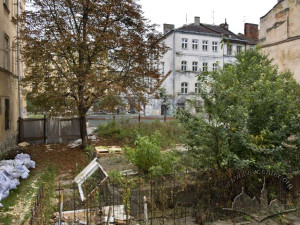
    Beth Hamidrash was a house of prayer that included a heated library where Talmud was studied independently. It was a brick, Baroque building with a modest architectural decoration constructed in the city center in 1797. It had arched windows on the ground floor through which the prayer hall was illuminated. At the end of the nineteenth century Beth Hamidrash was expanded. In 1943 it was destroyed by the Nazis together with the "Golden Rose" synagogue.

    Read more
  • Vul. Brativ Rohatyntsiv – Great City Synagogue (no longer exists)
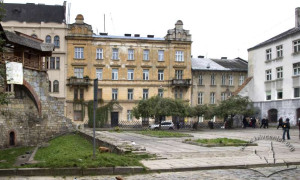
    The synagogue was built in 1801 in Neo-Classicist style on the site of a Gothic synagogue which dated back to 1555. Two semicircular arches through which one can today access the square from Staroyevreiska and Brativ Rohatyntsiv Streets are the remaining entrances to the synagogue. The city synagogue had a compositional-space structure similar to the one of the synagogue in the Cracow outer distric (pl. Przedmiejscie Krakowskie). The Great City Synagogue was destroyed in 1943. Today (2008) an empty square is on it's place.
    Read more
  • Pl. Sv. Yura, 5 – archbishop's residence
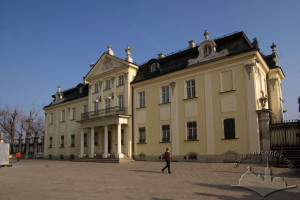
    The residence (now of the UGCC archbishops) was built in 1761–1762 as part of the Baroque ensemble of the cathedral of St. George. It is not known for sure who its architect was (researchers mention Klemens Ksawery Fessinger, Pierre Ricaud de Tirregaille, Jan de Witte in this regard). The Baroque complex is complemented by Metropolitan gardens on the slopes of St. George's Hill. It is an architectural monument of national significance (protection number 376) and a UNESCO World Heritage site.

    Read more
  • Vul. Sianska, 4 – former "Chasidim Schul" synagogue
    The appearance of Chasidim Schul Synagogue is known because of a preserved photograph which was taken after 1918 pogrom. In 1941 the building was demolished by Nazis. Its  Neorenaissance style was the result of the reconstruction carried out according to the design of architect Artur Schleyen. Today utility buildings as well as a cafe are located there.

    Read more
  • Pl. Staryi Rynok – former Tempel synagogue
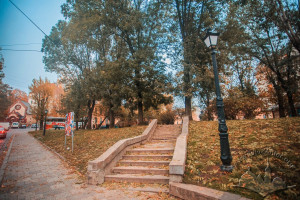
    The Lviv progressive synagogue, called Tempel (temple), was the first reformed synagogue in Galicia. It was a monumental building in Neoclassicist style, notable for its large dome; unlike European progressive synagogues with their typical oriental and Moorish decorative motifs (Berlin, Vienna or Budapest), it more resembled a Byzantine church. The Lviv Tempel was destroyed by the Nazis in the summer of 1941.

    Read more
  • Vul. Brativ Mikhnovskykh, 4 – "Tsori Gilod" synagogue
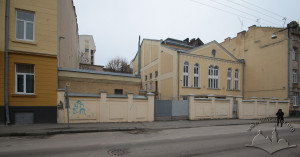
    The Tsori Gilod (pol. Cori Gilod) synagogue is located within residential housing of two streets and is notable for its large windows and Secession-style decoration. This is one of a few Ukraine's synagogues where murals have been preserved; here they were made by Maximilian Kugel. In 1989 the building was restored to the Lviv Jewish community Beis Aharon V’Yisrael.

    Read more
  • Pl. Soborna – St. Jan from Dukla Column
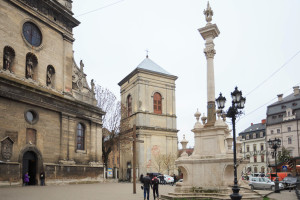
    This baroque column with a statue of the saint was installed near the former Bernardine monastery in 1736 sponsored by the voivod Seweryn Michał Rzewuski. The statue disappeared from the column around 1950, a vase was installed in its place.

    Read more
  • Pl. Henerala Petra Hryhorenka – monument to St. George the Dragon Slayer

    The monument to St. George the Dragon Slayer was erected on Hryhorenka Square (former Smolky Square) in 1999 by sculptors Andriy and Volodymyr Sukhorski). The monument rises in front of the current building of the Ministry of Internal Affairs of Ukraine and is dedicated to the memory of all those who have died in the fight against crime. Until 1946 a monument to Franciszek Smolka, local Polish liberal politician who lived in a building on this square (number 4) was located here.  

    Read more
  • Vul. Virmenska – St. Christopher column
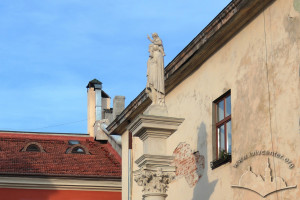
    The column representing the patron saint of the Armenians appeared in the Armenian quarter of Lviv in 1726, when the reconstruction of the Armenian cathedral was completed. The initiator of the installation was Krzysztof Augustynowicz.
    Read more
  • Vul. Bibliotechna – Sykstus Column
    The Sykstuses Column (named after the Sykstus family, the owners of a land plot and former manor) was constructed in 1580 as a boundary-marking post, or perhaps a memorial. The planes of the tall quadrilateral pedestal exhibited relief Crucifixion scenes, as well as Latin inscriptions; the column was crowned by a cross. Twenty years later the foundations of a chapel were laid close to the site; construction of the chapel was funded by noblewoman Anna Pstrokońska. The chapel was extended, eventually ending in the construction of the St. Mary Magdalene Church on this spot. Today (2009) the changed and deformed Sykstuses Column exists as a corner-post of the stone wall, surrounding the St. Mary Magdalene Church, which functions as the Organ Music House.
    Read more
  • Vul. Maksyma Zalizniaka, 11 – Church of St. Joseph the Betrothed
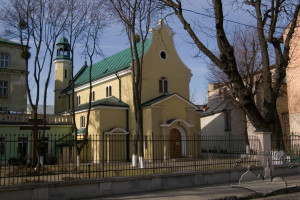
    The former Jesuit Retreat House is a monument of early twentieth-century architecture, situated set back on its plot southwest of the city center in the Novyi Svit district. It was constructed according to a design by architects Józef Piątkowski and Karol Richtman. Between 1914 and 1916, the Jesuit Church of St. Joseph and Blessed Andrzej Bobola was built adjacent to the retreat house, based on a design by architects Stanisław Dydek and Franciszek Mączyński. In September 1939, during the shelling and aerial bombardment of Lviv, the roofs of both the retreat house and the church were damaged. The Soviet authorities closed the house on April 4, 1946. During the Soviet period, it functioned as a school; the building was remodeled, connected to the church by a gallery, and the decoration of the principal elevation was altered. Since August 1993, a portion of the building has been transferred to the novitiate of the Greek Catholic Congregation of the Sisters of Mercy of St. Vincent de Paul. The church now houses the Greek Catholic Church of St. Joseph the Betrothed, while most of the house's premises are used by the National Forestry and Wood-Technology University of Ukraine.

    Read more
  • Vul. Vuhilna, 1–3 – former Jankel Jancer Shul synagogue
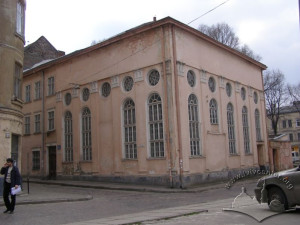
    It is one of the few preserved synagogues in Lviv, which functioned in the Soviet times. Before the distortions caused by the disasters of the 20th c. it was a magnificent Secessionist (Art Nouveau) building which enriched the architecture of the old Sv. Teodora square inhabited by the Jews since the 19th c.

    Read more
  • Vul. Yaroslava Mudroho, 39 – former "Ahudas Schloma" synagogue
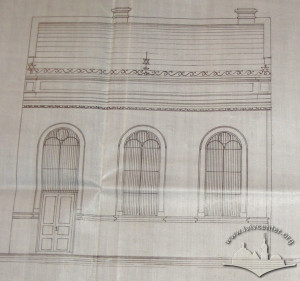
    The Agudas Schloma synagogue was one of Lviv's numerous Hasidic kloizes. Despite its modest architecture, it stood out against the background of the block's housing. The synagogue was destroyed during the Shoah. After the destruction a vacant plot has remained in its place.

    Read more
  • Vul. Maidanna, 1a – the Holy Trinity Church

    Vul. Maidanna, 1a – the Holy Trinity Church
  • Vul. Zelena, 385 – St. Michael the Archangel Church (Sykhiv)

    Vul. Zelena, 385 – St. Michael the Archangel Church (Sykhiv)
  • Vul. Tryliovskoho, 9a – Pentecost Church

    Vul. Tryliovskoho, 9a – Pentecost Church
  • Prosp. Chervonoi Kalyny – John Paul II Park

    Prosp. Chervonoi Kalyny – John Paul II Park
  • Pl. Katedralna, 1 – Boim Chapel

    Pl. Katedralna, 1 – Boim Chapel
  • Pl. Katedralna, 1 – Campian Chapel

    Pl. Katedralna, 1 – Campian Chapel
  • Prosp. Chervonoi Kalyny, 89 – St. Volodymyr Church

    Prosp. Chervonoi Kalyny, 89 – St. Volodymyr Church
  • Vul. Stepana Bandery, 8 – Organ Hall and St. Mary Magdalene Church

    Vul. Stepana Bandery, 8 – Organ Hall and St. Mary Magdalene Church
  • Vul. Chernecha Hora, 1 – Church of Wisdom of God (former St. Nicholas Church)

    Vul. Chernecha Hora, 1 – Church of Wisdom of God (former St. Nicholas Church)
  • Vul. Ivana Franka, 121a – St. Sophia Church

    Vul. Ivana Franka, 121a – St. Sophia Church
  • Vul. Horodotska, 32 – st. Anne's church

    Vul. Horodotska, 32 – st. Anne's church
  • Vul. Mykhaila Hrushevskoho, 2 – former st. Nicholas' church

    Vul. Mykhaila Hrushevskoho, 2 – former st. Nicholas' church
  • Pl. Katedralna, 1 – Cathedral of the Assumption of the Virgin Mary

    Pl. Katedralna, 1 – Cathedral of the Assumption of the Virgin Mary
  • Vul. Bohdana Khmelnytskoho, 28 – St. Nicholas Church

    Vul. Bohdana Khmelnytskoho, 28 – St. Nicholas Church
  • Vul. Bohdana Khmelnytskoho, 36 – The St. Onuphrius Church of the Basilian Monastery

    Vul. Bohdana Khmelnytskoho, 36 – The St. Onuphrius Church of the Basilian Monastery
  • Vul. Bohdana Khmelnytskoho, 36 – the bell tower of St. Onuphrius Church

    Vul. Bohdana Khmelnytskoho, 36 – the bell tower of St. Onuphrius Church
  • Vul. Bohdana Khmelnytskoho, 36 – St. Onuphrius Monastery

    Vul. Bohdana Khmelnytskoho, 36 – St. Onuphrius Monastery
  • Vul. Bohdana Khmelnytskoho, 77 – St. Paraskeva Church

    Vul. Bohdana Khmelnytskoho, 77 – St. Paraskeva Church
  • Vul. Mykoly Kopernyka, 27 – St. Lazarus Church

    Vul. Mykoly Kopernyka, 27 – St. Lazarus Church
  • Vul. Mykoly Kopernyka, 40 – "Rusalka Dnistrova" museum (the bell tower of the former Church of the Holy Ghost)

    Vul. Mykoly Kopernyka, 40 – "Rusalka Dnistrova" museum (the bell tower of the former Church of the Holy Ghost)
  • Vul. Tarasa Bobanycha "Khammera", 1 – Seventh-day Adventist Church (former Church of the Immaculate Conception)

    Vul. Tarasa Bobanycha "Khammera", 1 – Seventh-day Adventist Church (former Church of the Immaculate Conception)
  • Vul. Tarasa Bobanycha "Khammera", 3 – St. George Church

    Vul. Tarasa Bobanycha "Khammera", 3 – St. George Church
  • Vul. Krakivska, 21 – Church of the Transfiguration

    Vul. Krakivska, 21 – Church of the Transfiguration
  • Pl. Marka Kropyvnytskoho, 1 – The SS. Olha and Elizabeth (former St. Elizabeth) church

    Pl. Marka Kropyvnytskoho, 1 – The SS. Olha and Elizabeth (former St. Elizabeth) church
  • Vul. Lychakivska, 49a – St. Anthony Church

    Vul. Lychakivska, 49a – St. Anthony Church
  • Vul. Lychakivska, 82 – St. Peter and Paul Church

    Vul. Lychakivska, 82 – St. Peter and Paul Church
  • Pl. Mytna, 2 – former church of the Clares Monastery

    Pl. Mytna, 2 – former church of the Clares Monastery
  • Vul. Ruska, 7 – Church of the Assumption

    Vul. Ruska, 7 – Church of the Assumption
  • Vul. Ruska, 7 – Korniakta Tower

    Vul. Ruska, 7 – Korniakta Tower
  • Vul. Ruska, 7 – Chapel of Three Prelates

    Vul. Ruska, 7 – Chapel of Three Prelates
  • Pl. Rynok, 9 – former Archbishops' Townhouse

    Pl. Rynok, 9 – former Archbishops' Townhouse
  • Vul. Snizhna, 2 – Church of Our Lady of Perpetual Help (former Church of St. Mary of the Snows)

    Vul. Snizhna, 2 – Church of Our Lady of Perpetual Help (former Church of St. Mary of the Snows)
  • Pl. Soborna, 3a – St. Andrew Church (former bernardine church)

    Pl. Soborna, 3a – St. Andrew Church (former bernardine church)
  • Pl. Soborna, 3a – Central State Historical Archive of Ukraine

    Pl. Soborna, 3a – Central State Historical Archive of Ukraine
  • Pl. Soborna, 3 – The bell tower of the former Bernardine Church

    Pl. Soborna, 3 – The bell tower of the former Bernardine Church
  • Pl. Staryi Rynok – former St. John the Baptist church

    Pl. Staryi Rynok – former St. John the Baptist church
  • Pl. Muzeina, 3 – church of the Blessed Eucharist (former Dominican convent church)

    Pl. Muzeina, 3 – church of the Blessed Eucharist (former Dominican convent church)
  • Pl. Muzeina, 1 – the former Dominican convent bell tower

    Pl. Muzeina, 1 – the former Dominican convent bell tower
  • Pl. Muzeina, 1 – museum building (former Dominican Monastery)

    Pl. Muzeina, 1 – museum building (former Dominican Monastery)
  • Pl. Sv. Yura, 5 – St. Yuriy (St. George) Cathedral

    Pl. Sv. Yura, 5 – St. Yuriy (St. George) Cathedral
  • Pl. Sv. Yura, 5 – the Curia building

    Pl. Sv. Yura, 5 – the Curia building
  • Vul. Teatralna, 13 – St. Peter and Paul Church (former Jesuit Church)

    Vul. Teatralna, 13 – St. Peter and Paul Church (former Jesuit Church)
  • Vul. Tershakovtsiv, 9 – The Most Holy Trinity church (the former church of the convent of the Benedictine Sisters of the Blessed Sacrament)

    Vul. Tershakovtsiv, 9 – The Most Holy Trinity church (the former church of the convent of the  Benedictine Sisters of the Blessed Sacrament)
  • Vul. Vicheva, 2 – Church of All Saints (former Benedictine church)

    Vul. Vicheva, 2 – Church of All Saints (former Benedictine church)
  • Vul. Virmenska, 7 – Cathedral of the Assumption of the Blessed Virgin Mary / Armenian Cathedral

    Vul. Virmenska, 7 – Cathedral of the Assumption of the Blessed Virgin Mary / Armenian Cathedral
  • Vul. Virmenska, 7 – bell tower of the Armenian Cathedral

    Vul. Virmenska, 7 – bell tower of the Armenian Cathedral
  • Vul. Volodymyra Vynnychenka, 22 – St. Michael Church (former church of Discalced Carmelites)

    Vul. Volodymyra Vynnychenka, 22 – St. Michael Church (former church of Discalced Carmelites)
  • Vul. Volodymyra Vynnychenka, 30a – Church of the Meeting of the Lord (former Roman Catholic church)

    Vul. Volodymyra Vynnychenka, 30a – Church of the Meeting of the Lord (former Roman Catholic church)
  • Vul. Zamarstynivska, 9 – former church of the Holy Cross

    Vul. Zamarstynivska, 9 – former church of the Holy Cross
  • Vul. Zelena, 11b – former st. Ursula's church

    Vul. Zelena, 11b – former st. Ursula's church
  • Vul. Zhovkivska, 8 – Prayer House of Evangelical Christians (Former St. Martin church)

    Vul. Zhovkivska, 8 – Prayer House of Evangelical Christians (Former St. Martin church)
  • Vul. Maksyma Kryvonosa, 1 – St. Clement Sheptytskyi Church

    Vul. Maksyma Kryvonosa, 1 – St. Clement Sheptytskyi Church
  • Vul. Ivana Fedorovycha, 27 – former Golden Rose Synagogue (Taz, Turey Zahav)

    Vul. Ivana Fedorovycha, 27 – former Golden Rose Synagogue (Taz, Turey Zahav)
  • Vul. Staroyevreiska, 41 – former Beth Hamidrash building

    Vul. Staroyevreiska, 41 – former Beth Hamidrash building
  • Vul. Brativ Rohatyntsiv – Great City Synagogue (no longer exists)

    Vul. Brativ Rohatyntsiv – Great City Synagogue (no longer exists)
  • Pl. Sv. Yura, 5 – archbishop's residence

    Pl. Sv. Yura, 5 – archbishop's residence
  • Vul. Sianska, 4 – former "Chasidim Schul" synagogue

    Vul. Sianska, 4 – former "Chasidim Schul" synagogue
  • Pl. Staryi Rynok – former Tempel synagogue

    Pl. Staryi Rynok – former Tempel synagogue
  • Vul. Brativ Mikhnovskykh, 4 – "Tsori Gilod" synagogue

    Vul. Brativ Mikhnovskykh, 4 – "Tsori Gilod" synagogue
  • Pl. Soborna – St. Jan from Dukla Column

    Pl. Soborna – St. Jan from Dukla Column
  • Pl. Henerala Petra Hryhorenka – monument to St. George the Dragon Slayer

    Pl. Henerala Petra Hryhorenka – monument to St. George the Dragon Slayer
  • Vul. Virmenska – St. Christopher column

    Vul. Virmenska – St. Christopher column
  • Vul. Bibliotechna – Sykstus Column

    Vul. Bibliotechna – Sykstus Column
  • Vul. Maksyma Zalizniaka, 11 – Church of St. Joseph the Betrothed

    Vul. Maksyma Zalizniaka, 11 – Church of St. Joseph the Betrothed
  • Vul. Vuhilna, 1–3 – former Jankel Jancer Shul synagogue

    Vul. Vuhilna, 1–3 – former Jankel Jancer Shul synagogue
  • Vul. Yaroslava Mudroho, 39 – former "Ahudas Schloma" synagogue

    Vul. Yaroslava Mudroho, 39 – former "Ahudas Schloma" synagogue