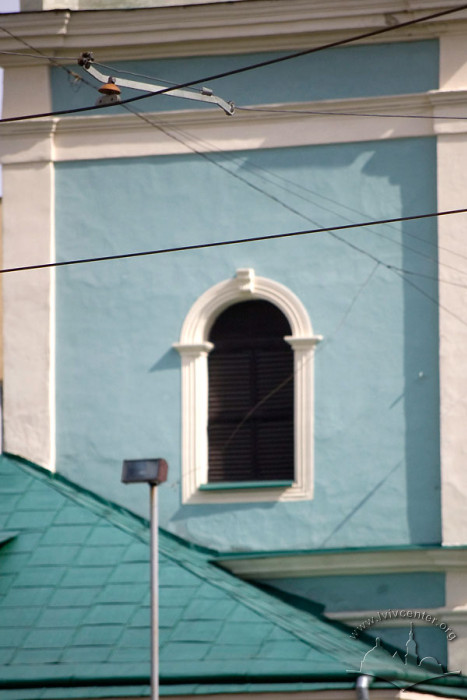
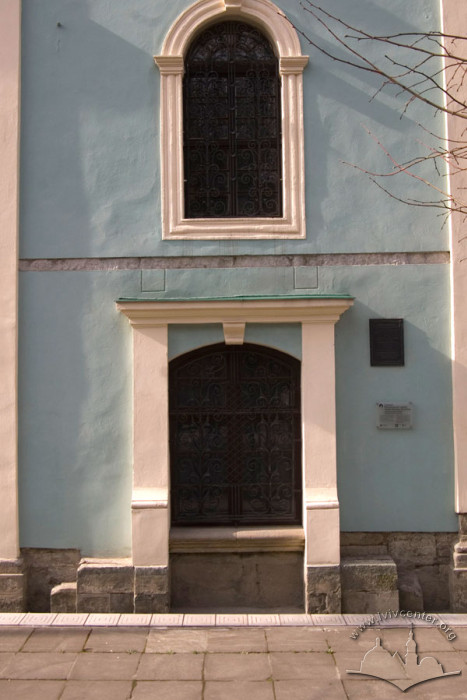
Vul. Mykoly Kopernyka, 40 – "Rusalka Dnistrova" museum (the bell tower of the former Church of the Holy Ghost) ID: 208
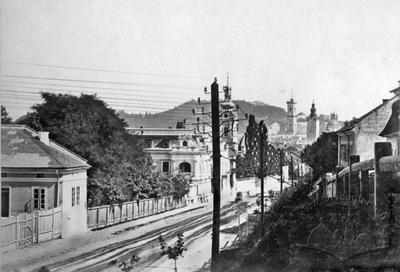
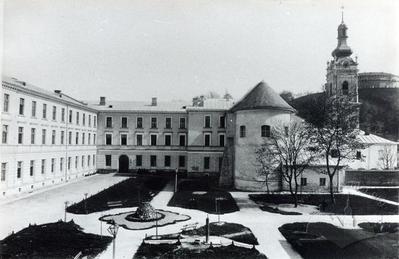
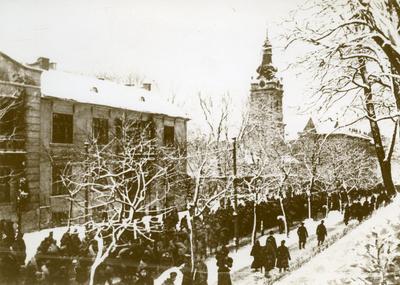
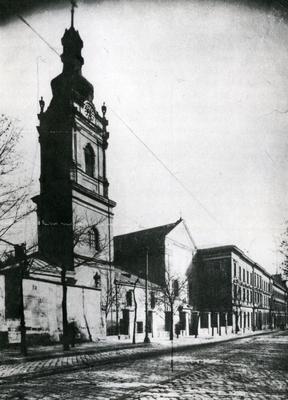
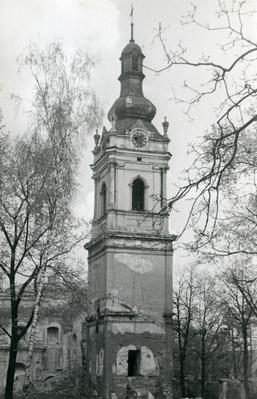
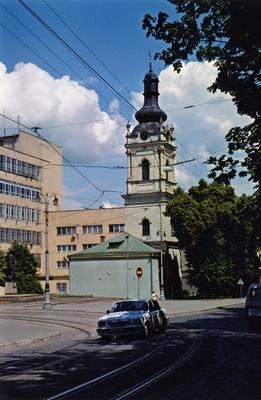
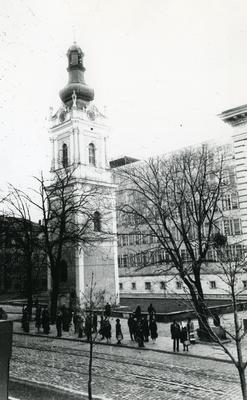
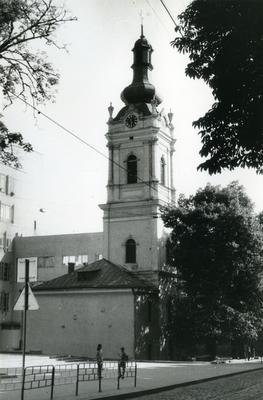
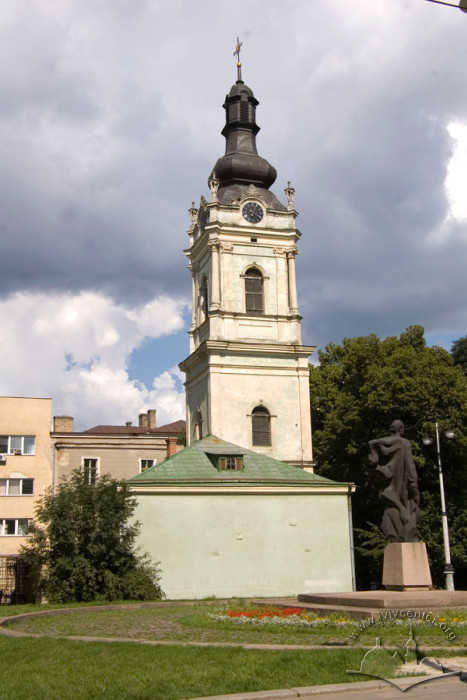
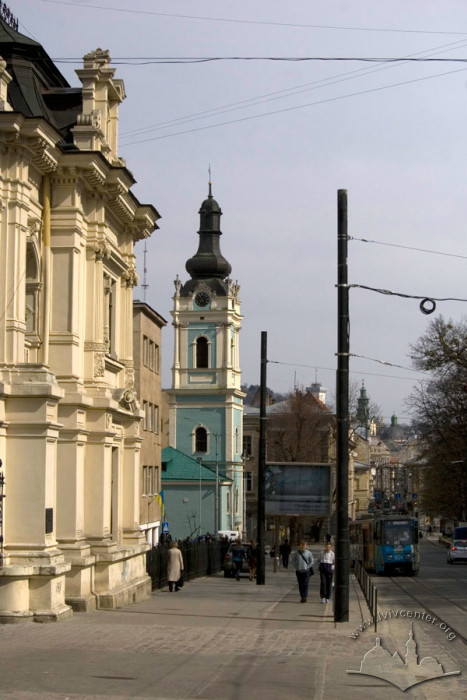
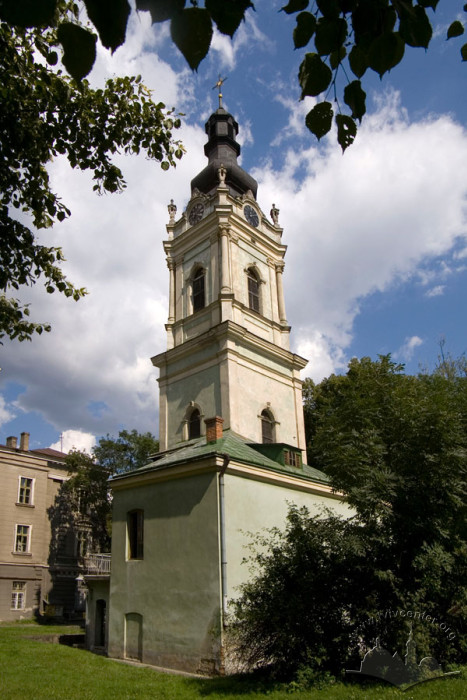
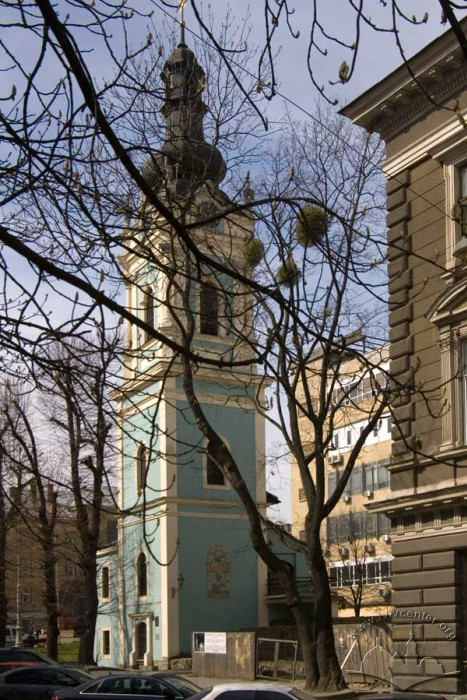
The bell tower of the former Church of the Holy Ghost was constructed in 1722–1729. The tower served as the bell tower for the former Greek Catholic Seminary Church of the Holy Ghost. The church was destroyed during World War II, and only its bell tower has survived. In 1987, an extension for museum premises was constructed on the western side. Today (as of 2010), the "Rusalka Dnistrova" Museum, a department of the Lviv National Art Gallery, is located in the bell tower.
Story
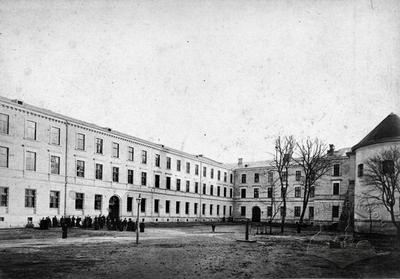
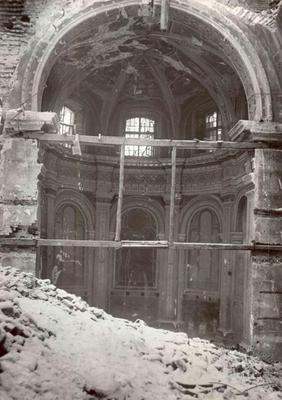
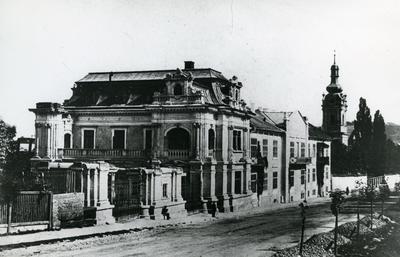
Previously, on present-day vul. M. Kopernyka stood the Church of the Holy Ghost with a bell tower, rebuilt in the eighteenth century from a Baroque church of the Dominican Sisters, constructed in 1722–1729 along with a monastery. The church and monastery of the Dominican Sisters were erected at the expense of the benefactress Teofilia Wiśniowiecka (née Leszczyńska). Following the secularization reforms of Emperor Joseph II in 1783, the monastery complex was given to the Ukrainian community for the newly formed Greek Catholic Theological Seminary (since 1926 — the Theological Academy), and the church was converted into the Seminary Church of the Holy Ghost. At that time, a five-tier iconostasis painted by the artist Luka Dolynsky was installed in the church, with the carving executed by the woodcarver Ivan Shchurovsky.
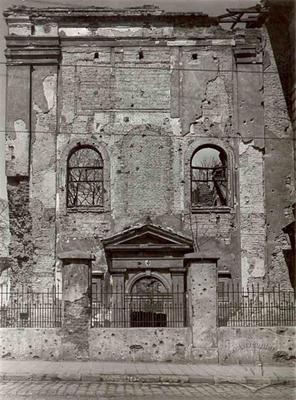
The Seminary Church of the Holy Ghost was a modest single-nave temple with a semi-circular apse under a gable roof, which formed a triangular pediment on the façade facing vul. M. Kopernyka. Due to its architecture, the church barely stood out among the uniform buildings of the former monastery. The walls of the church were painted by the artist Modest Sosenko. In the 1840s, the church's iconostasis was restored by Marcin Jabłoński.
At the beginning of the twentieth century, a commemorative plaque dedicated to the 100th anniversary of the birth of Markiyan Shashkevych, who studied at the Theological Seminary (since 1926 — the Theological Academy), was placed on the façade of the church.
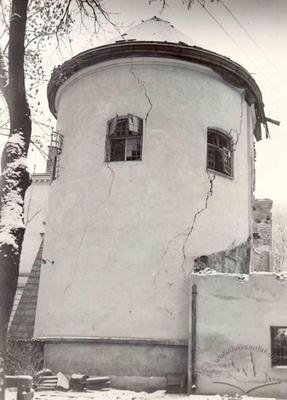
The church was destroyed during World War II on September 15, 1939, by a German bomb. Only the slender three-tier Baroque bell tower, which was part of the Church of the Holy Ghost complex, remained. It was built somewhat later than the church, presumably in the late 1740s, by the architect Marcin Urbanik.
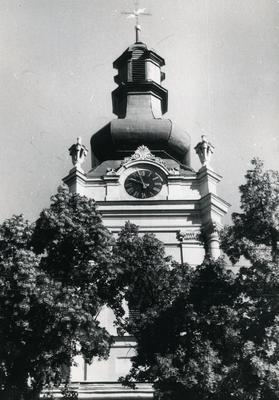
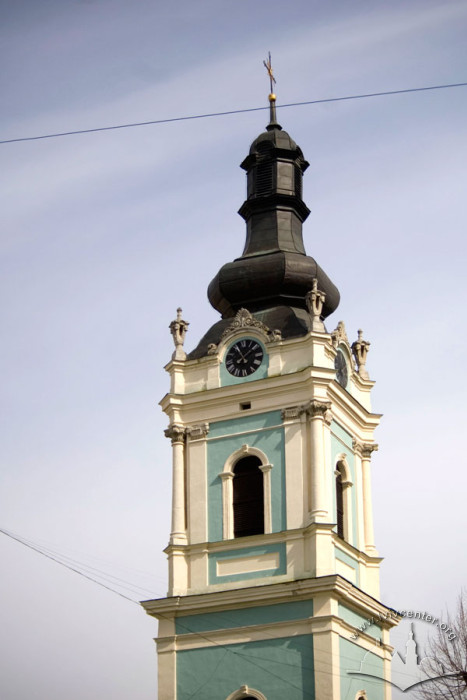
The clock of the bell tower originates from the ancient Manyava Skete and was installed on it in 1786. The church's iconostasis, a monument of sacred art from the second half of the eighteenth century, partially survived thanks to the efforts of art historian Mykhailo Drahan, the then director of the Museum of the Lviv Theological Academy. Six icons (albeit with numerous damages) from this iconostasis were rescued from the ruins of the church, and they are currently kept in the collection of the Lviv National Museum.
In April 1942, a competition was announced in the newspapers "Lvivski Visti" and "Krakivski Visti", the program of which was to produce an architectural design for the reconstruction of the Church of the Holy Ghost at vul. M. Kopernyka 36 in Lviv. The idea of holding this competition, despite the difficult wartime conditions and material hardship, was proposed by the rector of the seminary, and later metropolitan and cardinal, Father Josyf Slipyj.
Fifteen entries were submitted to the competition. The second prize was awarded to the authors of the mottos "Black Dot in Green" — Yevhen Nahirny, and "Black Cross in a Circle" — Otto Fedak in co-authorship with Oleksandr Pezhansky. Of all the designs submitted to the competition at that time, only one has survived completely in the original — the design by architect Stepan Havrylyuk under the motto "Sobor" (Cathedral).
In the 1950s, the ruins of the church were dismantled, and sports grounds were laid out on the site. Today, a new building of the ATS (automatic telephone exchange) stands on this spot.
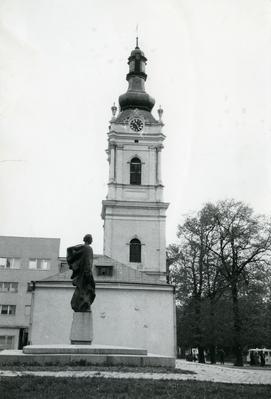
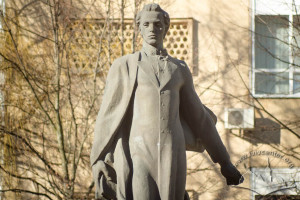
In 1990, the building of the "Rusalka Dnistrova" Museum, a department of the Lviv Art Gallery, was located in the bell tower of the former Church of the Holy Ghost. Behind the museum, on a small square, a bronze monument was erected to the founder of "Rusalka Dnistrova", Markiyan Shashkevych (sculptors: Dmytro Krvavych, Mykola Posikira, architects: V. Dubinina and Mykhailo Fedyk, 1990).
In 1997, a large bronze commemorative plaque to the Patriarch of the UGCC and rector of the Theological Academy, Josyf Slipyj, was installed on the wall of the former seminary and academy facing vul. Kopernyka (sculptor Yulian Savko, architect R. Kychma).
Architecture
The bell tower is a stone, square-in-plan, three-tier structure with a Baroque termination and stone-carved vases at the corners. Each of the tiers is flanked by pilasters and half-columns, and the windows of the tower feature semi-circular terminations. A clock from the ancient Manyava Skete (installed in 1786, repaired in 1987) is mounted on the tower.
Related buildings and spaces
-
Vul. Mykoly Kopernyka – monument to Markian Shashkevych
People
Petro Kholodny –– painter, monumental artist, graphic artist, designer of applied art, educator.
Sources
- Проекту "Галіціана" (І. Жук), 2001-2002.
- Вуйцик В. С., Липка Р. М. Зустріч зі Львовом. Львів: Каменяр, 1987.
- Вуйцик В. Матеріали конкурсу на кращий проект відбудови церкви Св. Духа при греко-католицькій духовній семінарії у Львові у 1942 р.// Українське сакральне мистецтво: традиції, сучасність, перспективи. – Львів, 1994. – С. 157- 161.
- Вуйцик В. Конкурс на кращий проект відбудови церкви Св. Духа // Галицька брама. Львів:видавництво "Центр Європи". – 2000. №6. – С. 6-7.
- Голубець М. Провідник по Львові. – Жовква, 1925.
- Крип'якевич І. Історичні проходи по Львові. – Львів: "Каменяр", 1991.
- Сидор О. Перед Святодухівським іконостасом… // Галицька брама. Львів:видавництво "Центр Європи". – 2000. №6. – С. 8-9.
- Orłowicz M. Przewodnik po Lwowie. – Lwów, 1925.
Citation
Khrystyna Kharchuk, Ihor Zhuk. "Vul. Mykoly Kopernyka, 40 – "Rusalka Dnistrova" museum (the bell tower of the former Church of the Holy Ghost)". Lviv Interactive (Center for Urban History, 2010). URL: https://lia.lvivcenter.org/en/objects/kopernyka-40/Urban Media Archive Materials