Leon Topf
– Industrialist, the owner of "Aida" paper factory in Lviv.
Raphael Lemkin
– Rafał (Raphael) Lemkin (1900-1959) is by now the most prominent Polish lawyer of the 20th century, widely known for his investment in conceiving the linguistic and legal terms appropriate for what due to his efforts has become common currency under the expression genocide.
Hersch Lauterpacht
– Sir Hersch Lauterpacht
(1897–1960) is considered one of the most influential
international legalists of the twentieth century, if not the founder of modern
international law, due to his remarkable contributions to the foundation of the
international protection of human rights after 1945.
Giza Frenkel
– An art historian and researcher of Jewish culture.
Maksymilian Goldstein
– Collector, art historian, one of the initiators of the Jewish Museum in Lviv. The biography describes Goldstein's collecting activities.
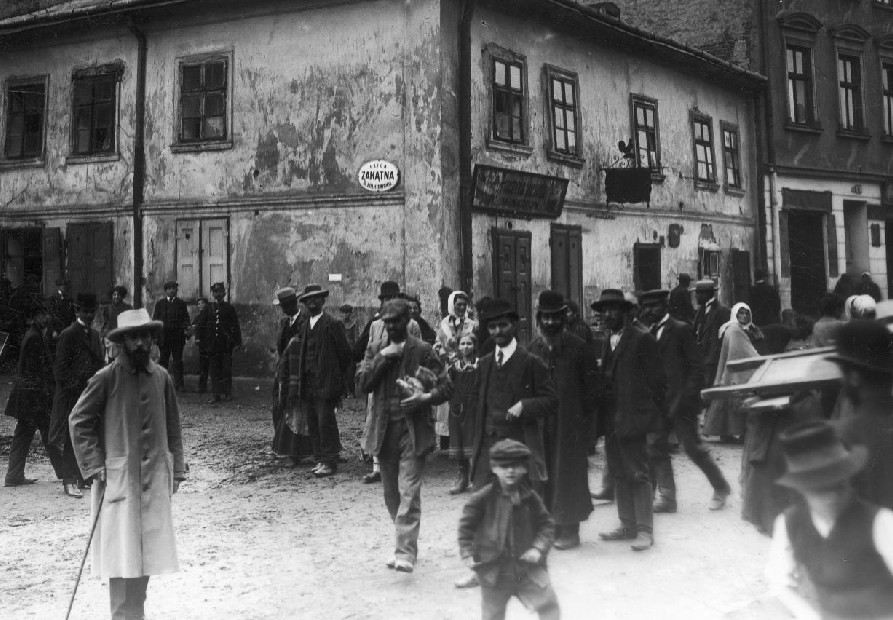
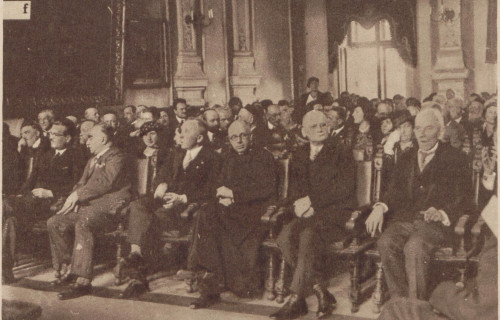
This theme highlights the sites and personalities in the history of the Jewish community in the city. Jews have made a sizeable proportion of Lemberg’s population throughout centuries, often up to one third of the city inhabitants. While prominent in selected aspects of urban public life, Jews have historically been restricted to reside in districts other than the small historic ghetto in the old town and the Żółkiewske and Krakowskie foretowns and often fell victim of unjustified Gentile anger: the pogroms. Until 1867, when residential restrictions were finally abolished, only selected Jews who were willing to compromise their dress code and culture could leave outside the designated areas. At the fin-de-siècle and the first decades of the twentieth century, many Jewish industrialists were prominent in public life by supporting various projects, educational and charity institutions. The history of the Jewish community came to an abrupt end with the end of the Second World War, and only recently there have been attempts to revive it and to give it more adequate public presence.
Literature:
Garkavy Aleksandr and L. Katzenelson, eds. Evreiskaia entsiklopediia, Svod znanii o evreistvie i ego kulture v proshlom i nastoiashchem. St. Petersburg: Brockhaus-Efron, 1906-1913; The Hague: Mouton, 1969-71), Vol. 10.
Melamed, Vladimir. Yevrei vo Lvove (XIII - pervaja polovina XX veka): sobytija, obshchestvo, liudi. Ľviv: TEKOP, 1994.
Gabriele Kohlbauer/Fritz, “Zur Geschichte der Juden in Lemberg,” in Hans Bisanz, ed., Lemberg / Ľviv 1772-1918. Wiederbegegnung mit einer Landeshaupstadt der Donaumonarchie. Vienna: Historisches Museum der Stadt Wien, Katalog der 179. Sonderausstellung, 1993.
Organizations
Jewish Community Museum
The Jewish
Community Museum (or the Jewish Museum) functioned in Lviv in 1934–1940. It was
founded by a group of collectors, philanthropists, and representatives of
Jewish elites and artists, including Józef Awin, Marek and Ada Reichenstein,
Ludwik Lille, and Wiktor Chajes. The museum was created as an institution
within the Jewish community of Lviv, which was to be engaged in identifying,
preserving, and exhibiting cultural memorabilia. The museum's collection was
based on private collections and deposits from synagogues and individuals.
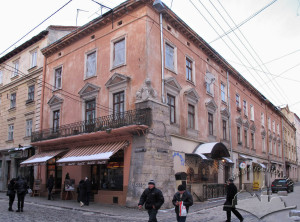
The Ogozałkowski Townhouse (conscription no. 232 old, no. 244 new) was built in the eighteenth century in the Baroque style on the foundations of an older building. It is widely known for its corner relief of a lion. Throughout its history, the property has belonged to various owners: the Ogorzałkowski (seventeenth century), the Ozgewicz family, the Krzyżowski, and later the Moruński. By Decree No. 442 of the Council of Ministers of the Ukrainian SSR (dated September 6, 1979), the building was added to the National Register of Monuments under protection no. 1284.
Currently (as of 2014), the ground floor faces vul. Halytska houses the "Tsyfra" electronics store and a fast-food cafe. The "Khors" cafe is located within the vaulted cellars, with its entrance at vul. Staroievreiska 5.
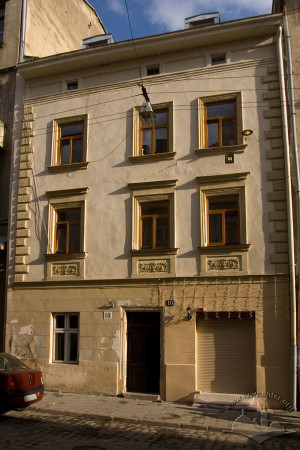
Harayevychivska stone manor house is one of Lviv’s central town characteristic renaissance era masonry buildings, preserving architectural elements of the period. During its existence it has change ownership repeatedly and undergone numerous reconstructions altering its appearance. Jewish families owned the building from the 19th century, putting its ground floor to use as a store and pub. During the soviet period the house was used as a residence, a purpose which it maintains.
The building is a registered national urban architectural landmark – the decision taken by the 442nd session of the Ukrainian Soviet Republic Council of Ministers on 6 September 1979, Decree No. 1296.
The
Pokorovychivska (Pokorowiczowska) house (conscription no. 336) was for two
centuries the residence of noted Lviv architects and constructors who had
influenced its appearance: Adam and Jan Pokorowicz, Ambroży Przychylny, Andrzej Bemer, Jan Poprawa,
Jan Herbut Wygodny and Józef Dublowski. Due to various reconstructions the
house has reached our time in modified condition; however, the old ground floor
and cellars have been preserved. According to the resolution of the Council of
Ministers of the Ukrainian SSR number 442 dated 6 September 1979, the house was
entered in the National register of monuments under protection number 1300.
The buildings of the Kahal Building with a hospital, ritual bath with mikvah (pool), and shchita (butchery) are located on a parcel on recent Arsenalska, 7. This building complex was formed over the course of several centuries.
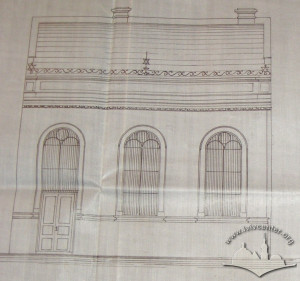
Beth Hamidrash was a house of prayer that included a heated library where Talmud was studied independently. It was a brick, Baroque building with a modest architectural decoration constructed in the city center in 1797. It had arched windows on the ground floor through which the prayer hall was illuminated. At the end of the nineteenth century Beth Hamidrash was expanded. In 1943 it was destroyed by the Nazis together with the "Golden Rose" synagogue.
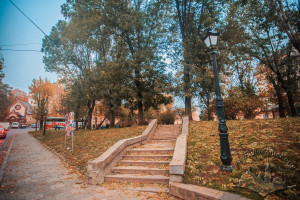
The
cemetery was opened in 1855 owing to the closing of the old Jewish
cemetery. It was destroyed during the German occupation. In the
postwar period, the remains of the Jews from the destroyed old burial
places and of those executed in 1942–1943 were reburied there, and an
obelisk was set up. The cemetery deserves special attention as some
remains of the early twentieth century gravestones, which are in fact
unstudied monuments of art, have been preserved there. The cemetery
has been attached to Yanivsky cemetery since 1962.
The
old Jewish cemetery was located within the limits circumscribed by
contemporary Rappaporta, Kleparivska, Brovarna and Bazarna streets,
in the place of the contemporary Krakivsky market. It was one of the
oldest Jewish cemeteries in Europe mentioned for the first time in
1414. The cemetery has not been preserved.
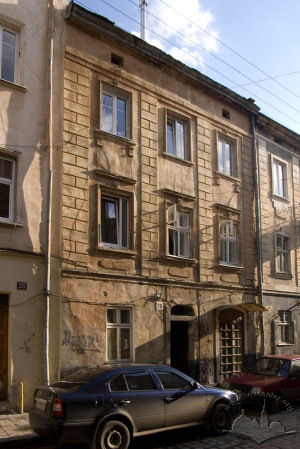
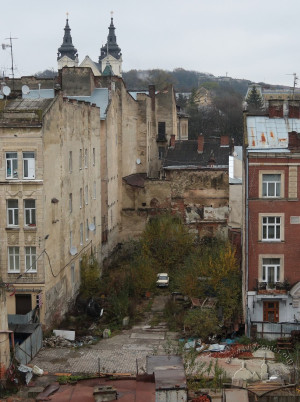
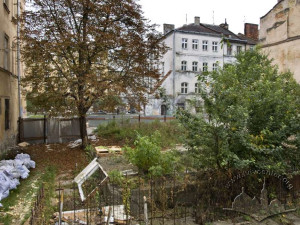
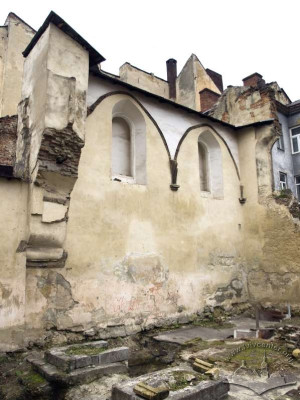
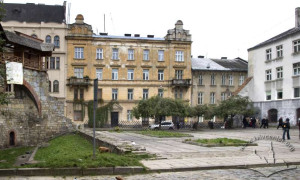
The synagogue was constructed in Renaissance style in 1582-1595 from brick and stone by architect Paweł Szczęśliwy (Pavlo Shchaslyvyi) and funded by the wealthy Nachmanowicz family. The synagogue would have been one of the oldest within the current borders of Ukraine. Yet in August 1941, all its religious objects were plundered and in 1943 it was demolished by explosives by the Nazis. The ruins that remain today, long neglected but undergoing some preservation efforts recently, are a symbol of the tragedy of Lviv’s Jews.
The synagogue was built in 1801 in Neo-Classicist style on the site of a Gothic synagogue which dated back to 1555. Two semicircular arches through which one can today access the square from Staroyevreiska and Brativ Rohatyntsiv Streets are the remaining entrances to the synagogue. The city synagogue had a compositional-space structure similar to the one of the synagogue in the Cracow outer distric (pl. Przedmiejscie Krakowskie). The Great City Synagogue was destroyed in 1943. Today (2008) an empty square is on it's place.
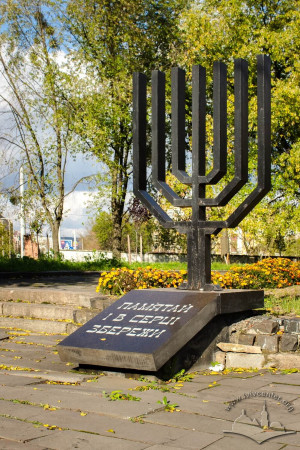
An initiative to set up a monument to victims of the Lviv ghetto was
taken by the Sholem Aleichem Society of Jewish Culture (1988). The monument was
installed in 1992 under a project designed by sculptor Luiza Shterenshtein and
architect Vasyl Plikhivskyi. A place near the railway bridge was chosen for its
location, where the main entrance to the ghetto had been located.
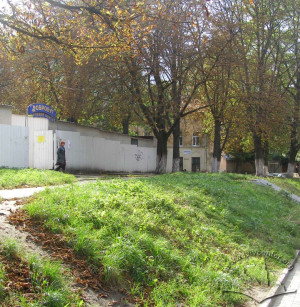
The building of former Jewish hospital was designed by architect Kazimierz Mokłowski and constructed in 1898–1901. The construction costs were covered by Maurycy Lazarus's foundation. The building is located in the northwestern part of the city, on a slope. It is a monumental free-standing structure dominating both vul. Rappaporta and vul. Leontovycha, its design features Historicist Moorish Revival style. In 1902 a brick fence surrounding its territory was constructed, this project was designed by architect Władysław Hodowski. Today the building is used by the Maternity Department of the 3rd Municipal Clinical Hospital.
The suburban synagogue in the former Krakivske suburb was a defensive
structure. During all its existence, its appearance changed several times. In
autumn of 1941 the synagogue was blown up by the Nazis, and its ruins were dismantled
in the late 1940s.
The appearance of Chasidim Schul Synagogue is known because of a preserved photograph which was taken after 1918 pogrom. In 1941 the building was demolished by Nazis. Its Neorenaissance style was the result of the reconstruction carried out according to the design of architect Artur Schleyen. Today utility buildings as well as a cafe are located there.
The Lviv progressive synagogue,
called Tempel (temple), was the first reformed synagogue in Galicia. It
was a monumental building in Neoclassicist
style, notable for its large dome;
unlike European progressive synagogues with their typical oriental and Moorish decorative motifs (Berlin, Vienna or Budapest),
it more resembled a Byzantine church. The Lviv
Tempel was destroyed by the Nazis in
the summer of 1941.
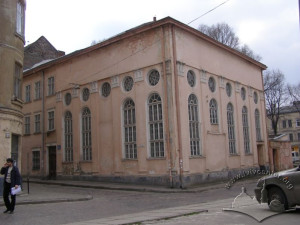
The Tsori Gilod (pol. Cori Gilod) synagogue is located within residential housing of two
streets and is notable for its large windows and Secession-style decoration.
This is one of a few Ukraine's synagogues where murals have been preserved;
here they were made by Maximilian Kugel. In 1989 the building was restored to
the Lviv Jewish community Beis Aharon V’Yisrael.
It is one of the few preserved synagogues
in Lviv, which functioned in the Soviet
times. Before the distortions caused by the disasters of the 20th c. it
was a magnificent Secessionist (Art Nouveau) building which
enriched the architecture of the old Sv.
Teodora square inhabited by the Jews since the 19th
c.
This old townhouse dating from
the 16th c. was called Krochmalowska
due to the name of its owner, Schloma Krochmal. It was a Renaissance-style
building, typical of Lviv at that time, which was depicted by Franciszek Kowaliszyn
in his drawing of Blacharska street in 1904 and whose theoretic reconstruction
was proposed by architect Janusz Witwicki in 1944.
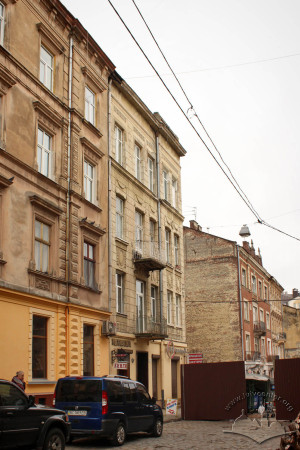
The house number 21 in the Art Nouveau style was
erected before the First World War on the foundations and cellars of the
previous Renaissance townhouse called Krokhmalivska (pol. Krochmalowska) after
the name of its owner Schloma Krochmal, a Jew. The present building is one of
many residential buildings erected in Lviv at the turn of the 20th
century. Today the ground floor premises are occupied by the bookshop Ridkisna Knyha (The Rare Book) and the
telephone repair shop Mobaks.
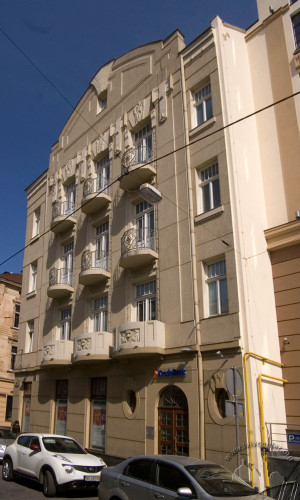
Residential building constructed in 1912 according to the design by architect Józef Awin for Władysław Żilber in the Art Nouveau style on the site of a demolished small two-story building dating back to the 1830s. Reconstructive modifications to the building's façade along ul. św. Stanislawa (now vul. Tyktora) were carried out based on the design by architect Władysław Szpetman in 1926. In 1935, the structure was renovated into the "Splendid" Hotel (renamed "Prykarpatskyi" after 1945). Beginning in December 2002, the hotel building underwent reconstruction for Kredobank JSB (Ukraine).
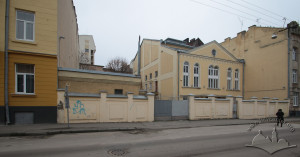
The Agudas Schloma synagogue was one of
Lviv's numerous Hasidic kloizes. Despite its modest architecture, it
stood out against the background of the block's housing. The synagogue was
destroyed during the Shoah. After the destruction a vacant plot has remained in
its place.
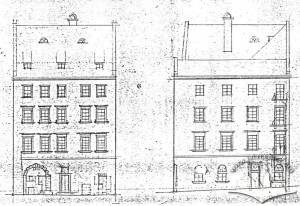
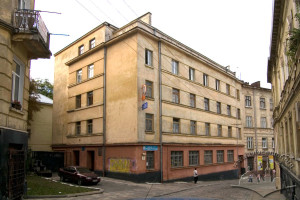
The building of the "Jewish Homeless Shelter Society" (1929, former ul. Starotandetna 2а) was designed by architects Marek Weitz and Juliusz Kolner. The plot of land for construction was granted free of charge on the condition that a shelter for the homeless would be built on the site within three years. The five-story building featured two entrance gates; a public dining hall with a seating capacity of 260 was located on the first floor. In 1935, a demountable stage for performances was set up in the dining hall. Prior to World War II, when the Jewish community was dissolved, a polyclinic was established in the building. In 1941, by order of the Governor of the "Distrikt Galizien", the Judenrat, along with all of its departments, was housed in this building.