ID: 42

ID: 42

Related buildings and spaces

  • Pl. Katedralna, 1 – Cathedral of the Assumption of the Virgin Mary
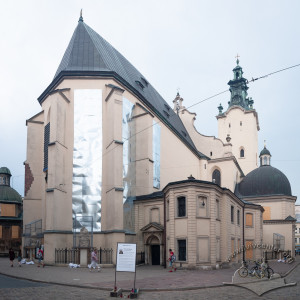
    The Cathedral is the only object of Gothic architecture in Lviv, preserved in its integrity. Its tower, along with the City Hall, the Kornyakt tower, and the bell tower of the former Bernardine church are symbols of the city, dominating in the panorama of its central part.
    At present this is the Roman Catholic Arch-Cathedral of the Assumption of the Blessed Virgin Mary, also known as the Metropolitan Basilica, an architectural monument of national significance (protection number 316/0).

    Read more
  • Vul. Kniazia Romana, 1–3 – building of Lviv Polytechnic National University (former "Palace of Justice")
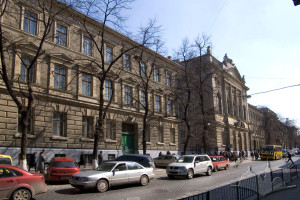
    The former Regional Court building — the "Palace of Justice" (1891–1895, architect Franciszek Skowron). This monumental building in the central part of the city finished with a pediment featuring a balustrade and an attic sculptural group (1893, sculptor Leonard Marconi). The northern vestibule is adorned with an allegorical sculpture symbolizing justice (1896, sculptor Antoni Popiel). The second-floor hall is decorated with plasterwork ornamentation and wall paintings by artists of the Jan Matejko school. The building's style is Historicism, utilizing Neorenaissance and Neobaroque forms. Its principal (western) elevation faces Kniazia Romana Street, while its side (northern) elevation faces Halytska Square. Today (2009), it serves as building No. 19 of Lviv Polytechnic National University.

    Read more
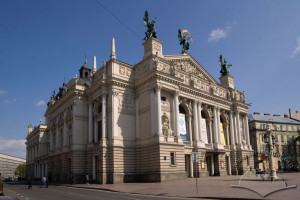
  • Prosp. Svobody, 28 – Lviv Opera house

    The Lviv State Academic Opera and Ballet Theater was built in 1897–1900 under a project designed by architect Zygmunt Gorgolewski. The building is erected in historicist style and influenced by the so-called Vienna Neo-Renaissance. The monumental theater building has occupied a key position in the architectural ensemble of the city's main avenue created in the late 19th – early 20th century.

    Read more
  • Prosp. Shevchenka – former monument to Kornel Ujejski
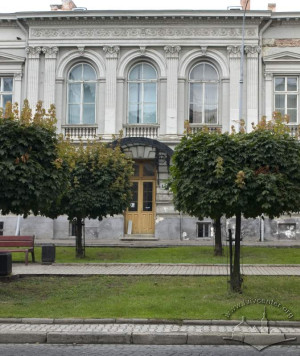
    The monument to Kornel Ujejski, "the last great poet of the Romantic era," was installed on the initiative of the Literary and Artistic Circle near the City Casino in 1901. It was made by sculptor Antony Popiel. After the Second World War the monument was transported to Szczecin (Poland).
    Read more
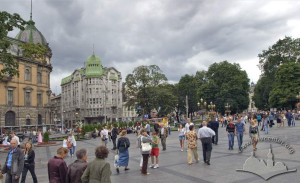
  • Prosp. Svobody

    Svobody Boulevard (prospekt Svobody) is the main street of Lviv. From the mid-nineteenth century it consisted of two streets, known as Untere/Obere Karl Ludwig Straße or, in Polish, Karola Ludwika wyższa/niższa ("Lower/Upper Karl Ludwig Street"). In 1871 the Obere Karl Ludwig Straße was renamed Hetmańska, in honor of the Great Crown Hetman Stanisław Jabłonowski, whose monument had been erected there in 1859. Obere Karl Ludwig Straße became simply Karl Ludwig Straße/Karola Ludwika, until 1919, when it was renamed Legionów ("Legions"). The bed of the river Poltva was driven underground in 1887, under supervision of engineer Wacław Ibański. In 1940 Hetmańska nad Legionów Streets became part of the single Pershoho Travnia ("First of May") Street. In 1941 the street was first divided into Opernstrasse and Museumstrasse, and later joined under the name of Adolf Hitler Platz/Ring. In 1944 the street's name went back to Pershoho Travnia. Later it was renamed Lenina Boulevard. In 1991 it was renamed Svobody Boulevard.

    Read more
  • Vul. Teatralna, 13 – St. Peter and Paul Church (former Jesuit Church)
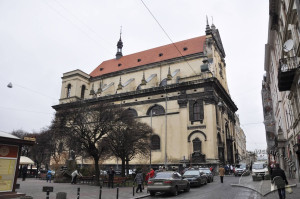
    The Jesuit church is located in the historic center of Lviv, near the former western side of the town fortifications. This is one of the biggest churches of the city, an example of a baroque and Renaissance basilica built upon the pattern of the Il Gesù church in Rome by well-known architects, sculptors, carvers and painters. According to the resolution of the Council of Ministers of the Ukrainian SSR number 970 dated 23 August 1963, the Jesuit church was entered in the National list of monuments under protection number 338.

    Read more
  • Vul. Horbachevskoho, 6 – villa (no longer exists)
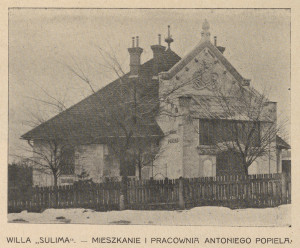
    This former individual house with an art studio was constructed between 1901 and 1902 according to a design by Ivan Levynskyi's bureau. The property functioned as a villa-studio for the sculptor Antoni Popiel. It was designed as a detached building, the architecture of which was distinguished by the expressive modeling of its avant-corps and roof silhouette. The compositional dominant was the spacious sculptor's studio, with a block oriented diagonally relative to the main wing. This villa is one of the structures in the Kastelivka neighborhood that has not survived to the present day.

    Read more
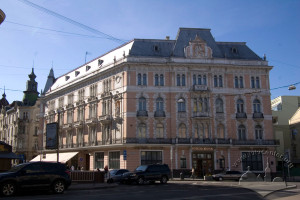
  • Pl. Mitskevycha, 1 – "George" Hotel

    "George" Hotel (1899–1901, architects H. Helmer and F. Fellner; 1932 — remodeling of part of the premises, architect Tadeusz Wróbel; pl. Mitskevycha). Late Historicism (Neorenaissance, Neobaroque, Neoempire), Secession elements, Art Deco (1930s interiors). A monumental building in the city center. The principal elevation is accented along its central axis by an avant-corps featuring the main entrance and an attic wall crowned with a "St. George" relief; in the niches of the side façades are allegorical figures of the four continents (sculpted by Leonard Marconi and Antoni Popiel). Many famous personalities stayed at the hotel. In 1848, during the Spring of Nations, celebratory banquets were held here. In 1910–1912, Alfred Altenberg's bookstore operated in the hotel, followed in 1912–1920 by the publishing union "H. Altenberg, H. Seyfarth, E. Wende and Co.". In 1940, the hotel was renamed "Lviv", and from 1945 to 1995, it was called "Intourist".

    Read more
  • Pl. Dvirtseva, 1 – central railway station
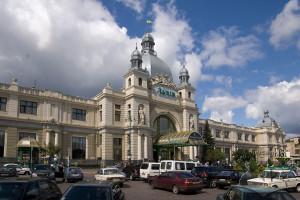
    Lviv Central Railway Station building (1901–1904, architect Władysław Sadłowski — general design; Alfred Zachariewicz and Tadeusz Obmiński — interiors; engineering group led by Ludwik Wierzbicki — structural engineering; 1921–1922 — addition of the second floor; 1946–1951 — reconstruction with interior renovation). The architectural style is Secessionist with Neorenaissance elements. The train shed was designed by a group of railway engineers led by L. Wierzbicki; in 1946 — reconstructed; 2000–2001 — restored). The Lviv main station complex stands as a prime example of a monumental architectural structure designed at the turn of the twentieth century.

    Read more
  • Pl. Mitskevycha – monument to Adam Mickiewicz
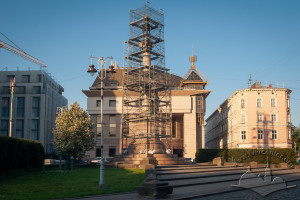
    The monument to the national Polish poet was opened on 30 October 1904. Its construction was carried out from late 1903 under the supervision of Alfred Zachariewicz and Józef Sosnowski. The author of the project, who won an architectural competition, was Antoni Popiel, a famous sculptor. Earlier, there was a figure of the Virgin Mary on its place.

    Read more
  • Pl. Kropyvnytskoho, 1 – The SS. Olha and Elizabeth (former St. Elizabeth) church
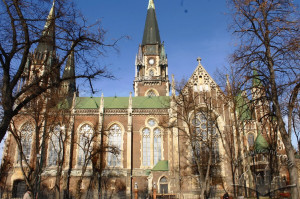
    A Neo-Gothic church, noted for its high towers and pointed spires, is one of  Lviv's trademarks. It  was designed by architect Teodor Talowski. Well-known architects, sculptors and painters took part in the construction of this church. According to the resolution of the Lviv regional executive committee number 130 dated 26 February 1980, the church was entered into the local register of monuments under protection number 146. In 1991 the church was handed over to the local Greek Catholic community.

    Read more
  • Vul. Mechnikova – Lychakivskyi (Lychakiv) cemetery
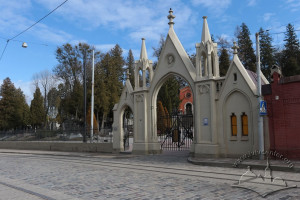
    Lychakivsky (Lychakiv) cemetery is situated close to Mechnykova street; its territory occupies the Lychakiv plateau and its vicinities. As for today, this is the oldest preserved cemetery in Lviv which was officially opened in 1786. It is one of the best known European necropolises containing a lot of artistic monuments. The cemetery has been declared a historical, archaeological and artistic monument of national significance. There one can see the graves of many prominent persons, military burial places belonging to the times of the First and Second World Wars etc.

    Read more
  • Vul. Kostiushka, 11 – Lviv State University of Physical Culture
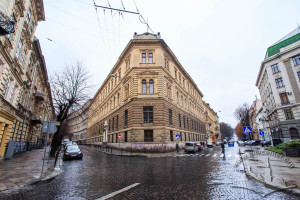
    The former Regional Bank building (currently — the main building of the Lviv State University of Physical Culture; 1895–1903, architect –– J. Cybulski). The style of the building is Historicism (Neorenaissance). The building is situated on the corner of vul. Kostiushka and pl. Hryhorenka, and features a V-shaped configuration in plan.

    Read more
  • Vul. Rappaporta, 8 – hospital building

    The building of former Jewish hospital was designed by architect Kazimierz Mokłowski and constructed in 1898–1901. The construction costs were covered by Maurycy Lazarus's foundation. The building is located in the northwestern part of the city, on a slope. It is a monumental free-standing structure dominating both vul. Rappaporta and vul. Leontovycha, its design features Historicist Moorish Revival style. In 1902 a brick fence surrounding its territory was constructed, this project was designed by architect Władysław Hodowski. Today the building is used by the Maternity Department of the 3rd Municipal Clinical Hospital.

    Read more
  • Pl. Katedralna, 1 – Cathedral of the Assumption of the Virgin Mary

    Pl. Katedralna, 1 – Cathedral of the Assumption of the Virgin Mary
  • Vul. Kniazia Romana, 1–3 – building of Lviv Polytechnic National University (former "Palace of Justice")

    Vul. Kniazia Romana, 1–3 – building of Lviv Polytechnic National University (former "Palace of Justice")
  • Prosp. Svobody, 28 – Lviv Opera house

    Prosp. Svobody, 28 – Lviv Opera house
  • Prosp. Shevchenka – former monument to Kornel Ujejski

    Prosp. Shevchenka – former monument to Kornel Ujejski
  • Prosp. Svobody

    Prosp. Svobody
  • Vul. Teatralna, 13 – St. Peter and Paul Church (former Jesuit Church)

    Vul. Teatralna, 13 – St. Peter and Paul Church (former Jesuit Church)
  • Vul. Horbachevskoho, 6 – villa (no longer exists)

    Vul. Horbachevskoho, 6 – villa (no longer exists)
  • Pl. Mitskevycha, 1 – "George" Hotel

    Pl. Mitskevycha, 1 – "George" Hotel
  • Pl. Dvirtseva, 1 – central railway station

    Pl. Dvirtseva, 1 – central railway station
  • Pl. Mitskevycha – monument to Adam Mickiewicz

    Pl. Mitskevycha – monument to Adam Mickiewicz
  • Pl. Kropyvnytskoho, 1 – The SS. Olha and Elizabeth (former St. Elizabeth) church

    Pl. Kropyvnytskoho, 1 – The SS. Olha and Elizabeth (former St. Elizabeth) church
  • Vul. Mechnikova – Lychakivskyi (Lychakiv) cemetery

    Vul. Mechnikova – Lychakivskyi (Lychakiv) cemetery
  • Vul. Kostiushka, 11 – Lviv State University of Physical Culture

    Vul. Kostiushka, 11 – Lviv State University of Physical Culture
  • Vul. Rappaporta, 8 – hospital building

    Vul. Rappaporta, 8 – hospital building

People

Leonard Marconi – Leonard Marconi was a sculptor and building decorator, professor at the Higher Technical School in Lviv.