Pl. Adama Mitskevycha, 1 – "George" Hotel ID: 386
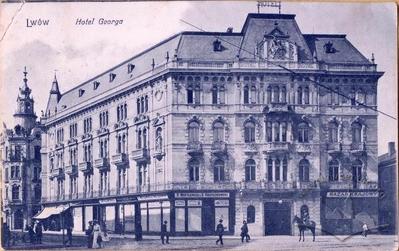
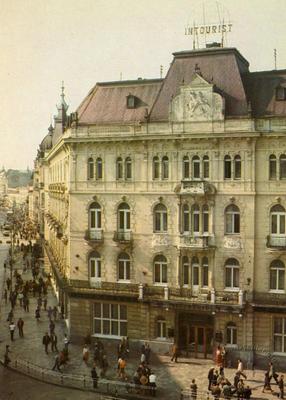
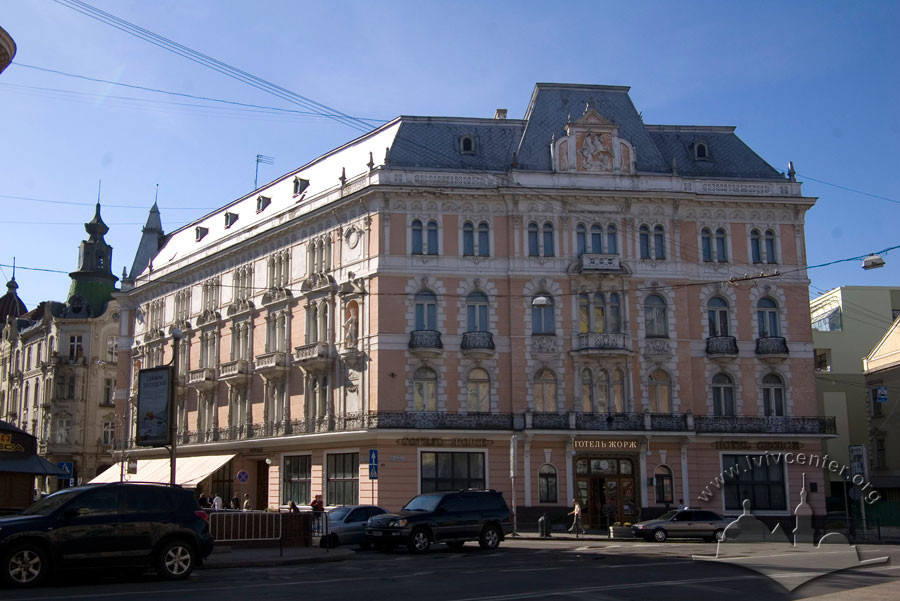
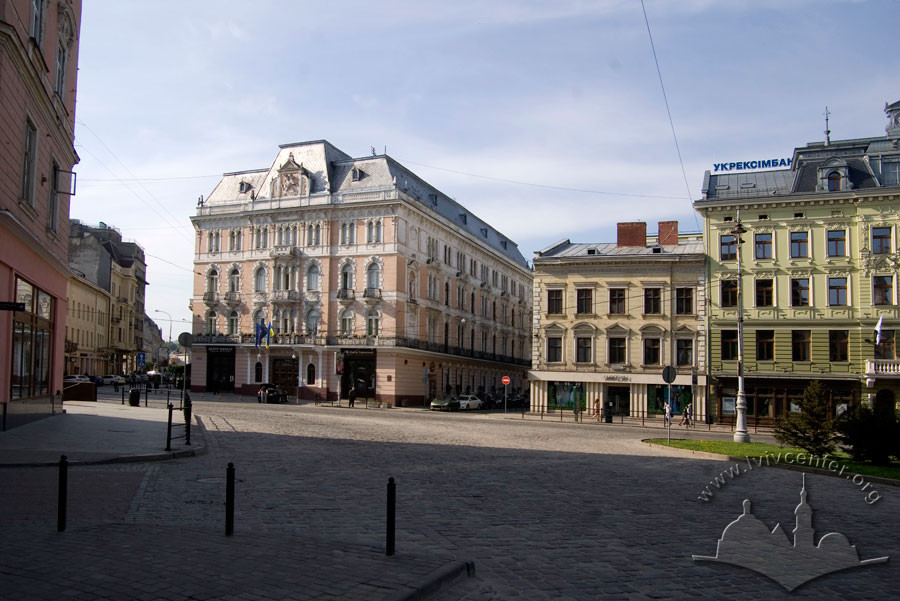
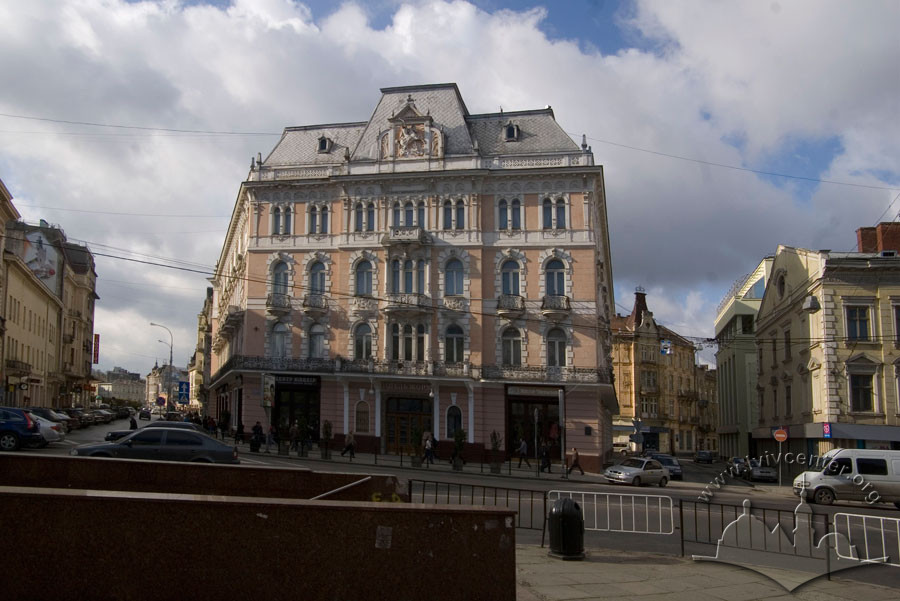
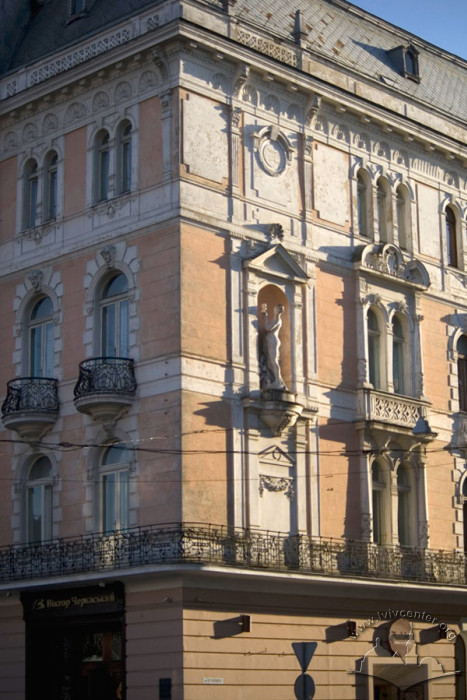
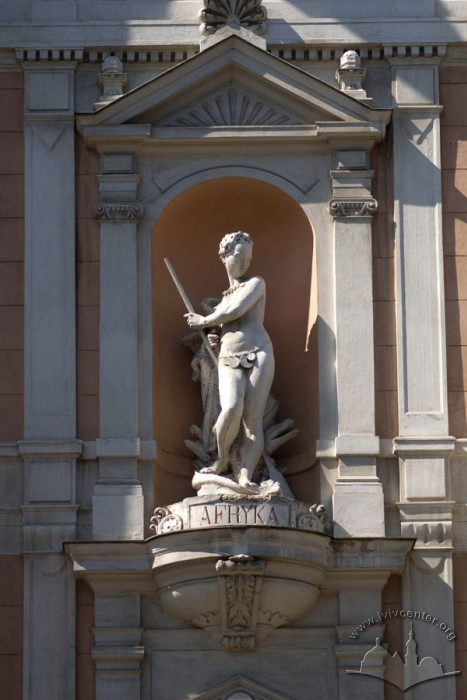
"George" Hotel (1899–1901, architects H. Helmer and F. Fellner; 1932 — remodeling of part of the premises, architect Tadeusz Wróbel; pl. Mitskevycha). Late Historicism (Neorenaissance, Neobaroque, Neoempire), Secession elements, Art Deco (1930s interiors). A monumental building in the city center. The principal elevation is accented along its central axis by an avant-corps featuring the main entrance and an attic wall crowned with a "St. George" relief; in the niches of the side façades are allegorical figures of the four continents (sculpted by Leonard Marconi and Antoni Popiel). Many famous personalities stayed at the hotel. In 1848, during the Spring of Nations, celebratory banquets were held here. In 1910–1912, Alfred Altenberg's bookstore operated in the hotel, followed in 1912–1920 by the publishing union "H. Altenberg, H. Seyfarth, E. Wende and Co.". In 1940, the hotel was renamed "Lviv", and from 1945 to 1995, it was called "Intourist".
Story
The present hotel building was constructed in 1899–1901 according to an 1898 design by the famous Viennese architectural firm of Ferdinand Fellner and Hermann Helmer. To execute the project, the drawings by the Austrian architects were slightly modified by architects Ivan Levynskyi and Julian Cybulski.
The new hotel opened on January 8, 1901, featuring 93 rooms, 32 of which were luxury suites. Room rates ranged from 6 to 24 Austro-Hungarian gulden per day.
In 1906, architect Ivan Levynskyi added a third and fourth story above a portion of the building on the south side. That same year, engineer Volodymyr Podhorodecki reconstructed the roofing over the main part of the building.
In 1927–1929, the interior spaces were replanned, and a fifth story was added on the south side.
In 1932, the reading room and restaurant of the hotel were remodeled according to a design by architect Tadeusz Wróbel.
Reconstructions were also carried out in the 1940s–1950s and in the 1990s. In 1940, the hotel was renamed "Lviv", and from 1945 to 1995, it was named "Intourist".
During the years of Ukrainian Independence, the hotel's original name, "George", was restored.
Architecture
A freestanding, four-story, plastered brick building with a high mansard roof, irregular quadrilateral in plan layout. The first floor, separated by a balcony balustrade, features large rectangular windows across its façade surfaces, while the upper floors feature arched windows with molded surrounds. The principal elevation is accented along its central axis by an avant-corps with the main entrance, topped by a shaped attic wall featuring a "St. George" relief; in the niches of the side façades are allegorical figures of the four continents created by Lviv sculptors Leonard Marconi and Antoni Popiel.
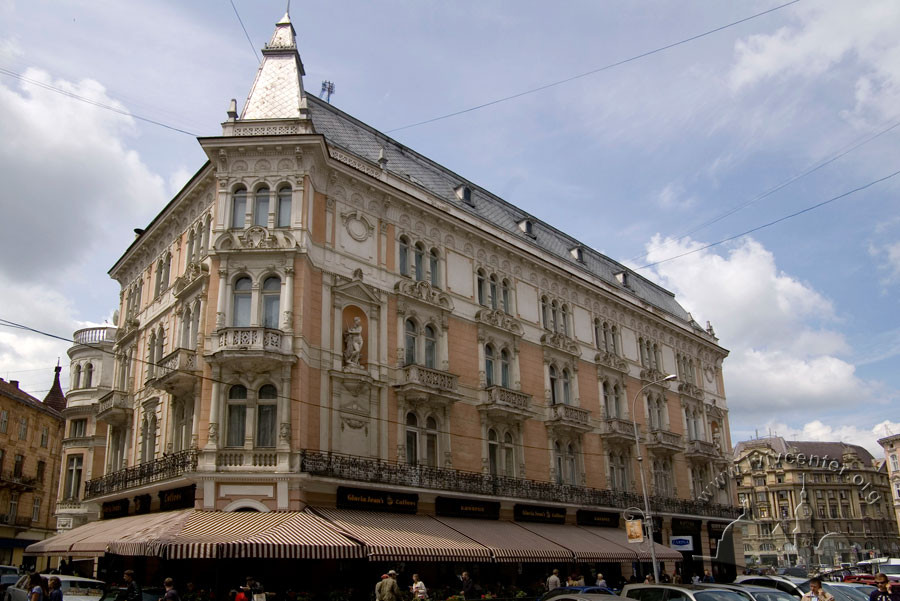
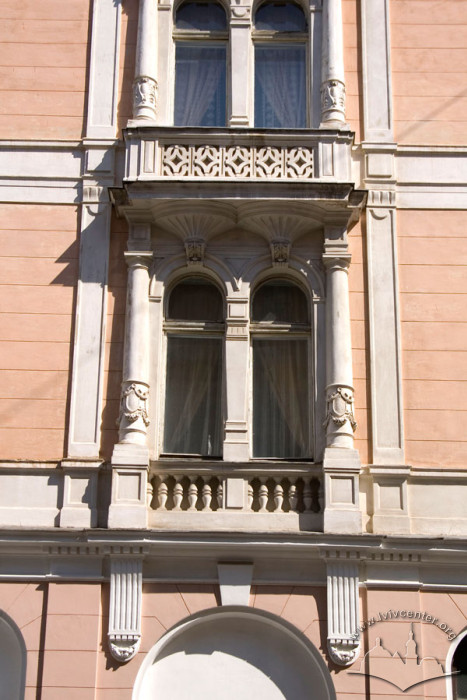
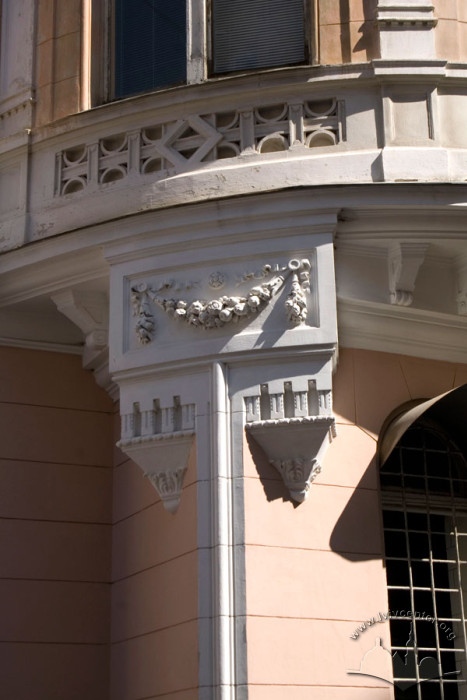
The interior layout of the hotel is primarily of the corridor type, with rooms arranged on both sides. On the first floor is a spacious foyer with entrances to the restaurant and administrative offices. The floor slabs are flat, while those above the stairwell are rounded barrel vaults with lunettes. The composition of the principal elevation is symmetrical, accented by a central avant-corps crowned with a shaped attic wall. On the south façade, two side avant-corps and a central semicircular bay window project outward. This façade has five stories with mezzanines above the fourth floor of the avant-corps. The first floor is decorated with linear rustication and separated from the second by a balcony with openwork railing extending around the entire perimeter of the building. The second and third floors feature bifora windows adorned with engaged columns topped with Tuscan and Corinthian capitals. The east and west façades are identical in their design. The building is topped with an arcature frieze with shell motifs and a prominent cornice supported by molded modillions. The Neorenaissance division of the three elevations is enlivened by Neobaroque ornamentation and dynamic sculptures positioned in central niches at the corners of the building — allegories of Europe, Asia, America, and Africa, symbolizing the four parts of the world.
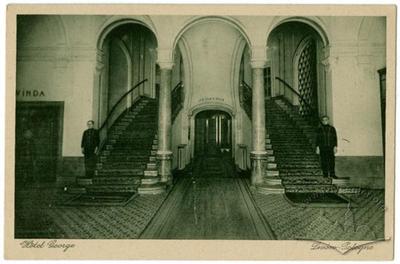
In the interior, the first floor features a large foyer with entrances to the restaurant and administrative offices. The upper floors have a corridor layout with rooms on both sides.
The building's interior retains stucco work in the lobby, an Secession balustrade on the marble staircase, and ceramic fireplaces crafted in 1900. The "Skhidna" (Oriental) and "Karpaty" (Carpathians) restaurant halls feature modern stylized decor.
The building stands as Lviv's most striking example of nineteenth and early twentieth-century luxury hotel architecture.
Related buildings and spaces
-
Pl. Adama Mitskevycha, 1 – "Under the Three Hooks" Hotel, "De La Russie" (no longer extant)
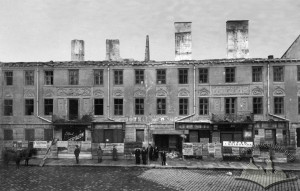
People
Antoni Popiel –– sculptor, educator. One of the leading Lviv sculptors of the late 19th and early 20th centuries. He executed the sculptures of "Europe," "Asia," "America," and "Africa," as well as the St. George relief for the hotel.
Many famous personalities stayed at the hotel (both in the previous structure and the current building), including:
Honoré de Balzac,
Franz Liszt,
Ethel Lilian Voynich,
Maurice Ravel,
Jean-Paul Sartre,
Jan Kiepura,
Mozaffar ad-Din Shah Qajar,
Józef Piłsudski,
Nikita Khrushchev,
Oleksandr Korniychuk and others.
In 1848, during the Spring of Nations, celebratory banquets were held here in honor of Generals Józef Bem and Józef Dwernicki.
In 1910–1912, Alfred Altenberg's bookstore operated in the George Hotel, and later, from 1912 to 1920, the publishing union "H. Altenberg, H. Seyfarth, E. Wende and Co." was located there.
Organizations
-
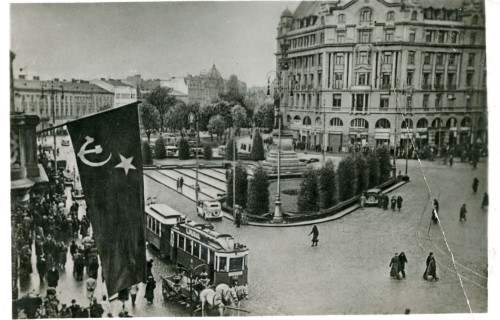
The George Hotel
It is a prestigious Lviv hotel located on the present pl. Mitskevycha.
Read more
Sources
- Oпис чacткoвo опрацьований в межах проекту "Галіціана", 2001-2002
- Державний архів Львівської області. – Ф. 2. – Оп.2. – Спр. 1241. – С. 1-10.
- ДАЛО. – Ф. 2. – Оп. 2. – Спр. 1242. – С. 3, 4.
- ДАЛО. – Ф. 2. – Оп. 2. – Спр. 1243. – С. 1, 2.
- ДАЛО. – Ф. 2. – Оп.2. – Спр. 1244. – С. 1, 5.
- ДАЛО. – Ф. 2. – Оп. 2. – Спр. 31. – С. 1, 7.
- Janusz B. Przewodnik po Lwowie. – Lwów, 1922. –S.35.
- Jaworski F. Przewodnik po Lwowie. –Lwów, 1907.– S. 12.