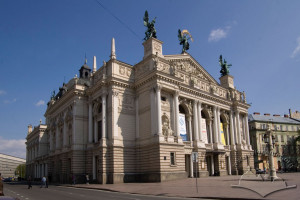
ID: 87

Related buildings and spaces

  • Vul. Petra Doroshenka, 19 – residential building
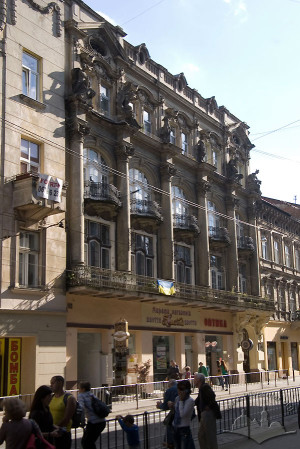
    This residential building with shops (1908–1909, architect — Volodymyr Pidhorodetskyi) is a work of Late Historicism (Neobaroque). Its interiors preserve their original stucco ornamentation. It serves as a striking example of the use of Neobaroque forms in late 1900s architecture and represents one of the finest instances of Late Historicism featuring lightly interpreted Baroque motifs.

    Read more
  • Pl. Dvirtseva, 1 – central railway station
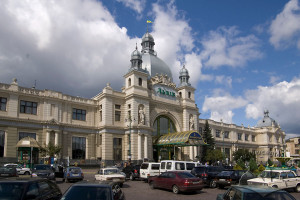
    Lviv Central Railway Station building (1901–1904, architect Władysław Sadłowski — general design; Alfred Zachariewicz and Tadeusz Obmiński — interiors; engineering group led by Ludwik Wierzbicki — structural engineering; 1921–1922 — addition of the second floor; 1946–1951 — reconstruction with interior renovation). The architectural style is Secessionist with Neorenaissance elements. The train shed was designed by a group of railway engineers led by L. Wierzbicki; in 1946 — reconstructed; 2000–2001 — restored). The Lviv main station complex stands as a prime example of a monumental architectural structure designed at the turn of the twentieth century.

    Read more
  • Pl. Katedralna, 1 – Cathedral of the Assumption of the Virgin Mary
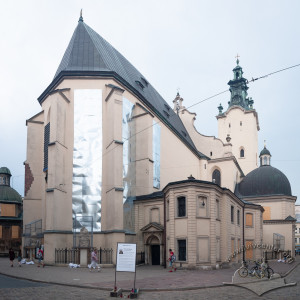
    The Cathedral is the only object of Gothic architecture in Lviv, preserved in its integrity. Its tower, along with the City Hall, the Kornyakt tower, and the bell tower of the former Bernardine church are symbols of the city, dominating in the panorama of its central part.
    At present this is the Roman Catholic Arch-Cathedral of the Assumption of the Blessed Virgin Mary, also known as the Metropolitan Basilica, an architectural monument of national significance (protection number 316/0).

    Read more
  • Pl. Marka Kropyvnytskoho, 1 – The SS. Olha and Elizabeth (former St. Elizabeth) church
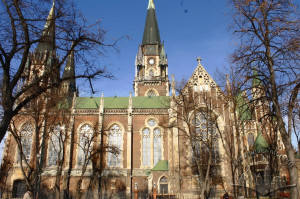
    A Neo-Gothic church, noted for its high towers and pointed spires, is one of  Lviv's trademarks. It  was designed by architect Teodor Talowski. Well-known architects, sculptors and painters took part in the construction of this church. According to the resolution of the Lviv regional executive committee number 130 dated 26 February 1980, the church was entered into the local register of monuments under protection number 146. In 1991 the church was handed over to the local Greek Catholic community.

    Read more
  • Pl. Mytna, 2 – former church of the Clares Monastery
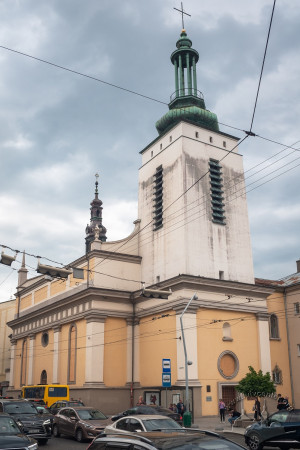
    The former Poor Clares Convent Church is the most prominent accent of the lower vul. Lychakivska development. Built in 1607 (architects Bernard Avelides and Paweł Rzymianin) , its interior was decorated in the 1760s. During 1938–1939, restoration with partial reconstruction was carried out (architect Antoni Lobos). The architectural design of the church's exterior combines Renaissance, Baroque, and Art Deco forms. Today, it houses the Johann Georg Pinsel Museum, a department of the Lviv National Art Gallery.

    Read more
  • Prosp. Svobody, 28 – Lviv Opera house

    The Lviv State Academic Opera and Ballet Theater was built in 1897–1900 under a project designed by architect Zygmunt Gorgolewski. The building is erected in historicist style and influenced by the so-called Vienna Neo-Renaissance. The monumental theater building has occupied a key position in the architectural ensemble of the city's main avenue created in the late 19th – early 20th century.

    Read more
  • Vul. Teatralna, 13 – St. Peter and Paul Church (former Jesuit Church)
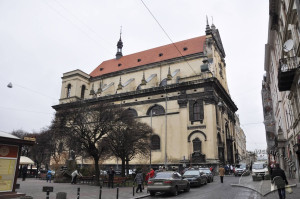
    The Jesuit church is located in the historic center of Lviv, near the former western side of the town fortifications. This is one of the biggest churches of the city, an example of a baroque and Renaissance basilica built upon the pattern of the Il Gesù church in Rome by well-known architects, sculptors, carvers and painters. According to the resolution of the Council of Ministers of the Ukrainian SSR number 970 dated 23 August 1963, the Jesuit church was entered in the National list of monuments under protection number 338.
    Read more
  • Vul. Volodymyra Vynnychenka, 30a – Church of the Meeting of the Lord (former Roman Catholic church)
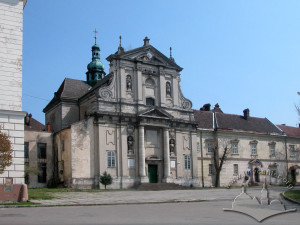
    The former Roman Catholic Church of the Meeting of the Lord (presently the Greek Catholic Church) was constructed on a hill with former monastery cells flanking it on the south. The construction period covers the years from 1642/1644 to the end of the seventeenth century; it is the work of the architect J.B. Jisleni. The cathedral is modeled after San Susanna Church in Rome and is a clear witness to the influence of the Roman Baroque style. 
    Read more
  • Pl. Adama Mitskevycha – monument to Adam Mickiewicz
    The monument to the national Polish poet was opened on 30 October 1904. Its construction was carried out from late 1903 under the supervision of Alfred Zachariewicz and Józef Sosnowski. The author of the project, who won an architectural competition, was Antoni Popiel, a famous sculptor. Earlier, there was a figure of the Virgin Mary on its place.

    Read more
  • Vul. Tarasa Shevchenka – Yanivsky (Yaniv) cemetery

    Yanivsky (Yaniv) cemetery was founded in 1883; it is situated on Shevchenka street. The area of the cemetery is about 38 hectares now; over 200 thousand persons are buried in its 68 fields. One can find there numerous burial vaults of high artistic value as well as civil and military graves from the First and Second World Wars, including those of the Ukrainian Galician Army riflemen, Polish military men, Nazi, the Yaniv concentration camp of 1941–1943 victims. In 1962 the territory of the nearby Jewish cemetery, which was founded in 1855, was attached to Yanivsky cemetery. Since the early 1980s the cemetery has been closed for burials because of lack of free area.
    Read more
  • Vul. Petra Doroshenka, 19 – residential building

    Vul. Petra Doroshenka, 19 – residential building
  • Pl. Dvirtseva, 1 – central railway station

    Pl. Dvirtseva, 1 – central railway station
  • Pl. Katedralna, 1 – Cathedral of the Assumption of the Virgin Mary

    Pl. Katedralna, 1 – Cathedral of the Assumption of the Virgin Mary
  • Pl. Marka Kropyvnytskoho, 1 – The SS. Olha and Elizabeth (former St. Elizabeth) church

    Pl. Marka Kropyvnytskoho, 1 – The SS. Olha and Elizabeth (former St. Elizabeth) church
  • Pl. Mytna, 2 – former church of the Clares Monastery

    Pl. Mytna, 2 – former church of the Clares Monastery
  • Prosp. Svobody, 28 – Lviv Opera house

    Prosp. Svobody, 28 – Lviv Opera house
  • Vul. Teatralna, 13 – St. Peter and Paul Church (former Jesuit Church)

    Vul. Teatralna, 13 – St. Peter and Paul Church (former Jesuit Church)
  • Vul. Volodymyra Vynnychenka, 30a – Church of the Meeting of the Lord (former Roman Catholic church)

    Vul. Volodymyra Vynnychenka, 30a – Church of the Meeting of the Lord (former Roman Catholic church)
  • Pl. Adama Mitskevycha – monument to Adam Mickiewicz

    Pl. Adama Mitskevycha – monument to Adam Mickiewicz
  • Vul. Tarasa Shevchenka – Yanivsky (Yaniv) cemetery

    Vul. Tarasa Shevchenka – Yanivsky (Yaniv) cemetery

People

Leonard Marconi – Leonard Marconi was a sculptor and building decorator, professor at the Higher Technical School in Lviv.