Janina Reichert-Toth ID: 324

Janina Reichert-Toth ID: 324
1895–1986
Sculptor.
Janina Reichert-Toth was born on June 22, 1895, in Stary Sambor (now Staryi Sambir) to court counsel Josef/Józef Reichert, a descendant of Austrian colonists, and Antonina Reichert (née Kilarska).
In 1903, the family moved to Lviv, where Janina began studying at the Juliusz Słowacki Private Girls' Gymnasium. From an early age, she showed an interest in drawing and handicrafts, particularly working with clay. In the summer of 1914, her mother Antonina died after a long illness at the age of 48, an event that deeply affected Janina and her three sisters and brought them closer together.
With the outbreak of World War I, Janina and her sisters Eleonora, Maria, and Felicia left Lviv and took refuge in Brno, Moravia. There, she received her certificate of maturity in July 1915, as well as certification to teach in public elementary schools in both Polish and Ukrainian, and to instruct in handicrafts.
Returning to Lviv in the fall of 1915, Janina began studying at the State Industrial School (Państwowa Szkoła Przemysłowa) in the Department of Decorative Sculpture. In the summer of 1917, she completed an internship at the studio of renowned Lviv stonemason Ludwik Tyrowicz. In 1918, she became one of the first female students at the Jan Matejko Academy of Fine Arts (Akademia Sztuk Pięknych im. JanaMatejki) in Kraków, studying under Konstanty Laszczka.
In 1921, after returning to Lviv, Janina set up her own studio in her family's townhouse at ul. Kurkowa, 25 (now vul. Lysenka) and taught drawing at the Nazareth Sisters' Girls' High School. She also worked at the State Women's Vocational School (Państwowa Żeńska Szkoła Zawodowa) and the Higher School of Home Economics for Women (Wyższa Szkoła Gospodarstwa Domowego) in the Snopków neighborhood of Lviv.
At the same time, the young artist continued to create, focusing primarily on sculpture — nudes, portraits, and works with religious themes.
Between 1920 and 1926, she created a series of sculptures titled Masks for the facade of the Faculty of Mechanical Engineering at Lviv Polytechnic.
Janina Reichert joined several associations, including the Union of Polish Women Artists (Związek Artystek Polskich) and the Union of Ten Artists (Związek Dziesięciu Plastyków). She exhibited her works at their shows as well as at the Spring and Summer Salons in Lviv, though without much response. In 1926, she traveled to Italy, where she became acquainted with Michelangelo's works.
A turning point in her career came in 1927, when she participated in an exhibition organized by the Society of Fine Arts Enthusiasts at the Industrial Museum in Lviv, presenting twenty-two works. The exhibition featured many well-known and respected artists — Ivan Trush, Antoni Bartkowski, Leon Wyczułkowski, and architect Józef Awin. Janina Reichert was one of the few women working in monumental sculpture at the time, which caused quite a sensation. Her works were highly praised by Lviv's leading critics — Artur Schroeder, Artur Lauterbach, and Władysław Kozicki — and were positively received by other artists. The plaster figure The Aviator (Lotnik) perhaps attracted the most interest. This success, which surprised even the artist herself, helped her achieve financial independence and secure new commissions, particularly for tombstones and sacred objects.
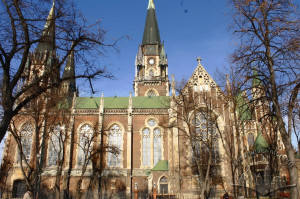
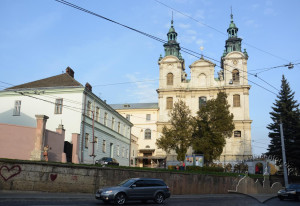
Her first major project consisted of figures for the main altar of St. Mary Magdalene Church in Lviv, which remain well-preserved and have been restored. Between 1931 and 1935, Janina Reichert also created sculptures for the Church of St. Elizabeth, as well as altars in Polanka near Krosno and in Tarnopol (now Ternopil).
Meanwhile, she worked on monument designs, notably one for Juliusz Słowacki, which was intended to be erected in front of the City Theater (a project ultimately never realized); one for Józef Piłsudski (reportedly to be placed on the site of the then-Second Gymnasium, now Lyceum No. 8); and one for Maria Konopnicka, as well as on monumental portraits, bas-reliefs, and medallions.
In 1930, the Lviv City Council allocated a studio to Janina free of charge at pl. Halicki, 10, on the first floor of the Biesiadeckich Palace, with a large window overlooking the marketplace. The studio in her family's townhouse on ul. Kurkowa had long since become too small for the scale of her work. That same year, Janina participated in a prestigious exhibition at Zachęta in Warsaw, and in 1932–33 created a large monument to the Fallen in Brzeżany (now Berezhany).
The year 1935 proved to be a defining moment in her career: her works were exhibited at the General International Exhibition in Brussels (Exposition Universelle et Internationale de Bruxelles). Among them was a bronze cast of The Aviator (now in the collection of the Lviv National Art Gallery), which was also featured in the exhibition catalog.
In 1936, Janina Reichert married Fryderyk Toth, an officer in the Austrian and Polish armies who later became a sculptor. After their marriage, she moved her studio to their new villa at ul. Odrowążów, 4 (now vul. Litnia, off Stryiska; after 1946, this studio was occupied by Yevhen Dzyndra).
In 1938, Reichert-Toth created the monumental figure Oracz (The Plowman) for the Maria Konopnicka monument in Stryisky Park, which was to be cast in bronze by Warsaw artisans by October 1939. However, due to the outbreak of World War II, the sculpture was never completed.
After 1939, together with her husband, Janina became a member of the Lviv branch of the Union of Soviet Artists of Ukraine. Fryderyk Toth even headed the sculpture section for some time. The couple participated in exhibitions, including the Art of Western Ukraine exhibition in Moscow in 1940–41, where Janina Reichert-Toth's Head of a Girl was acquired by the Museum of Western European Art. They also worked at the newly established ceramics and sculpture factory, creating sculptures for propaganda purposes, such as busts of Lenin, monuments to Pushkin and Taras Shevchenko, and various figures of athletes in the spirit of Socialist Realism.
During the German occupation, they were evicted from their home and part of their work was destroyed; nevertheless, the Toths remained in Lviv.
After the return of Soviet troops and authorities in 1944, they rejoined the art community and again tried to adapt to the new conditions, accepting state commissions and participating in union exhibitions.
In June 1946, Janina Reichert-Toth and Fryderyk Toth finally moved to Kraków, managing to take a significant portion of their artistic works and personal belongings with them from Lviv. They subsequently resumed their artistic work. One of their most significant commissions was the restoration of the Altar of the Assumption of the Blessed Virgin Mary (the Veit Stoss altar) in St. Mary's Church, which had been transported from Nuremberg to Kraków after the war. Janina also participated in the restoration of the Mickiewicz monument in Kraków's Main Square and later executed major commissions for churches in various towns — including Częstochowa — designed monuments, and worked on small-scale pieces. However, she never fully found her place in the Kraków art scene. After World War II, Janina Reichert-Toth did not return to monumental sculpture on the same scale as in prewar Lviv.
She died on March 7, 1986, in Kraków and is buried at the Salvator Cemetery.
Related buildings and spaces
-
Pl. Marka Kropyvnytskoho, 1 – The SS. Olha and Elizabeth (former St. Elizabeth) church
-
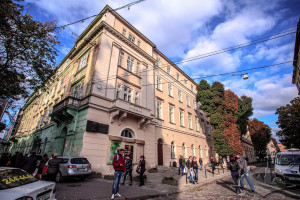
Vul. Lesi Ukrainky, 1 – Maria Zankovetska Theater (former Skarbek Theater)
-
Prosp. Svobody, 20 – Andrey Sheptytsky National Museum

-
Vul. Stepana Bandery, 8 – Organ Hall and St. Mary Magdalene Church
Sources
- Karolina Grodziska, Zapomniana rzeźbiarka. Janina Reichert-Toth (1895-1986) i jej twórczość (Kraków, 2009).
- Janina Reichert-Toth (1895-1985) Rzeźba/Sculpture, каталог виставки, Galeria Dyląg, 14 IV-14 V 2016.
- Колекція робіт Яніни Райхерт-Тот у Львівській національній галереї мистецтв ім. Б.Г. Возницького.