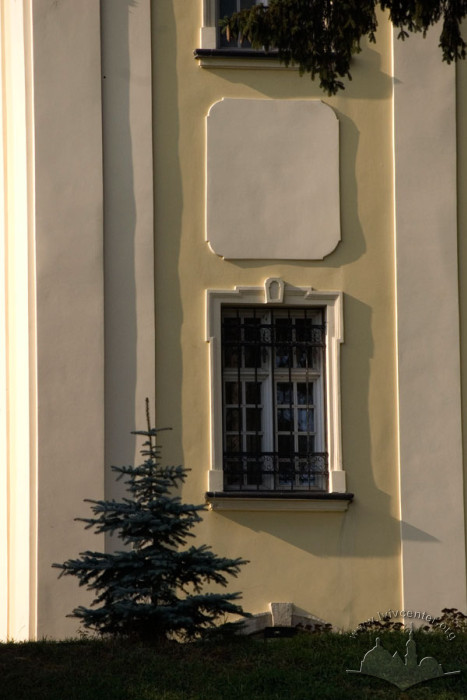
Pl. Sv. Yura, 5 – archbishop's residence ID: 409
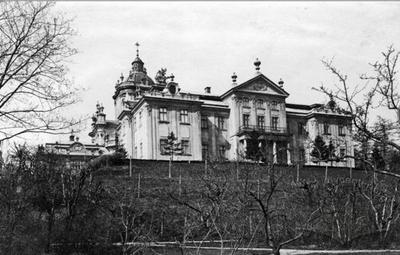
The residence (now of the UGCC archbishops) was built in 1761-1762 as part of the Baroque ensemble of the cathedral of St. George. It is not known for sure who its architect was (researchers mention Klemens Ksawery Fessinger, Pierre Ricaud de Tirregaille, Jan de Witte in this regard). The Baroque complex is complemented by Metropolitan gardens on the slopes of St. George’s Hill. It is an architectural monument of national significance (protection number 376) and a UNESCO World Heritage site.
Story
"Metropolitan Chambers" is the traditional name of the residence of bishops and metropolitans, today it is the palace of Greek Catholic archbishops. Built in 1761-1762, it is part of the St. George's Baroque ensemble. This building was erected on the site of a wooden residence built a hundred years earlier under bishop Yosyf Shumliansky (Aleksandrovych, Rychkov, 2008, 202).
The authorship question
It is not clear who the architect that designed the chambers was. In 1743, engineer Jan de Witte, who designed several buildings in Lviv, including the Dominican church, was commissioned by Bishop Atanasiy Sheptytsky to draw up a plan for the future St. George's complex, which included buildings for the Basilian monastery and the metropolitan chambers to be erected there after the construction of the cathedral (Voynylovets, Dilo, 1900, No. 102, 1). However, it was not de Witte who supervised this construction. Tadeusz Mańkowski, a Lviv art historian and Baroque researcher, considered Kantius Fessinger to be the author of the metropolitan chambers. The encyclopaedia Monuments of Urban Planning and Architecture (1983-1986) marks Klemens Ksawery Fessinger as the project architect. Historian Volodymyr Vuytsyk, studying archival documents in the late 20th century, was inclined to think that the design and construction of the metropolitan chambers was carried out by Pierre Ricaud de Tirregaille, while Fessinger rebuilt them later (Vuytsyk, 2003, 68).
Interior finishing works in the building were carried out in 1773-1776 under the direction of Franciszek Kulczycki. Sculptor Ivan Shchurovsky, artists Simeon Gradolewski and Stefan Ugnicki were involved in these works. In particular, it was then that fireplaces and stoves, as well as wall mirrors in decorative gilded frames were installed. The main hall was decorated with gold stucco and the coat of arms of the Sheptytsky family. Wooden panels covered with fabric were mounted on the walls. As a result of these works, the interior now had a distinctly Rococo-style appearance.
In 1885 the palace was restored according to a project designed by architect Sylwester Hawryszkiewicz, the interior of the palace being significantly changed and supplemented. A detailed list and description of the works, however, has not been preserved (Vuytsyk, 2012, 146).
In 1922, another restoration of the building took place, which was supervised by architect Lev Levynsky. A Ukrainian and Austrian art historian from Chernivtsi, Wladimir Zaloziecki, wrote an article dedicated to this event. He stressed that Levynsky had carried out a truly modern restoration. While restoring the metropolitan chambers in Lviv, he focused on clearing the inauthentic plastering of stone elements and carvings, as well as other elements added in the course of previous restorations, without adding new elements or other interventions that would adapt the old building to modern tastes. The timeworn balcony above the main entrance was repaired with the replacement of metal beams and parts of stone elements with similar ones. However, Zaloziecki also criticized some things, in particular, the fact that, under Levynsky's design, the building was plastered, which hid the patina of antiquity, as well as the addition of Classicist-style triglyphs, which contradicted the building’s original style. In general, however, he praised this restoration, which was done in the spirit of the concepts of Alois Riegl, the author of the famous work Moderne Denkmalkultus. One of the world's leading theorists of restoration, Riegl was also the main conservator of architectural monuments in the Imperial and Royal Central Commission for the Study and Care for Art and History Monuments in Vienna in the early years of the 20th century (Zaloziecki, 1923).
Wladimir Zaloziecki, interested in establishing the authorship of the building and its original appearance, carefully analyzed the building’s shape and style, as well as eight archival drawings of the metropolitan chambers and gardens from the collection of the National Museum in Lviv. He considered the style of the metropolitan residence to be the most beautiful example of late 18th-century architecture in the city and noted that it had more "light French" elements than "massive Roman" ones, the fact denying the possibility of the architect of the Dominican Church in Lviv Jan de Witte’s authorship (Zaloziecki, 1923).
Palace in the 20th century
During World War II and the Holocaust events, the metropolitan chambers were one of the places of refuge for Jewish children (the Church and the Holocaust, the story of David Kahane) thanks to Metropolitan Andrey Sheptytsky. After his death in 1944, the building began to fall in decay, and as a result of the decision of the pseudo-council in 1946, the entire St. George's ensemble was transferred to the ROC. It was only in 1990 that the cathedral of St. George was restituted to the UGCC. The metropolitan chambers were handed over to the UDCC Archcathedral Administration by order of the representative of the President of Ukraine in the Lviv region on April 7, 1992.
In 2001, the palace underwent restoration works along with some adaptations. Since then, the configuration of the roof has been changed, a lift has been installed, a boiler room has been completed and steam heating has been arranged, utilities have been replaced, and so on. The works were carried out by a team of scientists and architects of the Lviv Ukrzakhidproektrestavratsiya Institute, headed by Mykola Hayda. In late June 2001, Pope John Paul II stayed at the palace during his visit to Ukraine.
Until 2005, there was the residence of the Greek Catholic Church patriarchs in the palace. After the relocation of the patriarchal see from Lviv to Kyiv, the metropolitan chambers became the residence of the archbishops. Today (2021) the Greek Catholic Archbishop of Lviv, Metropolitan Ihor (Vozniak) lives there.
Baroque gardens
The area around the church of St. George had long been covered with woods stretching to the banks of the river Poltva (Gruneweg, A Description of the City of Lviv). Later, in the eastern part of the complex there were metropolitan vegetable gardens cultivated for the needs of the clergy. In the 17th century, there was also an arsenal and a cannon there, mentioned by Bishop Yosyf Shumliansky in his spiritual testament (Vuytsyk, 2012, 156). In the manuscripts of historian Yosyp Hronsky a description of the territory of the St. George's Hill as of the early 18th century can be found: "…Behind the chamber, there was the upper garden. At the end, there was a neat courtyard [garden]. Further, simple houses are described throughout the territory, a building where later there was a hospital for bishop's soldiers. Many houses were dismantled by monks. In the place of the monastery, there was a small wooden church. … Where once there was a hospital, the monks arranged their filwark. On the slope, there were "the bishop’s winter rooms.” Next to them, there was a small chapel [...] On the hill, there was a prison for the clergy..." (ЛННБ 214/42:6).
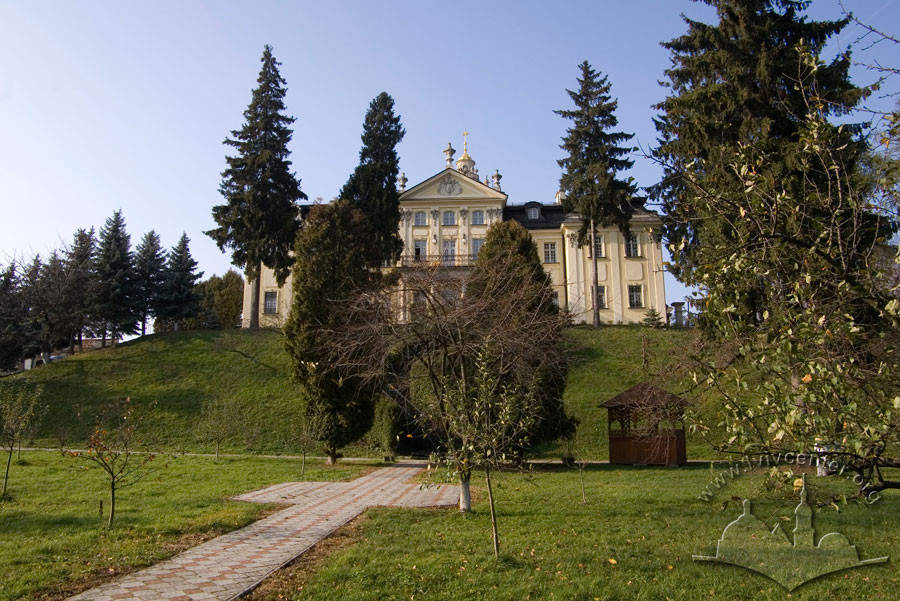
After the construction of the Baroque cathedral and metropolitan chambers, the northern and eastern slopes of the hill were divided by retaining walls into three terraces and integrated into the architectural ensemble. The garden was planned on a regular basis along the "cathedral — axis — park" compositional axis.
Of the three terraces, two are more public. The upper "Baroque" one and the lower fruit one are located on the east side of the palace and go down to the modern vul. Lystopadovoho Chynu. They are separated by a brick blind arcade fence, with, in the center, a gazebo grotto, open towards the palace (Aleksandrovych, 2008, 123). The third terrace is private, located below on the northern slope (from the side of vul. Zamknena and vul. Horodotska). The territory of the "Baroque" garden’s northern part formed a kind of enclosed space in the walls, which is connected by a staircase with the territory of the garden’s eastern part.
According to one version, it was the Belvederes of the Vatican and Vienna that served as models for the metropolitan gardens in Lviv (Kryvoruchko, 2013, 220); the similarities with them can be traced in the 1771 plan made by Klemens Fessinger from nature (Aleksandrovych, 2008, 104). The plan shows a regular parterre garden consisting of eight squares filled with patterned compositions arranged in two rows with round elements in the middle. The parterre itself, according to the plan, was to be enclosed on three sides by the so-called bypass alley, covered with arched trellises to maintain the winding greenery. This idea has not been fully implemented. Nevertheless, a regular park with three terraces existed at the episcopal chambers until the 19th century (Vuytsyk, 2012, 146).
In 1857 the metropolitan park was redesigned in the English style. Since that time, the main axes and retaining walls have been preserved. After 1864, the eastern lower terrace of the park was leased (ЦДІАЛ 491/1/705:11). In the early 20th century, on the initiative of Metropolitan Andrey Sheptytsky, fruit trees were planted there, thus turning the park into an orchard. In 1932, on the side of the modern vul. Lystopadovoho Chynu, Ivan Levynsky's company designed the fence, but it was finally built in 1933 under another project. In this form, it has survived to this day.
In the 1940s, an area of about 2 hectares was separated in the eastern part of the orchard, where three Mayak radio station retransmitters were installed in order to jam foreign broadcasts. Two of them were demolished in the early 2000s, the third one following in 2016. This part of the ancient gardens was finally restituted to the church in 2020. The Lviv Archeparchy of the UGCC plans to plant an orchard there.
Since 2015, the Spiritual Revival Foundation (headed by Fr. Taras Mylian) has undertaken the restoration of the metropolitan gardens. The forged coat of arms of the Lviv Archeparchy with the image of St. George was completed on August 24, 2016, at the expense of proceeds from charitable events, on the eastern slope adjacent to the Metropolitan Palace. Later, the foundation landscaped the upper "Baroque" garden; it also organizes an annual cleaning of the orchard.
Architecture
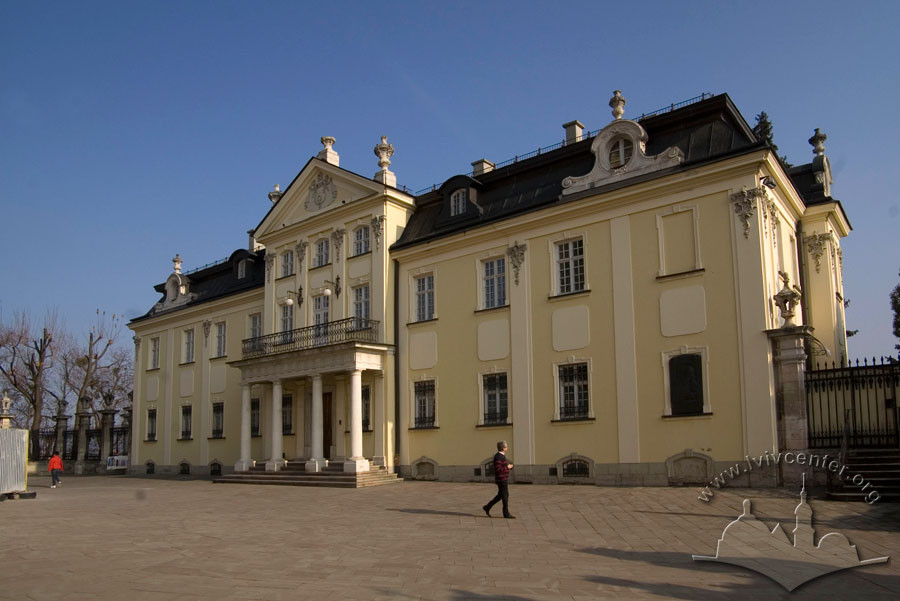
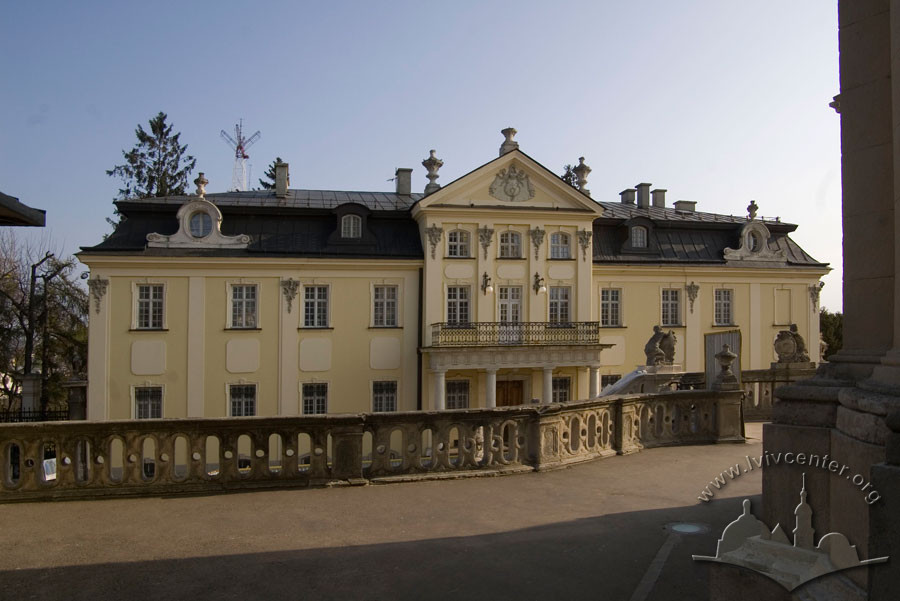
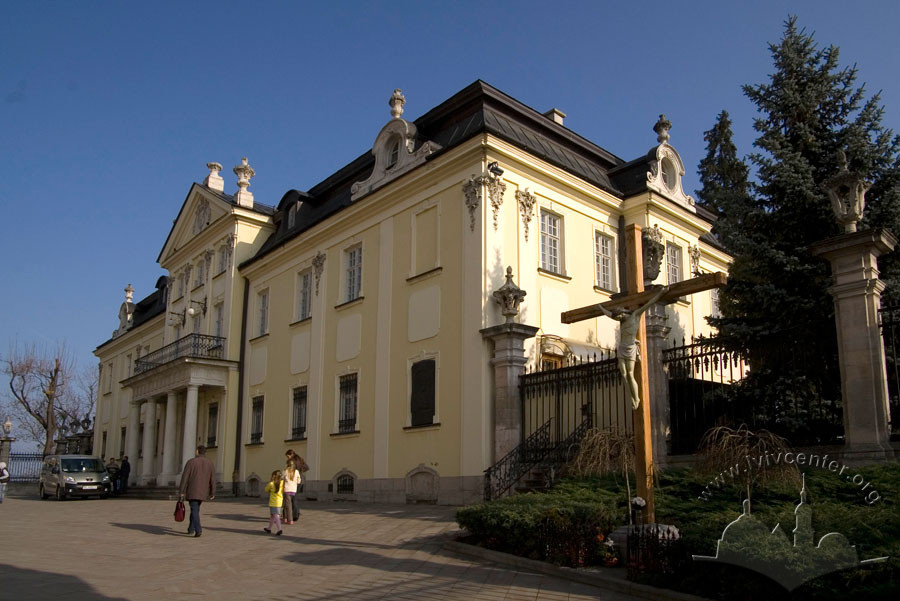
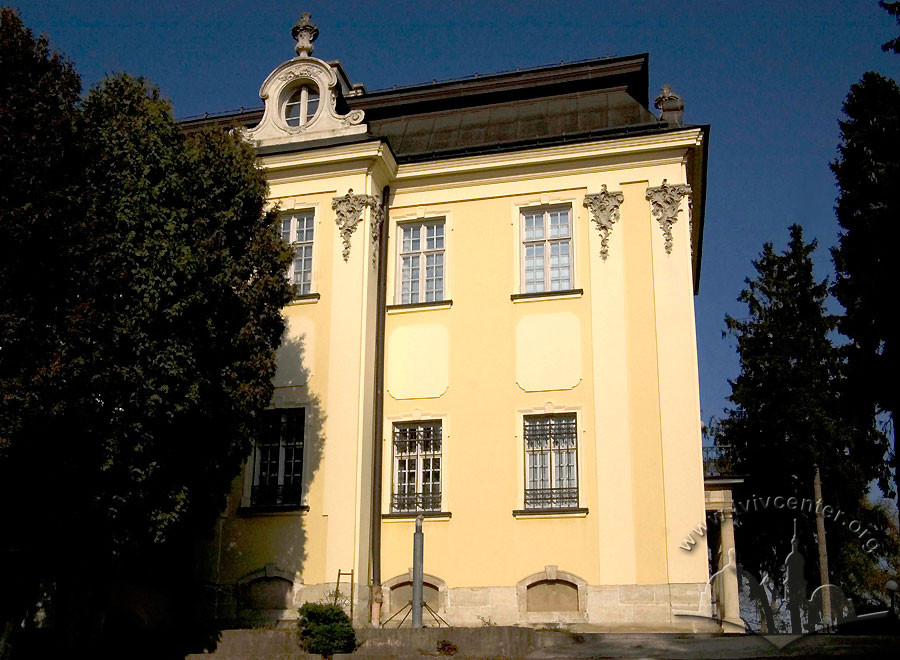
The metropolitan chamber is a brick two-storey plastered building with a quadrangular roof; it is rectangular in plan and elongated from north to south.
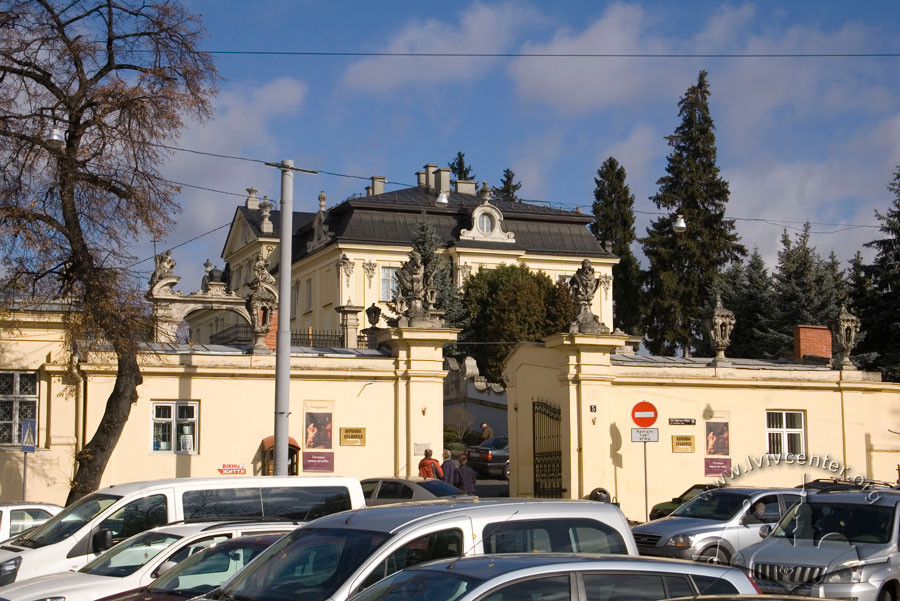
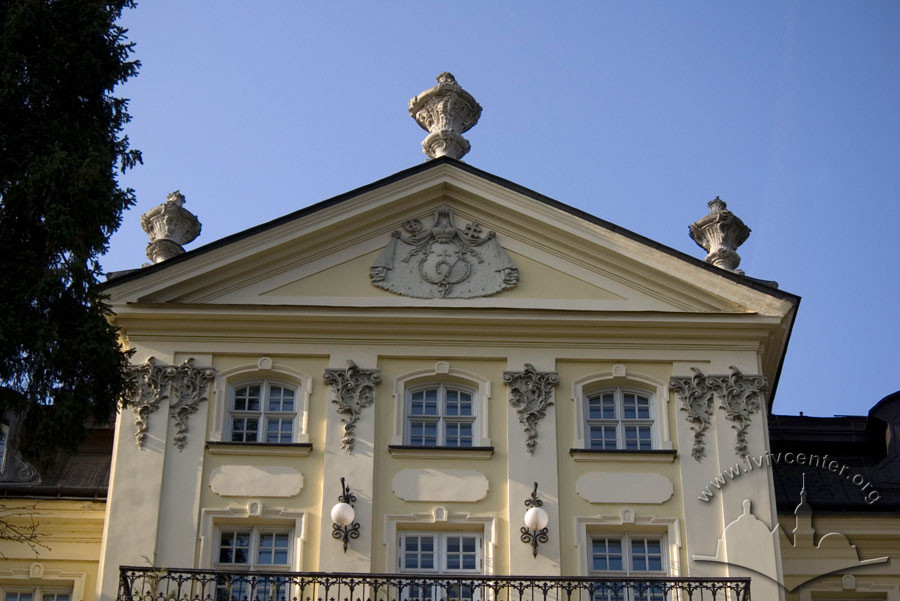
The main entrance leading to the metropolitan residence from the cathedral square is accentuated by a four-columned portico, above which there is a spacious balcony. The main axis of the western palace façade, facing the cathedral, is emphasized by an avant-corps, which turns into a mezzanine at the level of the third tier and is topped with a triangular pediment. A more developed division of the façade can be seen on the eastern side, where the exit to the upper terrace of the metropolitan garden is located.
The building’s façades have avant-corpses; the eastern and western avant-corpses are topped with gables. The eastern avant-corps is flanked with a portico, and a coat of arms is placed in the pediment’s tympanum. The side avant-corpses are decorated with pilasters and stucco. Stone vases are placed on the edges of the pediment.
On the main façade’s south side, there is a memorial plaque with a portrait of Metropolitan Andrey Sheptytsky and an inscription reading: "The spiritual leader of the nation, Servant of God Metropolitan Andrey Sheptytsky lived and served God and Ukraine in these chambers in 1901-1944." Above the image the coat of arms of the Sheptytsky family can be seen.
Interior premises are arranged in an enfilade. Stucco and wall paintings by artists Simeon Gradolewski and Stefan Ugnicki have been preserved in the interior.
In the Baroque garden, on the central axis of the cathedral and palace, there is a gazebo in the shape of a grotto made by Ksawery Fessinger. The gazebo is covered with a conch vault having a B aroque segmented pediment flanked by decorative vases. On both sides of the gazebo, there is a brick fence in the shape of a blind arcade.
Related buildings and spaces
-
Pl. Sv. Yura, 5 – St. Yuriy (St. George) Cathedral
-
Pl. Sv. Yura, 5 – the Curia building
People
Sources
- Львівська національна наукова бібліотека ім. Василя Стефаника, 214/42:6.
- Центральний державний історичний архів України у Львові (ЦДІАЛ) 491/1/705:11.
- Алла Мартинюк, "Бастіонні фортифікації в ансамблі церкви Святого Юра у Львові", Записки НТШ Т.ССХLI, (Львів: НТШ, 2001), 524-535.
- Віктор Войналович, "Що насправді коїлося к патріарших палатах", Маловідомі документи про опозиційний рух у Руській Православній Церкві, 1994.
- Володимир Александрович, Павло Ричков, Собор святого Юра у Львові, (Київ: Техніка, 2008), 232.
- Володимир Вуйцик, "Митрополит Атаназій і Лев Шептицькі та їх внесок у мистецьку культуру України", Київ. Церква, 2001, 253-256.
- Володимир Вуйцик, "Львівські барокові палаци. Палац Більських", Вісник інституту Укрзахідпроектреставрація, 2003, №13, 68.
- Володимир Вуйцик, Leopolitana, (Львів: ВНТЛ-Класика, 2012), 136-178.
- Володимир Залозецький, "Реставрація та стиль митрополичої палати при катедрі св. Юра у Львові", Літературно-науковий вісник, Т. 131, (Львів, 1923), 365-372.
- Мартін Ґруневеґ, Опис міста Львова (близько 1601-1608 рр.)
- "Митрополичі сади біля Собору св. Юра буде відновлено", Твоє місто
- Наталія Лукомська, "Сад ансамблю церкви св. Юра у Львові", Наукові зошити кафедри реставрації та реконструкції архітектурних комплексів, 1993, № 1, 51-68.
- Памятники градосторительства и архитектуры Украинской ССР, Т. 3, (Київ: Будівельник, 1983 –1986), 94.
- Юрій Криворучко, Галина Петришин, "Концепція Архітектурно-планувальної організація ландшафтно-історичного комплексу на Святоюрській горі у Львові", Вісник Національного університету "Львівська політехніка", 2013, №757, 220-230.
Citation
Andrii Husak, "Pl. Sv. Yura, 5 – archbishop's residence", Transl. by Andriy Masliukh, Lviv Interactive, (Center for Urban History, 2018). URL: https://lia.lvivcenter.org/uk/objects/sv-yura-palace/