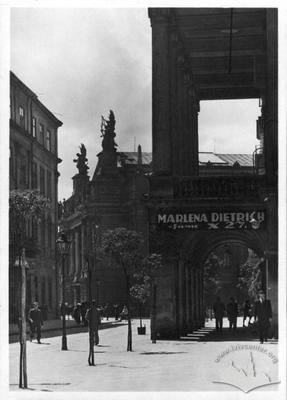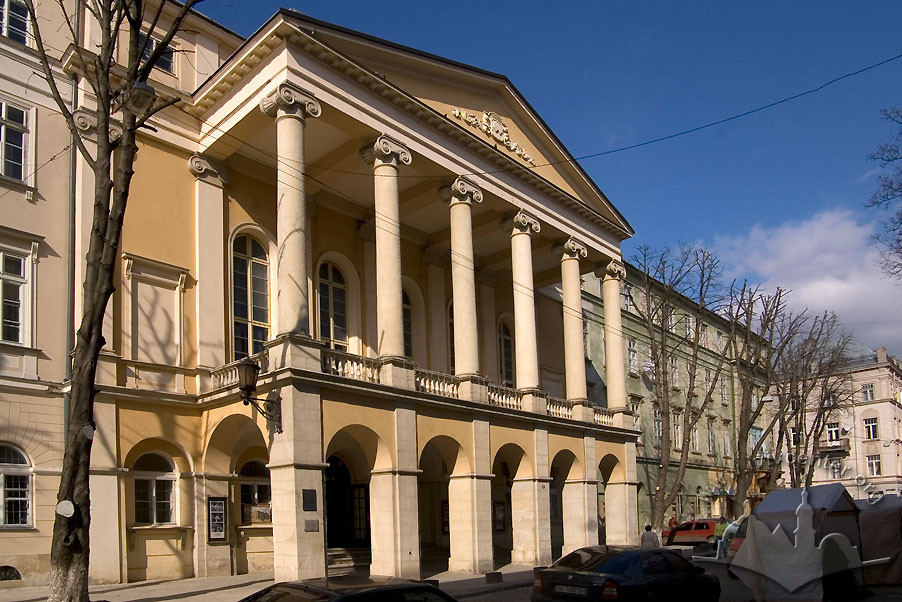
Vul. Lesi Ukrainky, 1 – cinema (no longer in operation) ID: 1624
In 1897, prior to theatrical performances, films were screened inside the theater building located at what is now vul. Lesi Ukrainky 1. In 1908, the building became home to a philharmonic society and one of Lviv's first permanent cinemas, Oeser's Electric Theater (Pol. Teatr elektryczny Oesera). The cinema operated here until 1939 under various names: Excelsior-Urania (1908–1911), Helios (1911), Lew (1913–1931), and Atlantik (1931–1939). Today, the building houses the Maria Zankovetska National Academic Ukrainian Drama Theater.
Story
From January 9 to January 20, 1897, visitors to the former Skarbek Theater were invited to watch films screened using a Lumière brothers' cinematograph apparatus before the start of theater performances. This marked the second public projection-based film screening in Lviv, following the sessions held at the Hausman Passage in 1896.
In 1900, the municipal theater relocated to a building on pl. Gołuchowskich, and a philharmonic society was established in the vacated property. Records show that at the end of 1906, The Royal Vio, a French cinematographic society, was established in Lviv, and by 1907, film screenings were being hosted inside the philharmonic building.
"Oeser's Electric Theater", 1908
In 1908, the cinema known as Oeser's Electric Theater, owned by Franciszek Józef Oeser, relocated to the philharmonic building. However, the cinema ceased operations that same year when its owner moved to Prague.
"Excelsior-Urania", 1908–1911
In 1908, the cinema operated by the Lviv branch of the Vienna educational society Excelsior-Urania, managed by Herman Opat, moved to this location from the Mikolasch Passage. Beginning on April 4, 1908, screenings took place three times a week (Saturdays, Sundays, and Wednesdays), with two sessions per day (at 4:00 p.m. and 8:00 p.m.). Attendance and revenues for this cinema were quite high. For instance, on Sunday, March 22, 1908, ticket sales brought in 885 crowns and 40 hellers (914 tickets); on Tuesday, March 24, it generated 223 crowns and 10 hellers (386 tickets); on Wednesday, March 25, — 665 crowns and 50 hellers (692 tickets); on Sunday, March 29, — 1,058 crowns and 80 hellers (1,028 tickets); on Wednesday, April 1, — 289 crowns and 95 hellers (523 tickets); on Saturday, April 4, — 508 crowns and 10 hellers (880 tickets); and on Sunday, April 5, — 947 crowns and 20 hellers (1,138 tickets).
In addition to regular film screenings, the venue organized themed evenings featuring lectures and movies. In early April 1908, several such evenings were held at the Excelsior-Urania cinema. On April 4, Professor Byger delivered a lecture titled "On Kościuszko's Times", and on April 5, a commemoration of the anniversary of the Battle of Racławice took place. Ticket prices were reduced for the occasion. Franciszek Ptak, a "representative of the Kraków lands" to the Galician Regional Sejm, delivered a speech; Teofil Lenartowicz's poem "The Battle of Racławice" (Pol. Bitwa Racławicka) was recited; and a choir performed patriotic songs. This was followed by a lecture from Edmund Libański entitled "Wonders of Modern Technology" (Pol. Z cudów współczesnej techniki), after which the film screening finally began. Engineer Edmund Libański's lectures covered a wide range of topics. For example, on April 8, 1908, prior to the film screening at the Urania, he gave a presentation on "The Evolution of the Navy" (Pol. Rozwój marynarki wojennej). Generally, the first Saturday session of each week (at 4:00 p.m.) at the Urania was reserved for school students, featuring a specially curated program and discounted ticket prices.
"Helios", 1911–1913
The Excelsior-Urania cinema was later renamed Helios. It was owned by Herman Opat in partnership with a company consisting of Józef Jaskólski and engineer Edmund Libański. In 1913, the Helios cinema was relocated to vul. Horodotska.
"Lew", 1913–1931
In 1913, the Lew cinema began operating inside the philharmonic building, continuing under this name until 1931. Between 1913 and 1916, the cinema was owned by Ludwik Kuchar, and from 1916 onward, it was managed by the Polish Golden Cross Society. At the time, it was effectively the finest and most expensive cinema in Lviv. In December 1913, ticket prices ranged from 20 hellers to 10 crowns (for a grand box). For comparison, opera tickets at the municipal theater ranged from 80 hellers to 26 crowns, while tickets for comedy dramas cost between 50 hellers and 18 crowns.
"Atlantik", 1931–1939
From 1931 to 1939, the cinema inside the philharmonic premises operated under a new name, Atlantik — a popular name for sound-equipped cinemas across Europe at the time. The owners of this theater were Tadeusz and Władysław Kuchar, the brothers Adolf and Markus Gerne, and Joachim Schall. In October 1930, the cinema began showing sound films, making it the fourth sound cinema in Lviv. In August 1933, the cinema underwent renovations. A 1939 report by the Lviv Starostwo noted that the Atlantik was a moderately successful cinema.
Related buildings and spaces
-
Vul. Lesi Ukrainky, 1 – Maria Zankovetska Theater (former Skarbek Theater)
-
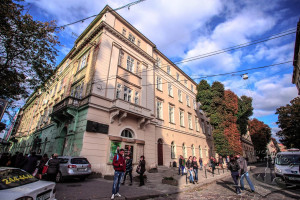
Vul. Volodymyra Antonovycha, 80 – residential building
People
Byger –– professor.
Adolf Gerne –– co-owner of the cinema.
Markus Gerne –– co-owner of the cinema.
Józef Jaskólski –– partner in the ownership group.
Władysław Kuchar (August 10, 1895 – December 4, 1983) –– athlete. Son of Ludwik Kuchar and younger brother of Tadeusz Kuchar. He graduated from the Lviv Polytechnic with a degree in architecture. Additionally, he became a co-owner of the Atlantik cinema in 1931.
Ludwik Kuchar –– co-owner of the cinema.
Tadeusz Kuchar (April 13, 1891 – April 5, 1966) –– eldest son of the Galician cinema magnate Ludwik Kuchar, athlete. In 1909, he graduated from Lviv Polytechnic as an engineer. From 1926, he owned the Kopernik cinema, and from 1931, he was a co-owner of the Atlantik cinema.
Edmund Libański (Mondschein) (1862–1928) –– graduate of Lviv Polytechnic, he worked as an assistant at the Department of Bridge Construction from 1893 to 1895. In 1897, he delivered a series of lectures on aviation topics and was a member of the Lviv Polytechnic Society. Between 1905 and 1907, he ran his own technical bureau in Lviv, Mielec, Drohobych, and then again in Lviv at vul. Zelena 5c. From 1908 to 1910, he headed the technical department of the Parcelation Bank in Lviv, and from 1911 to 1914, he worked in his professional capacity at the Regional Department. In addition to his primary professional work, he voluntarily engaged in educational outreach to popularize technical knowledge. He showcased the latest technical advancements in aviation, photography, and cinematography, and spoke on the future development of technology. From 1908, he was a co-owner of one of Lviv's first cinemas, Urania, which was then the largest in the city and located in the hall of the Philharmonic Society (the former Skarbek Theater). Before the start of each session, he gave introductory lectures explaining the mechanics of cinematography. He also used films for educational purposes. He co-founded the Kopernik Lviv Photographic Society (1909).
Herman Opat –– partner in the ownership group.
Franciszek Ptak –– representative to the Galician Regional Sejm.
Joachim Schall –– co-owner of the cinema.
Sources
- Kurjer Lwowski, 1926, №13.
- Przewodnik po Lwowie (Lwów: Reklama Lwowska, 1936).
- Słowo Polskie, 1923, №1.
- Słowo Polskie, 1923, №118.
- Słowo Polskie, 1923, №138.
- Słowo Polskie, 1923, №153.
- Taschenjahrbuch 1943: Für den deutschen Generalgouvernement (Krakau: ZKW Druck, 1943).
- Державний архів Львівської області (ДАЛО) 1/56/158.
- ДАЛО 3/1.5405.
- ДАЛО 3/1/5177.
- ДАЛО7/3/638.
- Центральний державний архів у м. Львові (ЦДІАЛ) 190/1/13.
- Barbara Gierszewska, Kino ifilmwe Lwowie do 1939 roku (Kielce: Wydawnictwo Akademii Świętokrzyskiej, 2006), 428.
- Dawna fotografia lwowska 1839–1939 (Lwów: Centrum Europy, 2004), 368.
- Б. В. Мельник, Довідник перейменувань вулиць і площ Львова. ХІІІ–ХХ століття (Львів: Світ, 2001).
- В. Проскуряков, Ю. Ямаш, Львівські театри: час і архітектура (Львів: Видавництво “Центр Європи”, 1997).
- Іван Яремко, Кухарі, Енциклопедія Львова, Т. 3 (Львів: Літопис¸ 2010), 714.