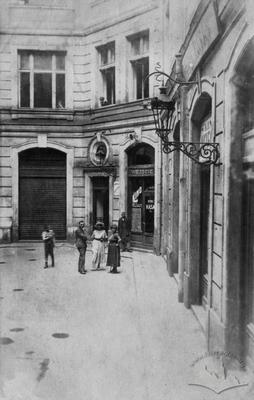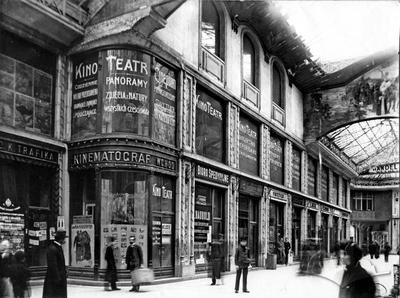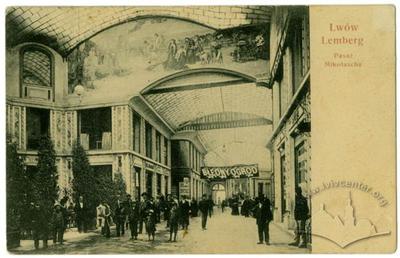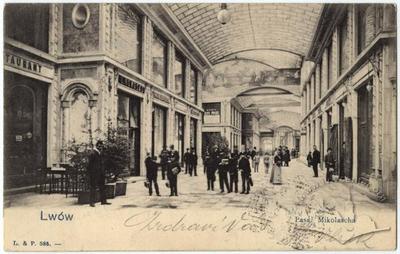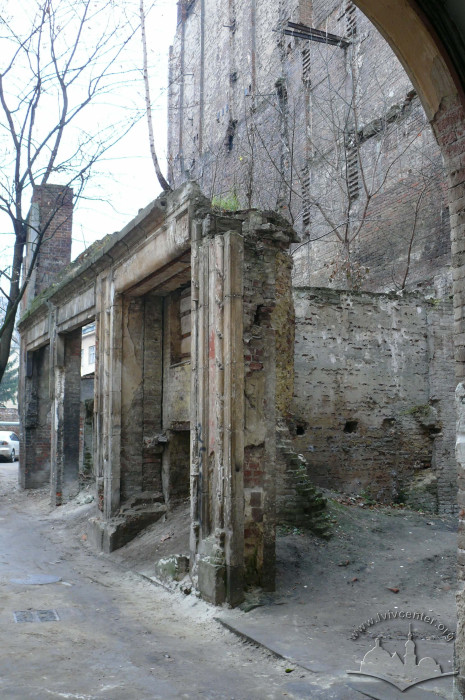
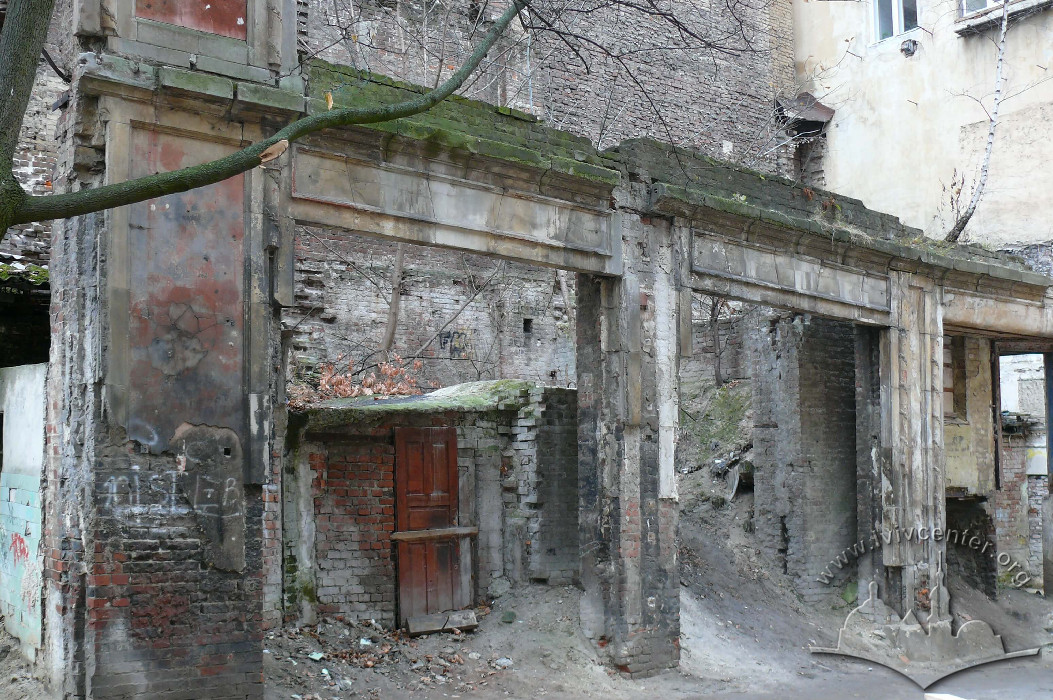
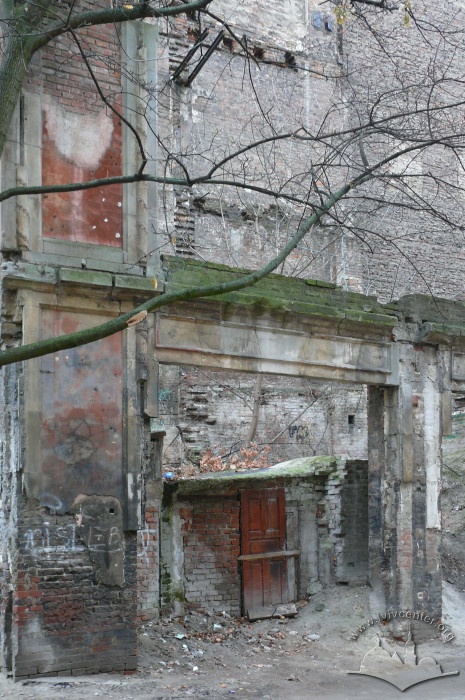
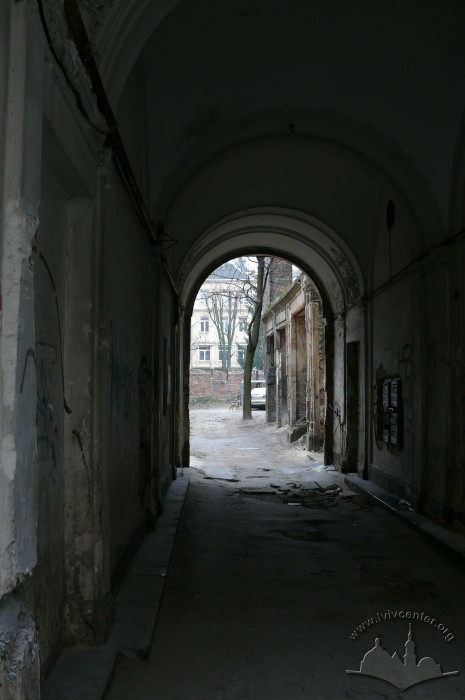
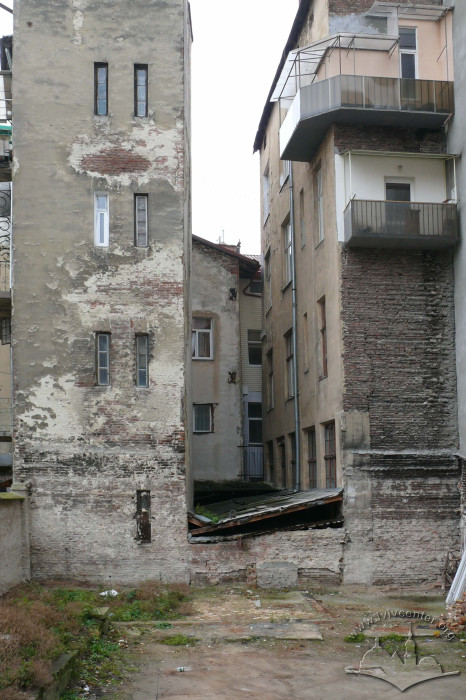
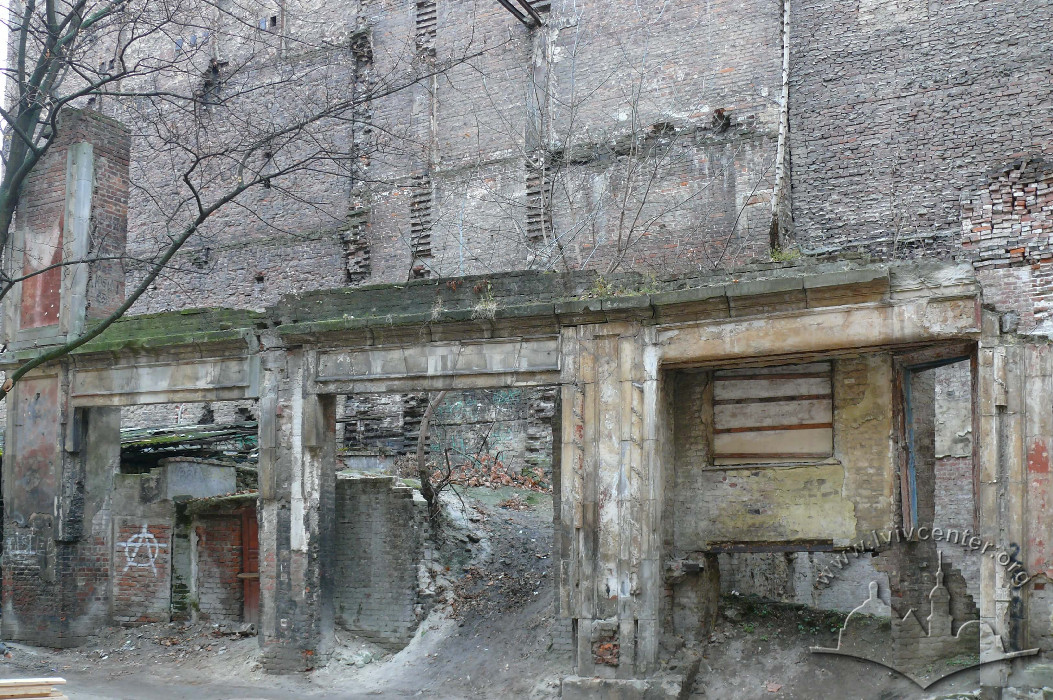
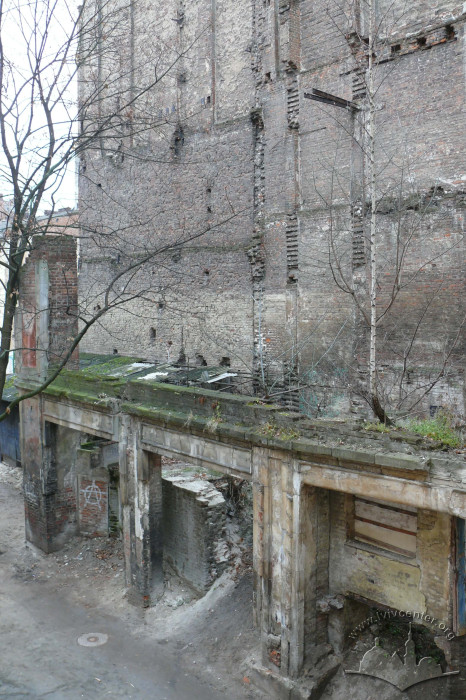
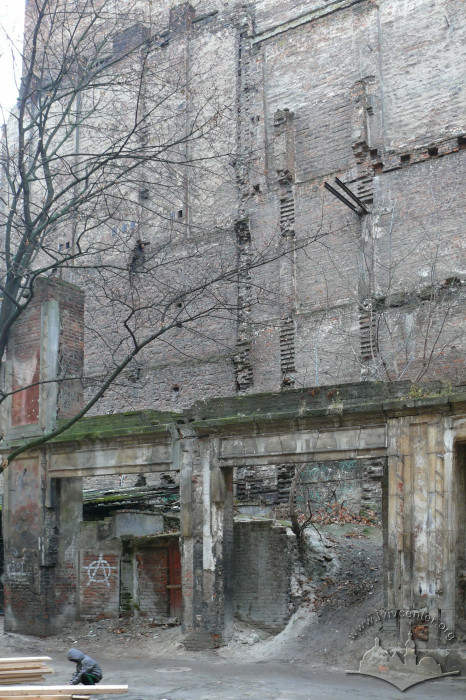
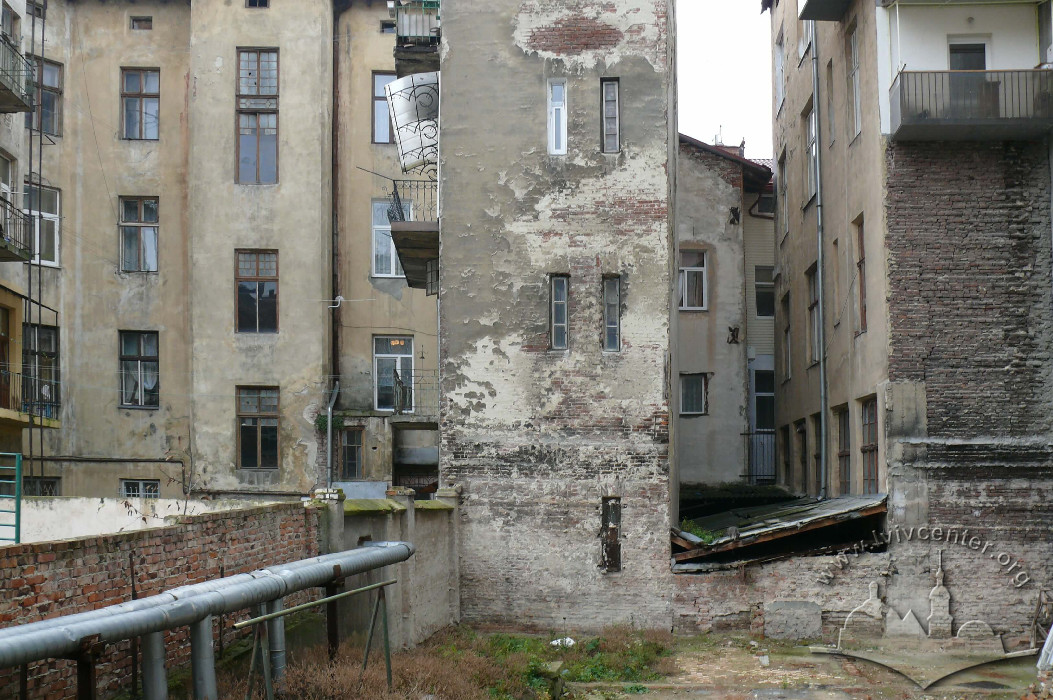
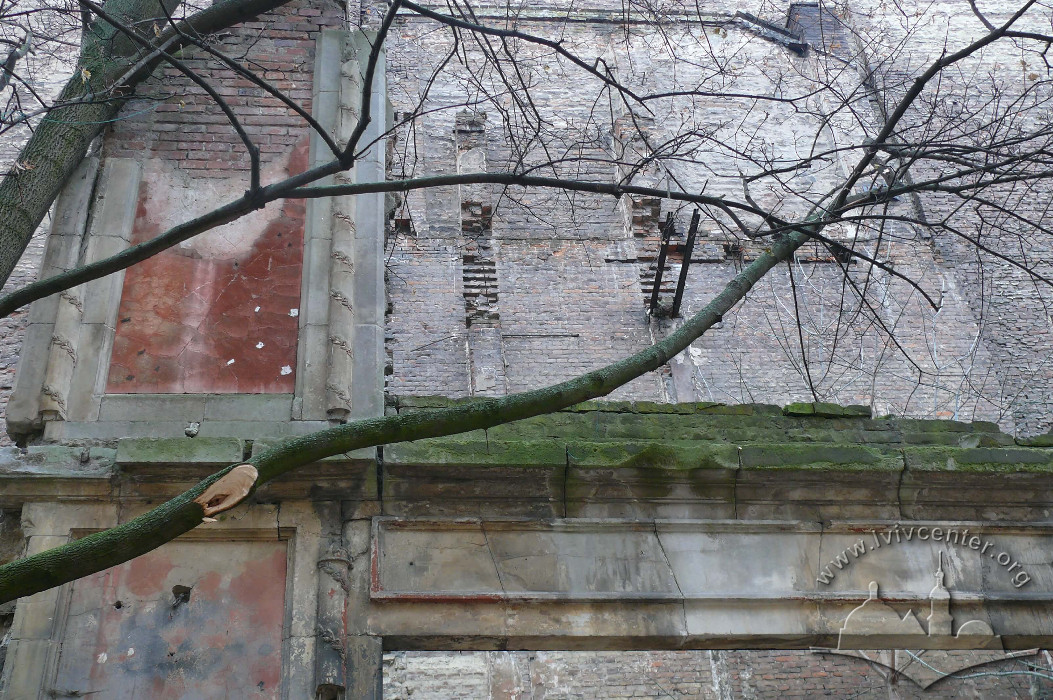
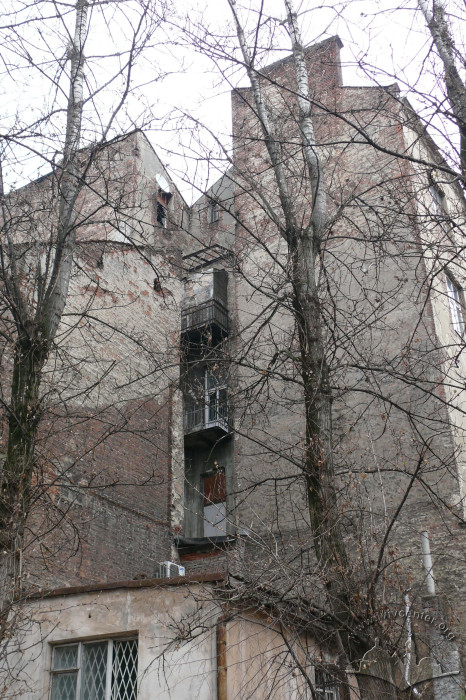
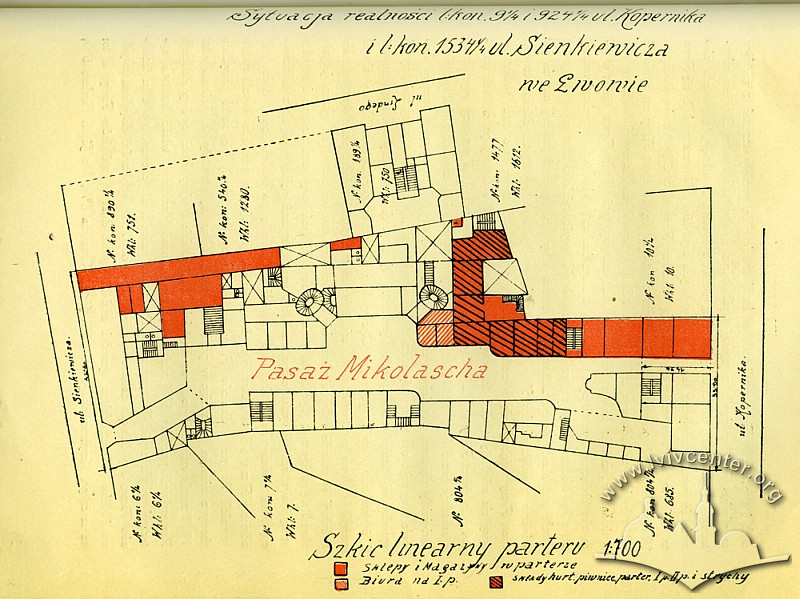
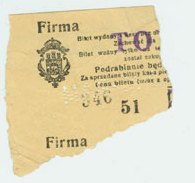
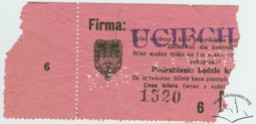
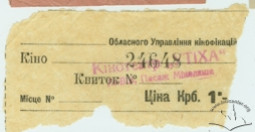
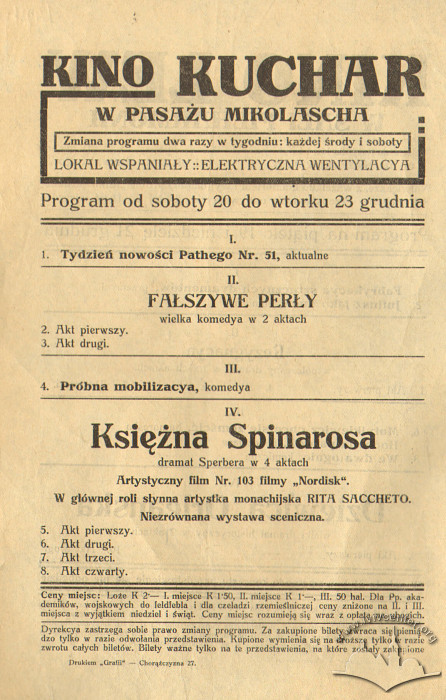
Vul. Mykoly Kopernyka, 1 – cinema in the Mikolasch passage (no longer exists) ID: 1705
A cinema operated in the Mikolasch Passage at the beginning of vul. Kopernyka under a succession of names and owners: "Urania" (1901–1907), "Cinephon" (1907–1911), "Kuchar" (1911–1915), "Pasaż" (1915–1935), and "Ton" (1935–1939). The "Lux" cinema operated nearby (1912–1924). Later, a new cinema named "Uciecha" (1926–1941) was opened in its place. On June 22, 1941, the Mikolasch Passage was destroyed by a German aerial bomb.
Story
In 1901–1907, the "Urania" cinema, which belonged to the Viennese cinematography network of the same name, operated in the Mikolasch Passage. Its owner was Herman Opat, who had previously owned a traveling cinema booth. For a certain period, it was the only permanent cinema in the city of Lviv.
An important place in the film screenings was occupied by scientific and educational films, which were often preceded by lectures on relevant topics. In 1908, this cinema was moved to a better premises, into the philharmonic hall (now the Mariia Zankovetska National Academic Ukrainian Drama Theater, vul. Lesi Ukrainky 1).
The first film screenings in the cinema located in the Mikolasch Passage are mentioned by Jan Parandowski in his autobiographical novel "The Sky is Aflame" (Pol. Niebo w płomieniach, 1934–1936): "Vivid, flickering pictures reproduced episodes of the Russo-Japanese War — 'The Khunkhuz Attack on a Train' — and the people in the cinema hall, who, like all of Lviv, sympathized with Japan, shouted 'Banzai!' at the end of the session".
"Cinephon", 1907–1911
In 1907, the "Cinephon" cinema, which had previously operated in the building at ul. Szajnochy 5 (now vul. Bankivska 5, was moved to the Mikolasch Passage. "Cinephon" was founded in 1906. The owner of this cinema, like "Urania", was Herman Opat.
"Kuchar", 1911–1915
In 1911, the owner of the "Cinephon" cinema became Ludwik Kuchar, who was an active Lviv cinema entrepreneur as well as the administrative director of the firm "Piotr Mikolasch & Spółka". He renamed the cinema "Kuchar".
The Kuchar family settled in Lviv in 1898. Ludwik was at one time the owner of several cinemas, and his children — well-known athletes — were members of the "Pogoń" sports society, the activities of which were actively financed by their father (obviously, this was enabled by his income generated from the cinemas). Ludwik Kuchar was a good manager and knew how to interest the audience. Frequently, during sessions in his cinemas, advertising flyers with the film program for the following days were distributed.
The auditorium of this cinema was quite comfortable, and electric ventilation operated here. The film repertoire changed every Wednesday and Saturday. The ticket price, as of December 1913, was from 50 hellers to 2 crowns. In addition to foreign films, locally produced films were also demonstrated in the cinema. Thus, on March 23, 1912, the premiere of the film "The Great Fire at the Oil Refinery in Drohobych", filmed in March of the same year by the Lviv studio "Kinofilm", took place in this cinema.
"Lux", 1912–1924
In 1912, Ludwik Kuchar founded another cinema in the Mikolasch Passage — "Lux", which operated simultaneously with the "Kuchar" cinema. From 1913, its owner became engineer Kazimierz Kropiowski.
On November 12, 1912, a fire occurred in the "Lux" cinema; however, there were no casualties.
During the years of the First World War, the "Lux" donated a portion of its profits to military needs. In November–December 1918, when battles for Lviv took place between Ukrainians and Poles, screenings were not held for a certain period.
On February 25, 1924, the "Lux" cinema was closed due to violations of cinematography regulations.
"Pasaż", 1915–1935
The "Kuchar" cinema changed its name to "Pasaż" in 1915, which indicated its location. The owner of this cinema continued to be Ludwik Kuchar. During the years of the First World War, this cinema donated a portion of its profits to military needs. In November–December 1918, when the Ukrainian-Polish battles for Lviv began, screenings did not take place for a certain period in "Pasaż", as in the rest of the cinemas in Lviv.
"Pasaż" was one of the most popular retirement-era cinemas of interwar Lviv. However, in April 1923, complaints were lodged against this cinema by members of the Piotr Skarga Society, which was engaged in the popularization of Polish literature in a Catholic spirit (they were located at vul. Teatralna 3). The reason was that children were admitted here to films that were banned by censorship for viewing by youth under 16 years of age. Complaints were also received by the city police regarding this cinema because tickets were repeatedly sold in excess of the available seats (specifically, in March 1927 and December 1928).
On March 3, 1932, a fire occurred in the cinema, the cause of which was the neglect of fire safety measures. The flames broke out when none of the visitors were present yet. The cinema suffered damages amounting to 25,000 zł. Following this, "Pasaż" underwent reconstruction until April 30 of the same year.
Entertainment films predominated in the repertoire, but there were also crime films. It was precisely because of this that one of the journalists of Kurjer Lwowski in March 1926 called "Pasaż" a university with three faculties: thievery, butchery, and banditry.
"Ton", 1935–1939
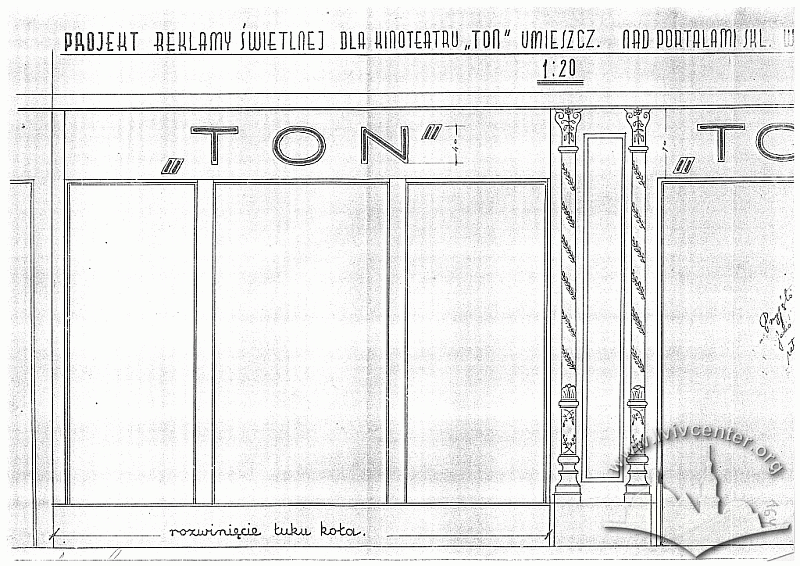
In 1935, "Pasaż" changed its name to "Ton" (obviously due to the transition to the screening of sound films). The owners of the "Ton" cinema were: Maurycy Gimpel, Izydor Merkel, and Czesław Dobrzeński. In the register of cinemas for 1939, it is noted that "Ton" was a successful cinema. The repertoire of the cinema was sufficiently diverse, but entertainment films predominated.
"Uciecha", 1926–1941
The "Uciecha" cinema was opened on the site of the "Lux" cinema, which had been closed in 1924. The first owner of "Uciecha" was Henryk Scheer, and from the early 1930s until 1939, the cinema was under the co-ownership of Maurycy Gimpel, Izydor Merkel, and Czesław Dobrzeński. The auditorium had 288 seats. The cinema enjoyed considerable popularity. In particular, Ukrainian workers of the city of Lviv liked to go there.
The cinema existed until June 22, 1941, when the Mikolasch Passage was destroyed by a German aerial bomb.
Architecture
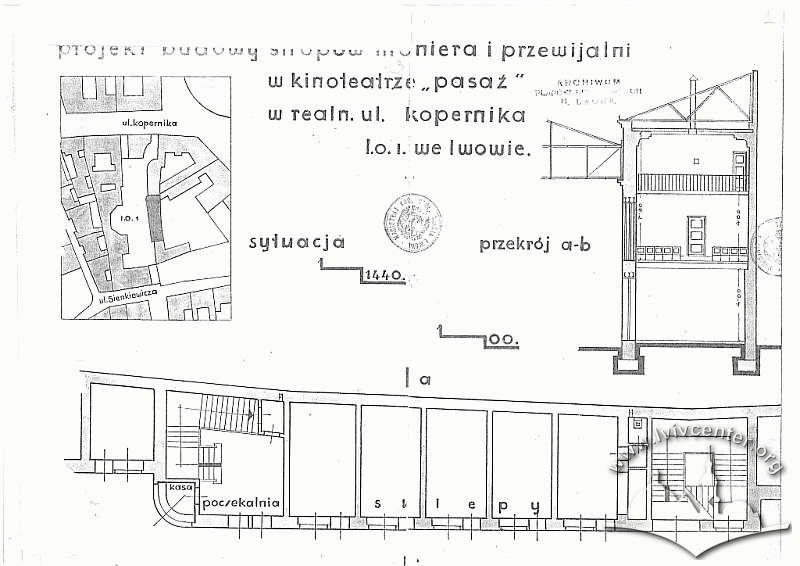
The cinema was located in one of the pavilions of the Mikolasch Passage, constructed according to the design of Ivan Levynskyi's firm in 1901. The pavilion was a three-tiered structure, built of brick and reinforced concrete, with I-beams used for the floor and ceiling structures. The façade decor was made of stone veneer from Ivan Levynskyi's factory.
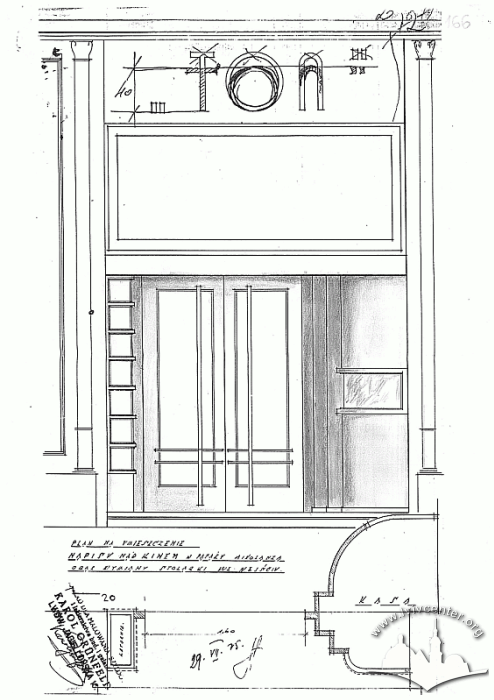
The façade on the 1st and 2nd floors featured large rectangular display windows; in the wall sections between them, there were small recessed panels flanked by thin semi-columns that were decorated with floral ornaments. On the 3rd floor, there were three rounded windows with surrounds; the elevation was topped by a cornice, and above it hung the glass roof of the passage made of a metal structure.
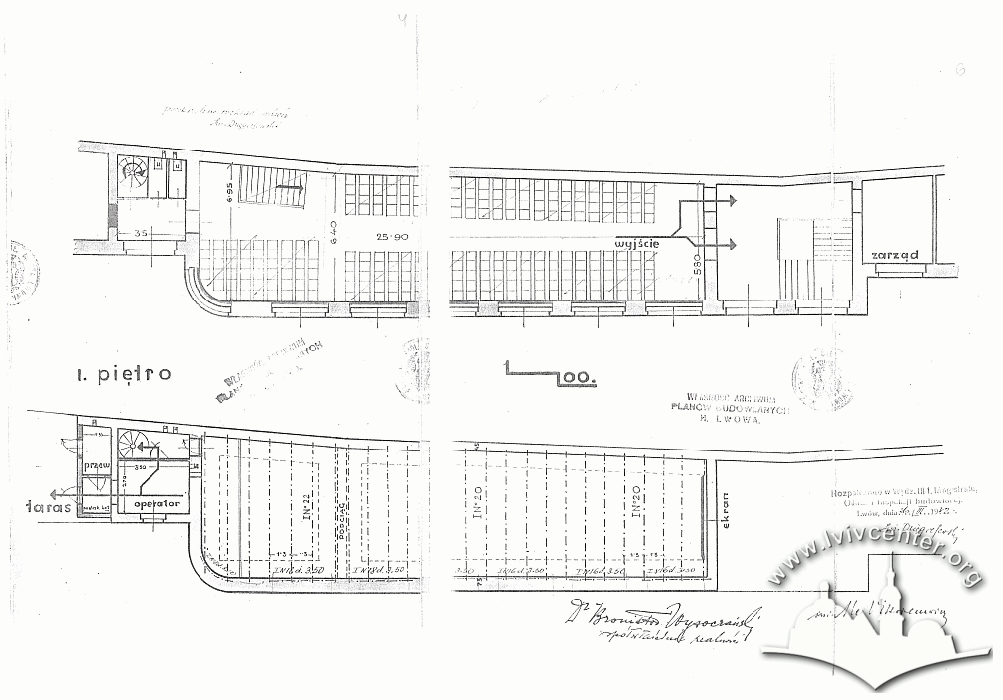
The entrance to the cinema led from the 1st floor, where the ticket office was located (until 1935 it was located in the corner room, and later moved to the right of the entrance doors) along with a staircase with three-flight stairs, which was accentuated by a corner display window that was rounded in plan. Located on the 2nd floor were the auditorium, restrooms, and spiral stairs to the 3rd floor. On the 3rd floor, there were the projection room, to which a utility room was later added, as well as a balcony in the auditorium, presumably for service purposes.
The auditorium was of a complex, longitudinally elongated shape in plan. According to the 1898 design, the width of the hall varied from 5.8 m in its narrowest part near the screen to 6.95 m in the widest part. In 1926, the hall was designed for 250 spectators, and after the 1935 reconstruction — for 309. The length of the hall was increased to 25,9 m at the expense of an airlock and a toilet, and, thus, the stairs from the 1st floor began to exit directly into the hall.
Related buildings and spaces
-
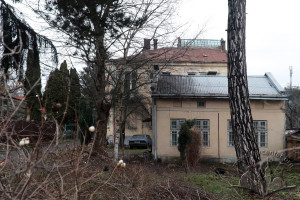
Vul. Volodymyra Antonovycha, 80 – residential building
People
Czesław Dobrzeński — one of the owners of the "Ton" cinema, subsequently one of the owners of the "Uciecha" cinema (from the early 1930s until 1939).
Jan Parandowski — polish writer, essayist, and translator. In his autobiographical novel "The Sky is Aflame" (Niebo w płomieniach), he mentions the first film screenings in the cinema located in the Mikolasch Passage.
Henryk Scheer — owner of the "Uciecha" cinema from 1926 until the early 1930s.
Herman Opat — owner of the "Urania" and "Cinephon" cinemas.
Izydor Merkel — one of the owners of the "Ton" cinema, subsequently one of the owners of the "Uciecha" cinema (from the early 1930s until 1939).
Kazimierz Kropiowski — engineer, owner of the "Lux" cinema from 1913.
Ludwik Kuchar — administrative director of the firm "Piotr Mikolasch & Spółka", active Lviv cinema entrepreneur, owner of several cinemas. In 1911–1915, he owned the "Kuchar" cinema (former "Cinephon"), which he later renamed "Pasaż" (1915–1935). He founded the "Lux" cinema in the Mikolasch Passage in 1912.
Maurycy Gimpel — one of the owners of the "Ton" cinema, subsequently one of the owners of the "Uciecha" cinema (from the early 1930s until 1939).
Ryszard Zygmunt Meiblum (February 2, 1890 – June 18, 1939) — in the interwar period, he used the name Sygfryd Mayflauer. During the First World War, he worked in Vienna as a director and cameraman. In the interwar period, he collaborated with the Warsaw studio "Terra-Polonia" and the Viennese "Ursus-Film". In 1924, he founded his own studio "Mayfilm", in 1926 became a co-owner of the "Olfilm" laboratory, and from 1936 ran the firm "R. Z. Meyblum – Produkcja Filmowa".
Sources
- Franciszek Pajączkowski, Życie kulturalne Lwowa w czasie walk polsko-ukraińskich 1.XI.1918 – 1.VI.1919 (Warszawa, 1938), 24.
- Mordownia czy kino?, Kurjer Lwowski, 1926, №70, 6.
- Державний архів Львівської області (ДАЛО) 7/3/638.
- ДАЛО 110/4/617.
- Центральний державний архів у Львові (ЦДІАЛ) 190/1/13.
- Ян Парандовський, Небо пломеніє (Львів: Каменяр, 1978), 252.
- Barbara Gierszewska, Kino i film we Lwowie do 1939 roku (Kielce: Wydawnictwo Akademii Świętokrzyskiej, 2006), 428.
- Slownik biograficzny filmu polskiego 1896–1939 (Krakow, 1996).
- Іван Яремко, Кухарі, Енциклопедія Львова, Т. 3 (Львів: Літопис¸ 2010), 714.