Vul. Konovaltsia, 16 – villa ID: 1393
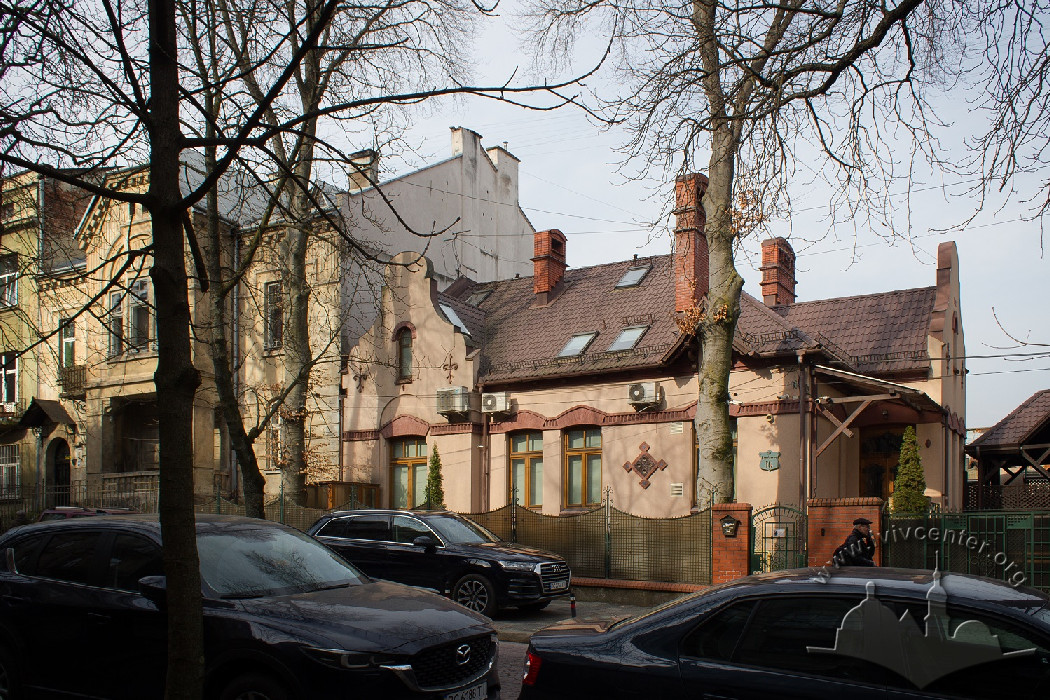
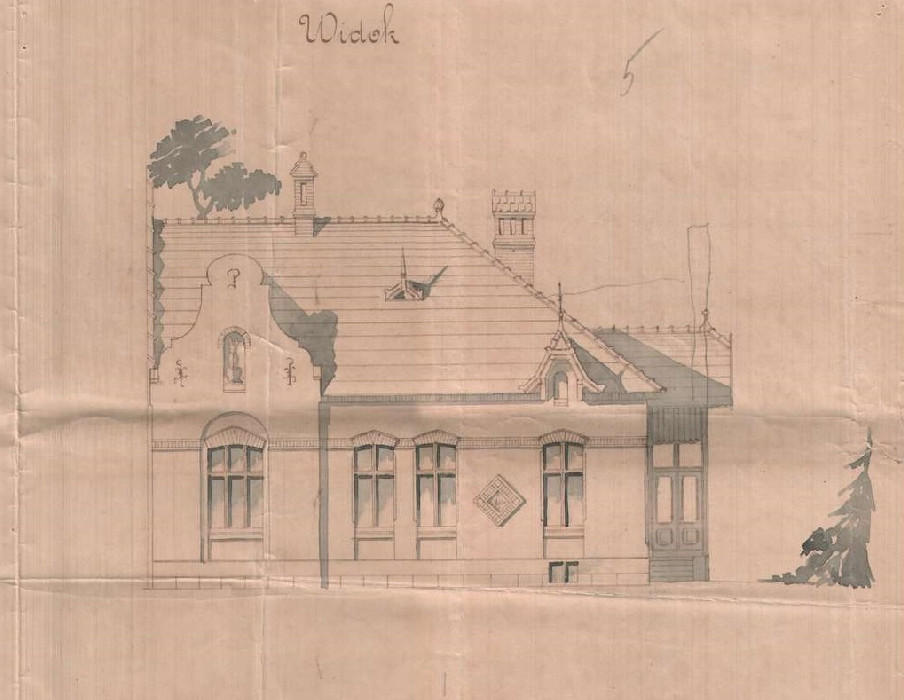
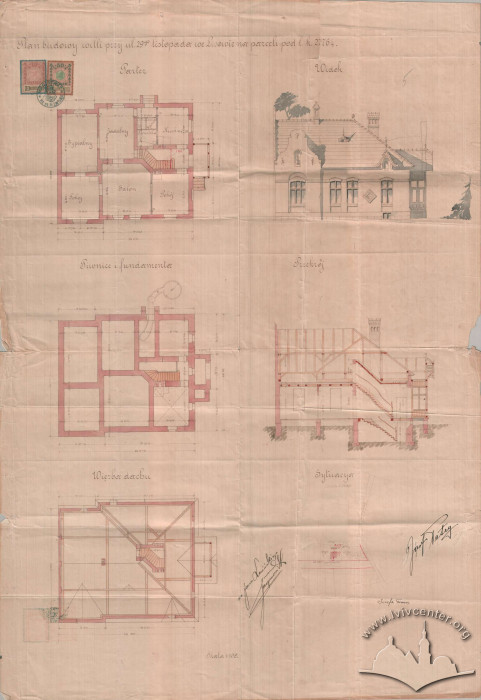
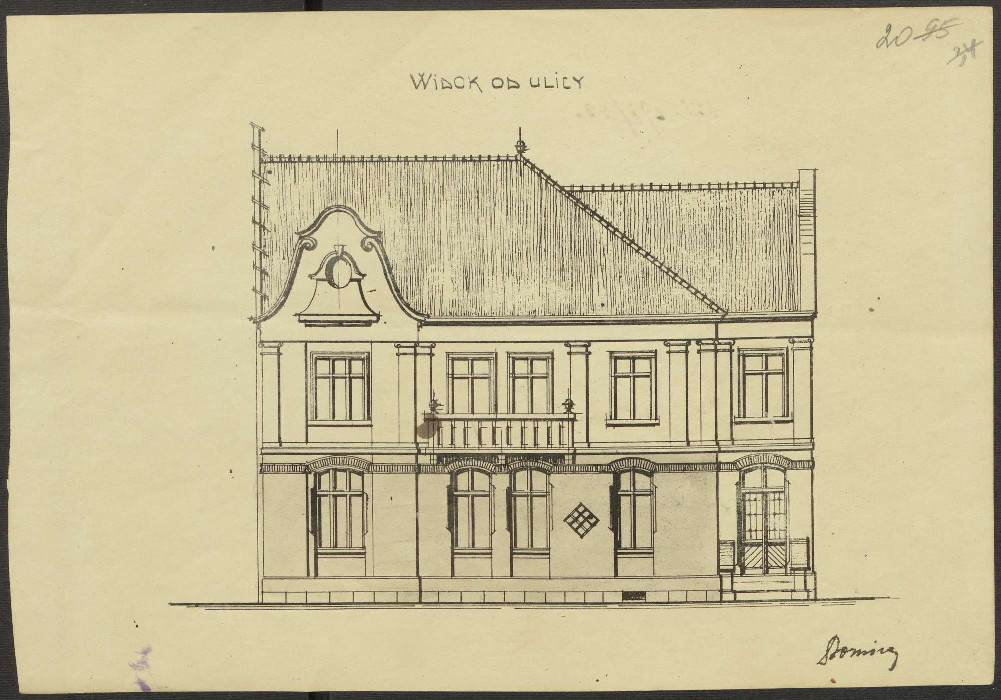
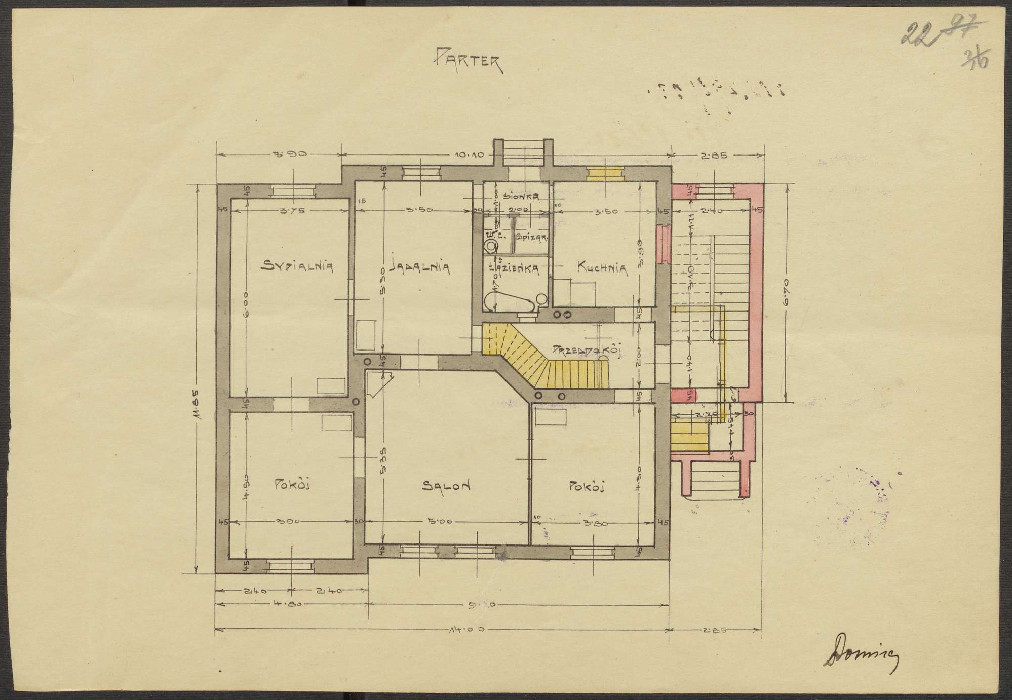
This single-story villa was built in 1901–1902 according to a project designed by Emanuel Jarymowicz, who was then working for Ivan Levynsky's company. It is an example of the picturesque style in architecture. The clients were Józef Petry, a forest inspector, and his wife Felicja. The villa is an architectural monument of local significance.
Story
During the 19th century, a larger plot (conscription number 86 ¼) was located here; closer to what is now vul. Kyivska, there was a small house. The plot was owned by Józef Wojciechowski (Wegweiser 1856; Neu verbesserter Wegweiser 1863) and later by Michał and Walenty Borecki. In 1892, perhaps due to the construction of ul. 29 Listopada (now vul. Konovaltsia), this plot was purchased by the Franz family, who owned a gypsum production facility in Lviv.
Around 1901, a plot separated from the large one (number 86 ¼) was purchased by Józef Petry and his wife Felicja. The construction of the villa was due to their move to Lviv as Petry got a job of an inspector in the Directorate of Forests and State Property, which was subordinate to the Governor’s Office. Although he had previously studied in Lviv, he worked mostly in the province: as a forester in Lopyanka and Lisovychi and later as the director and a teacher at the State School for Foresters in Bolekhiv. In 1901–1902, he rented apartments in Lviv — two addresses on ul. Krzyżowa (now vul. Chuprynky) are known. He apparently liked the idea of Kastelivka, which was developed and implemented by architects Julian Zachariewicz (1838–1899) and Ivan Levynsky (Jan Lewiński, 1851–1919). So he commissioned a design for a small villa from the latter; the drawings were signed by architect Emanuel Jarymowicz, who was then working for Levynsky.
In September 1901, Józef Petry submitted the design of a villa to be built at ul. 29 Listopada 4 (now vul. Konovaltsia 16) to the Lviv Magistrate and received approval in October. Stanisław Krzyżanowski, an engineer with the building authority who reviewed the project, emphasized in the permit that since there was no sewer system on the street, the owner was required to build a brick cesspool (ДАЛО 2/1/3368: 1-3). The villa was built by the summer of the following year, 1902. The permit to move in included a reminder to assign a new conscription number (ДАЛО 2/1/3368: 6-8). Soon, the house was assigned the number 1565 ¼.
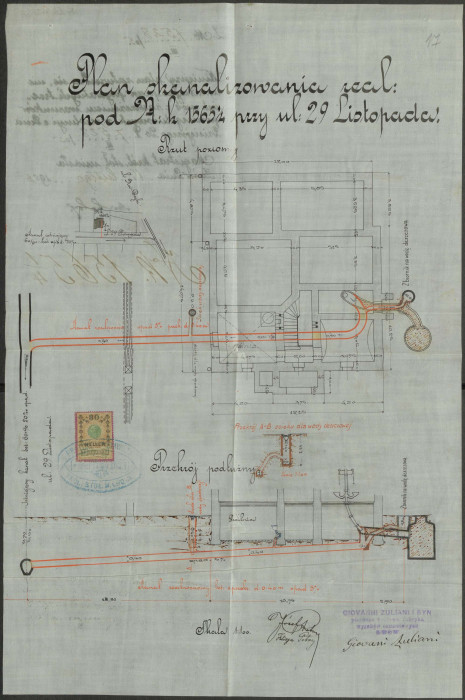
In 1905, after the sewer system was laid on ul. 29 Listopada, the Petrys decided to connect their house to it. The project was designed and implemented by the Giovanni Zuliani i syn (Giovanni Zuliani and Son) firm and was approved in February 1905 (ДАЛО 2/1/3368: 11, 17).
Józef Petry did not live in the villa for long, as he died in 1906 at the age of 54. According to address books, his wife Felicja continued to live there until at least 1916.
In 1923, the villa was purchased by Marian Bruliński, a mechanical engineer and lecturer at the Lviv Polytechnic. Sources also mention Bolesław Bruliński as a co-owner. They planned to add a second floor to the villa for which a design was prepared. The Magistrate granted permission for the construction (ДАЛО 2/1/3368:18), but, for unknown reasons, it was never implemented. The press mentions that the architectural and construction bureau of the Kogut i Tisch company was located here in 1923-1924.
Throughout the 20th century, the building remained residential. Today (2025), it has an attic floor, as evidenced by the roof windows; the original roof has been replaced with metal roofing; the chimneys have been rebuilt to match the authentic ones. The façades are covered with non-authentic plaster (possibly insulated), with air conditioners hung on them; the window woodwork have been replaced with metal-plastic one. A garage with a terrace on top is attached to the side of the villa. Nevertheless, the villa retains its overall appearance from the early 20th century.
Architecture
During the 19th century, a larger plot (conscription number 86 ¼) was located here; closer to what is now vul. Kyivska, there was a small house. The plot was owned by Józef Wojciechowski (Wegweiser 1856; Neu verbesserter Wegweiser 1863) and later by Michał and Walenty Borecki. In 1892, perhaps due to the construction of ul. 29 Listopada (now vul. Konovaltsia), this plot was purchased by the Franz family, who owned a gypsum production facility in Lviv.
Around 1901, a plot separated from the large one (number 86 ¼) was purchased by Józef Petry and his wife Felicja. The construction of the villa was due to their move to Lviv as Petry got a job of an inspector in the Directorate of Forests and State Property, which was subordinate to the Governor’s Office. Although he had previously studied in Lviv, he worked mostly in the province: as a forester in Lopyanka and Lisovychi and later as the director and a teacher at the State School for Foresters in Bolekhiv. In 1901–1902, he rented apartments in Lviv — two addresses on ul. Krzyżowa (now vul. Chuprynky) are known. He apparently liked the idea of Kastelivka, which was developed and implemented by architects Julian Zachariewicz (1838–1899) and Ivan Levynsky (Jan Lewiński, 1851–1919). So he commissioned a design for a small villa from the latter; the drawings were signed by architect Emanuel Jarymowicz, who was then working for Levynsky.
In September 1901, Józef Petry submitted the design of a villa to be built at ul. 29 Listopada 4 (now vul. Konovaltsia 16) to the Lviv Magistrate and received approval in October. Stanisław Krzyżanowski, an engineer with the building authority who reviewed the project, emphasized in the permit that since there was no sewer system on the street, the owner was required to build a brick cesspool (ДАЛО 2/1/3368: 1-3). The villa was built by the summer of the following year, 1902. The permit to move in included a reminder to assign a new conscription number (ДАЛО 2/1/3368: 6-8). Soon, the house was assigned the number 1565 ¼.
In 1905, after the sewer system was laid on ul. 29 Listopada, the Petrys decided to connect their house to it. The project was designed and implemented by the Giovanni Zuliani i syn (Giovanni Zuliani and Son) firm and was approved in February 1905 (ДАЛО 2/1/3368: 11, 17).
Józef Petry did not live in the villa for long, as he died in 1906 at the age of 54. According to address books, his wife Felicja continued to live there until at least 1916.
In 1923, the villa was purchased by Marian Bruliński, a mechanical engineer and lecturer at the Lviv Polytechnic. Sources also mention Bolesław Bruliński as a co-owner. They planned to add a second floor to the villa for which a design was prepared. The Magistrate granted permission for the construction (ДАЛО 2/1/3368:18), but, for unknown reasons, it was never implemented. The press mentions that the architectural and construction bureau of the Kogut i Tisch company was located here in 1923-1924.
Throughout the 20th century, the building remained residential. Today (2025), it has an attic floor, as evidenced by the roof windows; the original roof has been replaced with metal roofing; the chimneys have been rebuilt to match the authentic ones. The façades are covered with non-authentic plaster (possibly insulated), with air conditioners hung on them; the window woodwork have been replaced with metal-plastic one. A garage with a terrace on top is attached to the side of the villa. Nevertheless, the villa retains its overall appearance from the early 20th century.
People
Bolesław Bruliński — a co-owner of the villa in the
interwar period.
Marian Bruliński — a mechanical engineer, lecturer
at Lviv Polytechnic, publisher of the Gazeta Mlynarska, manufacturer of bells
and bronze products, owner and resident of the villa in the interwar period.
Julian Zachariewicz (1839–1898) — a Lviv architect,
professor and rector of Lviv Polytechnic, a co-author of Kastelivka — a villa
district of Lviv.
Giovanni Zuliani (1843–1909) — owner of a cement
products company in Lviv, which connected the villa to the city sewer system.
Stanisław Krzyżanowski — an architect, employee of the
City Construction Authority in Lviv.
Ivan Levynsky (Jan Lewiński, 1851–1919) — a Lviv engineer and architect, professor
at Lviv Polytechnic, a co-author of Kastelivka — a villa district in Lviv; his
company built this villa.
Felicja Petry née Szyszkowska — wife of Józef Petry, a co-owner
and resident of the villa until at least 1916.
Józef Petry (appr. 1852–1906) — a forester. He
studied at the Forestry School in Lviv and received a scholarship from the
Galician Diet (Sejm) to continue his studies in Vienna. He worked as an
assistant at the Directorate of Forests and State Property in Lviv, then as a
forester in various locations in the province. In the 1890s, he headed the
State School for Foresters in Bolekhiv. In 1901, he moved to Lviv after being
appointed as a forest inspector.
Juliusz Petry (1890–1961) — a Polish engineer,
director of Lviv Radio in the interwar period, and later a television employee
in the People's Republic of Poland. He probably spent part of his childhood in
this villa.
Józefa Franz (1827-1907) — owner of a plaster
products company in Lviv and a villa at vul. Konovaltsia 47. It was on her
initiative that this section of vul. Konovaltsia was built in 1892 (between
what are now vul. Kyivska and vul. Melnyka).
Emanuel Jarymowicz (1865–?) — an architect who
collaborated with Ivan Levynsky's company and designed the villa.
Sources
- Державний архів Львівської області (ДАЛО) 2/1/3368. URL: https://e.archivelviv.gov.ua/file-viewer/230147#file-1354241
- Alegata do sprawozdań stenograficznych z czwartej sesyi czwartego peryodu Sejmu Krajowego, (1881), s. 40.
- "C.k. Szkoła rządowa dla kandydatów na leśnych w Bolechowie", Kalendarz "Szkoły", 1901, s. 12.
- Ziemianin Polski. Kalendarz rolniczy na rok zwyczajny 1900, (Warszawa: Drukarnia Gazety Rolniczej, 1899), s. 88.
- "Kronika. Mianowania", Kurjer Lwowski, 1886, Nr. 356, s. 4.
- "Kronika. Mianowania", Kurjer Lwowski, 1891, Nr. 314, s. 4.
- "Kronika. Zmarli", Kurjer Lwowski, 1906, Nr. 276, s. 4.
- Szematyzm Królewstwa Galicyi i Lodomeryi, 1885.
- Szematyzm Królewstwa Galicyi i Lodomeryi, 1888.
- Szematyzm Królewstwa Galicyi i Lodomeryi, 1905.
- Henryk Strzelecki, Lasy i leśnictwo w Galicyi w stuleciu dziewiętnastem (Lwów: Drukarnia Polska, 1900), s. 73.