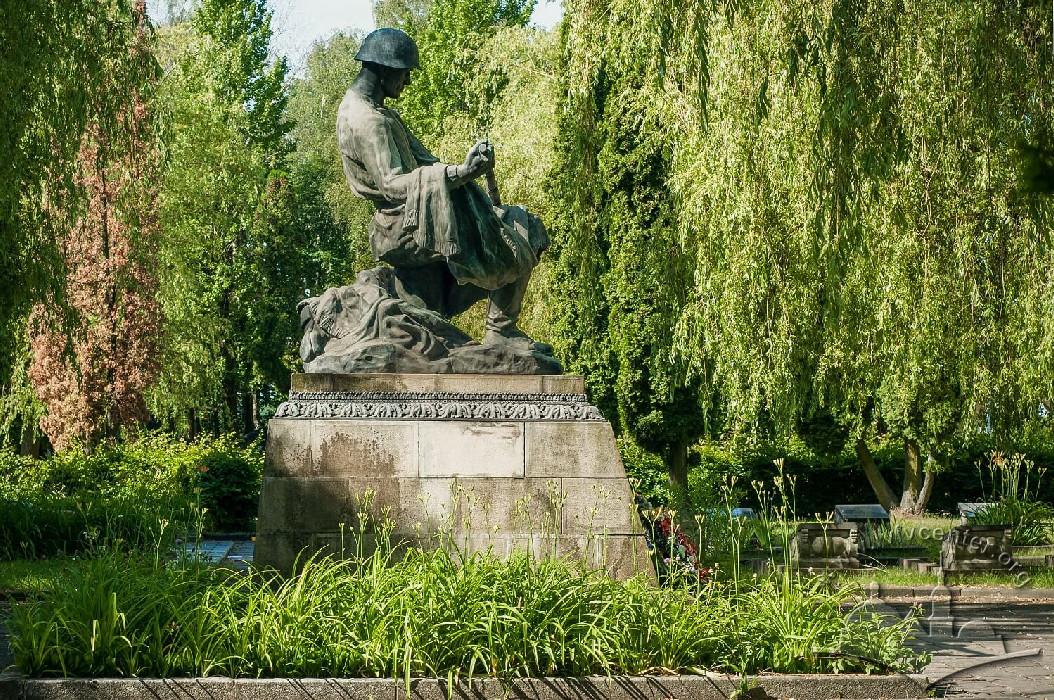
Vul. Pasichna – Hill of Glory ID: 1027
Located above Lychakiv Park on vul. Pasichna, the site formerly known as the Hill of Glory is Sector No. 87 of the Field of Mars (Honored Burials). It was designated in 2025 for the burials of Ukrainian service members who died during the Russian war against Ukraine. This was preceded by the dismantling of the Soviet Red Army Soldiers Memorial, which had stood on this site since 1952. Originally, the territory was allocated for a military cemetery established by the Russian authorities in 1914–1915 for the burial of soldiers who died in the Battle of Galicia.
Story
The cemetery was established by Russian authorities in 1914–1915 for the burial of Russian army personnel who died in the Battle of Galicia in August 1914, as well as those who succumbed to injuries and disease in Lviv hospitals. The cemetery was situated along present-day vul. Pasichna, next to Lychakivskyi Park. It was laid out under the patronage of the wife of the then Russian governor-general of occupied Galicia, Count Georgy Bobrinsky, and was named "Kholm Slavy" (the Hill of Glory).
During the Russian occupation, the Hill of Glory served as a venue for various patriotic demonstrations. For instance, in April 1915, a religious procession was organized from the Russian Orthodox Church of St. George on ul. Franciszkańska (now vul. Tarasa Bobanycha) to the Hill of Glory. It was attended by Lviv's Orthodox clergy, Russian administration officials, units of the Russian army, and representatives of the so-called Russophile parties of Galicia.
Following the Russian retreat from Lviv in the summer of 1915, the cemetery was left unattended. A magistrate commission — comprising representatives of the Polish Society for the Care of Heroes' Graves (Pol. Polskie Towarzystwo nad Grobami Bohaterów), the Mutual Aid Society of Russian Emigrants (Rus. Общество взаимопомощи российских эмигрантов), the Polish Red Cross (Pol. Polski Czerwony Krzyż), and other organizations — concluded that restoring the cemetery was unfeasible. The commission ruled to exhumate the infectious diseases section of the cemetery and relocate it to the main burials at the Austrian Military Cemetery. However, this magistrate decision was only carried out in the winter of 1937.
After the exhumation, the site of the former Russian army military cemetery was used for cattle grazing. The location where the infectious diseases cemetery had once stood was converted into a sand quarry, which was eventually fully excavated. No First World War burials survived here.
In the battles for Lviv during World War II, the Soviet Union lost numerous soldiers and officers who were mostly buried in temporary graves. After the war, city authorities faced the issue of creating a military cemetery — this time for Red Army soldiers. In 1944, a decision was made to build a Red Army Soldiers Memorial on the site of the former Hill of Glory cemetery.
On March 12, 1945, the City Council approved the memorial design for realization, and its construction was completed in 1952. In 1991, the Hill of Glory military cemetery was incorporated into the Lychakiv Cemetery Historical and Architectural Reserve.
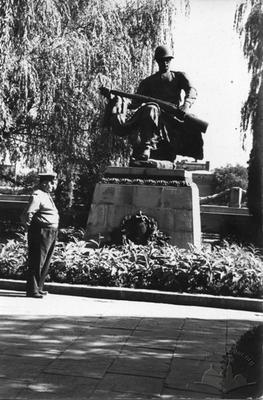
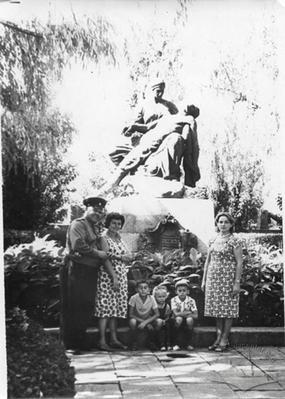
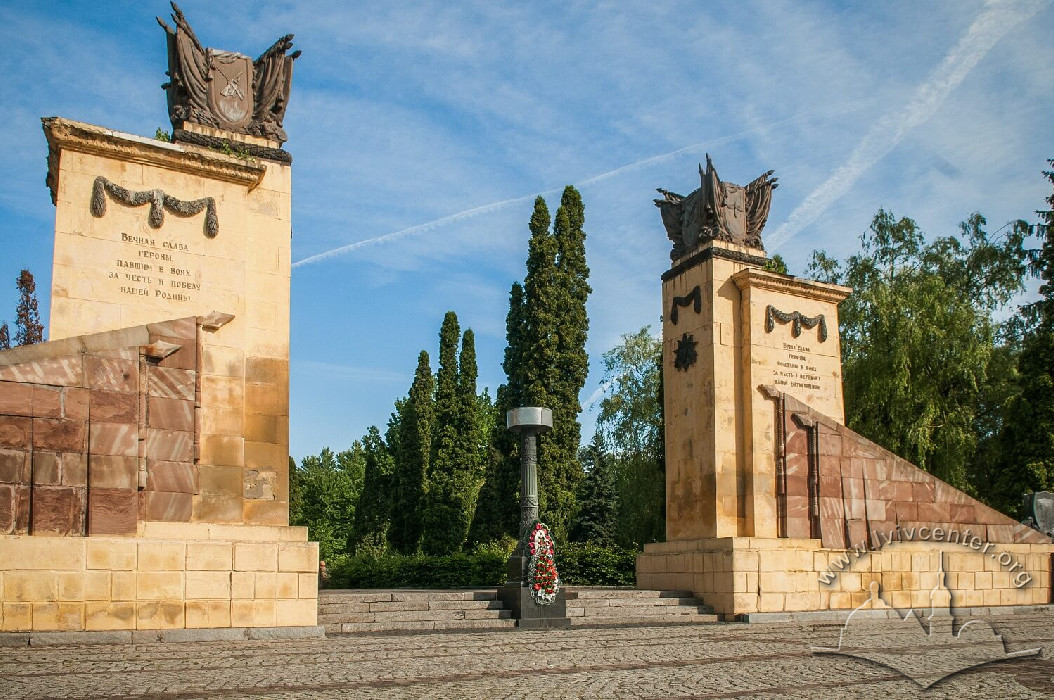
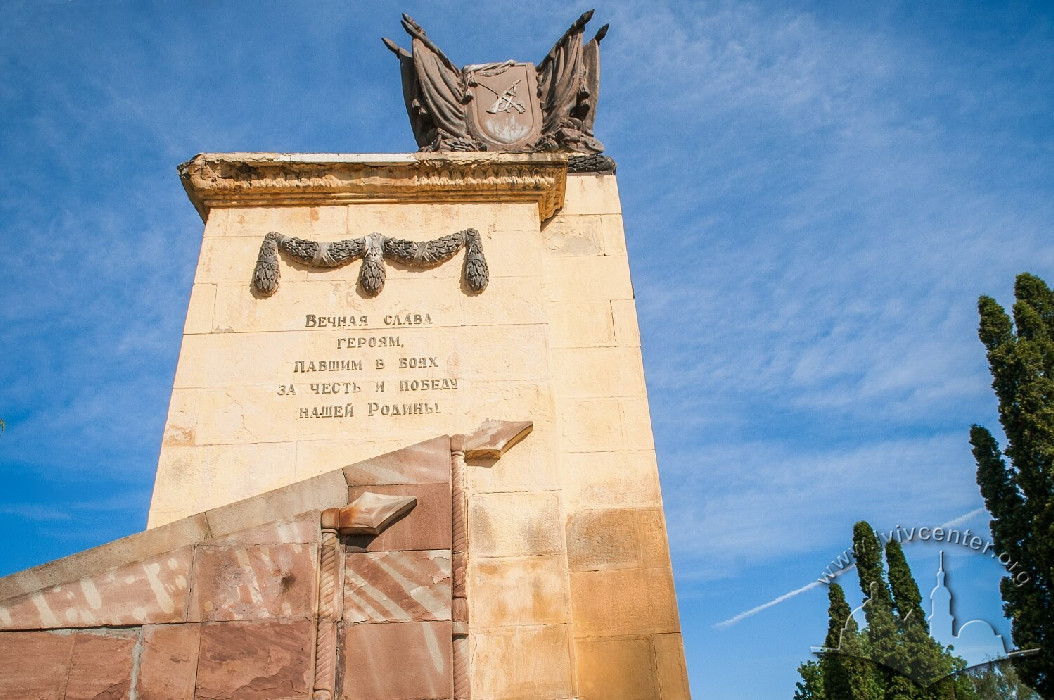
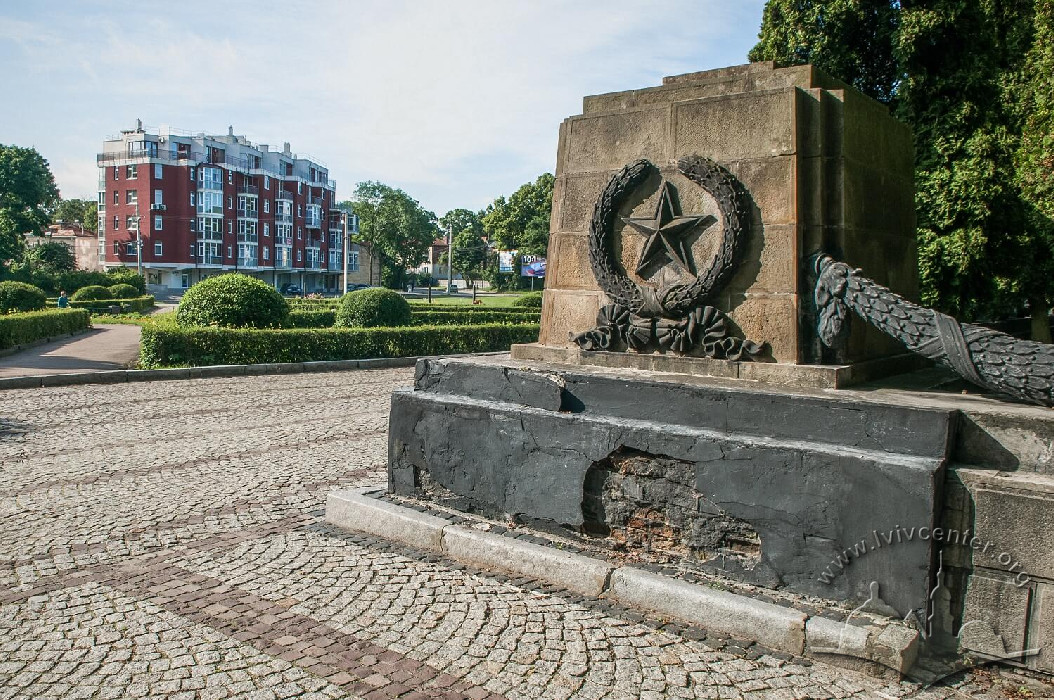
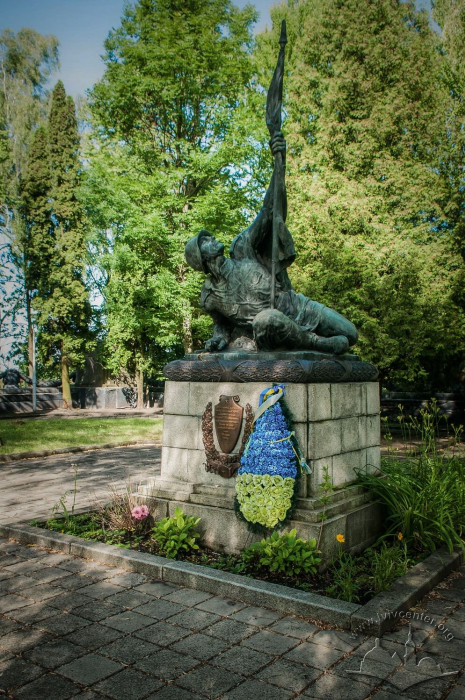
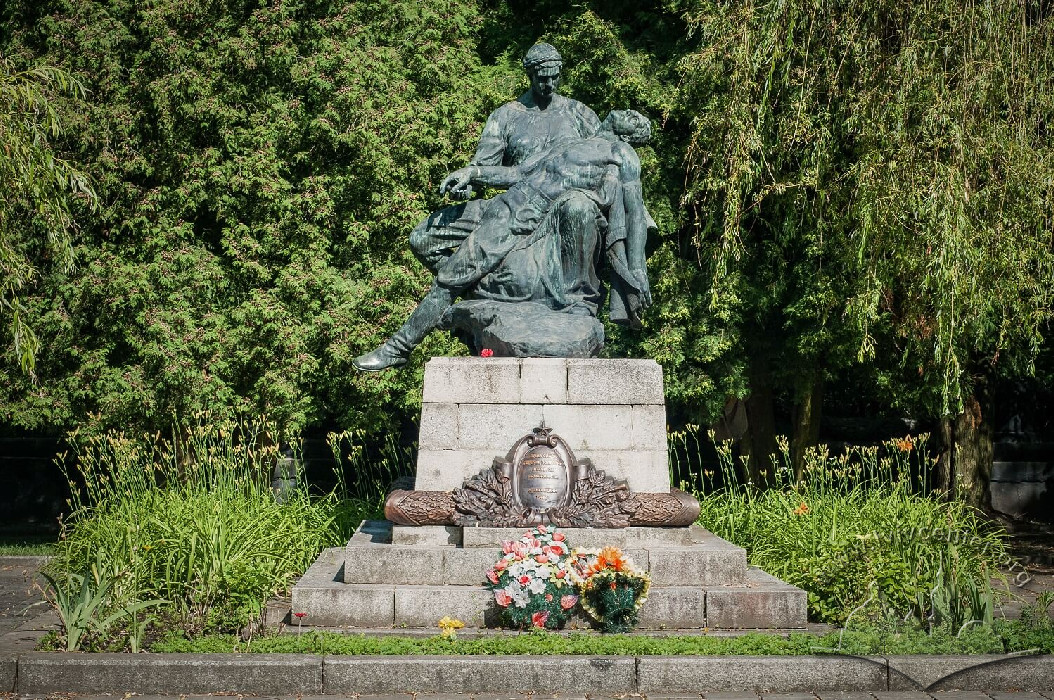
On April 16, 2022, the process of dismantling Soviet symbols began at the site. The first step involved removing the star and the hammer and sickle symbol. The next step was removing the Russian-language inscription: "Eternal glory to the heroes who fell in battle for the honor and glory of our Motherland". In 2023, three Soviet sculptural compositions were dismantled: "Motherland", "Warrior with a Flag", and "The Oath". The dismantled elements were transferred to the collection of the city's "Territory of Terror" museum.
In 2025, efforts began to investigate and exhumate Soviet burials on the territory of the Hill of Glory. In parallel, the columns that served as the entrance gate to the memorial were demolished. On July 16, 2025, the exhumation was completed.
On November 25, 2025, during a plenary session of the City Council, the creation of a new burial field for service members killed during the Russo-Ukrainian War was officially approved on the site of the former Hill of Glory.
Today, this is Sector No. 87 of the Field of honorary burials, which falls within the boundaries of Lychakiv Cemetery and is located within walking distance of the burial site on vul. Mechnykova (Field No. 86a). In December 2025, the first burial of a service member took place there.
Architecture
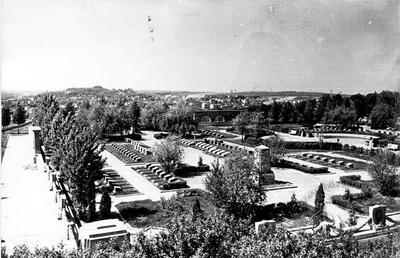
The Hill of Glory occupied a small plateau that sloped steeply toward Mazurówka and Cetnarówska streets (now vul. M. Cheremshyny) and consisted of two distinct sections. The first section was located directly behind the former Głowacki Park (now Lychakivskyi Park), where 141 mass graves and 177 individual graves of Russian soldiers and officers were situated across several terraces of the plateau. A small plot was also set aside here for Russian soldiers of the Muslim faith, whose graves were marked with headstones featuring Islamic symbolism.
In front of this plot, closer to present-day vul. Pasichna on a small level clearing, stood a 4-meter white-stone cross surrounded by a low wooden fence as late as the late 1930s. Its granite pedestal bore the inscription: "Mass graves of valiant Russian warriors who laid down their lives for Faith, Tsar, and Fatherland 1914–1915". A photograph of it from 1915 has been preserved.
Approximately 150 meters to the south, on a second ledge of the plateau, Russian soldiers who died from epidemic diseases were buried. Several memorial crosses were also erected here.
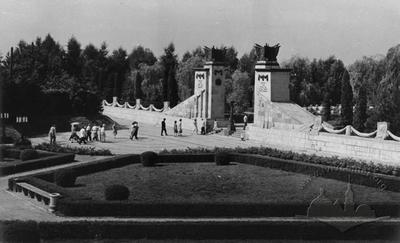
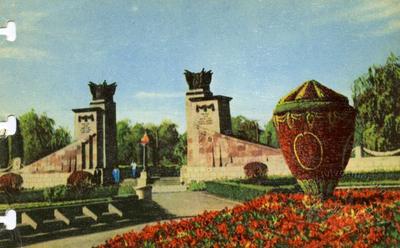
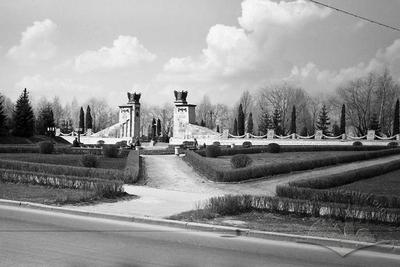
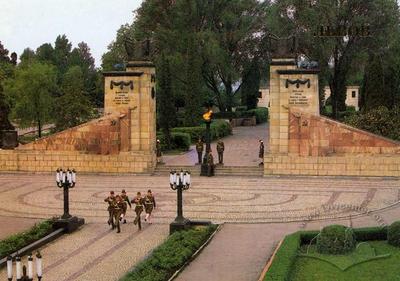
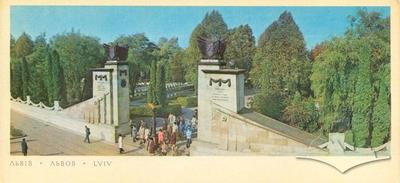
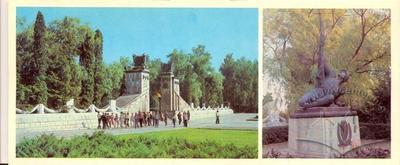
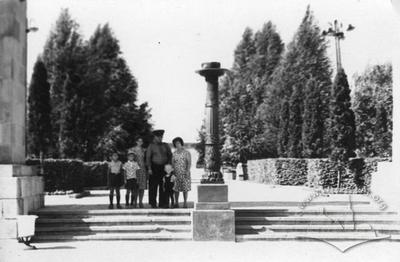
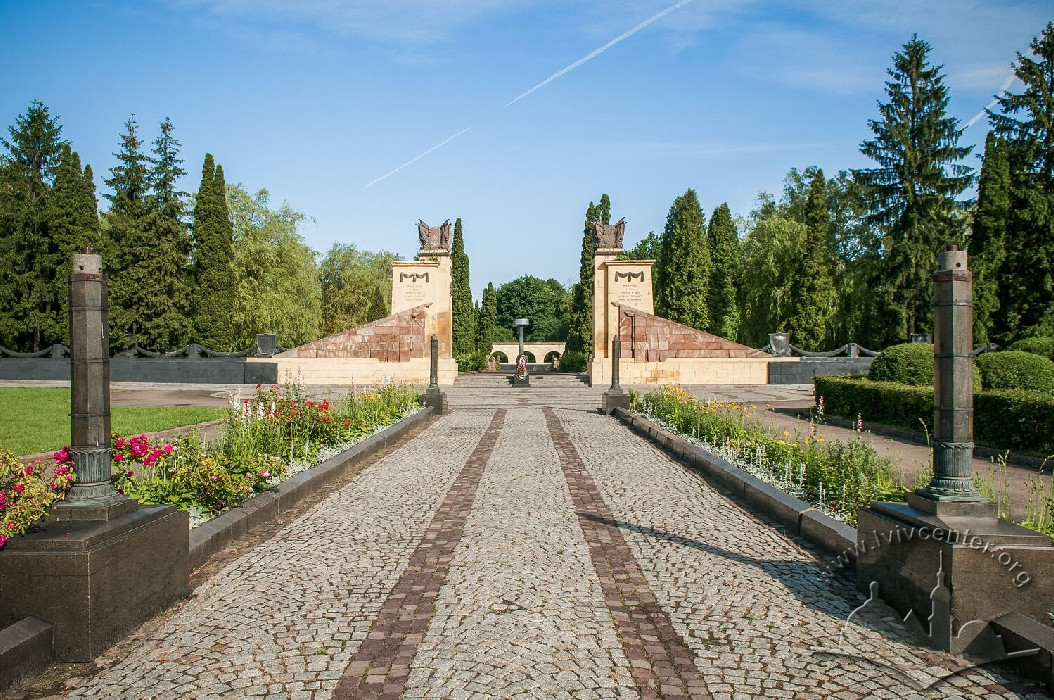
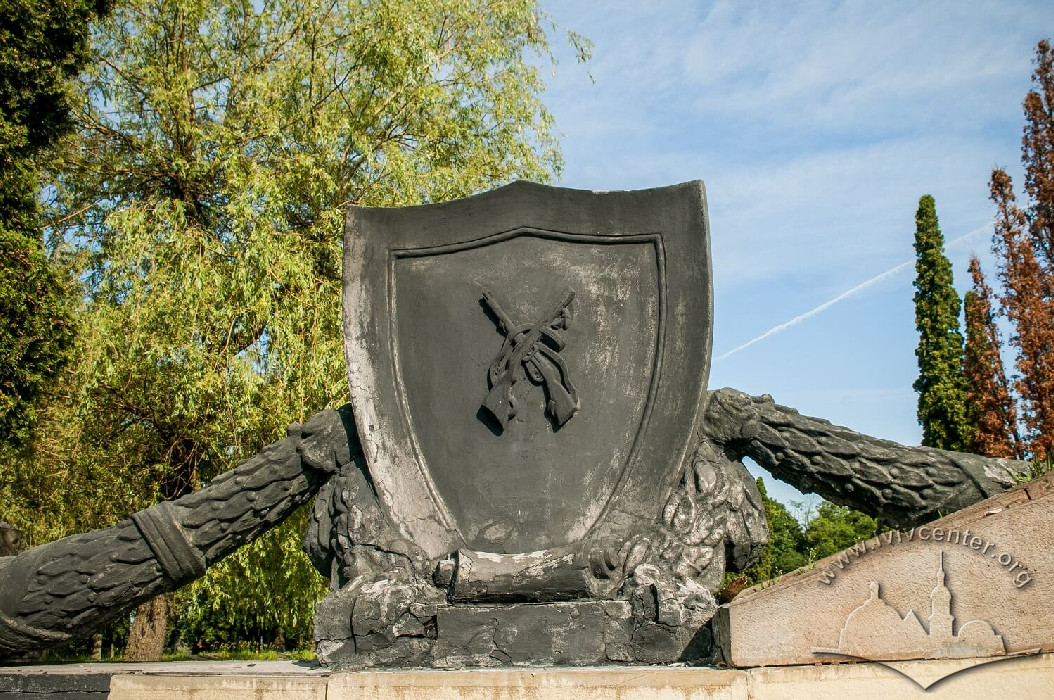
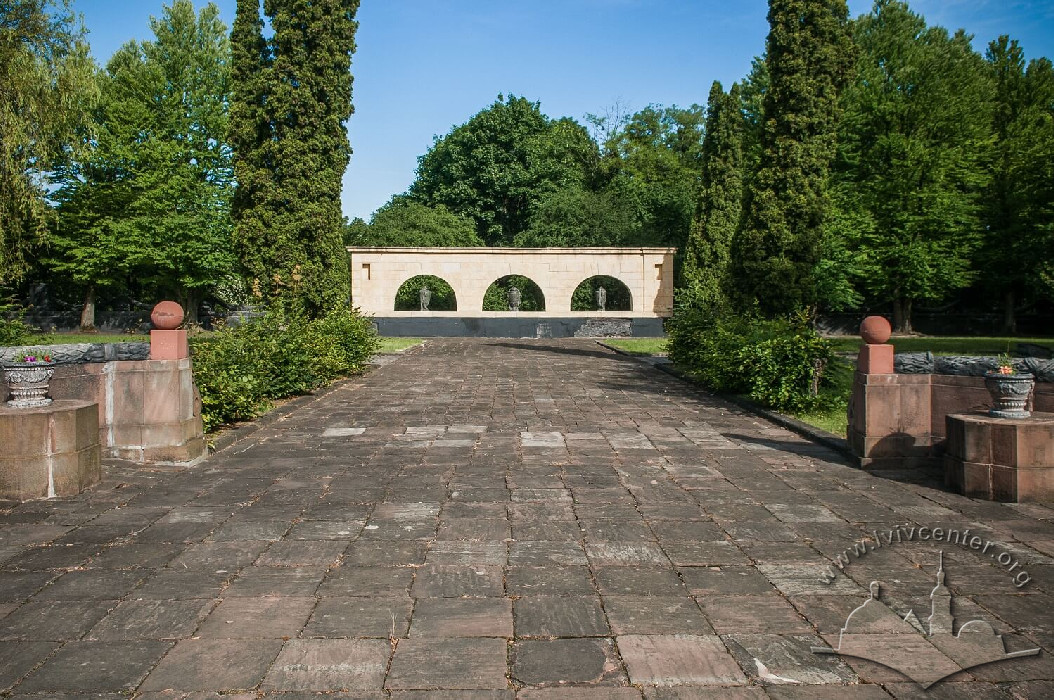
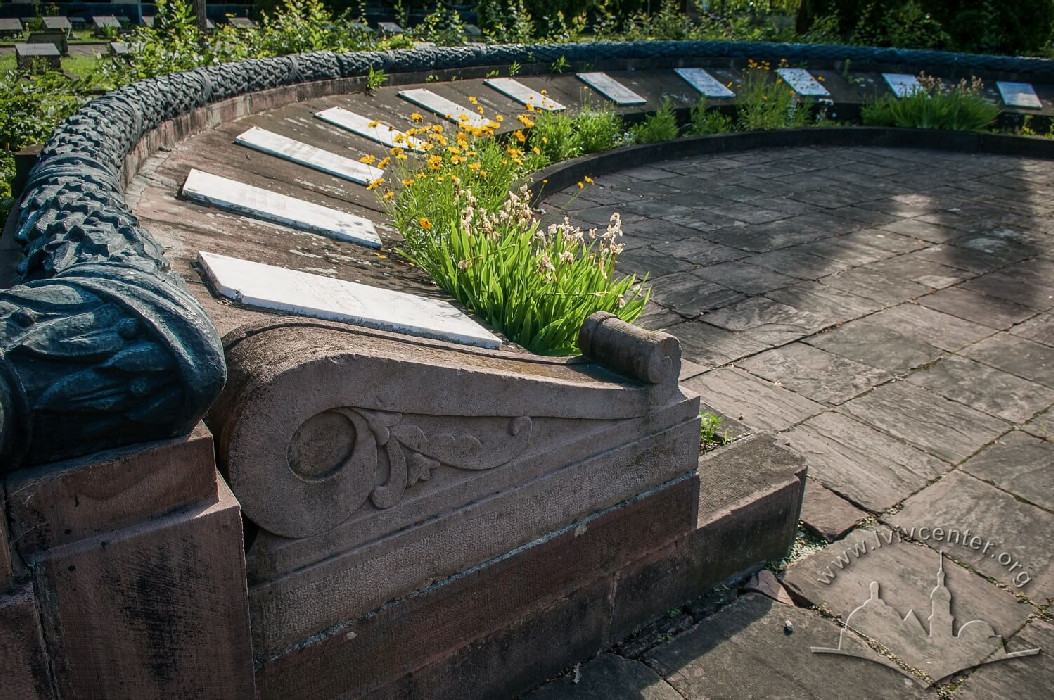
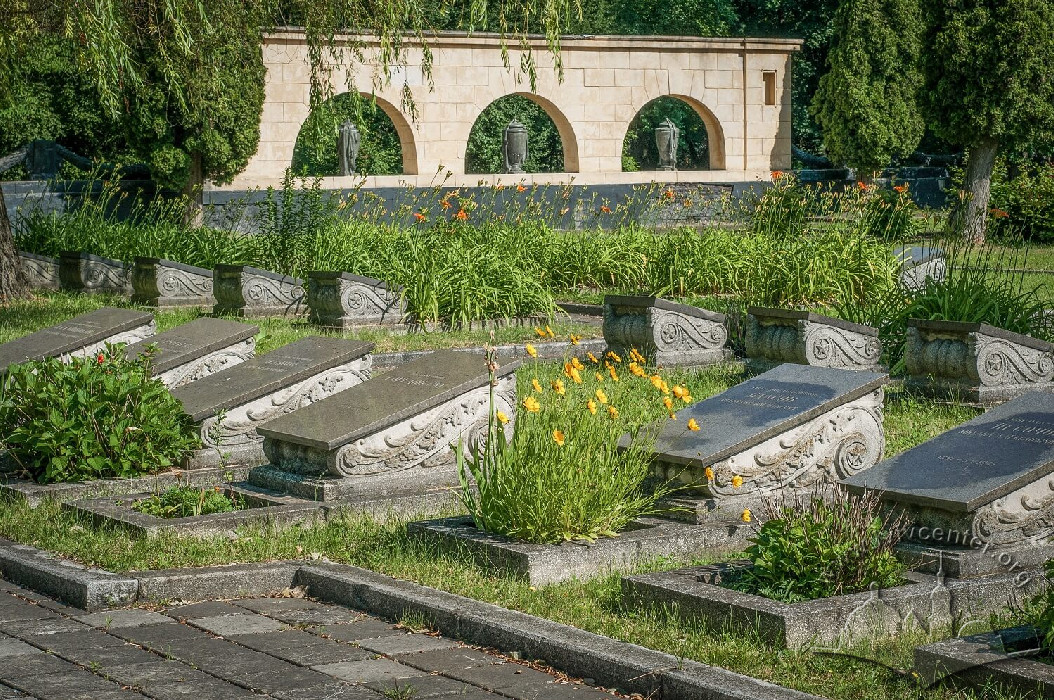
In 1952, the Red Army Soldiers Memorial was constructed on the site of the former Hill of Glory, designed by architects A. V. Natalchenko, H. A. Shvetsko-Vinetsky, and I. O. Persykov. Rectangular in plan, its territory was surrounded by a stone fence decorated with laurel festoons and heraldic shields displaying emblems of military branches. The entrance to the cemetery was framed by two red sandstone pylons. A bowl with an eternal flame was installed along the central entrance axis.
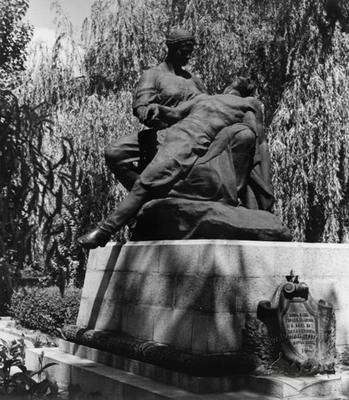
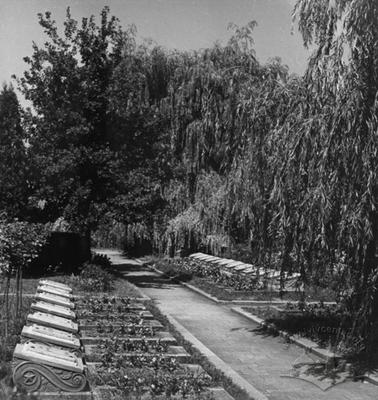
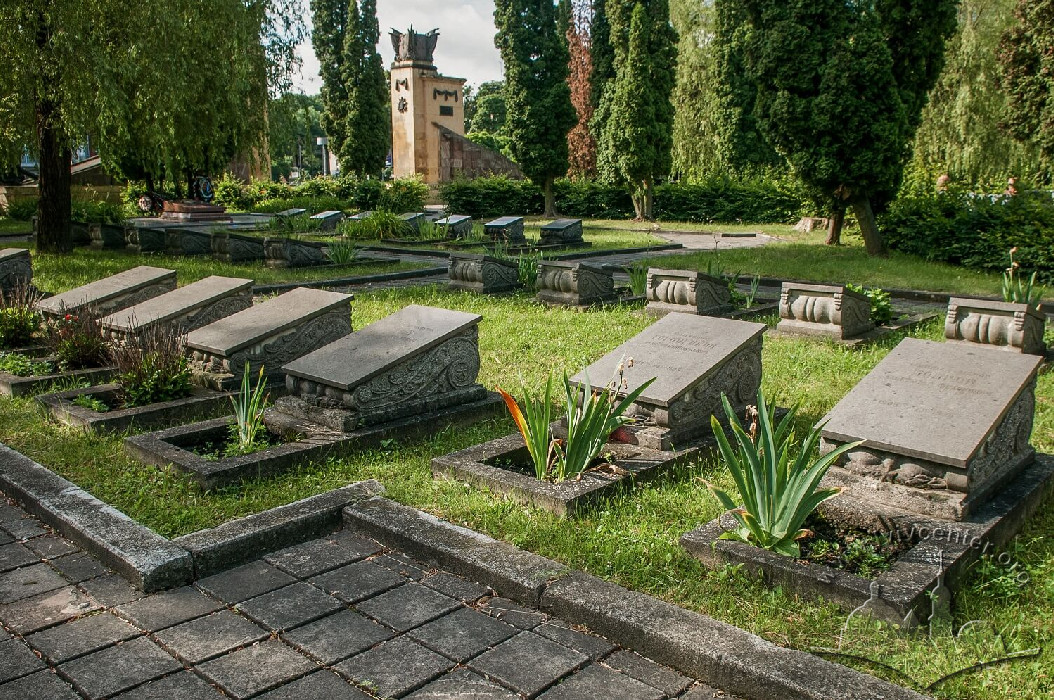
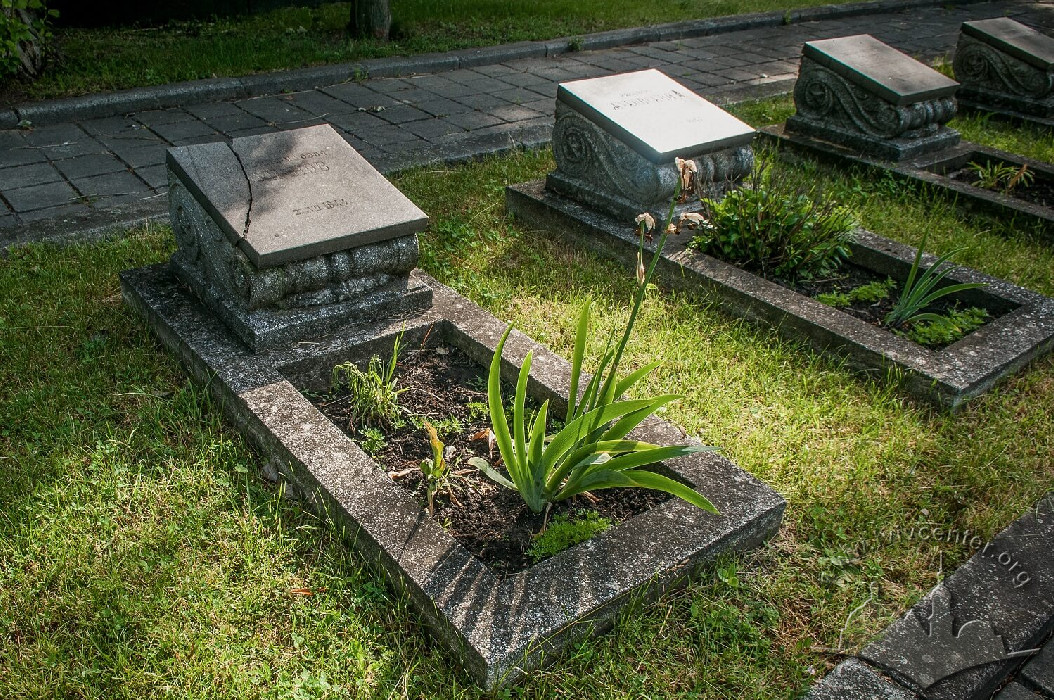
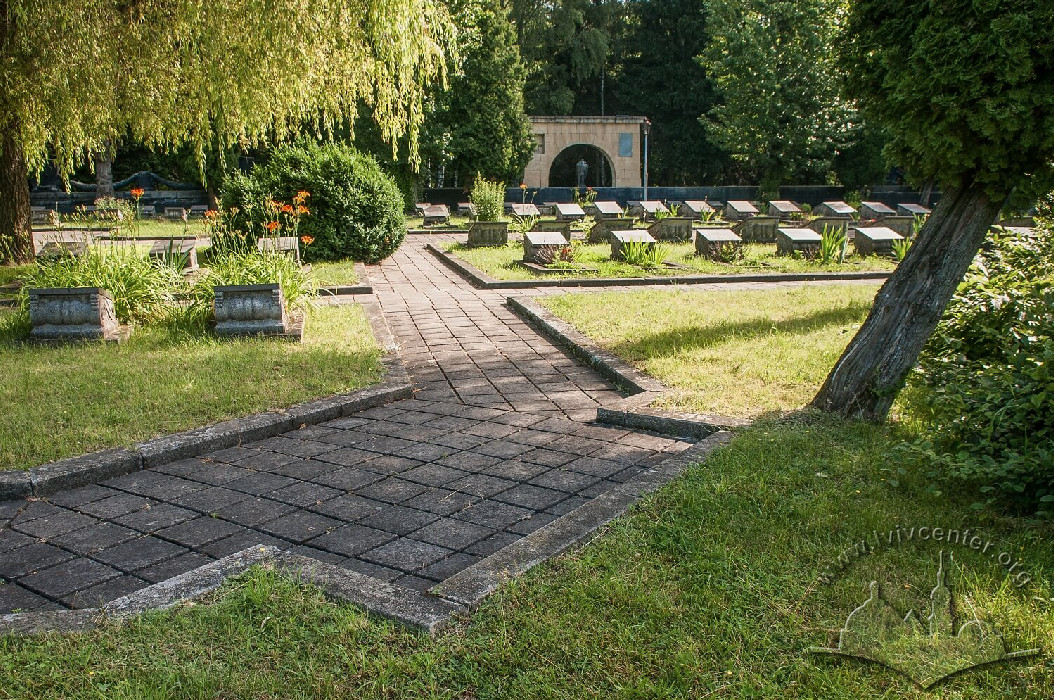
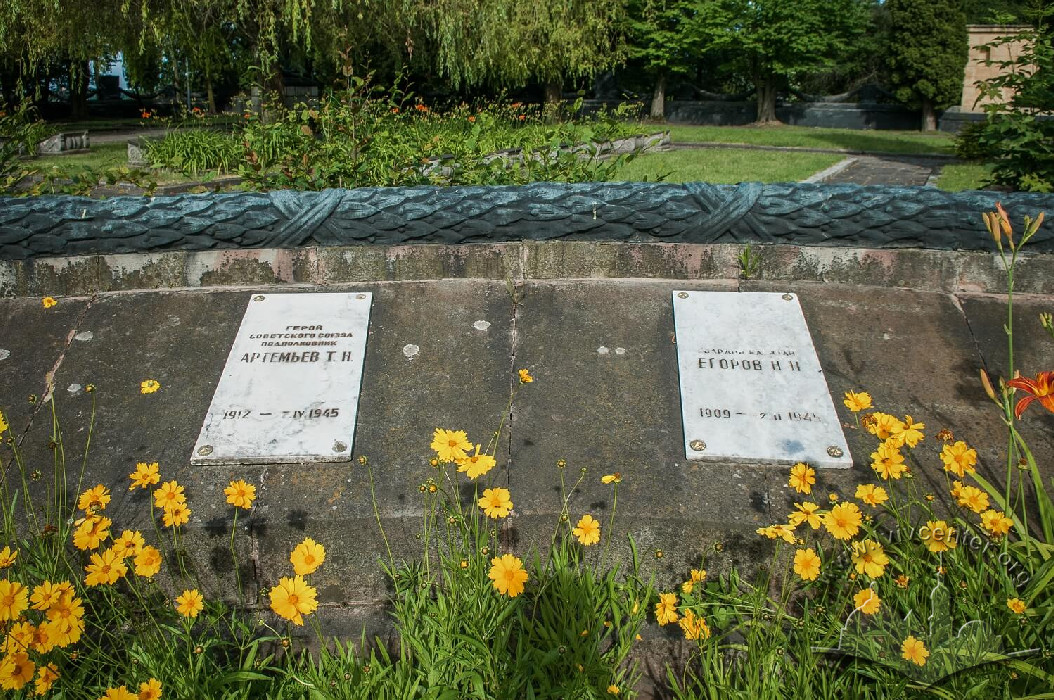
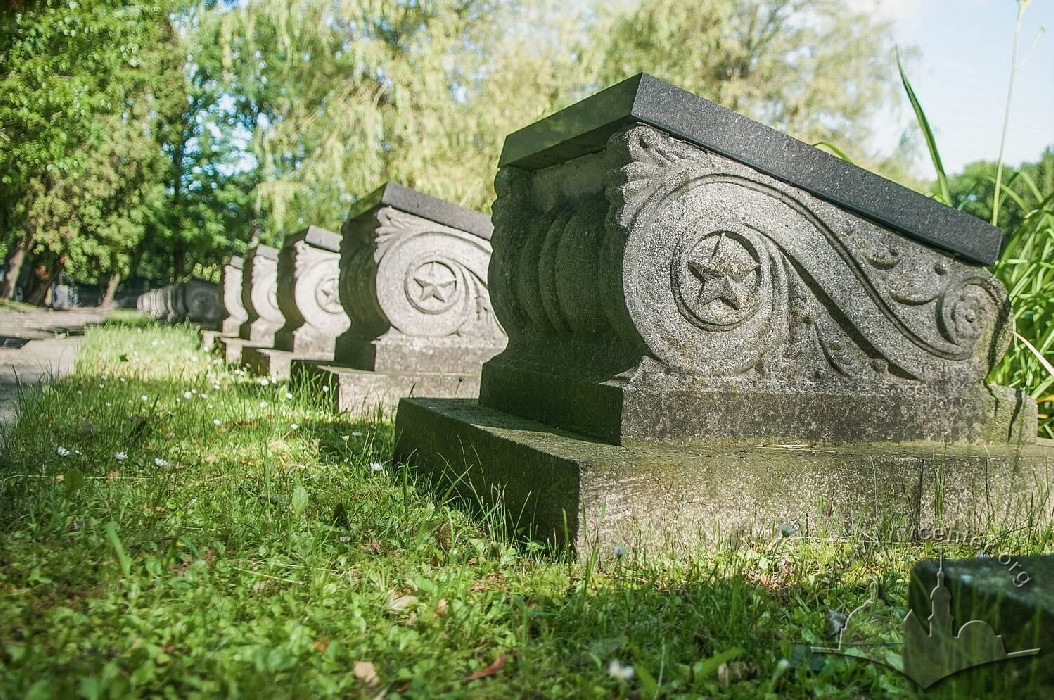
The central part of the cemetery was designed as a circle divided in half by the Avenue of Heroes, with thirteen headstones in each half. Six rows of graves were laid out to the left and right of the Avenue of Heroes. Along the axes of the transverse alleys above the mass graves stood bronze sculptural compositions: "The Oath" and "Motherland" (by sculptor M. Lysenko) and "Warrior with a Flag" (by sculptor V. Forostetskyi). To the left of the main entrance rose a granite obelisk, erected in 1952 to honor Russian army soldiers who died in battles during World War I in 1914–1915.
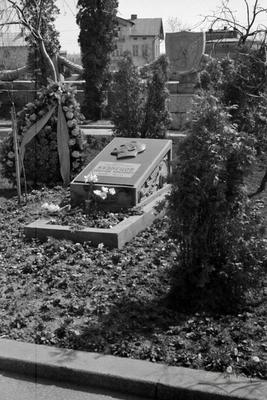
To the right of the main entrance was the grave of Soviet intelligence agent and terrorist Nikolai Kuznetsov, from the "Flag-Bearers" partisan unit named after Joseph Stalin. His remains were previously believed to have been moved from Boriatyn to the Hill of Glory on July 27, 1960. However, this likely did not occur, as Nikolai Kuznetsov was captured by the UPA and buried in Volhynia. A red granite tombstone with a bronze bass-relief was placed over the grave (designed by architect V. Podolskyi).
Following the dismantling of the former Soviet memorial, the current Field of honorary burials No. 87 will feature 12 sectors. As of November 2025, the following work had been completed: a main avenue with a permeable surface suitable for holding ceremonies at any time of year was established; a ceremonial area fully cleared of Soviet ideological elements was created; all green spaces were preserved, with the exception of a few hazardous arborvitae trees; and space was provisionally set aside for future elements of Ukrainian memorial architecture, which will be determined through a professional design competition.
People
Georgy Bobrinsky — count, Russian governor-general of occupied Galicia.
V. Forostetskyi — sculptor, author of the sculptural composition "Warrior with a Flag".
M. Lysenko — sculptor, author of the sculptural compositions "The Oath" and "Motherland".
A. V. Natalchenko — architect, co-author of the Red Army Soldiers Memorial project on the site of the former Hill of Glory cemetery.
I. O. Persykovyi — architect, co-author of the Red Army Soldiers Memorial project on the site of the former Hill of Glory cemetery.
V. Podolskyi — architect.
H. A. Shvetsko-Vinetskyi — architect, co-author of the Red Army Soldiers Memorial project on the site of the former Hill of Glory cemetery.
Interview
Sources
- Державний архів Львівської області (ДАЛО) 1/9/338.
- ДАЛО 1/50/168.
- ДАЛО 1/30/3551:2, 3.
- M. Baczyńska, Przewodnik po cmentarzach lwowskich Łyczakowskim i Janowskim (Lwów, 1937), 17-18.
- M. Orłowicz, Przewodnik po Lwowie (Lwów, 1925), 191.
- Г. Лупій, Личаківський історико-культурний музей-заповідник “Личаківський цвинтар”. Путівник (Львів, 1996), 155.
- М. Лазорко, Шануймо тіні полеглих, Діло, 1936, Ч. 95.
- "На Пагорбі Слави демонтували радянську символіку". Львівська міська рада (16.04.2022)
- "Із "Пагорба Слави" у Львові демонтували радянський надпис". Твоє місто (26.20.2023)
- "У Львові демонтували ще три пам'ятники з "Пагорбу слави"". Твоє місто (09.11.2023)
- "У Львові розпочали ексгумацію радянських поховань із Пагорба Слави". Львівська міська рада (23.04.2025)
- "У Львові повалили колони на вході до "Пагорба слави". Твоє місто (27.05.2025)
- "Поховання Захисників України продовжать на новому Полі почесних поховань на вул. Пасічній". Львівська міська рада (19.11.2025)
- "У Львові офіційно погодили нове місце для поховань Захисників та Захисниць України". Львівська міська рада (25.11.2025)
- "У Львові відбулося перше поховання військовослужбовця на новому полі № 87". Суспільне Львів (11.12.2025)
Citation
Khrystyna Kharchuk. "Vul. Pasichna – Hill of Glory". Lviv Interactive (Center for Urban History, 2014). URL: https://lia.lvivcenter.org/en/objects/kholm-slavy/Urban Media Archive Materials