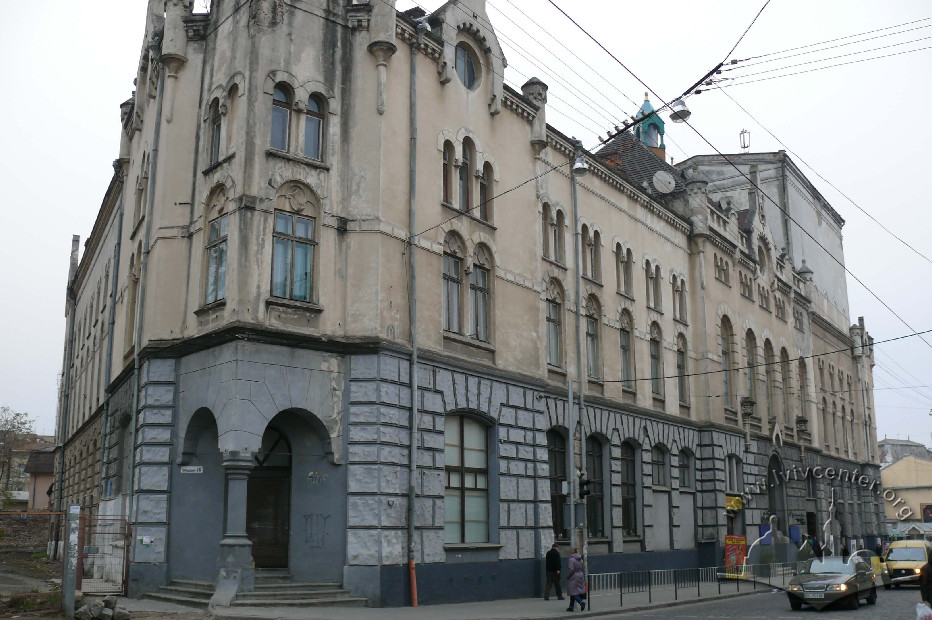
Vul. Horodotska, 36 – cinema (no longer in operation) ID: 1628
The building at vul. Horodotska 36 once housed a cinema that operated under several different names: "Illusion" (1911), "Stella-Mare" (1911), "Helios" (1911–1912), "Perła" (1912–1916), the "Ludowe Kino Czerwonego Krzyża" (1916–1918), "Świt", and the "Awangard" film club (1932–1944). Between 1918 and 1932, it served as the "Small City Theater", and from 1944 to 1948, it functioned as the "Moskva" cinema. Today, the building is home to the Lesia Ukrainka Lviv Dramatic Theater, with a portion of its premises leased to tenants.
Story
The "Illusion" cinema was founded in 1911 within the former Catholic House at ul. Gródecka 2b (present-day vul. Horodotska, 36). Its owners were Herman Opat and a partnership consisting of Józef Jaskólski and Edmund Libański. In 1911, the cinema was renamed "Stella-Mare", and later, the "Helios" cinema was relocated here from the former Skarbek Theater. In 1912, the establishment employed only seven people. The cinema's location in a "sparsely populated district" was considered unfavorable, and profits from screenings were meager. Consequently, the owners petitioned local authorities for a partial tax exemption. In 1912, ticket prices ranged from 20 hellers to 7 crowns.
From 1912 to 1916, the cinema operated under the name "Perła".
In 1916, the Red Cross took ownership, and the venue was renamed the "Ludowe Kino Czerwonego Krzyża". It operated under this name until the end of World War I, with a significant portion of its proceeds dedicated to aiding war victims. In addition to standard feature films, the cinema screened war newsreels that provided updates on military actions at the front.
From 1918 to 1932, cinema operations ceased, and the space was occupied by the "Small City Theater" (Pol. "Teatr mały").
On May 15, 1932, a new 469-seat sound cinema called "Świt" began its operations. The film "Król walca" was featured at the opening screening. The cinema continued under the name"Świt" until 1944. It was owned by the Union of Catholic Societies and Charitable Institutions (Pol. Związek Towarzystw Katolickich i Zarządів Dobroczynnych), with Stanisław Zborowski appointed as the manager.
Starting in 1932, the "Awangard" film club held screenings every Sunday morning, showing works by Sergei Eisenstein, Joris Ivens, the Themerson brothers, and others. In January 1933, the cinema hosted the Lviv premiere of "Biały ślad", a film about skiing shot in the Tatra Mountains by a member of the "Awangard" club. The film had previously been recognized at the Venice International Film Festival in August 1932.
A 1939 report from the Lviv Starostvo listed the owners as the Union of Catholic Societies and Charitable Institutions along with Stanisław Zborowski. Szczepan Bodzioch served as the manager and owner of the projection equipment for "Świt." By 1939, the cinema had accumulated debts totaling 40,000 zł.
From 1944 to 1948, the "Moskva" cinema operated in the building. As one of Lviv's first-category cinemas, it featured a comfortable auditorium and screened the latest releases. The cinema premises were later transferred to the Theater of Musical Comedy.
Related buildings and spaces
-
Vul. Horodotska, 36 – Lesia Ukrainka Lviv Dramatic Theater
People
Szczepan Bodzioch — one of the cinema's managers.
Stanisław Zborowski — one of the cinema's managers.
Edmund Libański — member of the owners' partnership.
Herman Opat — founder and co-owner of the cinema.
Józef Jaskólski — member of the owners' partnership.
Sources
- Biały ślad, Gazeta Lwowska, 1933, №7, 2.
- Gazeta Lwowska, 1933, № 49.
- GazetaLwowska, 1933, №41.
- Kurjer Lwowski, 1917, №1.
- Przewodnik po Lwowie (Lwów: Reklama Lwowska, 1936).
- Słowo Polskie, 1932, №133.
- Державний архів Львівської області (ДАЛО) 7/3/638.
- Радянський Львів: 1939–1955. Документи й матеріали (Львів: Книжково-журнальне видавництво, 1956).
- Центральний державний архів у м. Львів (ЦДІАЛ)190/1/13.
- Barbara Gierszewska, Kino i film we Lwowiedo 1939 roku (Kielce: WydawnictwoAkademii Świętokrzyskiej, 2006), 428.
- Віктор Проскуряков, Юрій Ямаш, Львівські театри: час і архітектура (Львів: Центр Європи, 1997), 132.
- Приватна збірка П. Ґранкіна.
- Роман Генега, Радянський кінематограф у Львові в перше повоєнне десятиліття, Український історичний журнал, 2011, №2, 106-122.