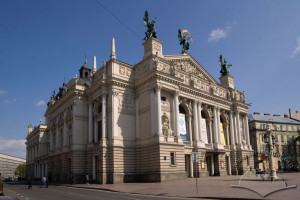
The Lviv
State Academic Opera and Ballet Theater was built in 1897-1900 under a project designed by
architect Zygmunt Gorgolewski.
The building is erected in historicist style and influenced by the
so-called
Vienna Neo-Renaissance. The monumental theater
building has
occupied a key position in the architectural ensemble of the city’s main avenue
created in the late 19th – early 20th century.
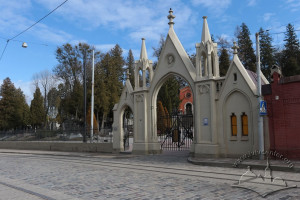
Lychakivsky (Lychakiv) cemetery is situated close to Mechnykova street; its territory occupies the Lychakiv plateau and its vicinities. As for today, this is the oldest preserved cemetery in Lviv which was officially opened in 1786. It is one of the best known European necropolises containing a lot of artistic monuments. The cemetery has been declared a historical, archaeological and artistic monument of national significance. There one can see the graves of many prominent persons, military burial places belonging to the times of the First and Second World Wars etc.
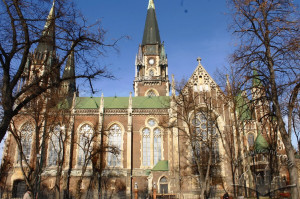
A Neo-Gothic church,
noted for its high towers and pointed spires, is one of Lviv's trademarks. It was designed by architect Teodor Talowski. Well-known
architects, sculptors and painters took part in the construction of this
church. According to the resolution of the Lviv regional executive committee
number 130 dated 26 February 1980, the church was entered into the local
register of monuments under protection number 146. In 1991 the church was
handed over to the local Greek Catholic community.
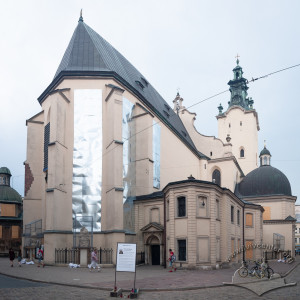
The Cathedral is the only object of Gothic
architecture in Lviv, preserved in its integrity. Its tower, along with the
City Hall, the Kornyakt tower, and the bell tower of the former Bernardine
church are symbols of the city, dominating in the panorama of its central part.
At present this is the Roman Catholic Arch-Cathedral of the Assumption of the Blessed Virgin Mary, also known
as the Metropolitan Basilica, an architectural monument of national
significance (protection number 316/0).
Pl. Kropyvnytskoho, 1 – The SS. Olha and Elizabeth (former St. Elizabeth) church
Pl. Katedralna, 1 – Cathedral of the Assumption of the Virgin Mary
Organizations
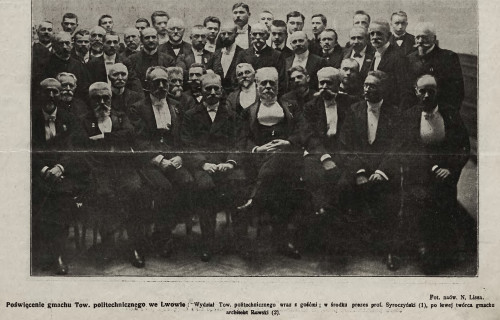
Polytechnic Society (Towarzystwo politechniczne)
Founded in 1876, functioned until 1939 (from 1913 known as the Polish
Polytechnic Society) — the first and leading non-governmental organization of technical
professionals in the crownland of Galicia. Combined the characteristics of a
trade union and a scientific society. Responsible for the founding of the
Industrial Museum in Lviv, the introduction to the city of electricity and the sewerage
system, etc.