ID: 41

ID: 41

Related buildings and spaces

  • Vul. Mykoly Kopernyka, 3 – Lviv State Academy of Finance
    The townhouse was constructed in 1909 according to the design of architect Alfred Zachariewicz for the Assicurazioni Generali insurance company in the late Secession style. Guidebooks refer to it as Italian; however, it was registered in the city of Trieste, which belonged to Austria-Hungary at the time. Prior to World War II, this building, adorned with high reliefs by Tadeusz Błotnicki and sculptures by Zygmunt Kurczyński, housed Józef Bajer's restaurant, where the "UL" ("Beehive") cabaret performed, as well as several fashionable shops. Today (as of 2009), the Financial and Economic Institute is located here.
    Read more
  • Pl. Henerala Petra Hryhorenka – monument to Franciszek Smolka (does not exist)
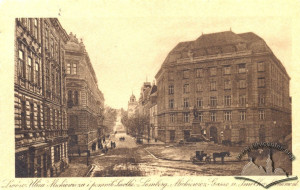
    A monument to Franciszek Smolka, a Polish politician and a resident of Lviv, was installed on the square by sculptor Tadeusz Błotnicki in 1913 and dismantled in 1946.

    Read more
  • Prosp. Svobody, 15 – Museum of Ethnography and Crafts (former Galician Savings Bank)
    Former building of the Galician Savings Bank. Currently (as of 2015), it houses the Lviv Museum of Ethnography and Crafts of the National Academy of Sciences of Ukraine and the Institute of Ethnology of the NAS of Ukraine. Built on the site of the former "English Hotel" according to a design by architect Julian Zachariewicz in 1889–1891 for the Galician Savings Bank. Constructed in Late Historicism style (Neorenaissance). An imposing bank building located on a corner plot at the intersection of prosp. Svobody (eastern façade) and vul. V. Hnatyuka (northern façade). Together with the former Prague Bank building situated opposite, it forms one of the most prominent landmarks on prosp. Svobody. The facility has been used as a museum building since 1950.
    Read more
  • Pl. Sv. Yura, 5 – St. Yuriy (St. George) Cathedral
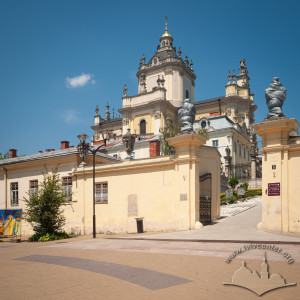
    St. George Cathedral of the Ukrainian Greek Catholic Church is the main building of the Sviatoiurivska Mountain construction complex and is one of the most dominant features of the Lviv panorama. The cathedral was built over the course of 1744–1761 (by the architects B. Meretyn and K. Fesinger) and was restored in 1905–1911, 1933, 1980 and 1999-2001.

    Read more
  • Vul. Illi Mechnykova – Lychakivskyi (Lychakiv) cemetery
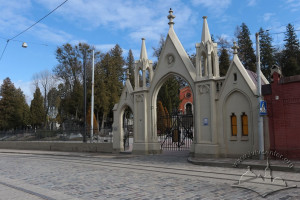
    Lychakivsky (Lychakiv) cemetery is situated close to Mechnykova street; its territory occupies the Lychakiv plateau and its vicinities. As for today, this is the oldest preserved cemetery in Lviv which was officially opened in 1786. It is one of the best known European necropolises containing a lot of artistic monuments. The cemetery has been declared a historical, archaeological and artistic monument of national significance. There one can see the graves of many prominent persons, military burial places belonging to the times of the First and Second World Wars etc.

    Read more
  • Vul. Ulasa Samchuka, 14 – building of the Department of Physical Culture of Lviv Polytechnic National University (former Palace of Arts)

    The former Palace of Arts was situated on the upper terrace of Stryiskyi Park along the main avenue of the 1894 General Regional Exhibition. It was the largest masonry building in the Exhibition's exposition complex. The palace was erected according to a design by architect Franciszek Skowron. The details of the design were elaborated by architects Hryhorii Pezhanskyi and Michał Łużecki. In 1950–1952, the Palace of Arts was converted into a sports complex for Lviv Polytechnic according to a design by Jan Bagieński. Today, the building houses a swimming pool and halls for basketball, volleyball, handball, soccer, tennis, chess, track and field, freestyle and Greco-Roman wrestling, judo and sambo, aerobics, boxing, sports tourism, and other sports. The building is an Architectural monument of local significance (protection No. M-1647).

    Read more
  • Pl. Halytska, 10 – Library of Ivan Franko National University of Lviv, former Biesiadecki Palace
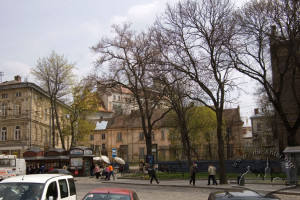
    The former Biesiadecki Palace (also formerly owned by the Bielski, Potocki, and Komorowski families; currently housing a library) was built in the early eighteenth century. It underwent major changes over the years: a reconstruction in 1756 by architect Pierre Ricaud de Tirregaille; an interior renovation in the 1820s by architect Fryderyk Bauman; and a further reconstruction in 1934 by architect Jan Bagieński. The architectural styles include Rococo, Empire (in the interior), and Neoclassicism.

    This standalone building is set back within the property behind a garden, which is separated from the square by a stone wall with an entrance gate. It is a prime example of eighteenth- and nineteenth-century urban palace architecture. Despite various renovations, the monument has preserved its original structural core.

    Read more
  • Vul. Mykoly Kopernyka, 3 – Lviv State Academy of Finance

    Vul. Mykoly Kopernyka, 3 – Lviv State Academy of Finance
  • Pl. Henerala Petra Hryhorenka – monument to Franciszek Smolka (does not exist)

    Pl. Henerala Petra Hryhorenka – monument to Franciszek Smolka (does not exist)
  • Prosp. Svobody, 15 – Museum of Ethnography and Crafts (former Galician Savings Bank)

    Prosp. Svobody, 15 – Museum of Ethnography and Crafts (former Galician Savings Bank)
  • Pl. Sv. Yura, 5 – St. Yuriy (St. George) Cathedral

    Pl. Sv. Yura, 5 – St. Yuriy (St. George) Cathedral
  • Vul. Illi Mechnykova – Lychakivskyi (Lychakiv) cemetery

    Vul. Illi Mechnykova – Lychakivskyi (Lychakiv) cemetery
  • Vul. Ulasa Samchuka, 14 – building of the Department of Physical Culture of Lviv Polytechnic National University (former Palace of Arts)

    Vul. Ulasa Samchuka, 14 – building of the Department of Physical Culture of Lviv Polytechnic National University (former Palace of Arts)
  • Pl. Halytska, 10 – Library of Ivan Franko National University of Lviv, former Biesiadecki Palace

    Pl. Halytska, 10 – Library of Ivan Franko National University of Lviv, former Biesiadecki Palace