ID: 92

ID: 92

Related buildings and spaces

  • Vul. Hrushevskoho, 4 – Lviv National Franko University building
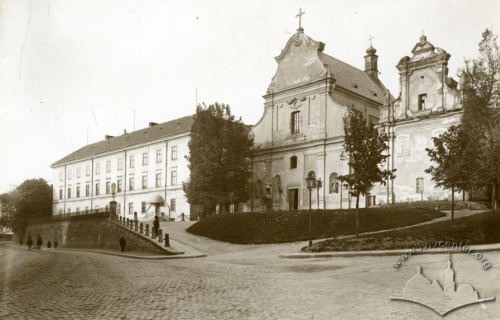
    A former convent school, later — a Lviv University building. It was originally built in 18th century, one of the major reconstructions was carried out in 1842 according to design of Fidelis Stadler. It is an example of Neo-Classicism in Lviv. It was built for a Jesuit convent school for young people from noble families. Later it housed military barracks. In 1851 it was transferred to the ownership of Lviv Franz-Joseph I University. Today (2015) it is one of Lviv Ivan Franko National University, it's Biology Department is located here.
    Read more
  • Vul. Kravchuka, 12 – residential building
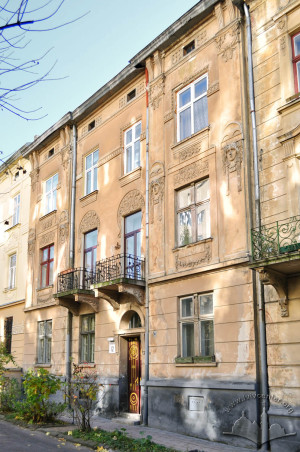
    One of the former houses of the engineer Franciszek Goląb (architect Andrzej Goląb's son), it was built on the newly laid vul. Kravchuka by the architect August Bogochwalski in 1906-1907. The house's façade and interior are designed in the style of the early (ornamental) Secession. The façade, in particular, preserves Secession carpentry with small carved pillars, door wrought iron and stucco, while the staircase interior features Secession overdoors, stained glass windows, bronze details, as well as Secession paintings under a layer of plaster, which need to be cleaned and restored. The building is an architectural monument (protection number 1075-M).

    Read more
  • Vul. Kotliarevskoho, 28 – residential building
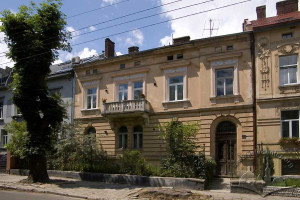
    The apartment building was constructed in the first half to the mid-1900s. It is situated on a site extending deep into the block, with a setback from the regulatory line. The two-story building features a body that is rectangular in plan with two firewalls on the sides, fitting into the perimeter development. A flowerbed is arranged in front of the principal elevation. The composition of the façade has a static character, dominated by horizontal divisions. The lower floor is rusticated and features rounded arched windows; a balcony is situated on the second floor. The portal and the staircase are offset to the right. Neorenaissance motifs are featured in the decor.

    Read more
  • Vul. Kotliarevskoho, 39 – residential building
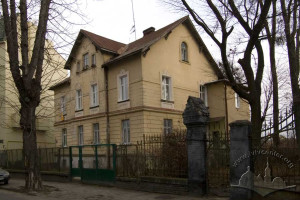
    The individual residential building (villa) was constructed in 1891–1892 according to the design of architect Jan Tomasz Kudelski from the bureau of Ivan Levynskyi. It is a detached two-story building with a basement and a mansard. It is rectangular in plan, with projections of small avant-corps that are topped by pediments. The roof is a gable roof with breaks, and carved wooden elements were used in its decoration. The entry hall and the staircase are situated near the northern end façade. The layout of the rooms is a double-row arrangement.

    Read more
  • Vul. Halytskoi Armii, 5 – residential building (villa)
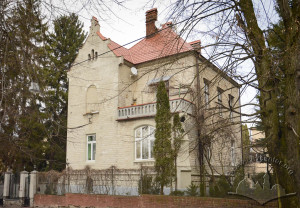
    This two-storied house was built in 1903–1904 under a project designed by architect Artur Schleyen as a private villa of Antoni Stefanowicz, a renowned artist. The architecture of the villa combines contemporary designs with Neo-Gothic décor. It is an architectural monument (protection number 1227).

    Read more
  • Piaski
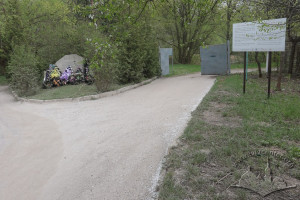
    Sites of mass murder of Jews near Janowska camp during the Nazi occupation.
    Read more
  • Vul. Hrushevskoho, 4 – Lviv National Franko University building

    Vul. Hrushevskoho, 4 – Lviv National Franko University building
  • Vul. Kravchuka, 12 – residential building

    Vul. Kravchuka, 12 – residential building
  • Vul. Kotliarevskoho, 28 – residential building

    Vul. Kotliarevskoho, 28 – residential building
  • Vul. Kotliarevskoho, 39 – residential building

    Vul. Kotliarevskoho, 39 – residential building
  • Vul. Halytskoi Armii, 5 – residential building (villa)

    Vul. Halytskoi Armii, 5 – residential building (villa)
  • Piaski

    Piaski

Organizations

  • Habsburg University

    Habsburg University

    The University, founded in 1784 by Joseph II on the basis of the abolished Jesuit academy, was to become the main source of professional officials for the capital of the Galician province. Stress was laid not on research, but chiefly on the training of managers. After numerous changes, in particular, the demotion of the institution status to that of a lyceum, in 1817 the university was refounded by Emperor Francis II. The institution existed in this condition till the end of 1918.

    Read more