Iryna Vilde (1907–1982) ID: 149


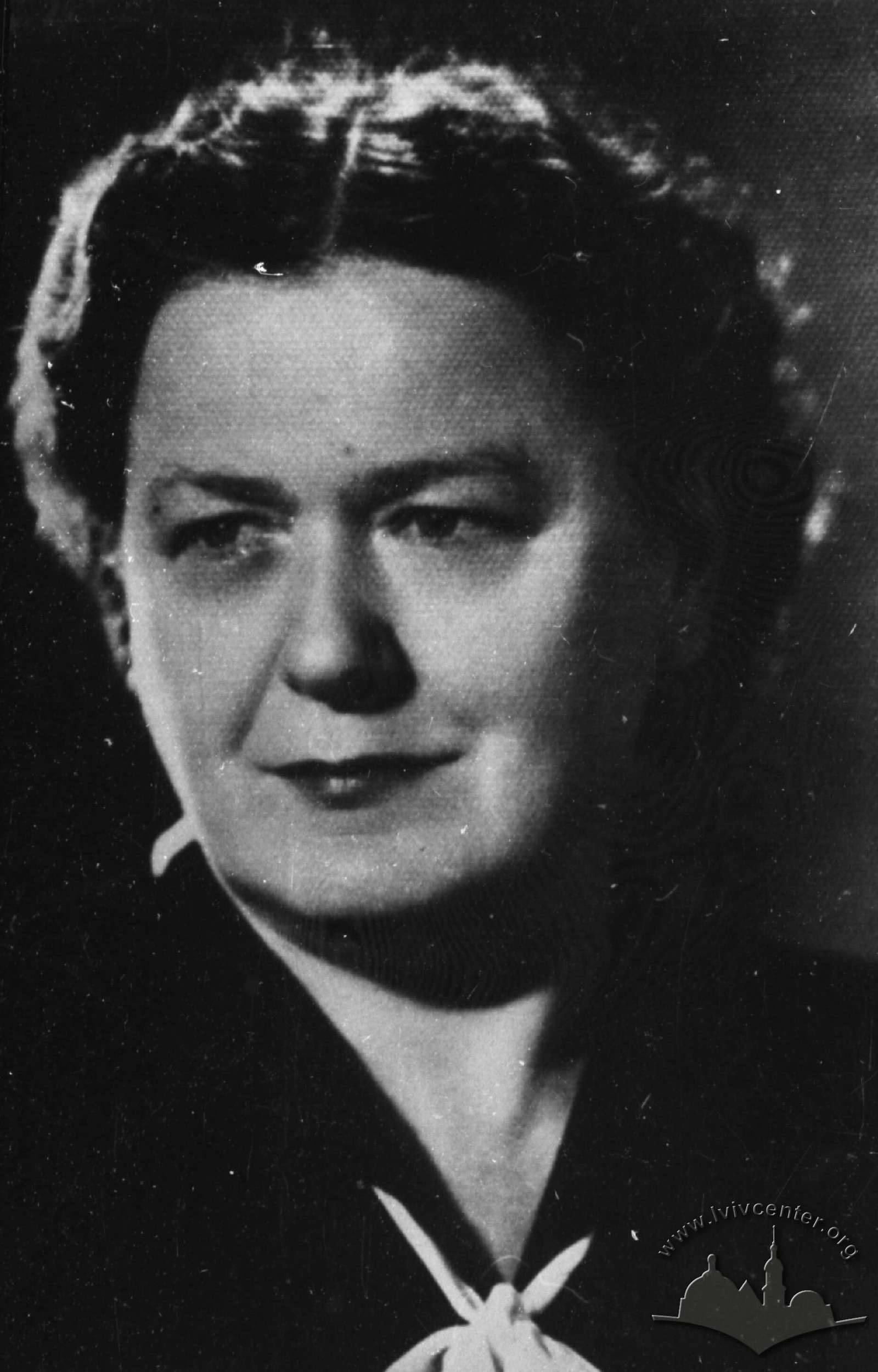

Iryna Vilde (1907–1982) ID: 149
Ukrainian writer, literary critic, editor.
Iryna Vilde is a pen-name of Daryna Dmytrivna Polotniuk-Makohon (Polotniuk was her husband's last name, Makohon was her father's name). She was born on May, 5, 1907, in the city of Chernivtsi in the family of a writer Dmytro Makohon, a descendant of an ancient noble family that made themselves noted during the Khotyn battle in 1621. She received her primary education in Chernivtsi. Because of conflicts of her father with Romanian authorities, in 1923 all of her family illegally crossed the Polish-Romanian border and settled down in Stanislaviv (presently Ivano-Frankivsk). She completed her middle school there and met her future husband Yevhen Volodymyr Polotniuk. Later, she worked in a private Ukrainian gymnasium. Since 1928, she had been doing Slavic studies at Jan Kazimierz University in Lviv. She studied together with Bohdan-Ihor Antonych at the same year and later kept in touch with him in their creative pursuits. During her fourth year of studies, she had to interrupt. According to some sources, it was due to financial difficulties, while the other sources claim it was due to suspicion of being related with Ukrainian Military Organization (UMO). In 1933, when her fellow students graduated from the university, Iryna Vilde worked as a teacher and started her journalism activities. She moved to Kolomyia where she worked in the newspaper "Zhinocha Dolia" (Women's Fate) that was half-social and half-literary. The writer and the journalist had lived and worked there until 1939. She was also proactive in Lviv literary milieu at a distance, as her books were published in Lviv. Her collection of short stories "Khymerne Sertse" (Whimsical Heart) and the novel "Metelyky na Shpylkakh" (Butterflies on Pins) published in 1935 promoted her to be the laureate of the second prize award of the Ivan Franko Society of Writers and Journalists which was the most prestigious literary award in Ukrainian Galicia.
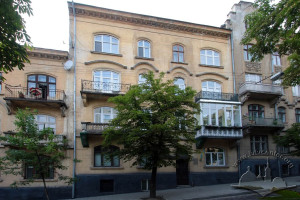
Since 1944 and until her death, Iryna Vilde stayed in Lviv. She worked as a reporter in the newspaper "Pravda Ukrayiny" (The Truth of Ukraine) (1945–1949); she had been elected a member of the Supreme Council of the Ukrainian SSR, to the regional and city councils of Lviv. She was awarded with two Soviet medals (1947, 1957). In 1965, she was awarded a Shevchenko prize for her novel "Sestry Richynski" (The Richynski Sisters). She had been head of Lviv organization of the Union of Writers of the USSR for a long time. In Lviv, the writer lived at the present vul. Kryvonosa, 33 (apt. 7). She died on October, 30, 1982. She is buried at Lychakiv cemetery.
–1939
In the context of literary process in the interwar period Galicia, Iryna Vilde was taking an important place. However, her writer's profile was modest. Almost until the late 1930s she had to make excuses that she it was her right not to raise burning social issues as in those times historical prose was mostly cultivated. The award of the Society of Writers and Journalists in 1935 caused a wave of debate such as whether the world, the style of writing and the assumingly marginal problems represented by Vilde in her works were worth awarding by a literary milieu and acknowledgement from the public. Nevertheless, Vilde had her supporters, predominantly among the circles of the so called liberal settings, i.e. beyond the ideology settings, of writers, critics, and artists. Even though she was not as well-known as two other contemporaries of hers, such as Katria Hrynevycheva and Natalena Koroleva, still, as an author of short stories and large prose, as well as of the series of journalist publications and editor of magazines, she had been acknowledged and enjoyed certain authority. In 1936, Bohdan-Ihor Antonych wrote a synthetic sketch on two books by Vilde that had been awarded. However, the text had never been published. Another important material that gives us most of information to understand artistic perceptions of Vilde is the interview that Mykhaylo Rudnytskyi recorded for the weekly "Nazustrich" (Towards) in the same 1936. In the interview, Vilde stated that she "was sort of concerned about the human heart as it is in itself, without the network of threads and nods that connect it to the external, or rather social world." And then: "No, no I wouldn't. Unless I manage the little world, the human heart, I would not embark on broader problems of human life, I won't manage them." The approach is interesting both as acknowledgement of her non-belonging to the dominant, ideologically predetermined discourse, and also as a contrast to what happened to the writer's life after 1939.
1939 and +1939
Iryna Vilde and Mykhaylo Rudnytskyi are the two prominent personalities of Western Ukrainian literary life of the interwar period. They were the pro-European persons in literature, representatives of the so-called liberal literary trend who stayed in Lviv after the Soviet Union settled down there definitely. The latter fact had an impact on their life and activities.
32-year-old Iryna Vilde faced 1939 as an author of about fifty pieces of short stories and large works, as well as essays. While in the interwar Galicia Iryna Vilde was far from social and national topics in her works and was an off-ideological writer, an expressively women's author (with respect for the then perception of femininity and literature for women), the Soviet cultural and literary policy was a challenge for her. After all, still today the motivation of Vilde's Sovietization as a person and a writer, dramatic or pragmatic reasons for this choice had not been sufficiently analyzed or contemplated. The same applies to Mykhaylo Rudnytskyi. His life was a subject of a greater attention, such as in the book by Ola Hnatiuk "Vidvaha i strakh" (Courage and Fear). There is a great contrast if one realizes the scope of the writer's worldview fluctuations. During the first Soviet occupation of Lviv in 1939, Iryna Vilde did not feel fully confident. Ostap Tarnavskyi mentions her among those authors who in 1939 found it "… difficult to join into the established and demanded social realism manner." She "was one of those with the largest temperament… and could not express the temperament, except for one short bleak story, she failed to write anything more" [it is about the first years of the "liberation"]. On the contrary, Petro Panch would describe Vilde as an author who used to live in the prewar Lviv and stayed to live and work there. According to him, they openly recognized their belonging to this discourse: "Iryna Vilde's texts sounded completely different. Each line implied genuine joy and gratitude to the Red Army who brought to Galicia happiness for the destitute people deprived of their homeland by evil imperialists." However, Iryna Vilde had to make her final decision only in 1944, during the second Soviet occupation. The motifs for such decision could be explained in a traditional way, by the fear and forced collaboration. As of today, there are two ways to interpret her conscious or forced choice. One of them is suggested by Natalka and Yarema Polotniuk, the son and the daughter-in-law of the writer. In the afterword to the revised edition of the inter-war cycle of her novels (2007) they claim: "... Iryna Vilde, the same as the rest of intelligentsia of the "second wave of immigration", could flee to the West in 1944; the writer was fluent in French and German. Moreover, some distant relatives of her mother used to live in Austria, or in Southern Germany. However, the "Roman" upbringing she received in the house of her parents and in the gymnasium tells the writer to stay in her native land and share the fate with her people. She was appreciated, she was trusted and relied upon. Staying in her homeland was not an easy decision to make, but she would not imagine any other decision, though." (p. 482). On the other hand, the entry on Iryna Vilde in the author's encyclopaedia of Ukrainian literature by Bohdan Romanenchuk "Azbukovnyk" (Philadelphia, 1973) describes the "Soviet" shift of the writer in an ironic, or rather negative manner. The author would use inverted commas to describe Soviet reality that had become the realia of creative and intellectual biography of Iryna Vilde: "During German occupation of Galicia, she would live here and there, while during the second arrival of the Bolsheviks she finally moved to Lviv and became a "public activist." She toured around villages with the groups of writers to advocate for the collectivization campaign. During that time, she also worked as a reporter for the "Pravda Ukrayiny" newspaper. For her activities, she was elected a member to the Supreme Council of Ukrainian Soviet Socialist Republic and to the regional and city councils of the city of Lviv. Later, she was also awarded with "huge trust from the party" and with two Orders (1947, 1957)..." (V. 2, P. 154).
Hence, Romanenchuk, in line with the peculiar rhetoric of the contemporary literary criticism, treated Vilde as a writer who fully fitted within the Soviet literary canon: "The writer studied communist ideology, according to her, upon recommendation of Stepan Tudor and Oleksa Desniak, in order to understand how the characters should think, act and feel in a Marxist way. She owes to the ideology as she was acknowledged a Soviet writer and accepted to the Union of Writers where she, as the one who used to write about "small human happiness", joined the cohort of the "giants of literature" (her own quote), such as Stepan Tudor, Oleksandr Havryliuk, Yaroslav Halan. Getting acquainted with the Marxist and Leninist philosophy, she "had grown in civil and political terms and felt happy" because "the public recognized her works", while critics called them "realistic, real-life, and truthful". She could not hope for more happiness." (v. 2, p. 157). It is obvious that correlation between the motifs of collaboration of West Ukrainian authors with the Soviet system and the rhetoric of the contemporary literary program discourse needs a more comprehensive analysis.
During the next four decades, Iryna Vilde worked on her opus magnum "Sestry Richynski" (The Richynski Sisters), readjusted her interwar novel "Povnolitni Dity" (Grown-up Children) and actively maintained contacts with young writers in Lviv. She would often arrange informal literary meetings. Some of the young authors called her "nanashka" (a Godmother) in literature. However, recalling the Galician interwar period and her activities in the period, she focused not on everything. In particular, she would avoid Bohdan Ihor Antonych, prohibited in the Soviet times, who was one of the most important writers for her before the war.
Works and projects
Works by Iryna Vilde:
Interwar period:
Collection of short-stories Khymerne Sertse (Whimsical Heart) (Lviv, 1936);
Trilogy of novels: Metelyky na Shpylkakh (Pinned Butterflies) (Lviv, 1936),
Bye Vosma (The Clock Strikes Eight) (Lviv, 1936),
Povnolitni Dity (Grown-up Children) (Lviv, 1939).
Soviet period:
Collections
of stories, sketches, and novels:
Istoriya odnoho zhyttya (A Story of One Life)
(1946);
Nashi batky roziyshlysya (Our Parents Have
Separated) (1946);
Ti z Kovalskoyi (The People From Kovalska
Street) (1947);
Stezhynamy zhyttya(Along the Paths of Life) (1949);
Yabluni zatsvily vdruhe (The Apple Trees Have Blossomed Again)
(1949);
Kury (Chickens)(1953);
Nova Lukavytsya
(1953);
Na porozi (On the Threshold)
(1955);
Vynen tilky ya(I Am the Only One to Blame) (1959);
Zhyttya tilky pochynayetsya (Life Is Just
Beginning) (1961);
Troyandy i ternya(Roses and Thorns)(1961);
Lyudske teplo(Human Affection) (1964).
Novels:
Grown-up Children (a readjusted version on the basis of the pre-war
series "Pinned Butterflies") (1952);
The Richynski Sisters (in 2 volumes,
1958–1964).
Related buildings and spaces
-
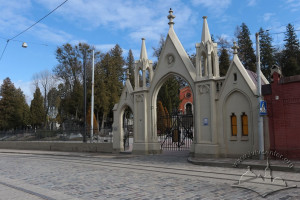
Vul. Illi Mechnykova – Lychakivskyi (Lychakiv) cemetery
-
Vul. Maksyma Kryvonosa, 33 – residential building
-
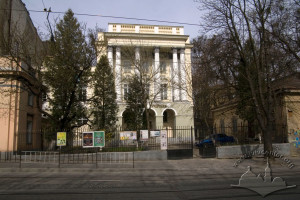
Vul. Mykoly Kopernyka, 42 – the Teacher's House
People
Organizations
-
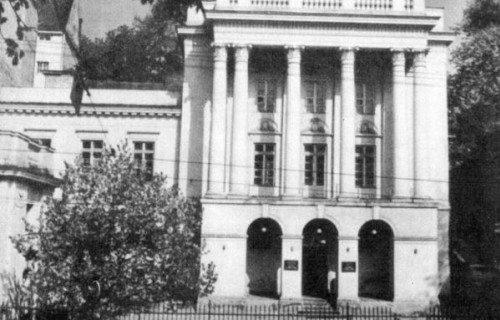
Lviv Organization of the Union of Soviet Writers of Ukraine
It was the key institution of official literary life in Soviet occupied Galicia. It functioned from 1939.
Read more -
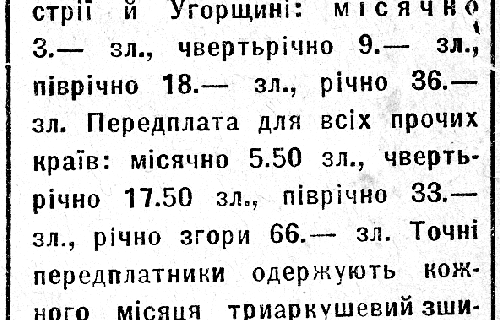
Ukrayinska Presa Concern
It was the largest scale Ukrainian publishing center of the interwar Galicia operating in Lviv.
Read more
Sources
Sources:
1. Богдан Романенчук, "Ірина
Вільде", Азбуковник: енциклопедія української літератури, (Філадельфія,
1973), т. 2, с. 154–158.
2. Кость Волинський, "Вільде Ірина", Українська літературна
енциклопедія (Київ, 1988), т. 1, с. 321–322.
3. Марія Вальо, "Забутий
світ Ірини Вільде", Ірина Вільде Незбагненне серце (Львів, 1990),
с. 3–23.
4. Ніна Бічуя, "Вільде Ірина", Енциклопедія Львова (Львів,
2007), т. 1 (за ред. А. Козицького та І. Підкови), с. 385–386.
5. Олег Баган, "Коли
серце, як на долоні (Кілька штрихів до ранньої творчости Ірини Вільде)", Ірина
Вільде, Метелики на шпильках; Б'є восьма; Повнолітні діти: повісті (Дрогобич,
2007), с. 3–12.
6. "Еротика, патріотизм, плани на майбутнє
(Розмова з Іриною Вільде)", Ірина Вільде Метелики на шпильках; Б'є
восьма; Повнолітні діти: повісті (Дрогобич, 2007), с. 13–16.
7. Наталка і Ярема
Полотнюки, "Через терни до зірок", Ірина Вільде, Метелики на
шпильках; Б'є восьма; Повнолітні діти: повісті (Дрогобич, 2007), с.
476–486.
Author — Danylo Ilnytskyi
Translated by Svitlana Brehman