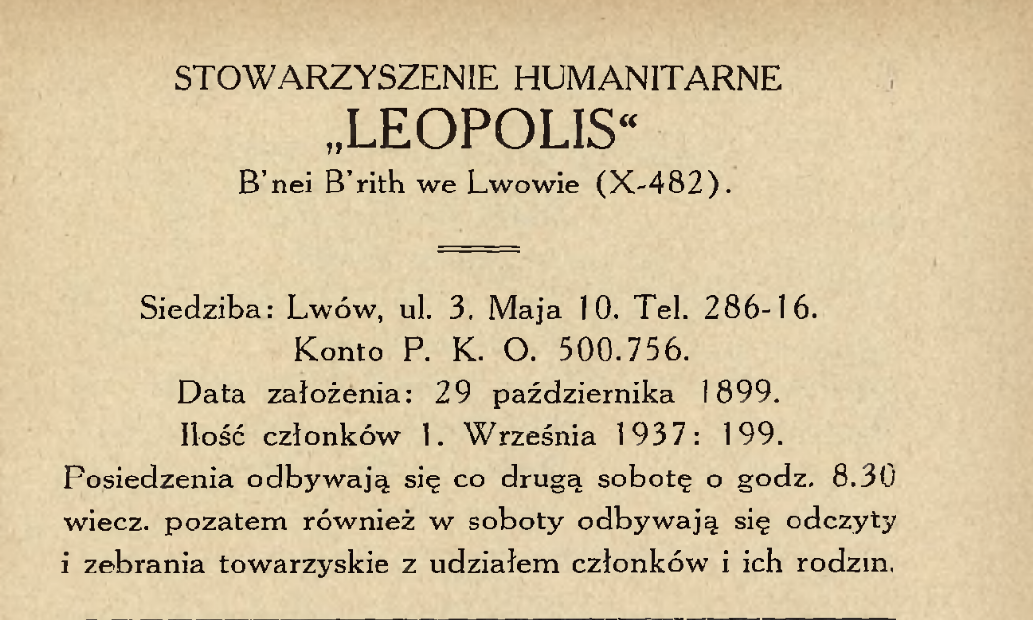
The B'nai B'rith Leopolis Society (1899–1938) ID: 145
At the end of the 19th century, Lviv became a city of social change, where modern education, economic development, and new constitutional laws paved the way for the Jewish community's emancipation and growing social influence. In this environment, the B'nai B'rith Leopolis Society emerged as a hub uniting bankers, lawyers, doctors, rabbis, scholars, and various politicians. They shared a sense of responsibility toward the Jewish community and a commitment to serving society through philanthropy, education, and mutual support. The history of Lviv's B'nai B'rith (Hebrew for "Sons of the Covenant") thus reflects the rise of the local Jewish elite in the modern era.
The B'nai B'rith brought together Jews of diverse political views, united by a common trait: their lives exemplified Jewish emancipation and the social mobility possible during the late Austrian period. The society's members represented the local elite — having received a secular education, they were primarily invested in the development of the city and community where they were born and lived.
The first B'nai B'rith society was founded by the German Jewish diaspora in New York in 1843, aiming to help newly arrived immigrants settle into their new country. The society's mission broadened when anti-Semitism surged again in Europe in the mid-19th century, prompting efforts to assist Jews in various countries. This led to the creation of B'nai B'rith societies in Europe, which united the local Jewish elite around charitable and educational initiatives. Such organizations emerged primarily in unified Germany and Austria-Hungary — especially after new laws in the late 1860s permitted voluntary associations of citizens. In central Poland, then part of the Russian Empire, these societies appeared only after 1918, as Russian law had previously prohibited them.
In Lviv, an organization called B'nai B'rith Leopolis was established by members from Krakow and registered by the Galician Governor's Office on October 5, 1899. The bylaws of each society required respect for the laws of the country in which it operated and encouraged members to regard it as a second homeland (Kargol, 2008: 260). On one hand, this echoed the Talmudic principle that the law of the land is binding (dina d'malkhuta dina); on the other, it fit seamlessly into the modern worldview of emancipated Jews.
The first premises of the B'nai B'rith society in Lviv were located at ul. Bernsteina, 12 (now vul. Sholom Aleichem, 12). The society soon sought to acquire its own building, but this plan took a long time to realize. Their premises at ul. 3 Maja, 10 (now vul. Sichovykh Striltsiv) finally opened on October 30, 1932 (Sroka, 2014: 102).
Throughout its existence from 1899 to 1938, the Lviv
branch was led by prominent members of the local Jewish community, including
Emil Byk (a proponent of assimilation and public figure), Jecheskel Caro
(Reform rabbi and historian), Józef Czeszer (public figure), Ludwik Gruder, Samuel Horowitz (banker and public
figure), Aleksander
Meyer, Emil Mieses (lawyer), Emil Parnas (lawyer), Jonasz Reinhold, Szymon
Schaff, Filip Schleicher, Józef Parnas, Rubin Sokal, Lewi Freund (rabbi),
Wiktor Chajes (assimilationist, banker, and public figure), Witold Wiesenberg,
Michał Ringel (Zionist and lawyer), Emil Grabscheid, Marceli Buber, and
Jecheskel Lewin (Sroka, 2014: 102).
After the collapse of the Austro-Hungarian Empire, the Lviv chapter resumed its activities in 1919. Membership peaked in 1924 with 246 members (B'nai B'rith. Organ Związku, 1928, No. 1: 19), making Leopolis the largest B'nai B'rith chapter in interwar Poland, where ten chapters existed at the time (Książka Adresowa, 1937). A notable feature of the Lviv chapter was the geographic diversity of its members — not only from Lviv, but also from other cities in Poland and abroad, including Chernivtsi, Tel Aviv, Vienna, and Paris. During the interwar period, the organization did not actively seek new members, so its numbers remained stable. A 1928 report even mentions a proposal to suspend new admissions for an extended period to encourage greater involvement from existing members (B'nai-B'rith. Organ Związku, 1929, No. 1: 27).
According to its charter, the organization was described as humanitarian and educational. Its primary objectives were the moral and intellectual development of the city's Jewish community, with social support — such as assistance to the sick, orphans, and widows — also playing a significant role. The only mandatory requirement for membership was ethnic affiliation (Sroka, 2014: 105).
The criteria for admitting new candidates reflected the society's elitist character: candidates had to be at least 24 years old, possess an impeccable reputation, and be in good physical and mental health. Recommendations from current members were also an important factor, and each member paid the required dues. Researcher Lukasz Sroka attempted to determine the percentage of accepted candidates but was unable to identify a clear trend. However, his analysis of the Lviv B'nai B'rith society's composition confirmed its elitist nature — by 1937, 55% of members held high social status: among 198 people, there were 90 doctors, 17 engineers, and 1 physician-engineer. The remaining members also had higher education, though not always high social status. Most society members represented the liberal professions, including industrialists, bankers, doctors, merchants, teachers, business owners, judges, architects, and pharmacists (Sroka, 2014: 103–104).
Philanthropy, Public Engagement, and Apolitical Stance
A key characteristic of the Lviv chapter of B'nai B'rith was its institutional apolitical stance. Although many members held differing political views, Leopolis never publicly declared any political platforms. In the introductory article "Our Goal" in the B'nai B'rith monthly, the prominent Zionist Ozjasz Thon, noting the need to clarify the goals of the societies in various Polish cities, wrote:
"I hope that in the future, B'nai B'rith will not have a 'program' in what I would call the 'vulgar' sense, in which various parties draw up grandiose — and sometimes enormous — programs. B'nai B'rith, as a general association, does not have a clearly defined program, and therefore there is unlimited opportunity for each member to search within his own soul, within his own worldview, and within his deepest convictions for those issues on which he would like to work within the framework of B'nai B'rith"(Thon, 1928, No. 1: 4).
The lack of political hegemony or a central ideology was most evident in the diversity of the members' worldviews. Generally, Leopolis made decisions collegially. The governing board consisted of a president, vice president, secretary, tax clerk, and treasurer. During the interwar period, leadership was shared among a mentor, president, vice president, secretary-registrar, treasurer, marshal, and security officer.
A practical explanation of the society's objectives was offered by one of the Lviv chapter's presidents, Rabbi Levi Freund. He connected the organization's modern mission to the continued existence of Jewish charitable institutions, noting that B'nai B'rith's activities largely replicated many functions of the kahal as outlined in its charter:
"Our first motto places a heavy responsibility upon us. Almost every day presents us with new social challenges. Overcoming the poverty caused by the prolonged war and postwar events, striving to prevent further economic decline among our people by establishing cooperative institutions, and guiding the younger generation toward practical professions all require great sacrifices on our part. And many of us, who are constantly called upon to contribute to social and charitable causes, believe that our generation is particularly burdened by circumstances of which our ancestors were completely unaware. Therefore, the time has come to acquaint the members of the B'nai B'rith Association with the immense social burden and contribution of past Jewish generations". (Freund, 1928: 12–13).
At the end of 1928, during Wiktor Chajes's presidency, a significant public turning point occurred for all B'nai B'rith chapters in Poland: in response to rising antisemitism and slander, the monthly informational magazine B'nai B'rith began publication. Its aim was to promote the society's activities (Kargol, 2008: 272). Published in Krakow, the magazine reported on the societies' current work in Poland and abroad.
Throughout its existence, the organization fostered cultural and social activities, holding meetings that featured a range of presentations — some closed for members, others open to the public. Between 1930 and 1932 alone, 50 presentations were given on social, cultural, and political topics. Notable speakers included well-known cultural figures, politicians, and scholars: Józef Awin on the life of artist Maurycy Gottlieb (pol. Maurycy Gottlieb, 1930), Cecylja Klaftenowa on The Aftermath of the Congress Against White Slavery (pol. Pokłosie kongresu walki z białym niewolnictwem, 1930), Rabbi Jecheskiel Lewin on On the Youth Organization (pol. O zrzeszeniu młodzieży, 1930), Michał Ringel on Massaryk and Balfour (pol. Massaryk i Balfour, 1930), Rubin Sokal on Polish Law Governing Jewish Communities (pol. Polskie prawo gmin żydowskich, 1931), Ada Reichenstein on Józef Roth — His Works and Significance in Literature (pol. Józef Roth — jego dzieła i znaczenie w literaturze, 1931), Henryk Rosmarin on The Current Situation of Jewish Youth (pol. Obecne położenie młodzieży żydowskiej, 1931), Abraham Insler on In the Kaleidoscope of Contemporary Russia (pol. W kalejdoskopie współczesnej Rosji, 1931), Majer Bałaban on Issues in Jewish Historiography and the History of Jews in Poland (pol. Zagadnienia historiografii żydowskiej a historia Żydów w Polsce, 1932), and Bernard Hausner on What I See and Hear Every Day in Palestine (pol. Co widzę i słyszę codziennie w Palestynie, 1932) (Sroka, 2016: 54–56).
During this period, the society's primary activity was supporting orphans. At the time, over 900 Jewish orphans lived in Lviv — some in boarding schools, others cared for at home. Leopolis also distributed 4,599.86 zlotys in assistance to the widows of its members (B'nai-B'rith. Organ Związku, 1929, No. 1: 28).
During the interwar period, B'nai B'rith, along with the Regional Zionist Organization (RZO), was the leading organization in Eastern Galicia to receive and raise funds from American donors, primarily from The Joint. Founded in 1914 at the outbreak of World War I, this humanitarian organization aimed to support Jews affected by violence. Over time, its objectives evolved to address the needs of local Jewish communities in Eastern Europe — supporting widows and orphans, rebuilding the economies of affected small business owners, and promoting Jewish involvement in agriculture. While the RZO directed funds toward developing cooperatives and professional infrastructure (Skokova, 2023, 142–148), B'nai B'rith primarily focused on humanitarian missions; specifically, one of the main activities for all B'nai B'rith societies in Poland was caring for orphans who had lost their breadwinners due to war and devastation. In total, 347 orphanages in Poland were maintained with support from The Joint, with one of the main centers located in Lviv (Steinberg, 1928, No. 1: 23).
There is evidence of one initiative, albeit unsuccessful, to expand the organization during the interwar period. In 1935, an attempt was made to establish a youth section within B'nai B'rith (Honigsman, 1999: 56). However, this idea never fully materialized. In general, the history of the B'nai B'rith societies demonstrates that their members belonged to a single generation that had benefited from emancipation laws and social mobility during the Austrian period. As a result, similar opportunities for social success no longer existed during the interwar period.
The situation for all B'nai B'rith chapters worsened dramatically after the death of Józef Piłsudski in 1935. Subsequent shifts in state policy, growing antisemitism, societal polarization, and the enactment of antisemitic laws shaped a new reality for Polish Jews in the late 1930s. The final blow to B'nai B'rith activities in Poland came with the adoption, on November 22, 1938, of anti-Masonic legislation modeled on Nazi laws, which was applied to the organization based on fabricated allegations of Freemasonry. Wiktor Chajes wrote the following notes dated November 30, 1938: "B'nai B'rith has been disbanded throughout Poland. Ten years ago, I was president of B'nai B'rith, and I have been a member for 20 years. Therefore, I was a Freemason for 20 years" (Chajes, 1997, 228).
The Success of Social Mobility
The founding of the B'nai B'rith society in Lviv took place during the most dynamic period of civil society development in the city. This process was the long-term outcome of the constitutional laws of the 1860s, which opened the way for various political, economic, and civic initiatives during the Habsburg era. The establishment of B'nai B'rith in Lviv in 1898 exemplified these national changes: nearly every member benefited from modern education and the social mobility of the late 19th century. In this way, the local Jewish elite of Lviv emerged, comprising members from diverse political parties and branches of Judaism. The society united both secular Jews (assimilated and nationalist) and representatives of different religious movements — Hasidism, Rabbinic Judaism, and Progressive Judaism. Membership lists show that left-wing ideologies were entirely excluded, as were fully assimilated Jews who no longer maintained contact with the community.
One of the most prominent members of the society was its co-founder and president, the Lviv banker and public figure Samuel Horowitz (1841–1924). He was an active patron of many civic and charitable initiatives in the city, founding several institutions that contributed to the development of Lviv's Jewish community. For instance, he established a fund to support Jewish merchants and artisans with his own resources, and in 1911, on his 70th birthday, donated 500,000 crowns ($100,000 in gold) to various charitable and community causes. He also financed the construction of a funeral hall at the Jewish cemetery, made a substantial donation to the Abraham Korkis School of Crafts and Industry (Szkoła Rzemieślniczo-Przemysłowa im. dra A. Korkisa), and supported the planned Rabbinical Seminary in Lviv. Alongside the renowned scholar Salomon Buber (1827–1906), he founded the Jewish community library in Lviv, which was named in his honor after his death in 1924. Throughout the interwar period, Samuel Horowitz was regarded as a model citizen by both Poland and the Jewish community (Brenner, 1937: 37–38).
Another notable community leader was Wiktor Chajes — a banker, public figure, and vice president of Lviv. In December 1927, after becoming president of B'nai B'rith, he wrote in his diary:
"Yesterday I was elected president of B'nai B'rith (Leopolis). This is the highest honor a Jew can attain in Lviv. The B'nai B'rith lodges, scattered throughout the world, uphold the principles of charity, brotherhood, and harmony. The Lviv lodge has about 200 members (the election was very competitive) and has existed for 29 years. Every year, it allocates significant sums to charitable causes, organizes lectures, and collaborates with other lodges in Poland. The Grand Lodge in Poland is located in Kraków, and the world headquarters is in Chicago. During the war, American lodges sent us large sums for war orphans. The presidency of B'rith did not match my youthful dreams and aspirations. I wanted to be Tobiasz Aschkenase…" (Chajes, 1997, 67).
In these memoirs, Wiktor Chajes referred to one of the most prominent examples of Jewish assimilation and professional achievement — Tobiasz Aschkenase (1863–1920) — a lawyer who served as president of the Lviv Bar Association from 1911, a City Council member from 1902 to 1913, and vice president of Lviv in 1909 (Sroka, 2012, 309, 475; Vovchko, 2016, 115). Aschkenase was also a leading defender of Jews affected by the November pogrom of 1918.
In contrast to Chajes and Aschkenase, well-known Zionist politicians were also prominent within the B'nai B'rith society in Lviv — Leon Reich and Emil Schmorak, leaders of the Regional Zionist Organization in Eastern Galicia, the largest modern Jewish political party in the region. Leon Reich (1879–1929) led the party at the peak of its popularity. His life story is another successful example of emancipation during the Habsburg period: born to a secular Jewish family in Drohobych, he was expelled from high school for participating in an underground youth organization, traveled throughout Europe and Palestine, studied law at the University of Lviv, and later earned a doctorate in political science from the School of Political Sciences in Paris (1910–1912). He first ran for parliament in 1911, albeit unsuccessfully.
After World War I and the sudden death of Gerschon Zipper, head of the Regional Zionist Organization, Leon Reich became the new leader of the Zionists. In the following years, the party gained the strongest support among local Jews in elections. Reich's leadership (1919–1929) coincided with significant ideological shifts within the Jewish community: politics became a mass phenomenon, and after the wars ended and borders were settled (1914–1923), Eastern Galicia saw a surge in civic and cultural life. Reich was also deeply engaged in defending the rights of Jews in the reconstituted Polish state and made several trips abroad to raise funds for rebuilding the economy of Galicia's Jewish community (Skokova, 2023, 97–99).
Another prominent Zionist and member of the B'nai B'rith society was Emil Schmorak (1886–1950(?)), who succeeded as leader of the Regional Zionist Organization. His biography closely parallels that of Reich: Schmorak also came from an emancipated Jewish family, received a secular education, studied law at the University of Vienna, and became active in national youth organizations as a student. His most significant contribution to the political movement in Eastern Galicia was the expansion of the Palestinian focus within the Regional Zionist Organization — whereas Leon Reich was the main proponent of diaspora nationalism in Zionism, advocating for equal rights for Jews in Poland. This Palestinian discourse intensified particularly after Schmorak became party leader, following the Lviv Zionists' setbacks in national politics (in the Sejm and Senate), and especially after Poland annulled the Treaty on the Rights of National Minorities in 1934 (Skokova, 2023, 103).
These examples of the life paths chosen by members of the B'nai B'rith society in Lviv vividly illustrate the impact of major societal changes during the Austrian period. Regardless of their public standing or popularity, every member of the B'nai B'rith society embodied a modern identity — defined not only by professional accomplishment but also by a commitment to contributing to community development.
Significance
The history of B'nai B'rith Leopolis Society marks a significant stage in the development of Lviv's Jewish community. The organization united generations of Jews who, through their social success, became the city's new elite. Although their life paths differed, members of the B'nai B'rith society shared key traits: a secular, modern education, professional achievement, and strong civic values — all hallmarks of the Austrian constitutional period. Regardless of their political differences, they were bound by philanthropy, social responsibility, and a commitment to active participation in the city's and community's life.
B'nai B'rith Leopolis was not only a charitable organization but also a crucial space for shaping modern Jewish identity in Lviv. Its activities reflected an effort to blend the tradition of Jewish mutual aid with new models of civil society. However, the history of interwar Poland — with the rise of antisemitism and populist influences — also exposed the society's institutional vulnerabilities.
People
Majer Bałaban (1877–1942(?)) — one of the most prominent historians of interwar Poland and the founder of Jewish historiography in Central and Eastern Europe. He co-founded the first academic institution dedicated to Jewish history — the Institute of Jewish Studies in Warsaw (Instytut Nauk Judaistycznych, 1928).
Emil Byk (1845–1906) — lawyer, public figure, and advocate of assimilation. He served as president of the Jewish community in Lviv (1902–1906), was a member of the city council, and represented the Polish Club in Vienna.
Wiktor Chajes (1875–1940) — banker, vice mayor of Lviv (1930–1939), leader of the Jewish community, philanthropist, and public figure; president of the B'nai B'rith Society from 1928 to 1929.
Lewi Freund (1877–1940) — rabbi of the Progressive Synagogue in Lviv (1920–1939), philosopher, and teacher. He served on the board of trustees that founded the Jewish Community Museum in Lviv.
Samuel Horowitz (1841–1924) — banker, philanthropist, and co-founder of the B'nai B'rith Leopolis Society in Lviv.
Cecylja Klaftenowa — Educator and social activist. From the Russian occupation of Lviv in 1914 until her death during the Nazi occupation, she was deeply involved in supporting orphans and providing vocational training for young people.
Jecheskel Lewin (1897–1941) — rabbi of the progressive synagogue in Lviv, philosopher, and historian. During the Soviet occupation (1939–1941), he was the only person permitted to conduct services in the synagogue. He was killed during the first July pogrom in 1941.
Emil Parnas (1867–1930) — lawyer, city council member, and head of the Jewish community during World War I. He served on the committee that aided Jewish victims during the November pogrom of 1918.
Józef Parnas (1870–1941) — lawyer, commissioner of the Lviv Jewish community (1937–1938), and city council member (1919–1939). He served three times as president of the B'nai B'rith Society and supported the idea of assimilation. From July to October 1941, he was chairman of the Judenrat.
Leon Reich (1879–1929) — a leading figure of Eastern Galician Zionism and a lawyer. He headed the Regional Zionist Organization of Eastern Galicia from 1919 to 1929, promoted numerous social and cultural initiatives, and was the chief advocate for national minorities' rights in the Polish Sejm (1922–1929).
Michał Ringel (1880–1941) — lawyer, journalist, Zionist, and senator. Throughout the interwar period, he was the permanent representative of the Lviv Zionists at the World Zionist Congresses.
Emil Schmorak (1886–1950(?)) — lawyer, publicist, and a leader of the Regional Zionist Organization in Eastern Galicia. During the interwar period, he focused on developing Palestine activities in Eastern Galicia, especially in the press and through the establishment of institutions.
Ozjasz Thon (1870–1936) — a leading figure among Polish Jews during the interwar period. He was among the first activists to support Theodor Herzl's idea of establishing a Zionist center. He served as rabbi of the Progressive Synagogue in Kraków (from 1897), was a publicist, and a member of the Sejm (1919–1936).
Sources
- Adolf Brenner, "Samuel Horowitz", Almanach i leksykon Żydostwa polskiego, 1937. T. 1: 37–38.
- Wiktor Chajes, Semper fidelis: Pamiętnik polaka wyznania mojżeszowego z lat 1926–1939 (Kraków: Księgarnia Akademicka, 1997).
- Książka Adresowa Członków Żyd. Stow. Hum. "B'ne B'rith" w Polsce (Kraków, 1937).
- Lewi Freund, "O dawnych żydowskich instytucjach charytatywno-społecznych", B'nai-B'rith. Organ Związku Stowarzyszeń humanitarnych "B'nai-B'rith" w Rzeczypospolitej Polskiej, Kraków, 1928, Rok 1, Nr. 2: 12–18.
- "Obecny stan liczebny Stowarzyszeń B'nai-B'rith w Polsce", B'nai-B'rith. Organ Związku Stowarzyszeń humanitarnych "B'nai-B'rith" w Rzeczypospolitej Polskiej, Kraków, 1928, Rok 1, Nr. 1: 19–20.
- Józef Steinberg, "Z akcji humanitarnej Związku B'nai-B'rith w Polsce", B'nai-B'rith. Organ Związku Stowarzyszeń humanitarnych "B'nai-B'rith" w Rzeczypospolitej Polskiej, Kraków, 1928, Rok 1, Nr.1: 23–25.
- Ozjasz Thon, "Nasz "cel"", B'nai-B'rith. Organ Związku Stowarzyszeń humanitarnych "B'nai-B'rith" w Rzeczypospolitej Polskiej, Krakow, 1928, Rok 1, Nr. 1: 3–5.
- "Ze sprawozdania Stowarzyszenia "Leopolis" B'nai B'rith we Lwowie", B'nai-B'rith. Organ Związku Stowarzyszeń humanitarnych "B'nai-B'rith" w Rzeczypospolitej Polskiej, Kraków, 1929, Rok 2, Nr. 1: 27–29.
- Anna Kargol, "Loża «Solidarność» i Zakon B'nei B'rith. Z dziejow parawolnomularstwa żydowskiego na ziemiach polskich", Przegląd Historyczny, 99/2, 2008: 249–275.
- Łukasz Sroka, "Members of the "Leopolis" humanitarian society in Lvov (1899-1938): a group portrait", Scripta Judaica Cracoviensia, Vol 12 (2014): 99–119. DOI: 10.4467/20843925SJ.14.008.2814
- Łukasz Sroka, Rada Miejska we Lwowie w okresie autonomii galicyjskiej 1870-1914: studium o elicie władzy (Kraków: Wydawnictwo Naukowe Uniwersytetu Pedagogicznego, 2012), 564 s.
- Łukasz Sroka, "Stowarzyszenie Humanitarne "Leopolis" we Lwowie (1899–1938)", Kwartalnik Historyczny, Vol 123, nr 1 (2016): 45–69.
- Марія Вовчко, Асиміляційні процеси єврейського населення Галичини у другій половині ХІХ – на початку ХХ ст., Дисертація, 2016, 245 с.
- Надія Скокова, Крайова сіоністська організація Східної Галичини (1918–1929), Дисертація, 2023, 211 с.
- Яків Хонігсман, "«Бней Бріт» у Східній Галичині", Українське єврейство, Вип.4. (1999): 46–59.