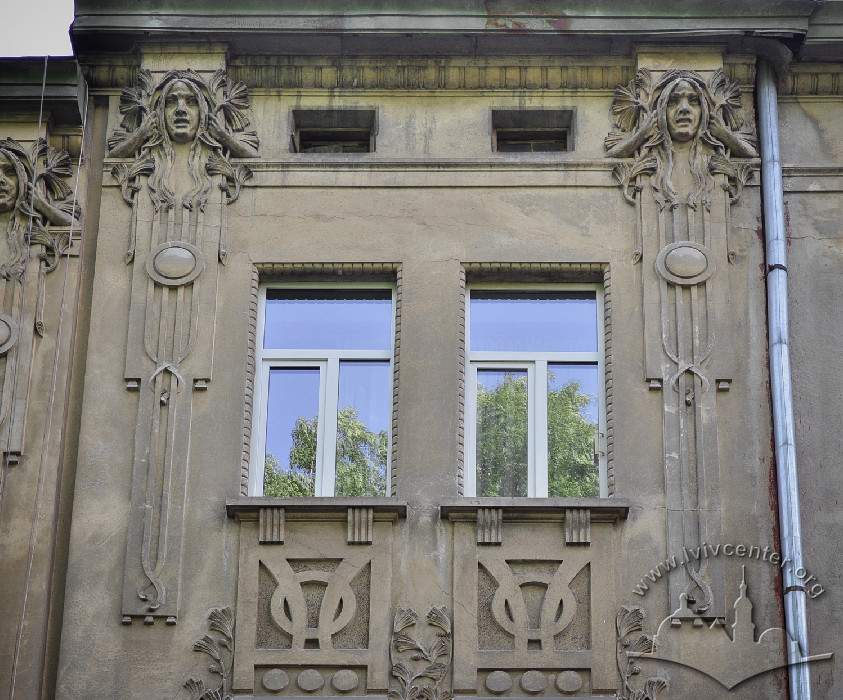
Vul. Nechuia-Levytskoho, 17–19 – residential building ID: 562
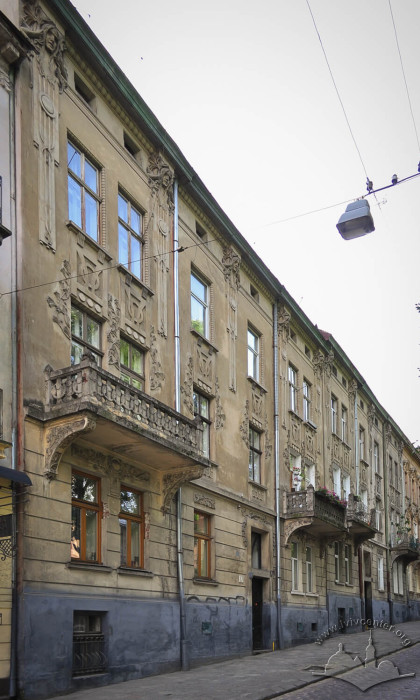
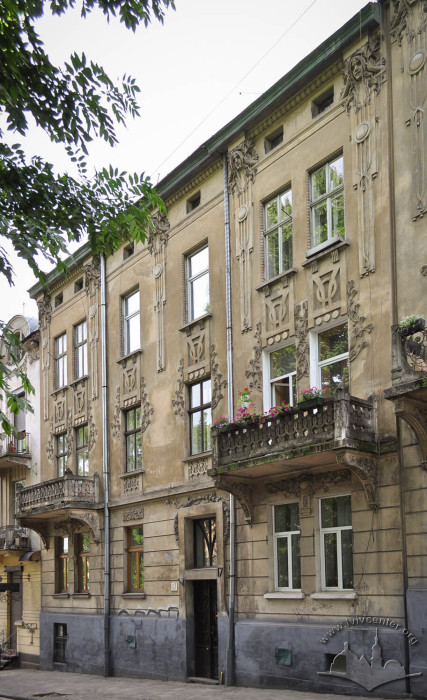
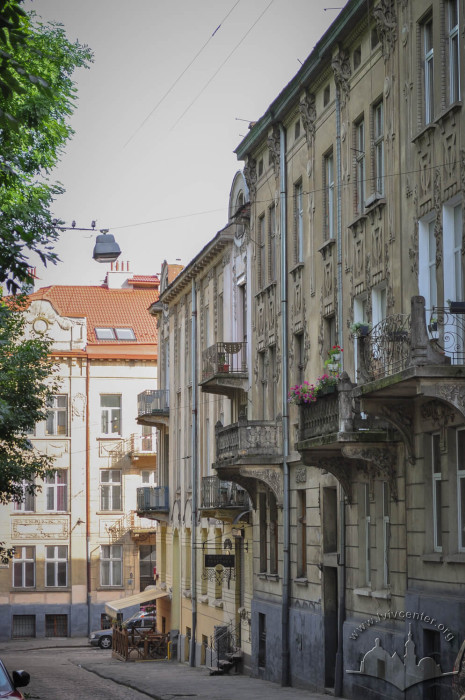
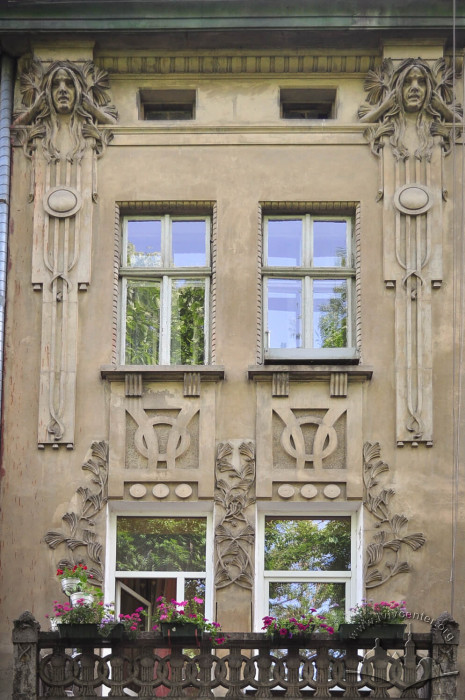
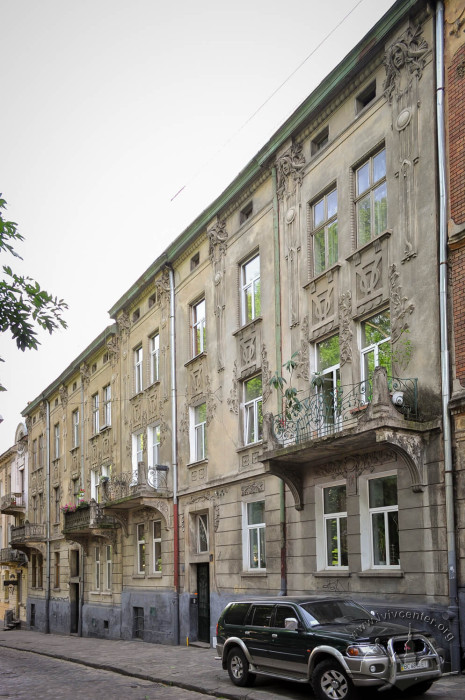
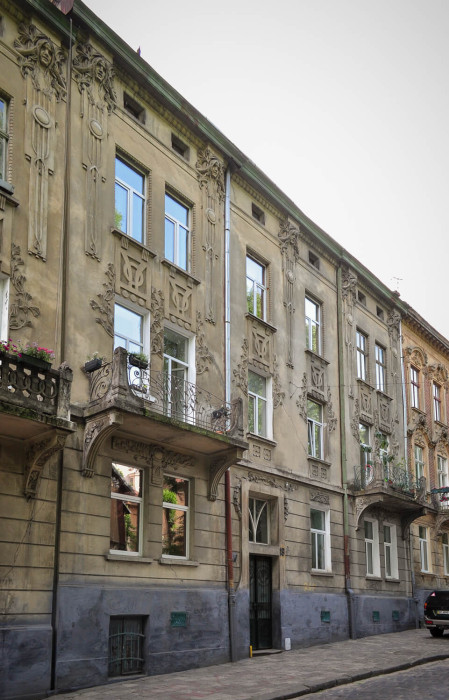
These two adjacent mirror-like houses were built by Jakub Rysiak in 1906−1907. Both feature the Secession style expressed in the distinctive stucco decoration and in the paintings with poppy motifs. The buildings are included in the Register of architectural monuments of local significance.
Story
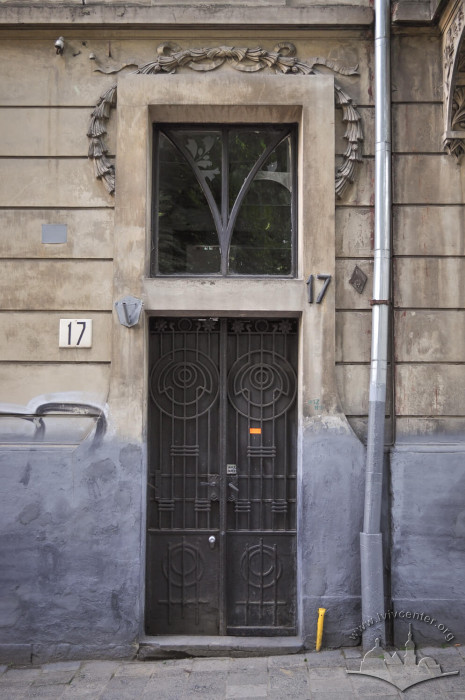
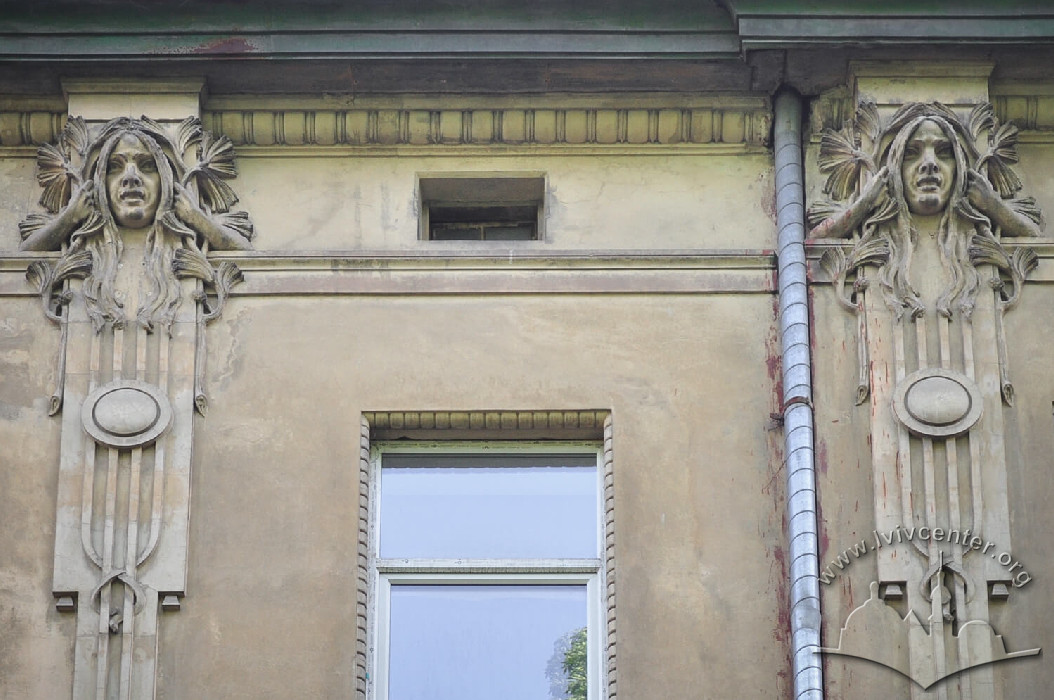
The houses at vul. Nechuia-Levytskoho 17 and 19 were built by the constructor Jakub Rysiak in 1906–1907 according to his own design. The houses are located in the northeastern part of the former suburban neighbourhood of Kastelivka, which was built up with villas and townhouses intended mostly for wealthy and noble Lviv residents starting from the 1880s. The houses of Helena and Jakub Rysiak were built in the Secession style, which is expressed in the distinctive stucco decoration with mascarons. The decor features a motif of larch branches on the façades, characteristic wrought-iron entrance doors, porch ceiling paintings with poppies and lilies, carved overdoors above both entrance and interior doors in the apartments, tiled stoves, etc.
These townhouses were built on a former large plot, which in the 19th century was designated by the conscription number 73¼ and was used for pastures and vegetable gardens. In the late 19th century it was parcelled for row housing, and the Rysiaks bought several parts of it. Since Jakub Rysiak was involved in construction, it was his wife Helena who took care of the bureaucratic procedures. Accordingly, it is her name that appears in the archival files (ДАЛО 2/2/1777; 2/2/1779). Thus, in 1906 Helena Rysiak acquired six parcels (ground numbers 2500/18, 2501/3, 2502/11, 2500/2, 2501/2, 2502/10 — ДАЛО 2/2/1777:1-3). The Rysiak family had two virtually identical mirror-like houses built on this land.
On 5 May 1906, Helena Rysiak applied to the magistrate for permission to build two three-storey houses with semi-basements facing the courtyard on the newly acquired plot and to have the submitted projects designed by the constructor Jakub Rysiak approved (ДАЛО 2/2/1777:1-5; ДАЛО 2/2/1779). By the way, in the same year, 1906, the Rysiak family moved to a newly built townhouse at ul. Nabieliaka 26 (now vul. Ivan Kotliarevskoho) (ДАЛО 2/1/5251). On 15 May 1906, the magistrate's construction department granted Helena Rysiak a building permit. Along with the permit, the department's engineer emphasised the regulations that had to be followed, in particular that the houses had to be built within the frontage line set by the already built townhouses 21 (owned by Ivan Levynsky) and 23 (ДАЛО 2/2/1777:6-8, ДАЛО 2/2/1779:5). On 19 May, Rysiak's project was approved (ДАЛО 2/2/1777:5).
The houses were built for a little over a year, and on 6 August 1907 Helena Rysiak received a permit from the magistrate's construction department to use house 17 (ДАЛО 2/2/1777:9); on 29 August the same permit was granted for house 19 (ДАЛО 2/2/1779:8). Along with this permit, the Rysiaks' property on ul. Lenartowicza received new numbers: the conscription one 1723¼ and the orientation one 17; the conscription one 1722¼ and the orientation one 19. The occupancy permits listed the composition of the two houses premises. In the lower tier house 17 had: 2 rooms, 2 kitchens, 1 shop, 1 room for the caretaker, 1 laundry, 1 toilet, 1 storeroom, 2 staircases, 4 cellars, 2 corridors; the ground floor consisted of 6 rooms, 2 hallways, 2 kitchens, 2 bathrooms, 2 toilets, 2 pantries, 2 staircases, 1 entrance porch; on the 2nd and 3rd floors, there were 7 rooms, 2 hallways, 2 kitchens, 2 bathrooms, 3 toilets, 2 pantries, 2 staircases (ДАЛО 2/2/1779:8). This list shows that there were two full-fledged apartments on each floor of the house's main part. The lower tier of house 19 contained: 2 rooms, 2 kitchens, 1 room for the caretaker, 2 corridors, 1 laundry, 1 toilet, 2 storerooms, 2 staircases, 3 cellars (ДАЛО 2/2/1779:8).
If we compare the constructed buildings with those designed, the architectural and artistic design of the constructed buildings' façades is much more magnificent and stylistically expressive than in the designs; they have only the layout in common. The project lacks stucco façade decor and balconies, as well as interior design.
It is worth noting that all of Jakub Rysiak's townhouse projects are similar: a single sheet contains a location diagram, plans, the main façade, longitudinal and transverse sections, which indicate the house's main parameters: its layout and structural elements like foundations, floors, wall thicknesses and roof structure. As for the façades, Rysiak only presented the layout and showed the decor schematically. The decoration was performed according to separate sketches, which were not approved by the magistrate's construction department. On the one hand, this was in line with the norms of the 1885 Lviv Building Code. Generally, however, the decoration of buildings was considered an integral part of the masonry profession and not of the architectural profession (Biriuliov, 2015, 211-219). Rysiak was a licensed bricklayer and at the same time a master of sculptural and decorative decoration, so he built according to his own designs and decorated the houses himself. Therefore, Rysiak submitted projects for approval in accordance with the requirements for construction.
In a short time, the houses built by the Rysiaks were acquired by wealthy owners. The 1913 address book lists the inhabitants of house 17: Stanisław Ehrlich, an insurance company inspector; Josef Mazur, a postal worker; Franciszek Wróbel, a tailor; Andrzej Kilian, a carpenter; Zygmunt Płatowski, a factory director; and Stanisław Płatowski, who was the owner of the real estate at that time (Księga adresowa, 1913). In later documents, Zygmunt Płatowski is listed as the owner of the real estate No. 17, while the owner of the real estate No. 19 was Jento Rawer, a Jew (ДАЛО 2/2/1779).
In 1938, the municipal technical department ordered Zygmunt Płatowski to restore the courtyard façade to the level of the 2nd floor balconies and the walls of the entryway. According to the resolution, the work was to be completed within 14 days. The house manager Maria Mitsza was responsible for this (ДАЛО 2/2/1777:11).
In the courtyard of the building No. 17 there was a stone statue of the Blessed Virgin Mary on a pedestal in a niche behind glass; the time of its construction is unknown.
During the Soviet period, the tenement townhouses were nationalised and inhabited by new residents, the apartments being converted into communal ones. During its existence, the building repeatedly underwent repair and restoration works, not always performed professionally; in particular, the paintings on the porch and staircase walls were mostly whitewashed. After Ukraine gained independence, authentic entrance doors and wooden window carpentry were replaced with metal-plastic ones in some apartments.
In 2024, the paintings in the staircase of house 19 were partly restored. The work was carried out by the Garda workshop led by Iryna Hirna.
Architecture
The townhouses are located in the row housing on the odd-numbered side of vul. Ivana Nechuia-Levytskoho, in an area steeply sloping to the south. Both buildings are L-shaped and stand on two almost identical rectangular plots. The total area of the plots is ~370.0 m2; the built-up area is ~258.0 m2 (length 3.00 m, width 16.00 m, height to the roof ridge 19.20 m); the courtyard area is ~112.0 m2.
The brick and plastered L-shaped houses with wings stand on brick foundations and are built in the Secession style; they have three floors with cellars and semi-basements facing the courtyard and are covered with gable tin roofs; due to the location on a plot steeply sloping to the south additional flights of stairs down to the courtyard are arranged.
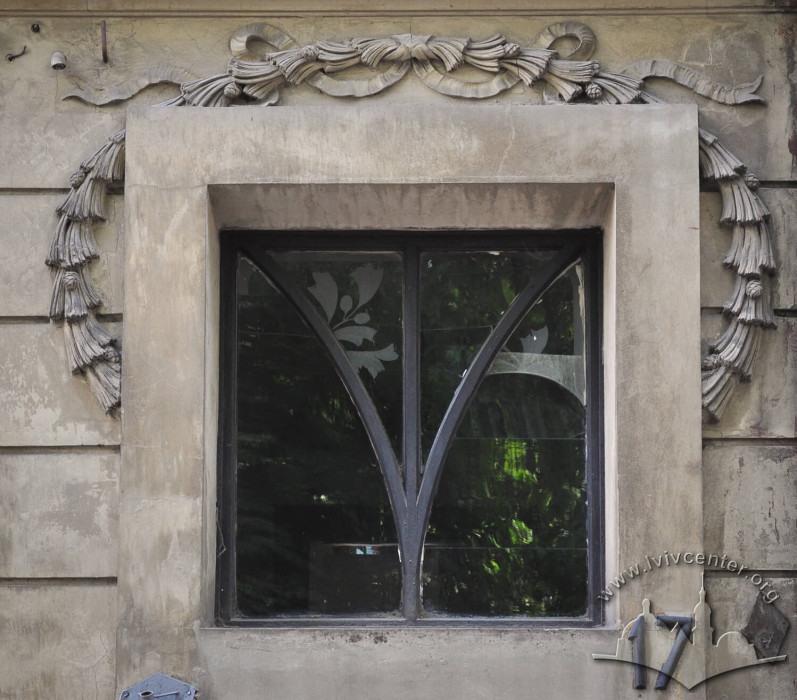
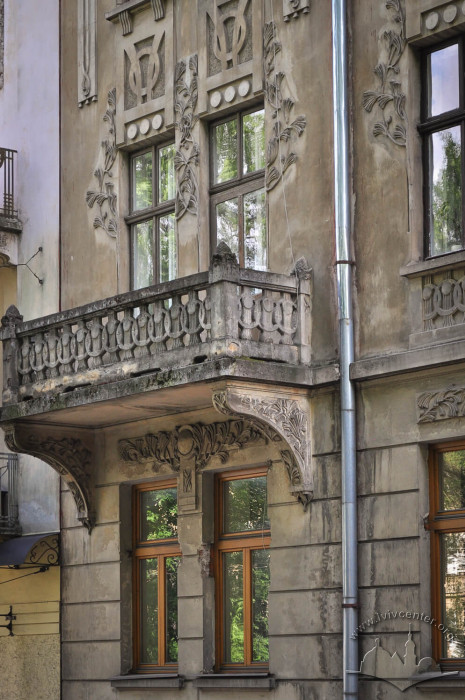
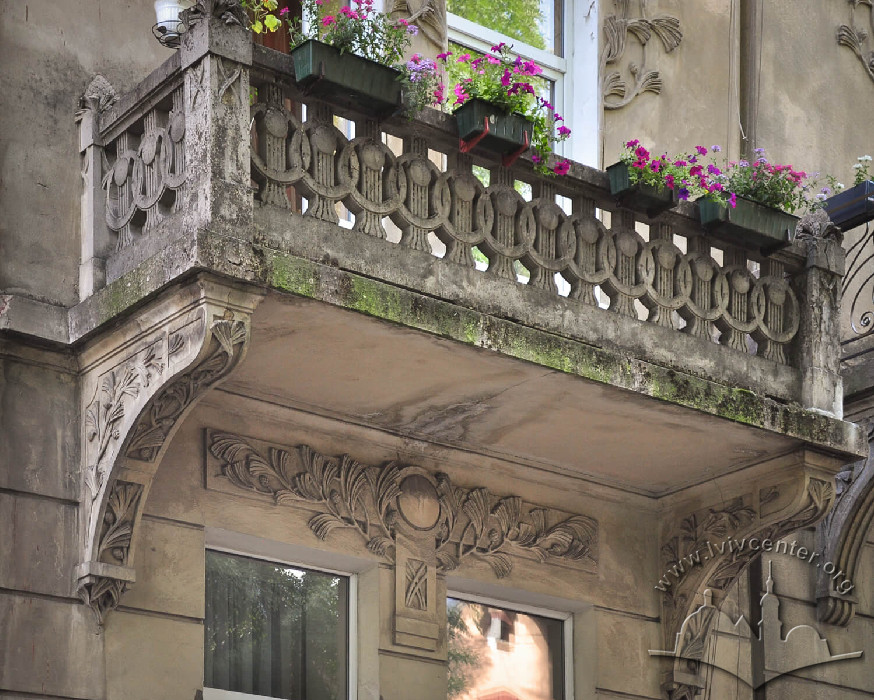
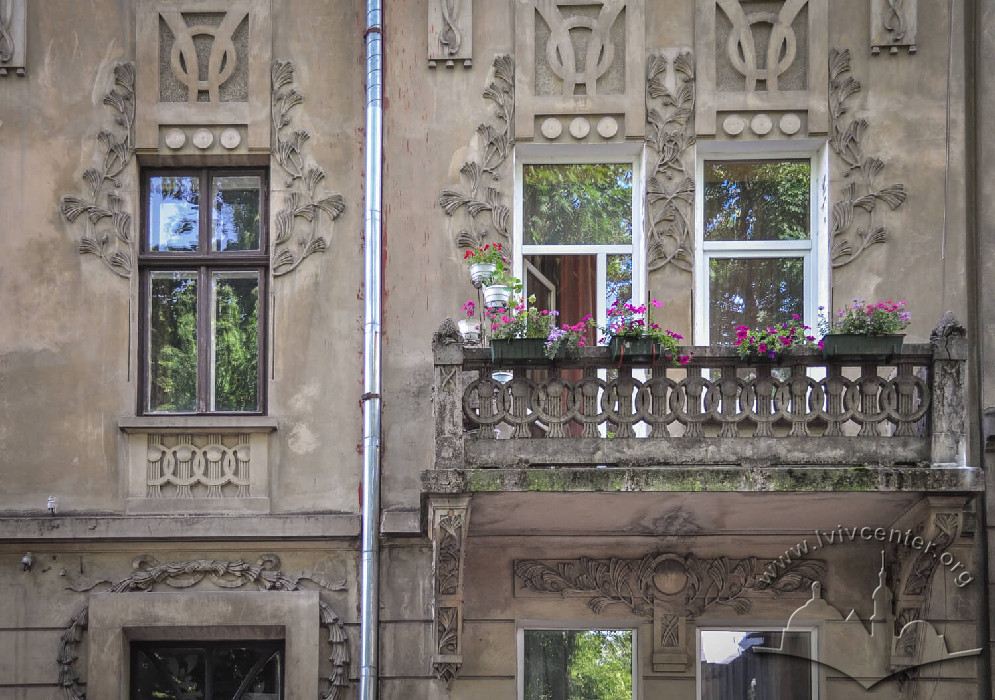
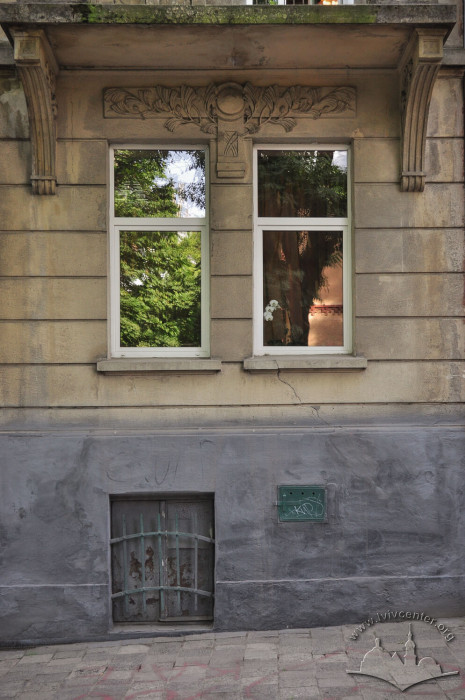
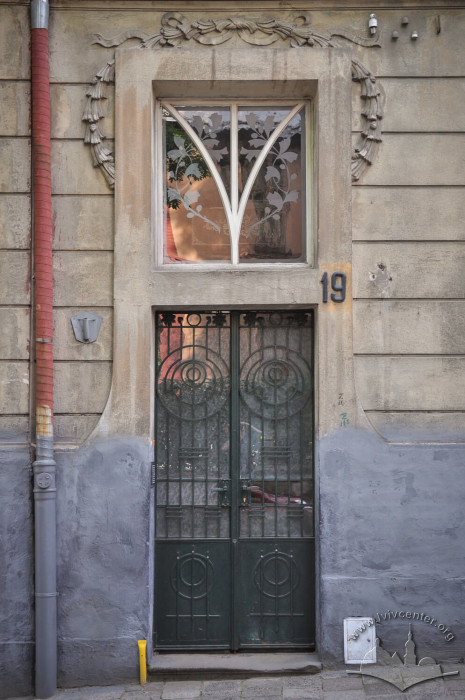
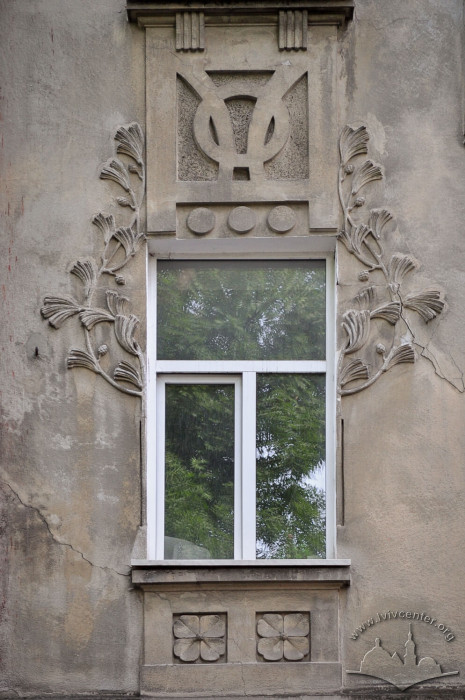
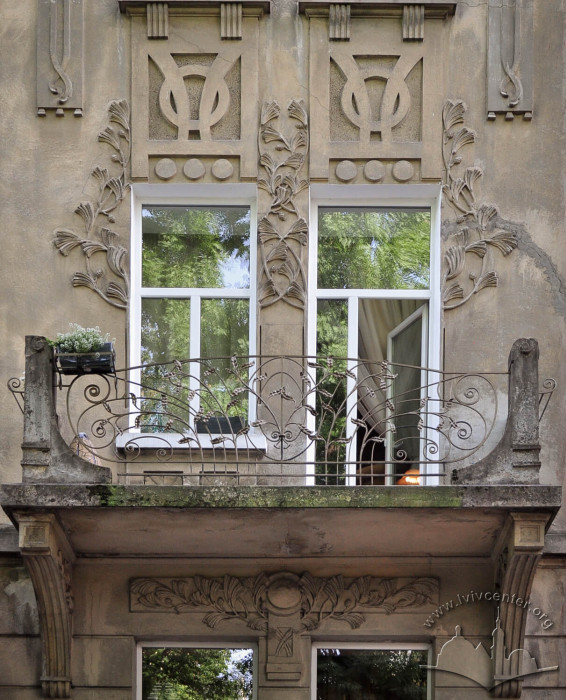
The main façades of each building have six window axes, grouped in three rows of two; the side ones have windows with close proximity, accentuated by protruded wall sections with balconies on brackets. The façades are given a Secession expressivity by the characteristic lisenes with round stamps and bas-reliefs of female heads that flank the protruded wall sections and separate the windows of the middle row on the third and attic floors. The Secession façade decoration uses the motif of larch tree branches, which decorate the windows of the first two floors, female heads, and balcony brackets. The balconies are the element that makes the façades of the two houses different. The balcony railings of house 19 are made as wrought-iron Secession lattices; the balconies of house 17 have masonry railings formed of textured columns and rings connected in a chain. A similar ornamental motif is used in the decoration under the second floor windows. The wall below the third floor windows is decorated with a circle motif; the second floor windows are also decorated with circles. The ground floor is separated from the first floor by a simple string, covered with a plank rustication. The façades are accentuated by entrance gates emphasised by portals with an overlight decorated with a garland. The iron main entrance door is glazed in the upper part and has a Secession wrought lattice. The overlight has a wooden infill and panes with etched stylised larch branches with cones. The façades are crowned with an elaborate brick cornice accentuated by a beaded roller with spools, and a frieze with rectangular attic windows; the high stone base is topped with a profiled roller. The façades facing the courtyard are smooth, plastered with lime-and-sand mortar and covered with an overhanging roof on wooden supports. The rear façades have ribbon gallery balconies on each floor with entrances to the apartments. Single-flight wooden stairs lead to the cellars and to the courtyard.
The houses have a sectional layout: each floor has two apartments with entrances from the staircase (one apartment with two entrances: a regular entrance through the hallway and a grand entrance leading to the living room), and one apartment in the wing with an entrance from the ribbon balcony.
The entrance area of the townhouses consists of an entrance portal, an entryway with a flight of 11 stone steps, which leads to the main wooden two-flight staircase through a double door.
The houses have a second, so-called "back" staircase, located in the rear part of the wing, with an entrance from the courtyard; these staircases have access to ribbon balconies that encircle the rear façades on each floor. The entrances to the semi-basements are from the courtyard.
The space of the porch and staircase is distinctly designed in the Secession style and looks quite respectable: the doors are decorated with overdoors having a bas-relief depicting a kneeling child in a decoration of poppy flowers and leaves. The motif of poppies can be seen in the etchings on the staircase window panes, as well as in the unique author's paintings of the porch and staircase ceiling. The staircase walls, preserved under a layer of plaster, also have paintings discovered by the restorers. The staircase landings are paved with patterned ceramic tiles produced by the Ivan Levynsky company.
The rooms have preserved oak parquet floors, Secession tiled stoves, door and partially window carpentry with brass fittings. The doors of the rooms are decorated with Secession overdoors, which have the same motif of larch tree branches as the façade; above one door in the second floor apartment is an overdoor with a bas-relief depicting a lyre and a female head in a laurel wreath, decorated with violet flowers.
In the middle of the courtyard of house 17 stands a sculpture of the Blessed Virgin Mary on a stone pedestal behind glass, the only one preserved in the inter-quarter space of Lviv's residential buildings.
Houses 17 and 19 on vul. Ivana Nechuia-Levytskoho are among the best examples of Lviv's tenement townhouses of the Modernist period in its Secession manifestation.
People
Franciszek Wróbel — tailor, resident of tenement house No. 17.Stanisław Erlich — insurance company inspector, resident of tenement house No. 17.
A. Kilian — carpenter, resident of tenement house No. 17.
Jan Lewiński — builder, owner of the tenement house at Nechuia-Levytskoho 21.
Józef Mazur — postal worker, resident of tenement house No. 17.
Marya Mitsza — housekeeper of house No. 19.
Zygmunt Platowski — factory director, owner of property No. 17.
Stanisław Platowski — owner of property No. 17.
Jento Rawer — owner of property No. 19.
Helena Rysiak — wife of builder Jakub Rysiak, owner of tenement houses at 17 and 19 Nechuia-Levytskoho Street.
Jakub Rysiak — builder and sculptor, licensed master mason, owner and builder of tenement houses at 17 and 19 Nechuia-Levytskoho Street.

Sources
- Державний архів Львівської області (ДАЛО), 2/2/1777.
- ДАЛО 2/2/1779.
- ДАЛО 2/1/5251.
- Księga adresowa król. stoł. miasta Lwowa, 1913.
- Księga adresowa Małopołski. Lwów-Stanisławów-Tarnopól, 1935–1936.
- Архітектура Львова. Час і стилі. XIII – XXI ст., ред. Юрій Бірюльов (Львів: Центр Європи, 2008).
- Юрій Бірюльов, "Творчість мулярських майстрів і скульпторів-декораторів львівських споруд кінця ХІХ – початку ХХ ст.", Вісник Національного університету "Львівська політехніка". Архітектура, 2015, № 836.
- Андрій Дорош, Проходи не без задоволення і з мораллю. Путівник (Львів, 2008).
- "Кастелівка", Енциклопедія Львова, Т. 3 (Львів, 2010).
- Львів. Туристичний путівник (Львів: Центр Європи, 2007).
- Борис Мельник, Довідник перейменувань вулиць і площ Львова (Львів: Світ, 2001).
- Ігор Мельник, Львівський Новий Світ та південні околиці Королівського столичного міста Галичини від Святого Юра до Наварії (Львів: Центр Європи, 2009).
- Ігор Мельник, Львівські вулиці і кам’яниці, мури, закамарки, передмістя та інші особливості королівського столичного міста Галичини (Львів: Центр Європи, 2008).
- Володимир Тимофієно, Зодчі України кінця XVIII - початку ХХ століть: біографічний довідник (Київ: НДІТІАМ, 1999).
- Орися Шиян, "У львівській кам'яниці відреставрували сецесійні квіткові розписи", Захід.нет.
- Jurij Biriulow, "Wiatr przemian. Nowe tendencje w architekturze Lwowa 1890-1914", Architektura Lwowa XIX wieku, red. Jacek Purchla (Kraków: Międzynarodowe Centrum Kultury, 1997).
- Jakub Lewicki, Między traducją a nowoczesnością. Architektura Lwowa lat 1893-1918 (Warszawa: Neriton, 2005).