Pl. Adama Mitskevycha, 10 – cinema (no longer exists) ID: 1721
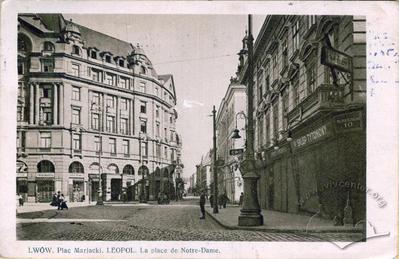
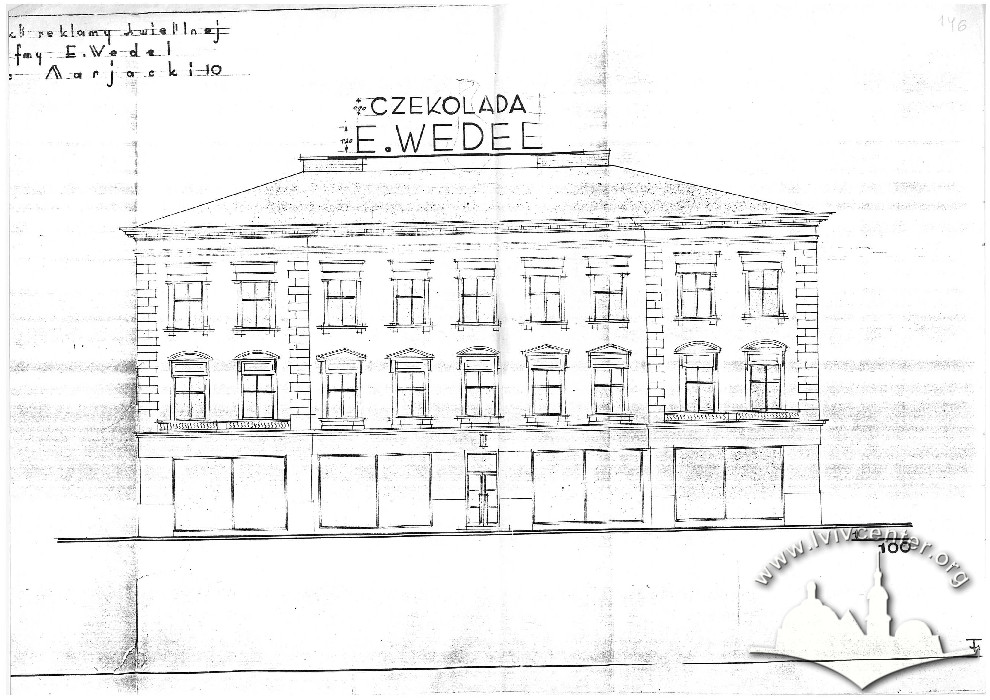
A cinema operated in the former building at pl. Mitskevycha 10 under several names and under various owners: "Wanda" (1908–1909), "Bajka" (1909–1912), "Helios" (1912–1917), "Fatamorgana" (1917–1931), "Miraż" (1931–1939), "Chronicle Cinema" ("Kinoteatr kroniki", 1939–1940), "Zentral" (1942–1944), and the "Ivan Franko Cinema" (1944–1990s). The building was demolished in January 1998.
Story
The cinema was located in the building at present-day pl. Mitskevycha 10 (formerly plac Mariacki).
"Wanda"
The Wanda cinema was founded in 1908 on the premises of the Catholic House by the board of the Lviv branch of the Vienna educational society Urania. Its managers were Herman Opat, Józef Jaskólski, and Edmund Libański. The cinema was also part of the Wiedza educational network, which operated in Galicia and Silesia and was affiliated with Social Democratic circles.
"Bajka"
In 1909, the cinema was renamed "Bajka". It was the first cinema in Lviv to install illuminated signage.
"Helios"
In 1912, Herman Opat relocated the "Helios" cinema here from the Catholic House at vul. Horodotska 36. In January 1915, during the Russian occupation of Lviv, the newspaper Kurjer Lwowski reported that films at this cinema were screened with Polish intertitles, and some with both Polish and Russian intertitles.
"Fatamorgana"
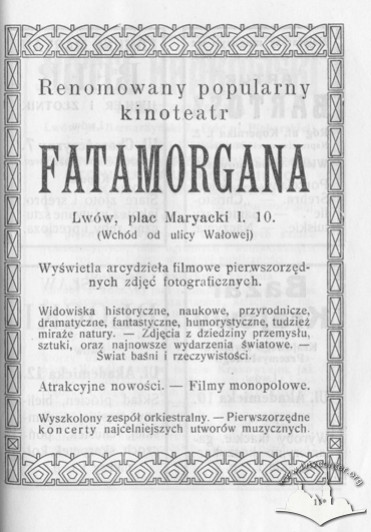
In 1917, the cinema was renamed "Fatamorgana". It was owned by the board of the Urania society in Lviv (Herman Opat, Józef Jaskólski, and Edmund Libański). In 1926, the prominent Lviv restaurateur Henryk Atlas became the owner.
"Miraż"
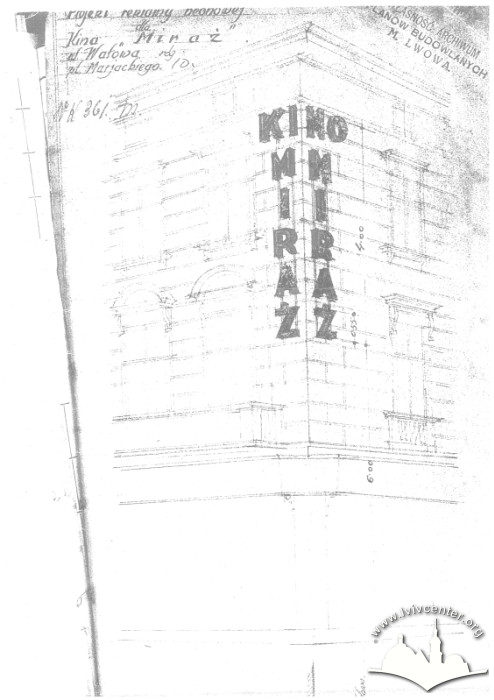
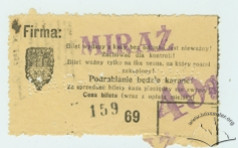
In 1931, another name change took place: the cinema was renamed "Miraż". It operated under this name until World War II. The owners were the Kulmann family, Stanisława Kozłowska, and W. D. Lewicki. The Kulman family owned the equipment, while Lewicki owned the premises. The cinema's auditorium seated 329 people. The cinema enjoyed moderate success.
"Kinoteatr kroniki" and "Zentral"
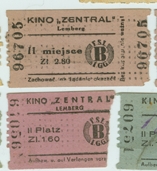
Its next name, the "Kinoteatr kroniki" (1939–1940), is known to have been changed to "Zentral" in 1942 during the Nazi occupation.
"Ivan Franko Cinema"
Starting in 1944, the "Ivan Franko Cinema" operated at vul. Valova 1. As of 1944, the cinema had 293 seats and held an average of two film screenings per day. Attendance averaged around 35% for adult screenings and 25% for children's shows. Based on its location and auditorium capacity, it was classified as a second-category Lviv cinema. Its repertoire primarily consisted of second-run film screenings (the gap between a film's Lviv premiere and its repeat screening here averaged one month). The repertoire selection was managed by the cinema's administration. By 1966, the "Ivan Franko Cinema" had 19.5 staff positions. That year, the cinema recorded 580,844 visits (for comparison, according to the 1959 census, Lviv's population was 410,700). It was a fairly popular cinema. The management attributed its success to a well-curated film selection: "...the key factor is selecting films that meet the needs of our audience, with whom we maintain continuous communication, both in person and in writing through requests".
In 1987, a fire broke out in the building. Reports from 1989 still mention that the "Ivan Franko Cinema" (219 seats) recorded 247,716 visits for the year, and in 1990, it held an average of ten screenings per day.
Having fallen into a state of ruin, the building was demolished in January 1998.
Related buildings and spaces
-
Pl. Adama Mitskevycha, 10 – Ukrsotsbank building

People
Henryk Atlas –– prominent Lviv restaurateur, co-owner of the cinema.
Józef Jaskólski –– co-owner of the cinema.
Stanisława Kozłowska –– co-owner of the cinema.
The Kulmann family –– co-owners of the cinema.
W. D. Lewicki –– co-owner of the cinema.
Edmund Libański –– co-owner of the cinema.
Herman Opat –– co-owner of the cinema.
Sources
- Chwila, 1939, 8 wrzesznia.
- Dziennik Polski, 1938, №249.
- Taschenjahrbuch 1943: Für den deutschen Generalgouvernement (Krakau: ZKW Druck, 1943).
- Z kinematografii, Kurjer Lwowski, 1915, №16, 3.
- Вільна Україна, 1946: №№ 227, 232;
- Вільна Україна, 1949, №105;
- Вільна Україна, 1958, № 260.
- Вільна Україна, 1965, №57.
- Державний архів Львівської області (ДАЛО) 1/56/158.
- ДАЛО 7/3/638.
- ДАЛО Р-1339/1/32.
- ДАЛО Р-1339/1/4.
- ДАЛО Р-1339/1/603.
- ДАЛО Р-1339/1/624.
- ДАЛО Р-1339/2/54.
- Львовская Правда, 1948, № 112.
- Львовская Правда, 1955 р., №111.
- Львовская Правда, 1958 р., №170.
- Barbara Gierszewska, Kino i film we Lwowie do 1939 roku (Kielce: Wydawnictwo Akademii Świętokrzyskiej, 2006), 428.
- Львов: Справочник (Львів: Вільна Україна, 1949).
- Приватна збірка П. Ґранкіна.
- Радянський Львів: 1939–1955 (Львів, 1956).
- Роман Генега, Радянський кінематограф у Львові в перше повоєнне десятиліття, Український історичний журнал, 2011, №2, 106-122.
- Справочник Львовской АТС (Львов, 1954).