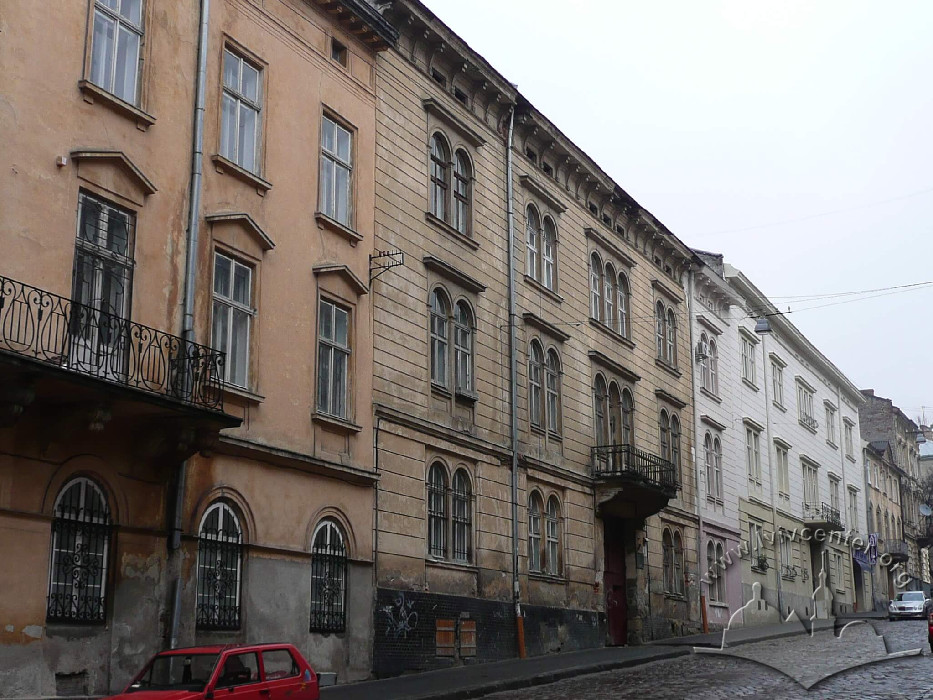
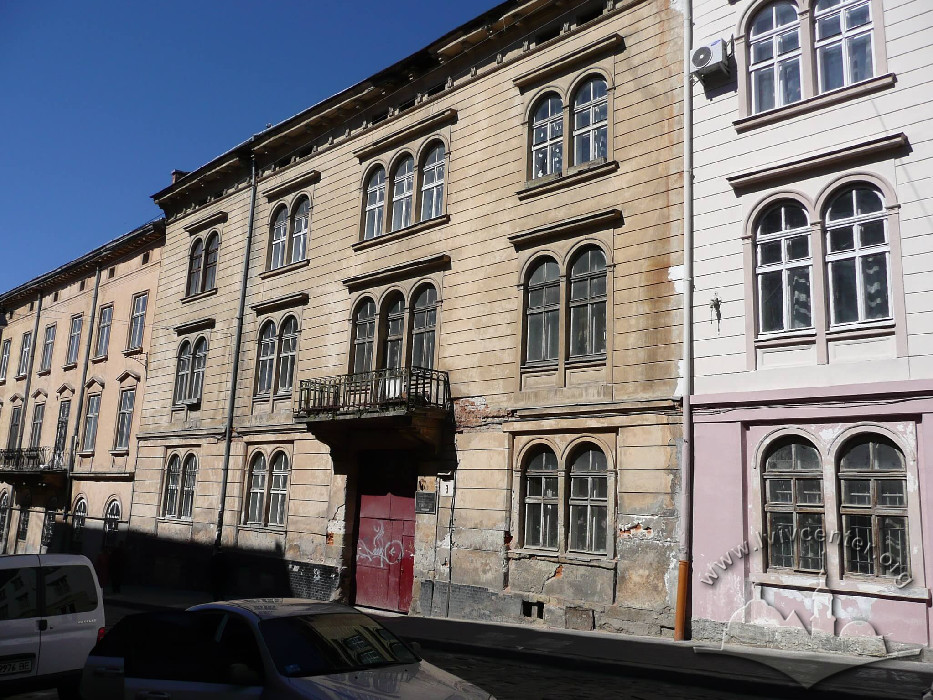
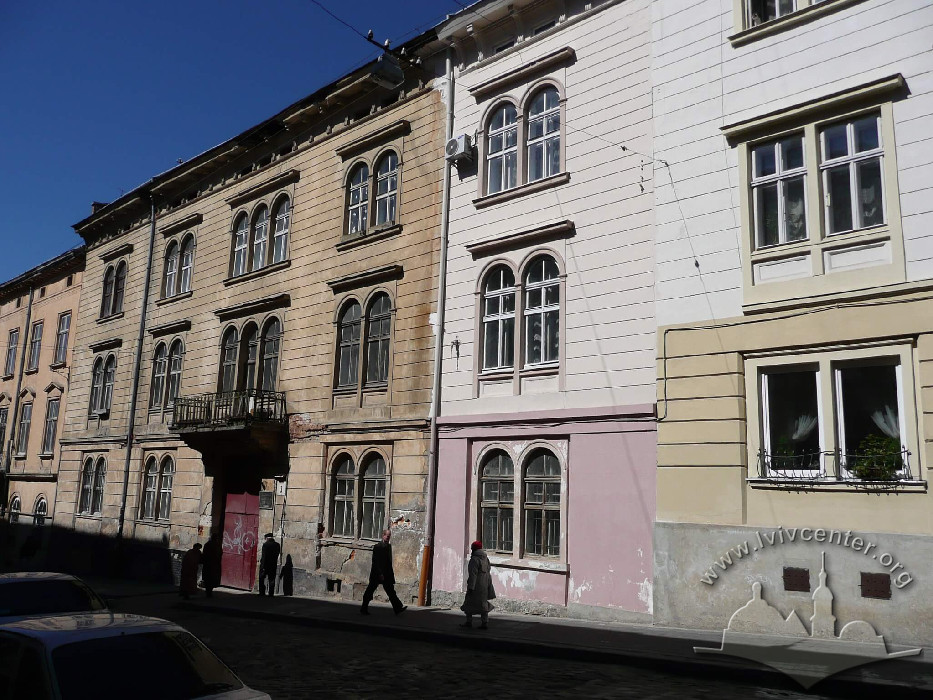
Vul. Mykoly Lysenka, 3 – residential building ID: 1532
In 1769, the architect Piotr Polejowski purchased the urban site between present-day Vynnychenka and Hutsulska streets from the Monastery of the Carmelite Sisters. In 1802, Karl Thiry became the owner of the plot. In 1837, Alojza Gablenz, the wife of Lviv merchant Edward Gablenz, bought the property from Thiry's heirs. Architects Johann Salzmann and Florian Onderka purchased the larger part of the urban site from Alojza Gablenz and constructed several buildings on it in the 1840s, including this one. Today, the building houses the "Syhnal" Specialized Children and Youth Sports School of the Olympic Reserve (SDYUSHOR). It is designated as an architectural monument of local significance under landmark ID no. 975 (a residential building from 1840–1841).
Architecture
This three-story building, set on a raised basement level and featuring a U-shaped floor plan with an internal courtyard, was constructed in the Late Classicism in 1840–1841 (by architects Johann Salzmann and Florian Onderka). The walls of the principal elevation are finished with banded rustication. Positioned above a wide carriage archway is a balcony with metal railings. The windows on the façade feature rounded headers.
People
Maciej Czerny –– engineer, resident of the building in 1902.
Konstantyna Des-Loges, Alojza Peykfeld, Julia Wyrobkowa, Jadwiga Pepłowska –– widows, residents of the building in 1910.
Karol Hetper – forestry counselor, resident of the building in 1902.
Wiktor Huber –– domains and forests official, resident of the building in 1910.
Aleksander Götz –– railway counselor, resident of the building in 1910.
Antoni Jaegermann –– court counselor, resident of the building in 1902.
Abgar Jaegerman –– graduate of the Polytechnic, resident of the building in 1910.
Józef Jaegerman –– owner of the building in 1910.
Józef Jaegerman (1843–1927) –– property owner, engineer, architect, and artist; Lviv city council member, resident of the building in 1910.
Jan Abgar Jaegermann –– owner of the building in 1916.
Dr. Wład. Jasiński –– physician, specialist in chest diseases, resident of the building in 1902.
Bronisława Janusiewicz, Jakób Kafka –– private individuals, residents of the building in 1910.
Kawana –– owner of the building in 1871.
Jan and Anna Cawana małol. –– owners of the building in 1889.
Zdenko Kirschner –– captain, resident of the building in 1910.
Emil Laskowski –– schoolteacher, resident of the building in 1910.
Józef Mrazek –– financial auditor, resident of the building in 1902.
Helena Peyersfeld, Jan Sopuch, Ferdynand Szicle –– clerks, residents of the building in 1910.
Włodzimierz Resl –– gymnasium professor and stenographer, resident of the building in 1902.
Kazimierz Sikora –– governor's office usher, resident of the building in 1910.
Eugeniusz Spożarski –– bookbinder, resident of the building in 1902.
Maryan Szydłowski –– private clerk, resident of the building in 1910.
Ivan Vozniak –– typographer, resident of the building in 1910.
Aniela Wisłocka –– pharmacist, resident of the building in 1910.
From 1894, the address of ul. Kurkowa 3 hosted the workshop of the prominent frame and iconostas maker Stanislaw Eustachy Szczuplakiewicz (1870–1922). Between 1906 and 1910, commissioned by Metropolitan Andrey Sheptytsky, he crafted Secession style iconostases for numerous churches.
Sources
- Вуйцик В. Вибрані праці // Вісник інституту «Укрзахідпроектреставрація», ч. 14. – Львів, 2004. – С. 166-169.
- Енциклопедія Львова. Т. 2. / За ред. А. Козицького. – Львів: Літопис, 2008. – С. 271.
- Памятники истории и культуры Украинской ССР: Каталог-справочник. – Киев, 1987. – С. 314.
- Biriulow J. Rzeźba lwowska od połowy XVIII wieku do 1939 roku: Od zapowiedzi klasycyzmu do awangardy. – Toruń, 2008.
- Czerner O. Lwów w dawnej rycinie i planie. – Wrocław–Warszawa–Kraków, 1997.
- Księga adresowa Król. stol. miasta Lwowa. – Lwów, 1902.
- Lwów. Ilustrowany przewodnik. – Lwów: Centrum Europy, 2003. – 320 s..
- Skorowidz król. stoł. miasta Lwowa z oznaczeniem podziału miasta. Nazw ulic I placów, oliczbowania domów numerami konskrypcyjnemi i orientacyjnemi z wymienieniem właścicieli realności – tudzież nazw i numerówdawniejszych. – Lwów: Nakładem król. stoł. miasta Lwowa, z drukarni Instytutu Stauropigiańskiego, 1889.
- Skorowidz król. stol. miasta Lwowa – Lwów, 1916.
- Skorowidz nowych i dawnych numerów realności, tudzież nazw ulic i placów król. stoł. miasta Lwowa... – Lwów, 1872.
- Spigel J.R. Skorowidz adresowy Król. stol. miasta Lwowa. – Rocznik II: Rok 1910. – Lwów, 1909.