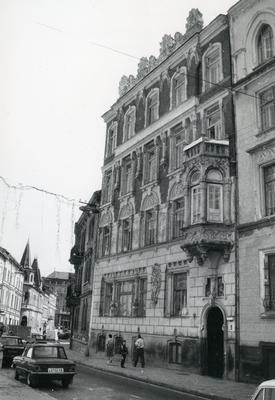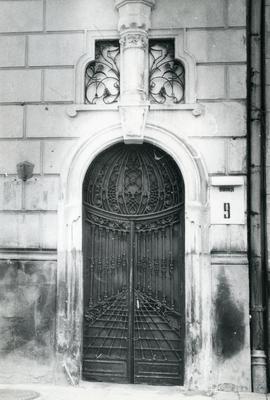
Vul. Dzhokhara Dudaieva, 9 – former building of Polytechnic Society ID: 2235
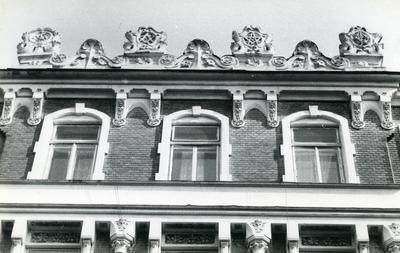
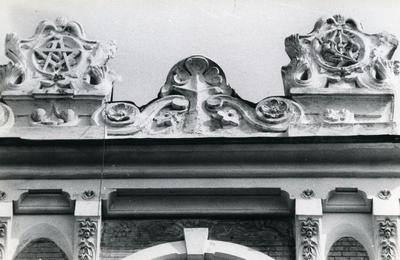
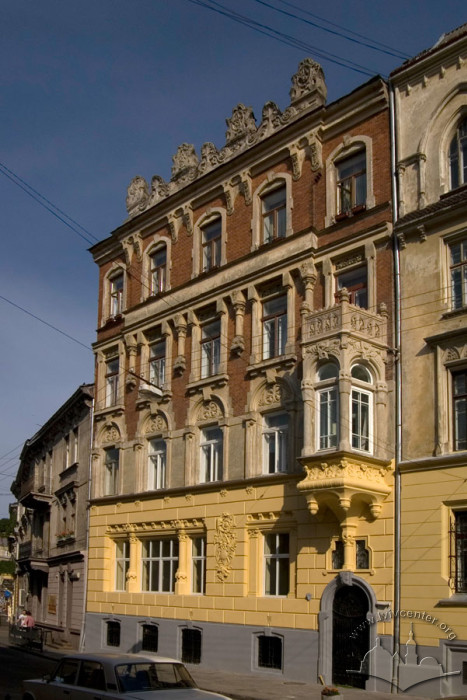
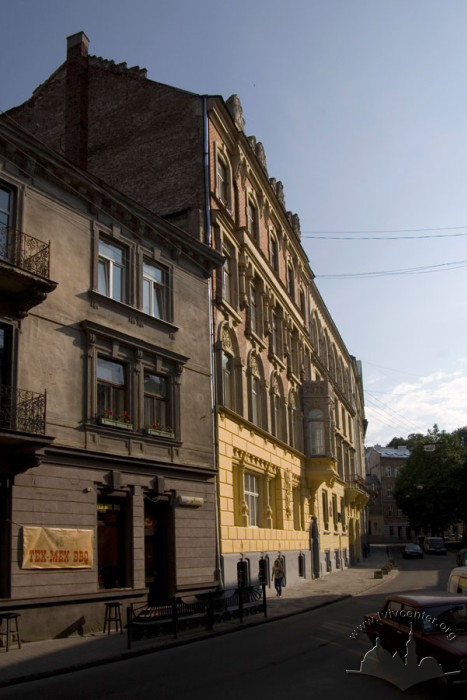
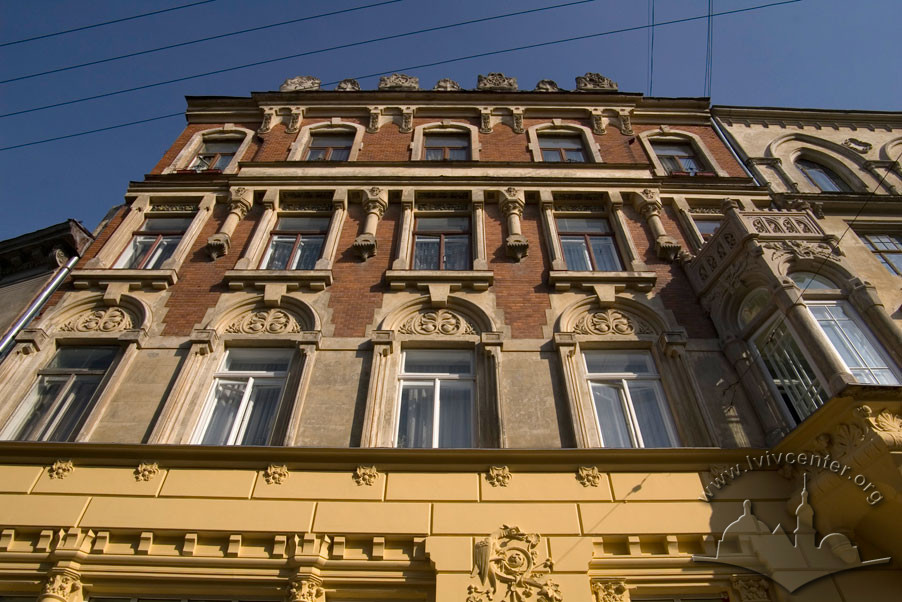
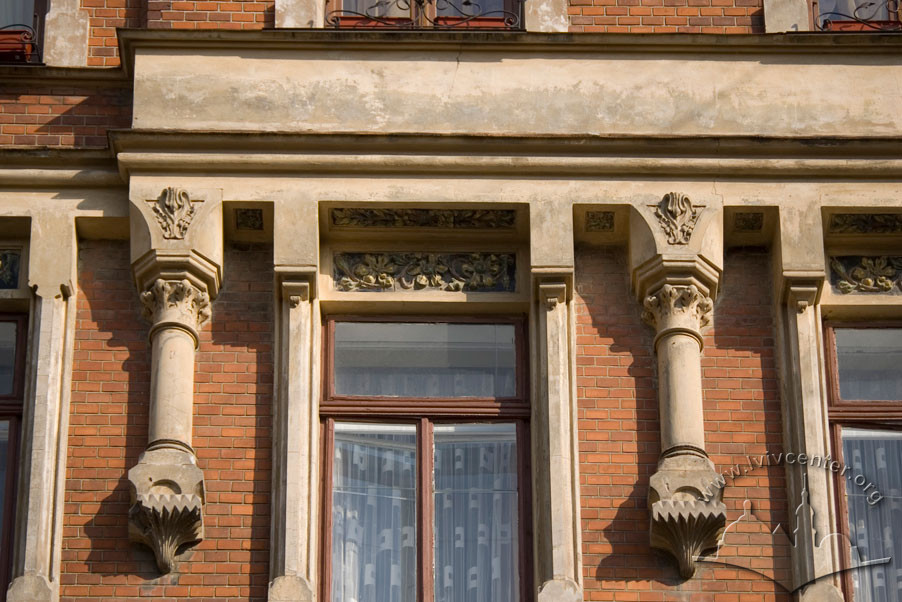
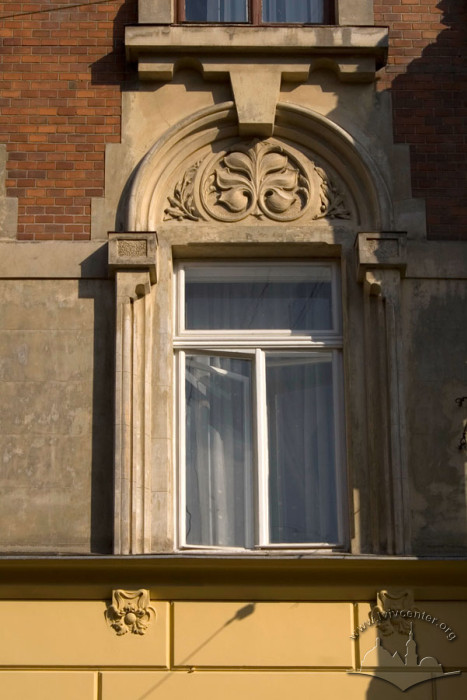
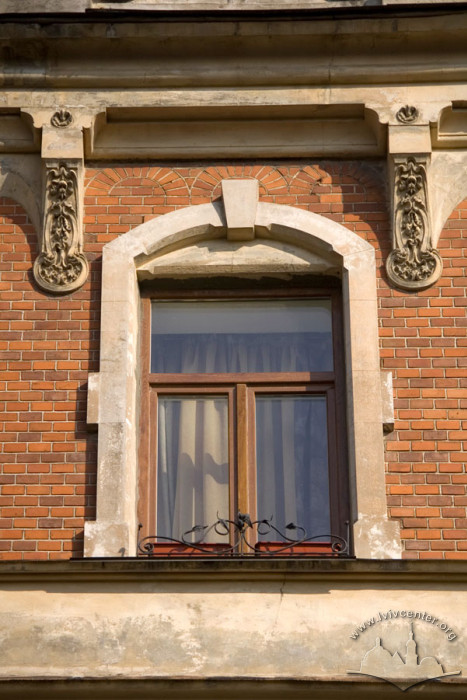
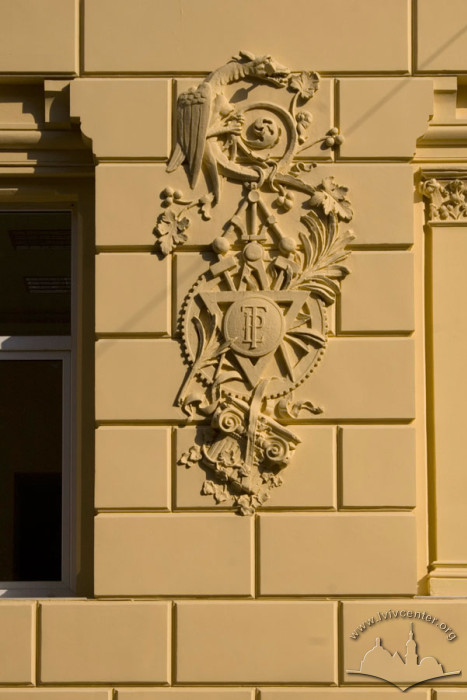
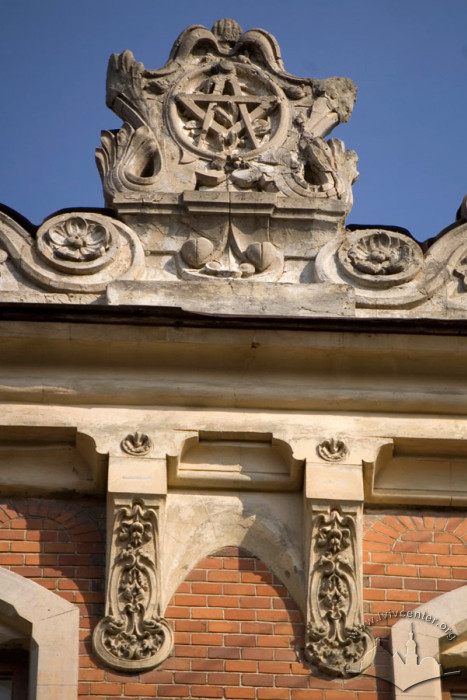
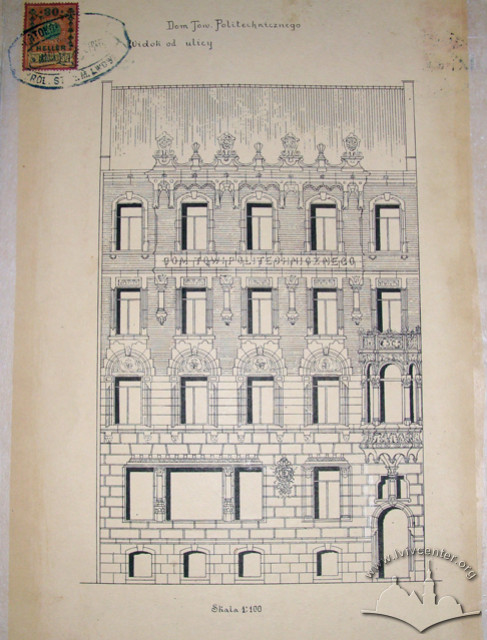
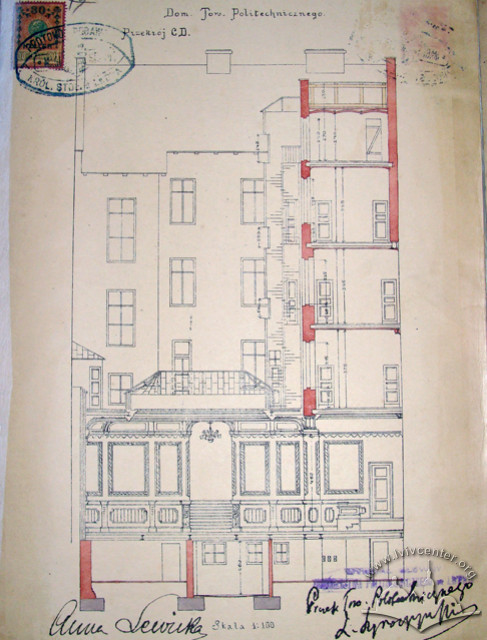
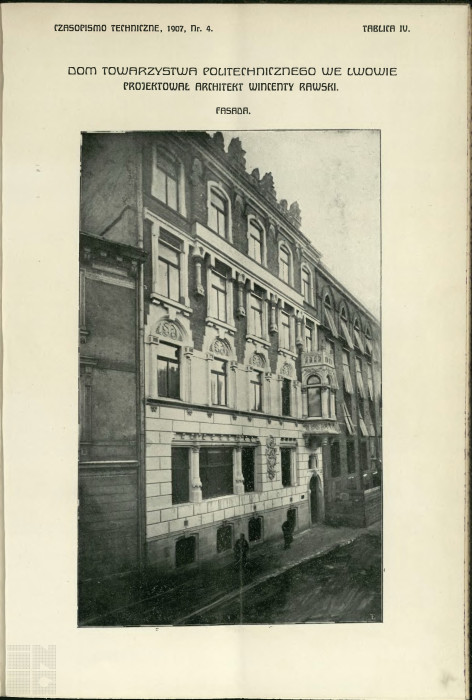
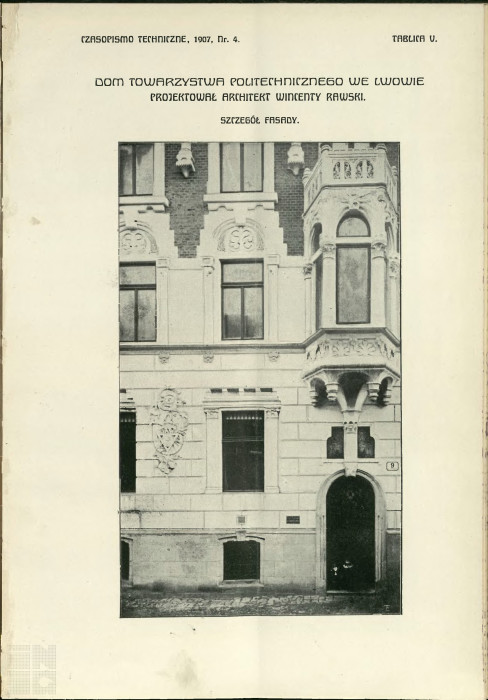
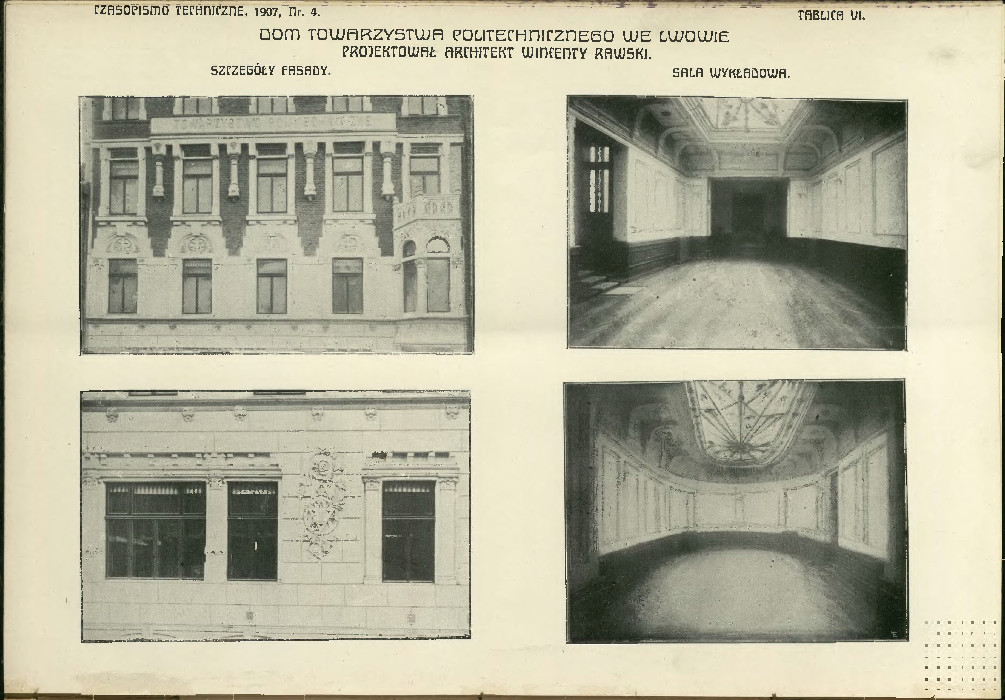
The Historicist-style building was erected between 1905 and 1907 according to the design of Lviv architect Wincenty Rawski and is an Architectural monument of local significance. The façade features the Society's symbols, which are often mistaken for Masonic imagery. Today, the Society's premises serve as bank offices, while the second through fourth floors remain residential.
Story
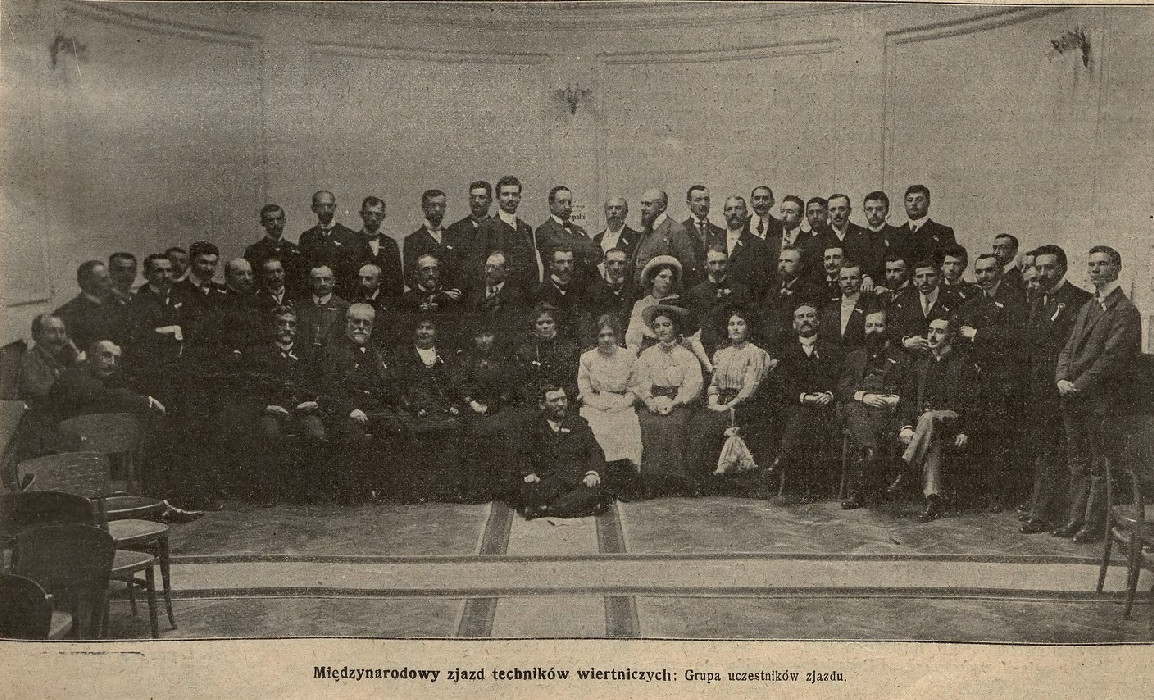
The Polytechnic Society was founded back in 1877 to provide mutual support for technicians and to advance technical science, both of which had not yet gained public recognition. For three decades, the Society rented various rooms throughout the city — from townhouses on pl. Rynok to vul. Chaikovskoho — and frequently relocated its office along with its library, archive, and the editorial staff of the Czasopismo Techniczne journal. Because the rented rooms were often small, the Society had to look for and lease additional halls even for regular weekly meetings and small-scale scientific presentations with discussions, let alone general annual meetings. This was even more necessary when it came to hosting major events like the Сongresses of Polish technicians (the second in 1886 and the third in 1894 were held in Lviv) or exhibitions, such as the Society's Twenty-Fifth Anniversary in 1902. Such events were held in the City Hall assembly room, in the Polytechnic's auditorium, and, starting from 1894, in the pavilions of the General Regional Exhibition of Galicia on the grounds of Stryiskyi Park.
However, talk of erecting their own premises in Lviv did not begin until 1892 — thanks to the unexpected success of the Building Trade Exhibition, which turned a profit for the Society.
Open 30 years after the Society's founding, their own building was seen as proof of the vitality of the community of technicians and their importance to the city, society, and the state. For them, the very existence of such a building was deeply symbolic. The opening in January 1907 was quite modest. It was primarily attended by the Society's members themselves and Polytechnic students, as well as local politicians and representatives of the City Council.
The construction method itself, the people involved (all local), the finances (zero government support), the materials and structures used (as local as possible), and the building's style — everything illustrates the technicians' desire to demonstrate their professional competence, as well as their local and ethnic distinctiveness during the Habsburg Empire.
The Proceedings of the Grand Opening of the Building on January 19, 1907
The winter opening of the building was likely due to construction delays or other complications. As early as the summer of 1906, advertisements seeking tenants appeared in the Lviv press, indicating that construction was originally scheduled for completion in the fall of that year.
On the eve of the event, heavy snowfalls swept across Central and Eastern Europe, which led to the cancellation or restriction of train service on many routes in Galicia starting January 17, 1907. Obviously, this impacted the number of attendees traveling from outside Lviv. On Saturday, January 19, the air temperature dropped to –9° on the Réaumur scale (equivalent to –11°C), and plummeted to –23°R (–29°C) over the following days, with newspapers reporting deserted city streets and residents facing shortages of heating fuel for their homes.
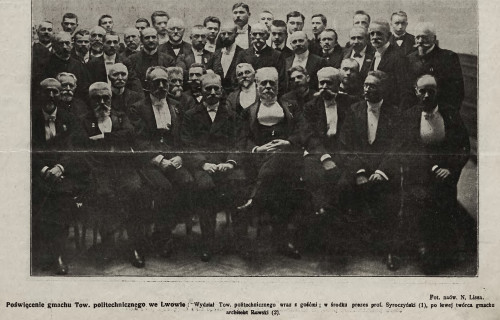
The celebration coincided with the Epiphany season under the Julian calendar. Despite the inclement weather, the festive divine service at the Church of the Transfiguration of the Lord — complete with a procession through Rynok Square and the blessing of the wells — was as crowded as ever. It was attended by prominent figures such as the Governor of Galicia, Andrzej Potocki, Marshal Stanisław Badeni, and City Mayor Michał Michalski. Once the festivities of the city's Greek Catholic community concluded, these dignitaries were able to join the grand opening of the Polytechnic Society building on ul. Zimorowicza (now vul. Dudaieva).
In addition to the politicians and the members of the Polytechnic Society themselves, the attendees included Archbishop Józef Bilczewski, Vice-Mayors Tadeusz Rutowski and Stanisław Ciuchciński, the Rector of the University, and the Deputy Rector of the Polytechnic. Several heads of manufacturing enterprises and financial institutions, representatives of the Lviv magistrate, members of other technical and scientific societies across Austria-Hungary and Polish societies from other empires, as well as students, also took part in the event.
"The fact that your excellencies and so many distinguished guests have come is proof to us that our many years of work have not been in vain, and that we [the Society] are a useful brick in the organism of the social building" — commented the President of the Society, Leon Syroczyński.
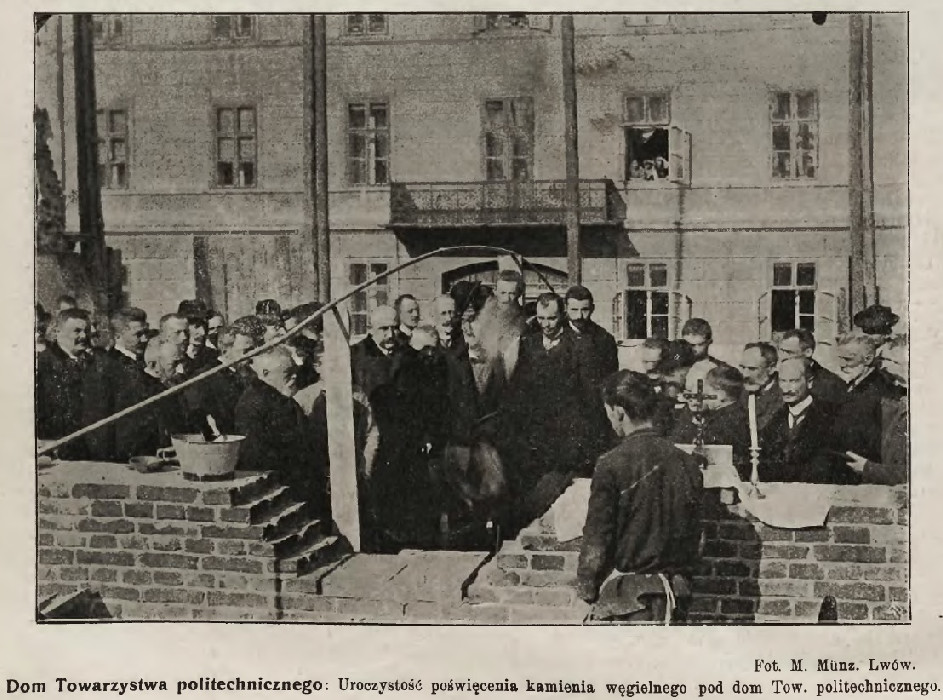
The event began at 12:00 PM with the blessing of the premises, performed by the Roman Catholic prelate Father Lenkiewicz, who had previously blessed the building's cornerstone back in October 1905. The technicians' choir, conducted by the kapellmeister of the Lviv Opera, Bronisław Wolfsthal, performed Wennerberg's "Prayer."
Next, the President of the Society, Leon Syroczyński, a mining engineer and professor at the Polytechnic, delivered a speech. He presented the more than 15-year history behind the building's creation — from its conception and fundraising to the execution of the project. He also highlighted the roles played by numerous members of the Society, who frequently worked on a voluntary basis. Afterward, other attendees took the floor to speak, followed by electrical engineering professor Roman Dziesłewski, who delivered a lecture titled "Engineering Technology in Relation to Society". The ceremony concluded at 1:30 PM.
In the evening, a celebratory dinner was held, attended by around one hundred guests. During the event, telegrams and letters of well-wishes were read aloud, particularly from individuals unable to attend the opening in person. These included messages from Societies in Kraków and Warsaw, Vienna and Prague, Aussig (the modern Czech city of Ústí nad Labem), Graz and Linz, Ostrava in Moravia, Salzburg, Stanyslaviv and Rzeszów, Nowy Sącz, Tarnobrzeg, Tarnów, and others.
Design and Construction of the Building
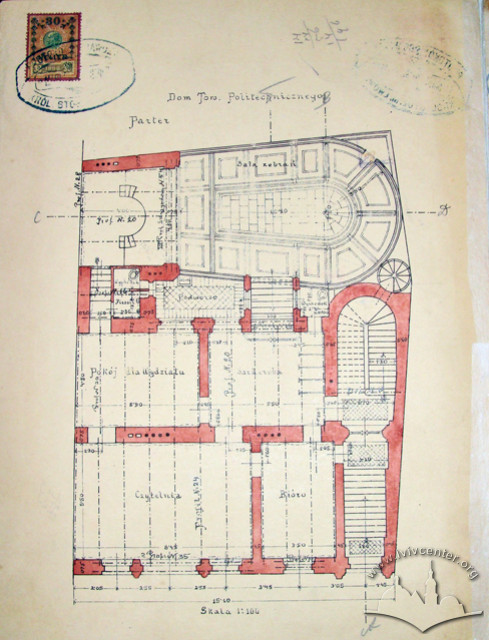
Nearly 15 years passed from the initial intent to build to the completion and opening of the building. For more than 5 of those years, various discussions, process planning, the organization of an architectural competition, and the refinement of project details took place. The first funds for the future building, along with the concept itself, emerged in 1892. Another milestone came in 1902 when the collected funds reached 30,000 krone; subsequent realization was financed through loans and donations.
Leon Syroczyński limited his remarks to a checklist of the building's materials and structures, offering no explanation of its aesthetic value; likewise, no records survive indicating that the project's architect, Rawski, ever addressed this aspect. The President's speech also reveals that the Polytechnic Society held a rather modest view of the outcome, believing that the building paled in comparison to similar technical society structures in Kraków and Warsaw. He emphasized the shortage of funds and the reliance on volunteer contributions from technicians and donors, calculating that it would take fully forty years to repay the borrowed loans.
Architecture
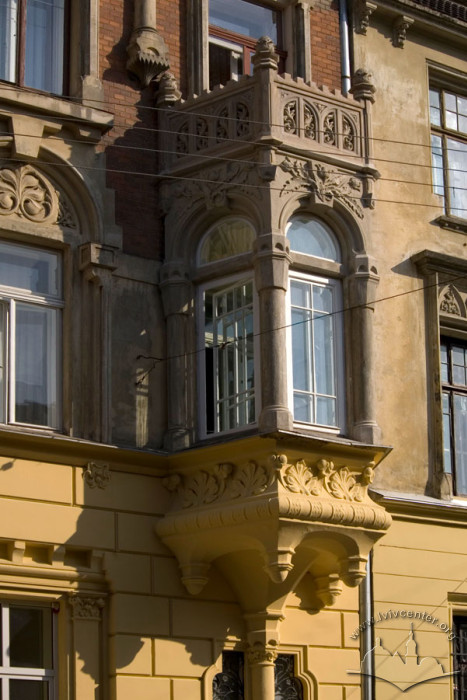
Architectural Style of the BuildingThe attic is further embellished with motifs of triangles and compasses.
People
Members of the Society and individuals involved in the construction:
Konstanty E. Biernacki — engineer for the Regional Department.
Gustaw Bisanz (1848–1935) — professor at the Polytechnic.
Karol E. Epler — railway engineer and member of the City Council.
Władysław Ekielski (1855–1927) — architect, architectural critic, editor of the Architekt journal, and co-owner of a stained glass firm in Kraków.
Eisig & Maurycy Fleck (Bracia Fleck/Fleck Brothers) — Painters, specialized in interior decorative painting in Lviv.
Edmund Gottlieb — engineer and owner of a locksmithing enterprise in Lviv.
Karol Hornung — engineer and owner of a joinery enterprise in Lviv.
Dionizy Krzyczkowski — architect and professor at the Industrial School.
Karol Łopata — completed the varnishing works.
Stefan Szeliga Łyszkiewicz — engineer and asphalt manufacturer in Lviv.
Salomon Meisels — joiner and co-owner of a glazing firm in Lviv.
Bracia Mund (Mund Brothers) — firm in Lviv, specialized in plumbing installation, among other services.
Leonard Nitsch — engineer and owner of a central steam heating firm in Kraków.
Zygmunt Piotrowicz — engineer and co-owner of an ironworks enterprise in Lviv.
Edmund Pliszewski — sculptor.
Wincenty Rawski Jr. (1850–1927) — architect, member of the Polytechnic Society and its board, and designer of the building.
Juliusz Ross — railway inspector.
Dawid Salz — glazier and co-owner of a glazing firm in Lviv.
Jan Schumann — engineer and co-owner of an ironworks enterprise in Lviv.
Gabryel Sokolnicki — co-owner of an electrical engineering firm in Lviv.
Leon Syroczyński (1844–1925) — professor at the Polytechnic, researcher of deep drilling, and President of the Society from 1903 to 1907.
Jan Tarczałowicz (1869–1923) — architect and designer of the Society's insignia.
Maksymilian Thullie (1853–1939) — professor at the Polytechnic.
Antoni Tuch — artist and co-owner of a stained glass firm in Kraków.
Arnold Werner — co-owner of a ceramic products firm in Hlynsko near Lviv.
Kazimierz Wiśniewski — co-owner of an electrical engineering firm in Lviv.
Julian Zachariewicz (1837–1898) — professor of architecture at the Polytechnic and founder of the Lviv Architectural School.
Edmund Żychowicz — architect and owner of a building firm.
Attendees at the opening of the building from outside the Polytechnic Society:
Stanisław Badeni (1850–1912) — Marshal of Galicia.
Stefan Bartoszewicz (1870–1934) — representative of the Oil Society, from whom the technicians rented premises for many years at what is now vul. Chaikovskoho 17.
Stanisław Ciuchciński (1841–1912) — Vice-Mayor of Lviv.
Bołesław Długoszowski — representative of the Chamber of Engineering.
Bronisław Dułęba — representative of the Government of Agricultural Circles.
Feliks Gryziecki (1837–1923) — professor of law and Rector of the Franciscan University in Lviv.
Tadeusz Gubrynowicz — representative of the Galician Chamber of Commerce and Industry.
Edmund Lukas — director of the Lviv magistrate.
Andrzej Lubomirski (1862–1953) — prince, industrialist, curator of the Ossoliński National Institute in Lviv, etc.; attended as the President of the Galician Manufacturing Union.
Michał Michalski (1846–1907) — Mayor of Lviv.
Jusef Mikułowski (1868–1935) — director of the Agricultural Academy in Dubliany.
Andrzej Potocki (1861–1908) — Governor of Galicia.
Józef Rychter (1843–1917) — professor of hydraulic engineering at the Polytechnic; represented the Society for the Advancement of Polish Science in Lviv.
Zygmunt Rucker — representative of the Galician Chamber of Commerce and Industry.
Tadeusz Rutowski (1852–1918) — Vice-Mayor of Lviv.
Karol Skibiński (1849–1922) — pro-rector of the Polytechnic.
Marian Smołuchowski (1872–1917) — professor at the University of Lviv, physicist; represented the Copernicus Polish Society of Naturalists.
Organizations
-
Polytechnic Society (Towarzystwo politechniczne)
Founded in 1876, functioned until 1939 (from 1913 known as the Polish Polytechnic Society) — the first and leading non-governmental organization of technical professionals in the crownland of Galicia. Combined the characteristics of a trade union and a scientific society. Responsible for the founding of the Industrial Museum in Lviv, the introduction to the city of electricity and the sewerage system, etc.
Read more -
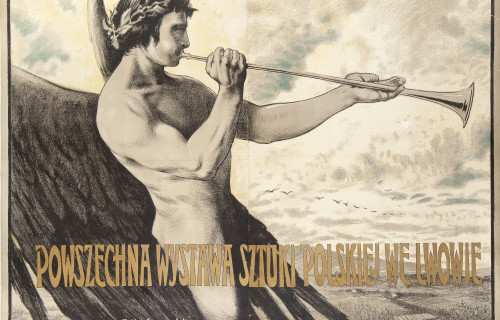
Society of Friends of Fine Arts in Lviv (Towarzystwo Przyjaciół Sztuk Pięknych we Lwowie)
The Society of Friends of Fine Arts in Lviv (Towarzystwo Przyjaciół Sztuk Pięknych we Lwowie) was the first art organization in Lviv to operate from 1868 until the outbreak of the Second World War. The Society brought together artists and art connoisseurs, organized exhibitions, sold works of art and provided material support to artists.
Read more -
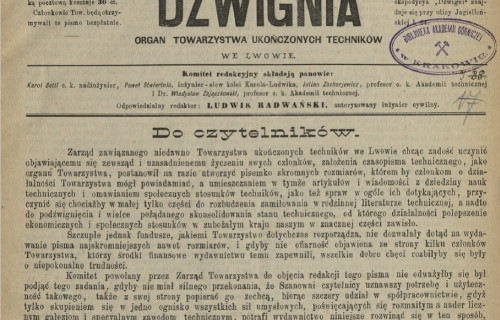
Technical Journal (Czasopismo Techniczne) 1877-1914
/* Style Definitions */ table.MsoNormalTable This was the printed organ of the Polytechnic Society. It was aimed at consolidating and promoting the newly created technical milieu in Galicia, which was formed due to Lviv Polytechnic. The periodical was published from 1877 until the beginning of the Second World War. Its first name, until the end of 1882, was the Dźwignia (pol. for lever).
Read more
Sources
- "In Arte Salus", Architekt, 1907, z. 1, 3-24;
- "Dom Towarzystwa Technicznego w Krakowie", Czasopismo techniczne, 1907, Nr. 3, 46-47;
- "Dom Towarzystwa Politechnicznego we Lwowie", Czasopismo techniczne, 1907, Nr. 4, 61-68;
- "Poświęcenie i otwarcie Domu Towarzystwa Politechnicznego", Gazeta Lwowska, 1907, Nr. 16, 3;
- "Kronika Lwowska. Uroczystość Jordanu", "Gmach Towarzystwa Politechnicznego", Gazeta Narodowa, 1907, Nr. 17, 2;
- "Kronika. We Lwowie. Uroczystość św. Jordanu", Kurjer Lwowski, 1907, Nr. 33, 3;
- "Nowy gmach towarzystwa politechnicznego", Kurjer Lwowski, 1907, Nr. 34, 2;
- "Dom towarzystwa politechnicznego", Nowości Illustrowane, 1905, Nr. 44, 12;
- "Poświęcenie gmachu Tow. politechnicznego we Lwowie", Nowości Illustrowane, 1907, Nr. 4, 15-16;
- Towarzystwo Politechniczne we Lwowie 1877-1902. Pamiętnik jubileuszowy, red. Edmund Stanisław Grzębski (Lwów, 1902);
- Polskie Towarzystwo Politechniczne we Lwowie 1877-1927. Pamiętnik jubileuszowy, red. Maksymiljan Matakiewicz, (Lwów, 1927);
- "Poświęcenie gmachu Towarzystwa politechnicznego", Słowo Polskie, 1907, Nr. 35, 4;
- Jakub Lewicki, Między tradycją a nowoczesnością: architektura Lwowa lat 1893-1918, (Warszawa: Neriton, 2005), 143.