Vul. Bandery, 57 – residential building ID: 2694
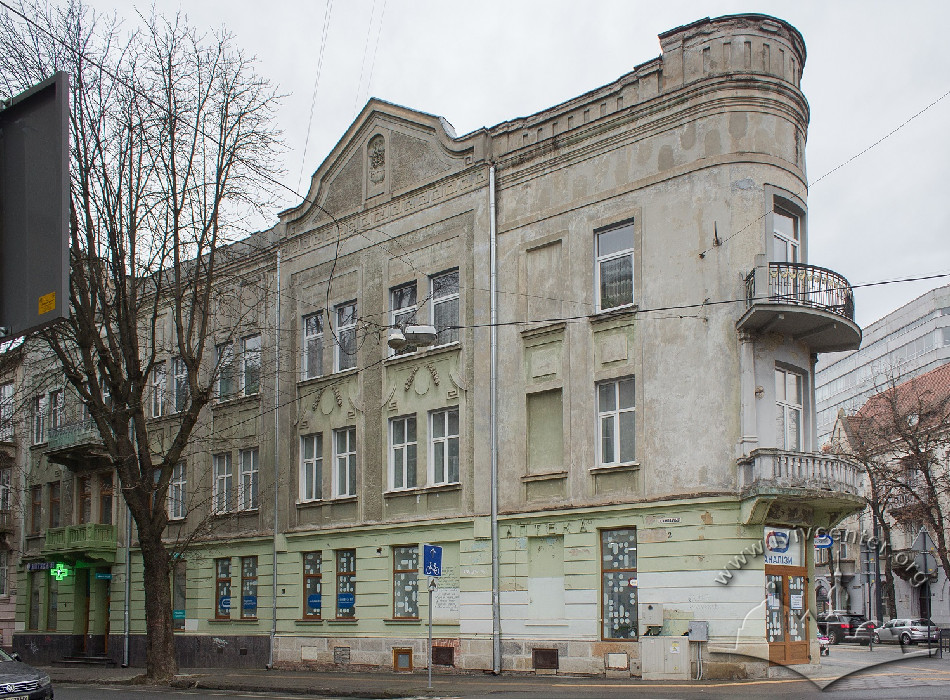
This three-story building was constructed in 1909—1910 as a tenement townhouse for Szulim Lapter and designed by Walery Szulman. It was intended as part of a complex with the building at vul. Konovaltsia 4. It is an example of modernized classicism in architecture, influenced by secession. Today (2025), there are several establishments on the ground floor, while the rest of the building is residential. It is an architectural monument of local significance.
Story
During the 19th century, the area between what is now vul. Bandery, vul. Konovaltsia, vul. Kyivska, and vul. Antonovycha was occupied by a large plot of land with conscription numbers 82-83 ¼. In 1871, part of it along contemporary vul. Konovaltsia was purchased by railway conductor Jakob Arkiel and his wife Ewa. For more details about the Arkiels' houses — single-story dwellings — see a separate description.
In 1903, these houses were purchased by the Piramowicz Boarding School Care Society, which built a boarding school here for students of the men’s teacher seminary (training college). When this building was erected, it had the address ul. Sapiehy 33. Today, it is located at vul. Konovaltsia 6. The city laid a street along the edge of this plot. The Society sold the rest of the old plot that was not occupied by the boarding school. The part closer to what is now vul. Bandery was purchased by the merchant Szulim Lapter. Lviv address books don’t let us know what he traded in; he was probably an employee in someone's trading company. However, it is known that he lived in an apartment on ul. Bernsteina (now vul. Sholom-Aleikhema), an important street for the city's Jewish community, where, in particular, the kahal building was located.
Lapter decided to build two tenement houses on the purchased plot and commissioned a project for them from the constructor Walery Szulman. The initial project was approved in November 1909 (ДАЛО 2/1/3353:3). However, during the construction, the layout was changed and new drawings were submitted for approval in March 1910. The Magistrate objected to the owner’s and architect’s wish to replace the basement with a semi-basement floor by raising the ground floor’s level and instructed Lapter to dismantle the structure and rebuild it under threat of a fine (ДАЛО 2/1/3353:3). In May 1910, the owner received permission to connect the houses to the sewage system (ДАЛО 2/1/3353:1); a month later he was allowed to install a shop window (ДАЛО 2/1/3353:4). In November 1910, the construction was completed, and Lapter requested permission to occupy the building. Additional drawings were also approved in November; in December, permission to occupy the building was granted (ДАЛО 2/1/3353:9−11). The building was assigned a new conscription number, 2000 ¼.
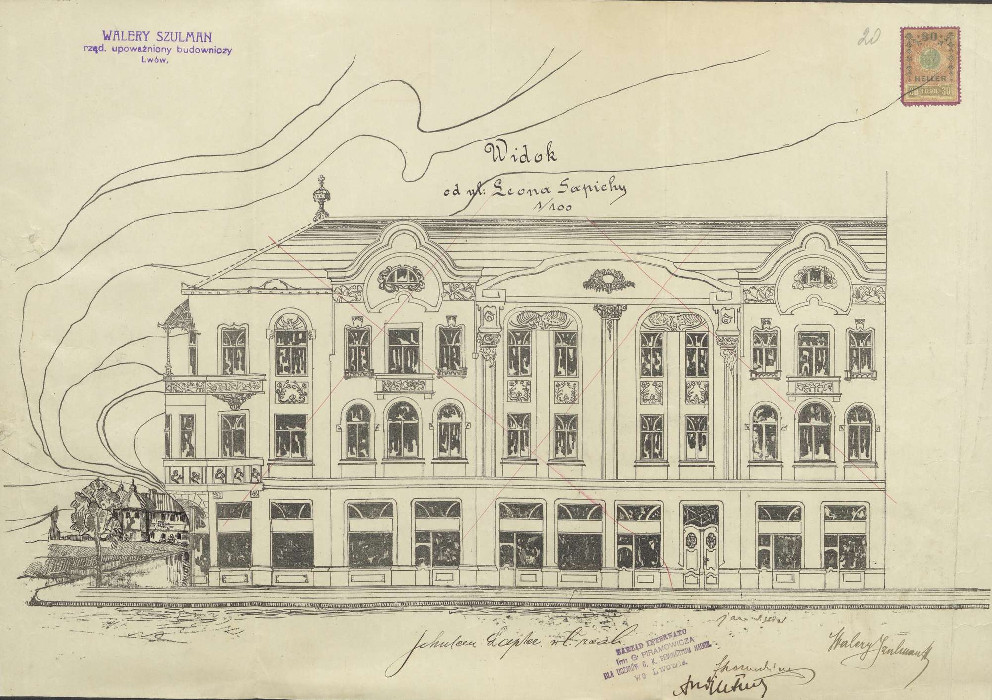
Szulman designed two versions of the façades. The Magistrate did not approve the first version, which showed a strong Secession influence, although Lapter's neighbors did not object (ДАЛО 2/1/3353:20). This drawing emphasizes the atectonic composition of the façades (the amount of decoration increases with height), all windows have rounded trimmings, several curved complexly shaped attics, fanciful balconies, especially the corner one, and a lot of stucco molding. It is unclear why Szulman drew a building with two domes in the lower left corner; it is probably just a decorative technique. From this angle, one could see the Schmalenberger building, erected in the 1890s (it’s current address is vul. Rusovych 2), which really has two domes. However, the drawing is more reminiscent of an old stone church or a small castle.
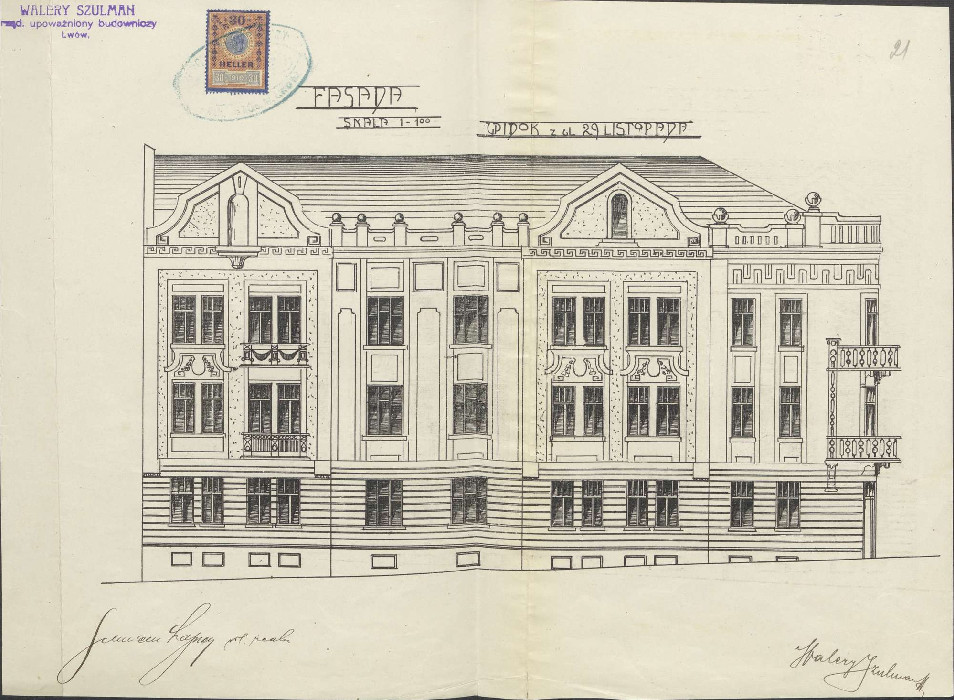
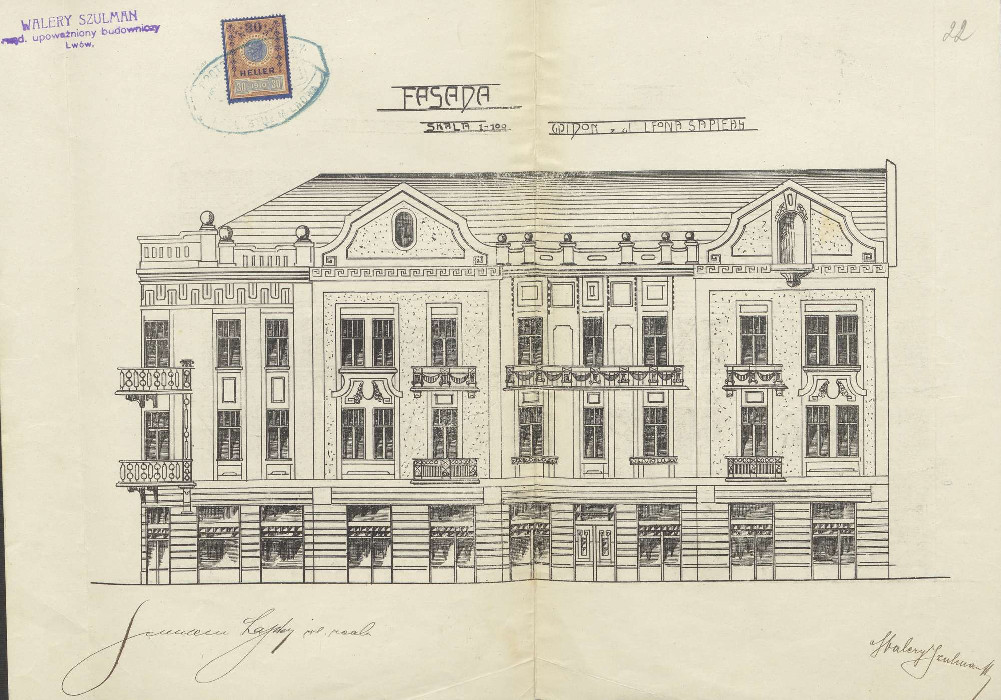
The second version of the façades, which was implemented (ДАЛО 2/1/3353:21−22), is more austere. The overall design is the same, the curved forms remaining, however, only in the attics. A certain Secession influence has also been preserved but Classicism in its modernized form dominates here.
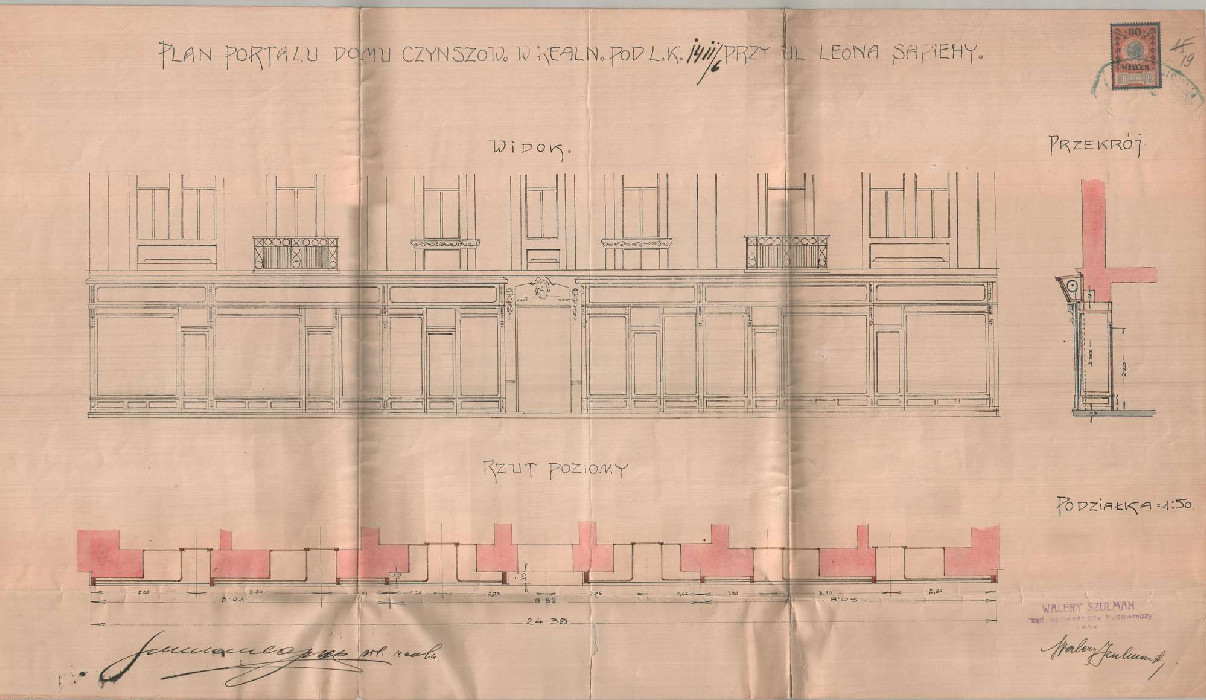
In 1910, using Szulman's design, Lapter had wooden shop windows added to virtually the entire ground floor of the building facing what is now vul. Bandery (ДАЛО 2/1/3353:19).
Szulim Lapter did not own the building for long. In 1913, it was purchased by Bolesław Lewicki (ДАЛО 2/1/3353:12). At that time, there were several people with that name living in Lviv, and, based on the available data, it is impossible to identify the owner more precisely.
Starting from 1910, there were shops located in the building. In 1918, during the Polish-Ukrainian battles for Lviv, it housed (one of) the commandant offices of the Polish side, as well as the Eska military supply store maintained by the Polish Civil Committee.
For years, the building housed Antoni Kunz's shop, which sold materials and devices for water supply, sewage, and heating. It also housed Józef Brück's paint and perfume warehouse; the Carbopetrol company's representative office while its co-founder, Izrael Segal, lived in the building; and much more. The 1935 address book mistakenly names Maria Draniewicz, the owner of the house at vul. Konovaltsia 1, as the owner of the building. After the Second World War, shops and establishments were also located on the ground floor. Today (2025), there is a medical laboratory and a pharmacy here.
Architecture
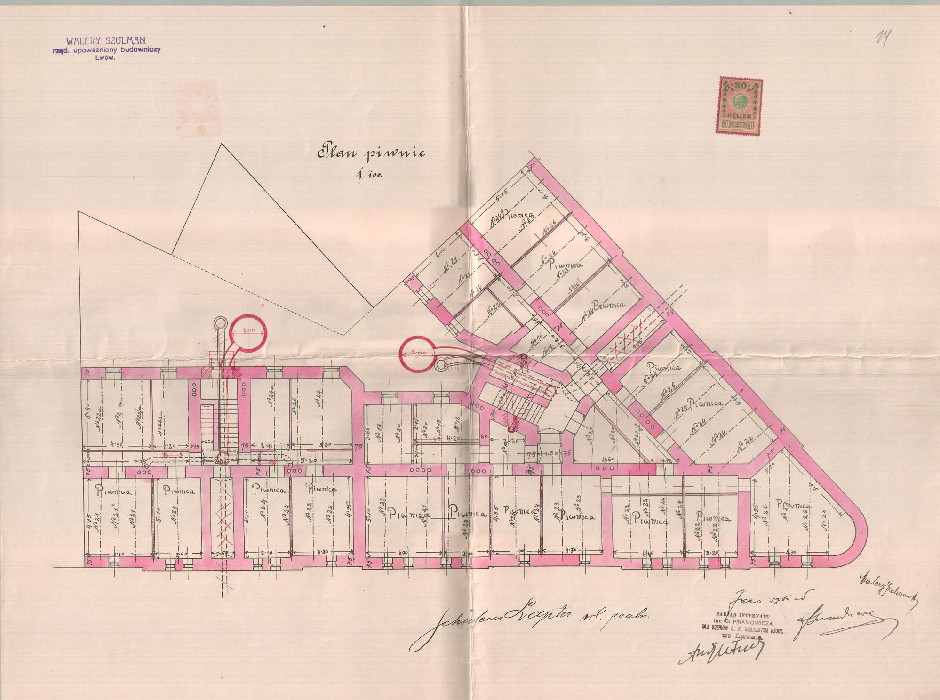
The building is located on a corner pentagonal plot. Its plan is close to an acute-angled triangle, the courtyard being the smallest size allowed at the time.
The building is built of brick with the use of reinforced concrete. The original design drawings from 1909 do not include any cross-sections (they were probably lost). The neighboring building at vul. Konovaltsia 4 was designed as part of the same complex, but its cross-sections do not specify the structure of the floors. The building has a flat tin roof.
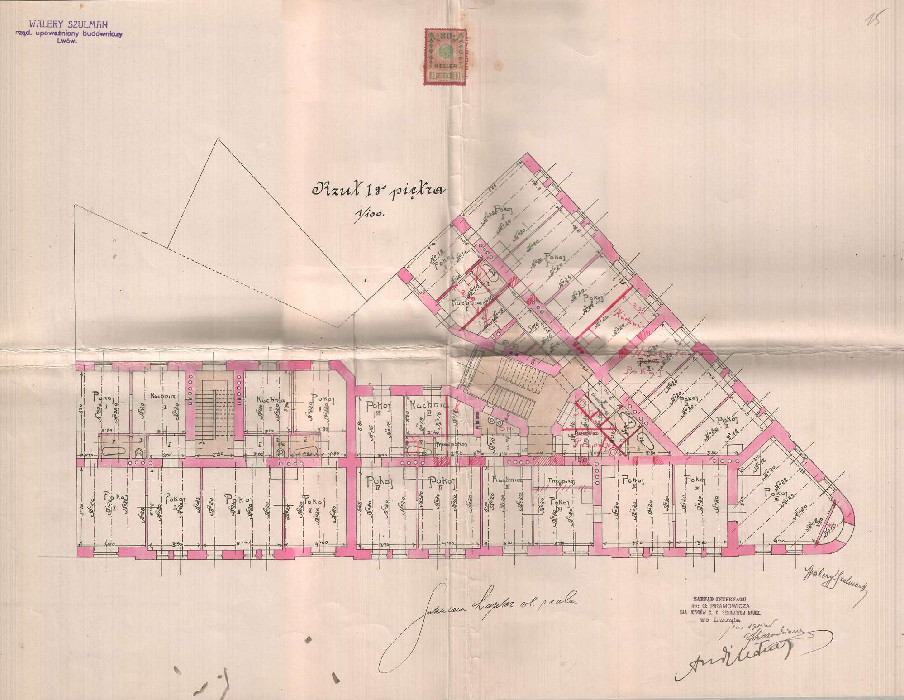
According to the preserved plan of the second floor, the original design included four apartments on each floor: two three-room apartments, a four-room one, and a five-room one. They all had small kitchens, separate bathrooms and toilets, and were heated by stoves. The drawing contains many corrections regarding the location of the bathrooms, and it is unclear from it which layout was actually implemented.
Two versions of the façades have been preserved in the archive file. One is unapproved, with abundant Secession stucco molding, curvilinear attics, floral ornaments between and above the windows, etc. The second version, which was actually implemented, is more restrained and geometric. Modernized Classicist features dominate there.
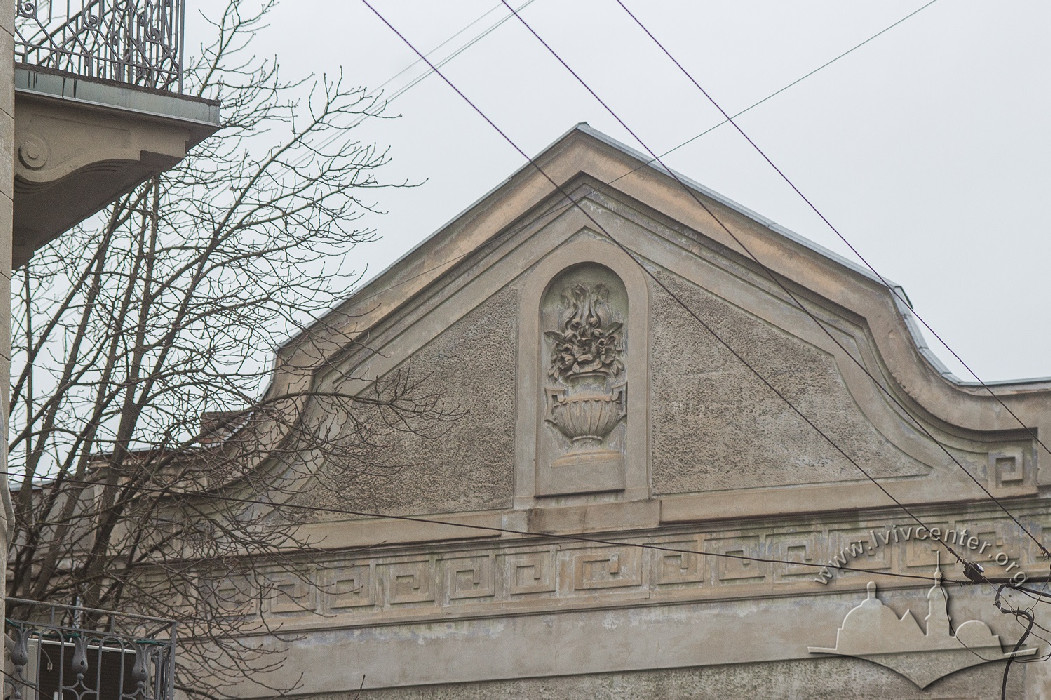
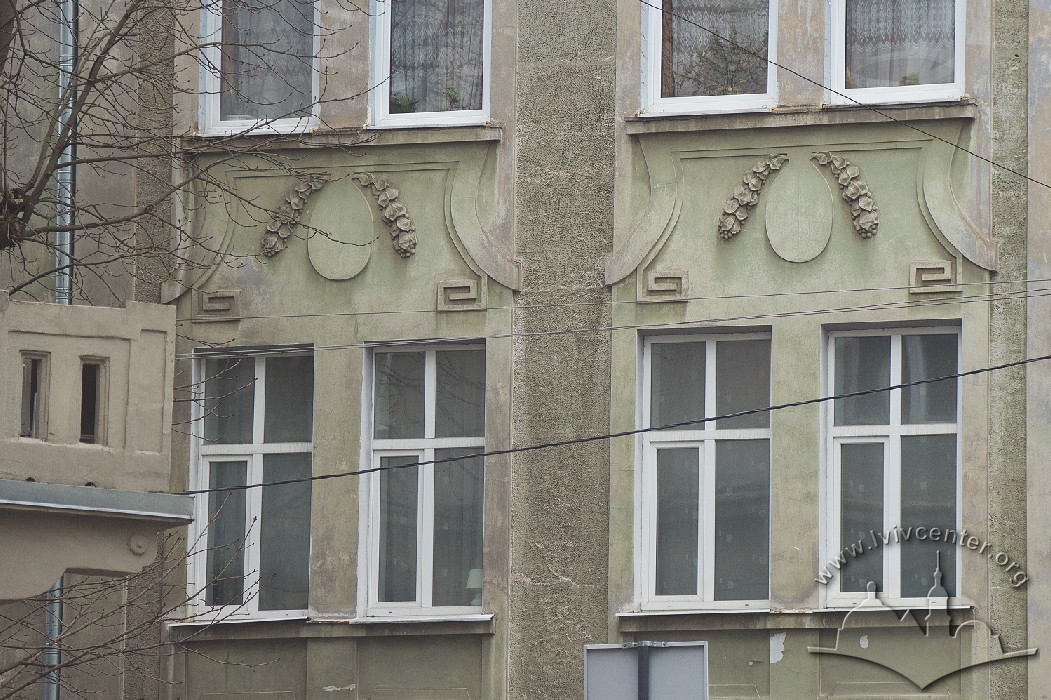
The ground floor is decorated with rustication and has simple rectangular windows without any decorations. On the second and third floors, inserts with textured plaster are used. In general, with atectonics typical of Secession architecture, the amount of decoration in this building increases with height. Balconies are located on the rounded corner. Four thin avant-corpses have attics on top, with molded relief inserts in the middle.
Shortly after the construction was completed, a significant part of the façade facing what is now vul. Bandery was covered with shop windows. They have not been preserved; it is unknown when they were dismantled.
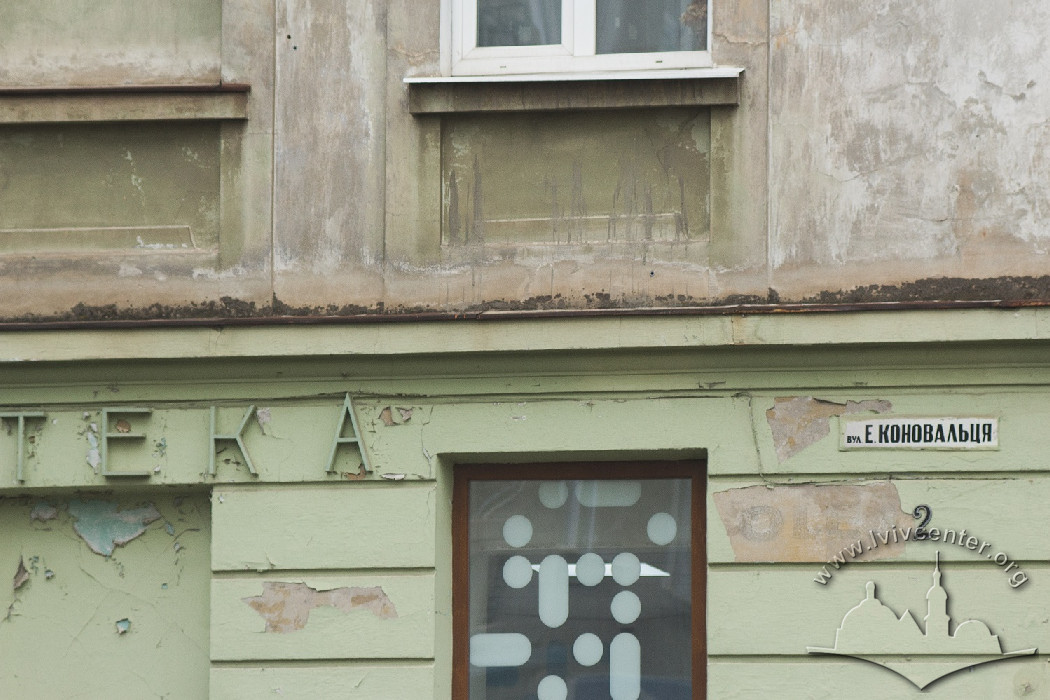
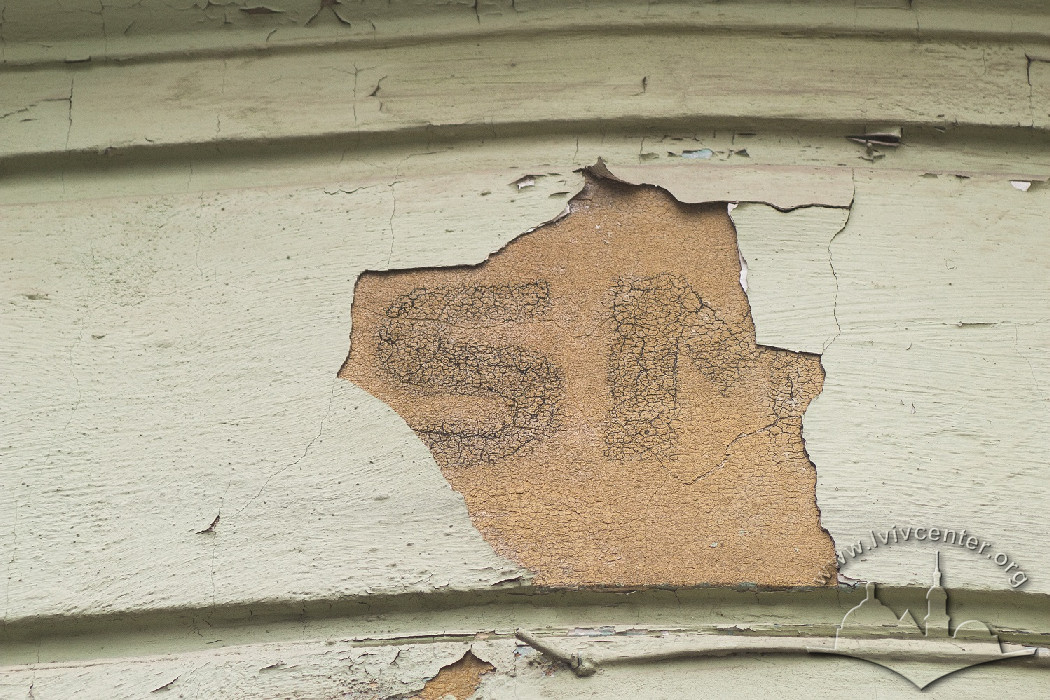
Today, there is practically no authentic window woodwork left in the building. Part of the decor on the rounded corner has fallen off or been dismantled: places which had decorative elements have been cemented over. The ground floor walls are painted but the paint is peeling off. In several places, letters of inscriptions from old shops are visible.
People
Fandzia Einaug — a sales assistant who lived in
the building (1935).
Jacob & Ewa Arkiel — owners of old single-story houses
on this site in 1871—1901.
Salomon Bindorf — a sales assistant who lived in
the building (1935).
Józef Brück — owner of a paint and perfume
warehouse that operated in the house during the interwar period.
Józef Hegedüss — a merchant who lived in the
building (1935).
Dominik Kornaga — a civil servant who lived in the
building (1935).
Antoni Kunz — owner of a shop selling materials
and devices for water supply, sewage, and heating, which operated in the building during the interwar period.
Bolesław Lewicki — owner of the building from around
1913.
Filip Lempert — an entrepreneur who lived in the
building (1935), a representative of the Nela-Wanda, a branch of a chemical
company from Krystynopol (now Sheptytskyi).
Szulim Lapter — a merchant, the first owner of
the building (1909—1913).
Karol Laturski — an officer of the Polish Army who
lived in the building (1935).
Jakób Modlinger — owner of a tobacco shop that
operated in the building (1932).
Julia Poręba — an office worker who lived in the
building (1935).
Andrzej Preuss — a plumber who lived in the
building (1935).
Helena & Jerzy Piasecki — a music teacher and an engineer
who lived in the building (1935).
Dawid Raut — owner of a haberdashery shop that
operated in the building around 1917.
Wilhelm Segal — a lawyer who lived in the
building (1935) and had a law office there.
Izrael Segal — a co-founder of the Carbopetrol
company who lived and had an office in this building in the 1930s.
Regina Tenenbaum — a resident of the building
(1939).
Julia Turteltaub — owner of a grocery store that
operated in the building around 1919.
Józef Fischler — owner of a bookbinding and
haberdashery shop that operated in the building around 1931.
Chmielewska — a seamstress who had a workshop
in the building around 1924.
Jan Czeremcha — a sales assistant who lived in
the building (1935).
Zygmunt Schorr — a writer, publisher, and artist
who lived in the building (1925).
Walery Szulman — a Lviv constructor who designed
the project of the building.
Natan Jad — a merchant who lived in the building (1935).
Sources
- Державний архів Львівської області (ДАЛО) 2/1/3353. URL: https://e.archivelviv.gov.ua/file-viewer/230132#file-1350574
- ДАЛО 2/1/3355. URL: https://e.archivelviv.gov.ua/file-viewer/230134#file-1348428
- ДАЛО 2/1/3357. URL: https://e.archivelviv.gov.ua/file-viewer/230136#file-1352462
- "Drobne ogłoszenia", Chwila, 1919, Nr. 264, s. 8.
- "Sprawa Steigera. Trzynasty dzień procesu", Chwila, 1925, Nr. 2376, S. 5-7.
- "Drobne ogłoszenia", Chwila, 1926, Nr. 2663, s. 8.
- Chwila, 1927, Nr. 3040, s.1.
- Chwila, 1935, Nr. 5730, s. 12.
- Chwila, 1939, Nr. 7237a, s. 12.
- "Ogłoszenia magistratu", Dziennik ludowy, 1919, Nr. 63.
- Księga adresowa Małopolski, 1935.
- Kurjer Lwowski, 1917, Nr. 255.
- Skorowidz król. stoł. miasta Lwowa, 1916.
- Eugeniusz Wawrzkowicz, Józef Klink, Obrona Lwowa 1−22 listopada 1918. Organizacja listopadowej obrony Lwowa. Ewidencja uczestników walk. Lista strat III (Lwów, 1939).
- Zbiór Ogłoszeń Firmowych Trybunałów Handlowych, 1928, z. 4, s. 145.