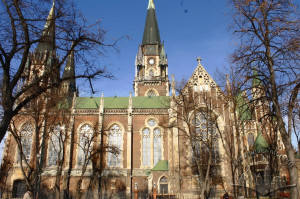
A Neo-Gothic church,
noted for its high towers and pointed spires, is one of Lviv's trademarks. It was designed by architect Teodor Talowski. Well-known
architects, sculptors and painters took part in the construction of this
church. According to the resolution of the Lviv regional executive committee
number 130 dated 26 February 1980, the church was entered into the local
register of monuments under protection number 146. In 1991 the church was
handed over to the local Greek Catholic community.
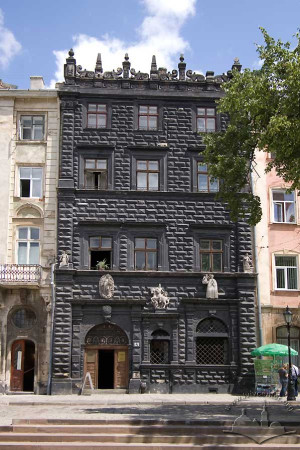
The building is a monument of Late Renaissance residential architecture. Its construction dates to 1588–1589. It is conjectured that the architects Petro Barbon and Pavlo Rymlyanyn built the townhouse. At that time, the townhouse was two stories tall. From 1596, the building became the property of merchant and apothecary Jan Lorenzowicz, who opened one of the first pharmacies in Lviv here. At that same time, a third story was added according to a design by the architect Petro Krasovskyi.
Lviv's largest stadium of the late nineteenth century was built for the Polish gymnastics society "Sokół" in 1898. Next to the stadium stood a covered wooden riding hall for equestrian sports, designed by architect and builder Ivan Levynskyi in the Zakopane style. Later, during the interwar period, it was reconstructed into a masonry brick building for athletic exercise. The complex includes a stadium, a sports palace, courts for team sports, and a throwing sector. Built between the 1950s and 1980s on the site of the former Cetnerowka manorial estate, it borders the recreational area of Pohulianka Park, the student dormitory grounds, the Hill of Glory, and the Lychakiv Cemetery. Today, it serves as one of the buildings of the Lviv State University of Physical Culture. The stadium received a new name – "Skif".
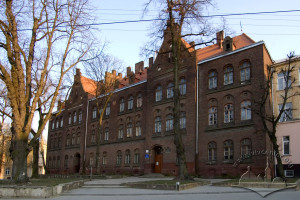
Building of the former City School of St. Mary Magdalene (1883–1884, additional construction 1909–1910; architect Juliusz Hochberger, Director of the City Construction Administration together with the Architectural Bureau of the Lviv City Council). Historicism (medievalising architectural forms). The façades, laid with unplastered red brick, were augmented with high Gothic frontons, Romanesque archvolts, and rosettes. The internal layout is based on hallways. The School of St. Mary Magdalene started as one of the city's general education schools, providing instruction mostly to students from the Kastelivka / Bajki district. As of today (2009) the object is still in use as a school building.
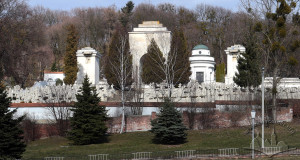
The Polish military memorial or the
Cemetery of the defenders of Lviv, also called the Cemetery of Eaglets (Cmentarz Orląt), is located
on a plot below Lychakivsky cemetery. The Poles who fought against the Western
Ukrainian People's Republic in 1918 and against the Bolsheviks in 1920, those fallen
in the German-Polish war of 1939 and participants of the Resistance Movement (1922–1944)
were buried there. In 1971 the cemetery was destroyed by the Soviet
authorities; a part of its territory was occupied by Banakha street which was
built in the same year. In 1989–2005 the memorial was partially reconstructed.