ID: 116

Related buildings and spaces

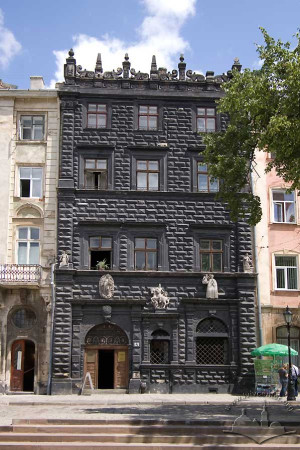
  • Pl. Rynok, 4 – Black townhouse

    The building is a monument of Late Renaissance residential architecture. Its construction dates to 1588–1589. It is conjectured that the architects Petro Barbon and Pavlo Rymlyanyn built the townhouse. At that time, the townhouse was two stories tall. From 1596, the building became the property of merchant and apothecary Jan Lorenzowicz, who opened one of the first pharmacies in Lviv here. At that same time, a third story was added according to a design by the architect Petro Krasovskyi.

    Read more
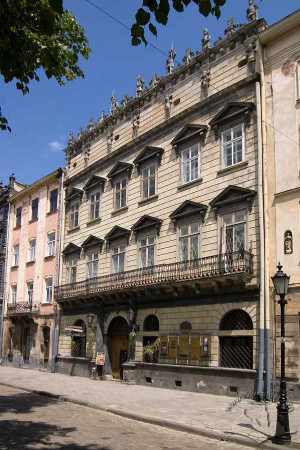
  • Pl. Rynok, 6 – former Korniakt Palace

    The building at pl. Rynok 6 (protection No. 326/5) is located within the territory of the State Historic-Architectural Preserve, set in the row development on the eastern side of the market square. The building was erected in 1580 for the wealthy Greek merchant Kostiantyn Korniakt on the foundations of two ancient Gothic townhouses.

    Read more
  • Vul. Pidvalna, 4 – architect's house (Powder Tower (Porokhova Vezha))

    The Powder Tower (today — the Architect's House; 1554–1556; reconstruction 1954–1956) is one of four preserved towers of the outer city fortification system. It is a freestanding, horseshoe-shaped stone structure built over four stories. The building is topped with a steeply pitched tile roof. Its façade wall is pierced with embrasures. Statues of reclining lions (nineteenth century) stand at the entrance. The Architect's House has been housed in the tower since 1956.

    Read more
  • Territory of Lychakiv cemetery – Polish military cemetery (Cemetery of Eaglets)
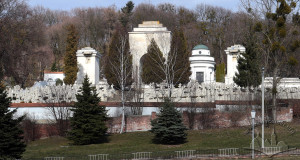
    The Polish military memorial or the Cemetery of the defenders of Lviv, also called the Cemetery of Eaglets (Cmentarz Orląt), is located on a plot below Lychakivsky cemetery. The Poles who fought against the Western Ukrainian People's Republic in 1918 and against the Bolsheviks in 1920, those fallen in the German-Polish war of 1939 and participants of the Resistance Movement (1922–1944) were buried there. In 1971 the cemetery was destroyed by the Soviet authorities; a part of its territory was occupied by Banakha street which was built in the same year. In 1989–2005 the memorial was partially reconstructed.
    Read more
  • Vul. Illi Mechnykova – Lychakivskyi (Lychakiv) cemetery
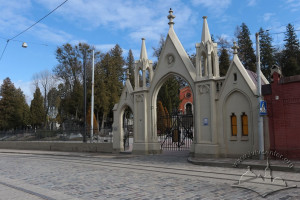
    Lychakivsky (Lychakiv) cemetery is situated close to Mechnykova street; its territory occupies the Lychakiv plateau and its vicinities. As for today, this is the oldest preserved cemetery in Lviv which was officially opened in 1786. It is one of the best known European necropolises containing a lot of artistic monuments. The cemetery has been declared a historical, archaeological and artistic monument of national significance. There one can see the graves of many prominent persons, military burial places belonging to the times of the First and Second World Wars etc.

    Read more
  • Vul. Arkhitektorska – monument to Lviv Eaglets (does not exist)

    The monument to the fallen participants of the 1918 battle for Lviv was installed near the main building of the Lviv Polytechnic in 1925. The authors of this project were architect Witold Wincenty Rawski, sculptors Józef Starzyński and Andrzej Albrycht. The monument was destroyed after 1950.

    Read more
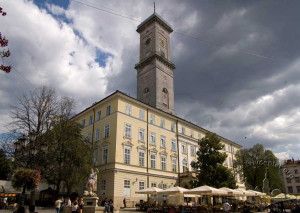
  • Pl. Rynok, 1 – The City Hall building

    The current building of the Lviv city hall was built in the years 1827–1835. The project was designed by architects Alois Wondraszka, Jerzy Glogowski, Joseph Markl, and Franz Trescher. In 1849–1851, after a fire, a reconstruction was carried out under a project by Johann Salzmann. The massive building is situated at the center of the Rynok square; it has four symmetrical Neo-Classicist façades. Its tower, which is square in plan, belongs to the most noticeable accents of Lviv's architectural panorama and is one of the visual symbols of the city. The style of the building can be considered a typical one for the Austrian administration buildings of the 1830–1840s. The city hall is the administrative center of the city, the Lviv City Council is located there.

    Read more
  • Pl. Halytska, 10 – Library of Ivan Franko National University of Lviv, former Biesiadecki Palace
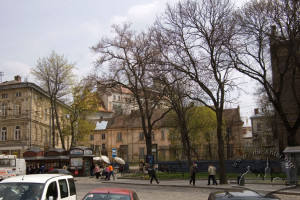
    The former Biesiadecki Palace (also formerly owned by the Bielski, Potocki, and Komorowski families; currently housing a library) was built in the early eighteenth century. It underwent major changes over the years: a reconstruction in 1756 by architect Pierre Ricaud de Tirregaille; an interior renovation in the 1820s by architect Fryderyk Bauman; and a further reconstruction in 1934 by architect Jan Bagieński. The architectural styles include Rococo, Empire (in the interior), and Neoclassicism.

    This standalone building is set back within the property behind a garden, which is separated from the square by a stone wall with an entrance gate. It is a prime example of eighteenth- and nineteenth-century urban palace architecture. Despite various renovations, the monument has preserved its original structural core.

    Read more
  • Pl. Rynok, 4 – Black townhouse

    Pl. Rynok, 4 – Black townhouse
  • Pl. Rynok, 6 – former Korniakt Palace

    Pl. Rynok, 6 – former Korniakt Palace
  • Vul. Pidvalna, 4 – architect's house (Powder Tower (Porokhova Vezha))

    Vul. Pidvalna, 4 – architect's house (Powder Tower (Porokhova Vezha))
  • Territory of Lychakiv cemetery – Polish military cemetery (Cemetery of Eaglets)

    Territory of Lychakiv cemetery – Polish military cemetery (Cemetery of Eaglets)
  • Vul. Illi Mechnykova – Lychakivskyi (Lychakiv) cemetery

    Vul. Illi Mechnykova – Lychakivskyi (Lychakiv) cemetery
  • Vul. Arkhitektorska – monument to Lviv Eaglets (does not exist)

    Vul. Arkhitektorska – monument to Lviv Eaglets (does not exist)
  • Pl. Rynok, 1 – The City Hall building

    Pl. Rynok, 1 – The City Hall building
  • Pl. Halytska, 10 – Library of Ivan Franko National University of Lviv, former Biesiadecki Palace

    Pl. Halytska, 10 – Library of Ivan Franko National University of Lviv, former Biesiadecki Palace

Organizations

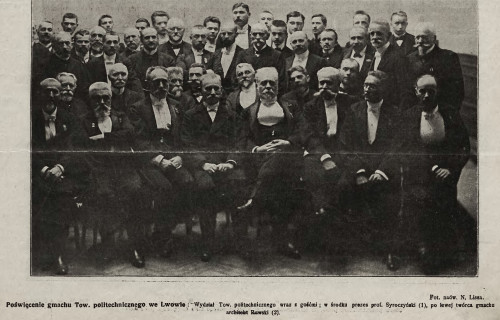
  • Polytechnic Society (Towarzystwo politechniczne)

    Polytechnic Society (Towarzystwo politechniczne)

    Founded in 1876, functioned until 1939 (from 1913 known as the Polish Polytechnic Society) — the first and leading non-governmental organization of technical professionals in the crownland of Galicia. Combined the characteristics of a trade union and a scientific society. Responsible for the founding of the Industrial Museum in Lviv, the introduction to the city of electricity and the sewerage system, etc.

    Read more