Hersz (Hersch, Herman) Bad ID: 320

Hersz (Hersch, Herman) Bad ID: 320
1862–1942?
Jewish religion teacher, philosopher, and book collector.
Hersz Bad (also known as Hersch or Herman) was born on May 5, 1869, in Peremyshliany. He came from a family influenced by the ideals of the Jewish Enlightenment — the Haskalah.
He attended school and received a religious education in Peremyshliany. He enrolled in a gymnasium in Lviv but completed his studies in Brody, graduating in 1894. That same year, he entered the Faculty of Philosophy at the University of Vienna, where he studied for one year (1894–1895). While in Vienna, he also attended lectures at the Israelitisch-Theologische Lehranstalt, the local rabbinical seminary.
In 1895, he left Vienna and began working at a private elementary school run by the Baron Hirsch Foundation (Baron Hirsch-Stiftung) in Zborów (now Zboriv). At the same time, he attended the Imperial-Royal Teachers Seminary (C.K. Seminarium Nauczycielskie) in Tarnopol (now Ternopil), earning his diploma in June 1896. In 1898, he obtained a teaching certificate qualifying him to teach elementary school. He continued working at Hirsch Foundation schools until October 1902, when he resigned to pursue further studies in philosophy in Lviv.
From 1902 to 1905, he attended the Faculty of Philosophy at the University of Lviv as an auditor. He also studied at the Institute for the Training of Jewish Religion Teachers (Zakład dla kształcenia nauczycieli religii mojżeszowej we Lwowie), founded by Lviv's Jewish community. On November 26, 1905, he was granted the qualification to teach Jewish religion in secondary schools with Polish as the language of instruction.
During 1905–1906, he taught Jewish religion at several public and private schools in Lviv, including the Konarski, Kordecki, and Staszic schools.
His main professional career was tied to Lviv's secondary schools (gymnasiums). He taught religion at the Fifth Gymnasium from 1904 to 1913, advancing from teaching assistant to certified deputy teacher. At the Third Gymnasium (known as the Franz Joseph Gymnasium, and during the interwar period as the Stephen Báthory Gymnasium), he served as a religion teacher from 1913 to 1928, attaining full-time (tenured) status in the 1917–18 school year. He also taught part-time at the First, Fourth, Sixth, Seventh, Eighth, and Tenth Gymnasiums, as well as at girls' gymnasiums. At the Słowacki Private Gymnasium, he taught an introductory philosophy course (propaedeutics of philosophy).
Beyond his school teaching, he trained professionals at the Institute for the Training of Jewish Religion Teachers (1910–1913) and worked at the private Talmud Tora school.
After the outbreak of World War I, he evacuated to Vienna, returning to Lviv at the end of 1915 and resuming his work at the Third Gymnasium.
Due to declining health, he went on leave in November 1929 and was officially retired on June 30, 1930.
Hersz Bad belonged to the earliest generation of students of Professor Kazimierz Twardowski. He was especially interested in Kantian philosophy. He published several philosophical works, contributed to the journals Przegląd Filozoficzny and Ruch Filozoficzny, and served on the editorial board of the latter. From 1907, he was a member of the Polish Philosophical Society in Lviv (Polskie Towarzystwo Filozoficzne we Lwowie). Roman Ingarden remembered him as "a modest scholar, yet full of enthusiasm for philosophical research and tenacity in substantiating and defending his theses" (Wspomnienia, 1946, 335).
In 1907, he joined the Secondary School Teachers' Association (Towarzystwo nauczycieli szkół wyższych). In 1935, he served as chairman of the board of the Safa Berurah School Society in Lviv. In 1932, he also served on a jury at the Lviv court.
He maintained an extensive personal library. In 1935, he donated 235 works (355 volumes) to the Hebrew University Library and the National Library in Jerusalem, covering philosophy, psychology, mathematics and logic, natural sciences, theology, Jewish studies, and art, as well as Judaica (including the Scroll of Esther and a Hanukkah lamp) and reproductions of paintings by Artur Grottger and Jan Matejko.
No information is available about his family or children.
Several of his addresses in Lviv are known: in 1910, he lived at ul. Grodecka, 53; in 1913–1914 and in 1916, at ul. Łyczakowska, 155; and in 1935, at ul. Sakramentek, 32.
Information about his death comes from a single source — a mention in the list of losses suffered by the Polish people (Olszewicz, Lista, 175).
Works and projects
- Hersz Bad, Czy Schopenhauer był filozofem? (Lwów: Nakładem L. Chmielewskiego, 1909), 54.
- Hersz Bad, Geneza i zmierzch legendy "Kant–Laplace" (Lwów: Wydawnictwo Księgarni M. H. Rubina, 1931), 48.
- Hersz Bad, "Georg Simmel: Kant. Sechzehn Vorlesungen, gehalten an der Berliner Universität (recenzja)", Przegląd Filozoficzny, 1905, nr 8.
- Hersz Bad, "Immanuel Kant, Prolegomena do wszelkiej przyszłej metafizyki (tł. Romuald Piątkowski) — recenzja", Przegląd Filozoficzny, 1907, nr 10.
- Hersz Bad, "'Grundlegung' Kanta w tłumaczeniu polskim", Przegląd Filozoficzny, 1908, nr 3.
- Hersz Bad, "O kwestię autentyczności deklaracji Kanta z dnia 29 maja 1801 r. pt. "Do publicznej wiadomości"", Przegląd Filozoficzny, 1920, nr 23: 19–43.
- Hersz Bad, "Immanuel Kant, Prolegomena do wszelkiej przyszłej metafizyki… (tł. Benedykt Bornstein) — recenzja", Ruch Filozoficzny, 1921–1922, nr 6–7: 88–90.
Organizations
-
Provincial School Board of Galicia
An institution supervising primary, secondary, and vocational education in the crown land. The Board was headed by the governor of Galicia or his appointed deputy and operated from 1868 to 1921.
Read more -
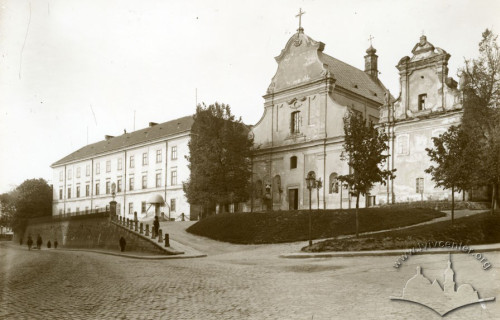
Habsburg University
The University, founded in 1784 by Joseph II on the basis of the abolished Jesuit academy, was to become the main source of professional officials for the capital of the Galician province. Stress was laid not on research, but chiefly on the training of managers. After numerous changes, in particular, the demotion of the institution status to that of a lyceum, in 1817 the university was refounded by Emperor Francis II. The institution existed in this condition till the end of 1918.
Read more
Sources
- Maria Vovchko, "Bad Hersz", у: Słownik biograficzny nauczycieli religii mojżeszowej. Edycja internetowa (2025). URL: https://nrm.project.uj.edu.pl/b/-/journal_content/56_INSTANCE_I1ntsDC1pduv/157144744/158200852
- Archiwum Główne Akt Dawnych (AGAD), 1/304/352u: 331.
- Центральний державний історичний архів України у Львові (далі — ЦДІАУЛ), ф. 178 (Крайова шкільна рада, м. Львів)/2/1152: 25.
- ЦДІАУЛ ф. 701 (Єврейська громада у Львові)/2/1221: 26; 701/2/1382: 63; 701/2/1437: 8; 702/2/1449: 84; 701/2/1547: 26.
- Державний архів Львівської області ф. 26 (Університет ім. Яна Казимира у Львові)/15/719: 17–18.
- Chwila, 1935, nr 5728; nr 5735; nr 5990.
- Gazeta Lwowska, 1894, nr 167; 1932, nr 193.
- Muzeum, 1908, t. 1, z. 5.
- Słowo Polskie, 1932, nr 232.
- Szematyzm królestwa Galicyi i Lodomeryi z wielk. księstwem krakowskiem na rok 1905: 487, 591, 595; 1906: 501, 621, 624, 625; 1907: 500; 1908: 500; 1909: 545, 547; 1910: 546; 1911: 569; 1912: 568; 1914: 626.
- Kalendarzyk Profesorski Towarzystwa Nauczycieli Szkół Wyższych (Lwów, 1914), 177.
- Sprawozdanie Gimnazjum im. Franciszka Józefa we Lwowie, 1916: 49; 1917: 14; 1918: 5.
- Sprawozdanie Gimnazjum IV we Lwowie, 1916: 28, 32.
- Sprawozdanie Gimnazjum V we Lwowie, 1904: 50, 51; 1905: 46; 1907: 48, 51; 1908: 54, 58; 1909: 135; 1910: 20; 1911: 24; 1913: 53; 1914: 31.
- Sprawozdanie Gimnazjum VI we Lwowie, 1905: 31; 1906: 38.
- Sprawozdanie Gimnazjum VII we Lwowie, 1911: 41; 1912: 31.
- Sprawozdanie Filii Gimnazjum VII we Lwowie, 1913: 33; 1914: 33.
- Sprawozdanie Gimnazjum Żeńskiego im. Juliusza Słowackiego we Lwowie, 1910: 13, 43.
- Sprawozdanie III Gimnazjum we Lwowie, 1930: 5, 7-8.
- Dziennik Ustaw Rady Szkolnej Krajowej, 1913, nr 16: 342; 1919, nr 8: 194.
- Dziennik Urzędowy Kuratorium Okręgu Szkolnego Lwowskiego, 1930, nr 9: 532.
- Księga pamiątkowa i adresowa wygnańców wojennych z Galicyi i Bukowiny 1914-1915 oraz Album pamiątkowe. Cz. 1. Lwów (Wiedeń, 1915), 27.
- Księga adresowa król. stoł. miasta Lwowa (Lwów, 1910, 1913, 1914, 1916).
- "Wspomnienia o filozofach zmarłych 1939–1945 [o Herszu Badzie - R. Ingarden]", Przegląd Filozoficzny, 1946, z. 3–4: 335.
- Almanach i leksykon żydostwa polskiego, t. II–III (Lwów, 1938): 664–665.
- Bolesław Olszewicz, Lista strat kultury polskiej (1 IX 1939 – 1 III 1946) (Warszawa, 1947).
- Jacek Jadacki, "Hersz Bad", [у:] Słownik filozofów polskich, red. Bogdan Andrzejewski, Ryszard Kozłowski (Poznań, 1999), 18.
- Lesław Jaworski, Gimnazjum VI im. Stanisława Staszica we Lwowie: 1902–1927. Dzieje i ludzie (Lwów, 1927).
- Leszek Kołakowski, "Hersch Bad", [у:] Filozofia w Polsce. Słownik pisarzy, red. Bronisław Baczko (Wrocław–Warszawa–Kraków–Gdańsk, 1971), 14.
- Anna Szyrwińska, "Z badań nad filozofią Kanta w kręgu Szkoły Lwowsko-Warszawskiej: Hersz Bad o teorii Kanta-Laplace'a", Studia z Historii Filozofii, 2014, nr 3 (5), 145–161.