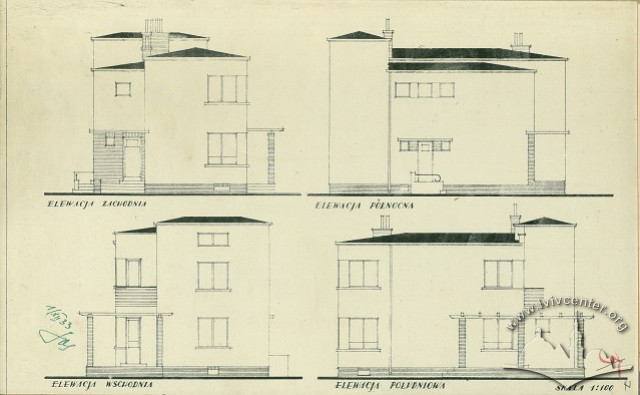
Vul. Zaporizka, 25 – residential building ID: 2495
This two-story, single-family villa with a basement and an attic was constructed between 1933 and 1934 based on standard design No. 3, which was developed by engineer-architect Tadeusz Wróbel for Jan and Franciszka Chlamtacz. It is an example of affordable single-family housing enveloped by a garden. The building is an Architectural monument of local significance and was assigned protection number 2601 by Decision No. 374 of the Lviv Regional Executive Committee on April 15, 1994.
Story
In the early 1930s, the area surrounding the Krasuczyn estate near Zalizna Voda Park caught the attention of the Lviv municipal government due to its picturesque location, healthy climate, and compliance with hygienic standards. The development of this district was initiated by the prominent engineer-architect Tadeusz Wróbel, who developed six standard designs for the "Nowy Lwów" settlement, a project he actively championed. In 1933, the magistrate allocated an area of about 8 hectares, dividing it into 115 urban sites for financially affordable private housing development. This territory is located within the boundaries of modern-day streets: Myshuhy (known as ul. Pomorska during the Polish period), Panasa Myrnoho (Kozielnicka, later Własna Strzecha), Lytovska, Zaporizka (Mazowiecka), Kybalchycha (Śląska), Ternopilska (which then consisted of two streets — Cieszyńska and Toruńska), and Tyverska (Kaszubska). On October 20, 1933, the Lviv Urban Development Committee approved the six standard building designs by Tadeusz Wróbel, which were to be used to build up the "On Zalizna Woda" residential colony. Each of the houses, designed with 3 to 5 rooms, was an example of affordable single-family housing surrounded by a garden, built upon the principles of modernist explorations that were being actively pursued across Europe and the world since the early 1920s.
An agreement was signed with each property owner stipulating that construction had to begin no later than September 1, 1934, and these buildings had to be commissioned for operation no later than September 1, 1936.
By 1934, 31 houses had been built, thanks to a state credit program with a repayment term of up to 10 years.
On October 31, 1933, Jan and Franciszka Chlamtacz petitioned the magistrate for a permit to construct a house according to standard design No. 3 (ДАЛО 2/2/1120:1); the permit was granted on December 23, 1933 (ДАЛО 2/2/1120:4). Construction was completed on April 20, 1934 (ДАЛО 2/2/1120:10), and the occupancy permit for the house was issued on June 25, 1934 (ДАЛО 2/2/1120:19).
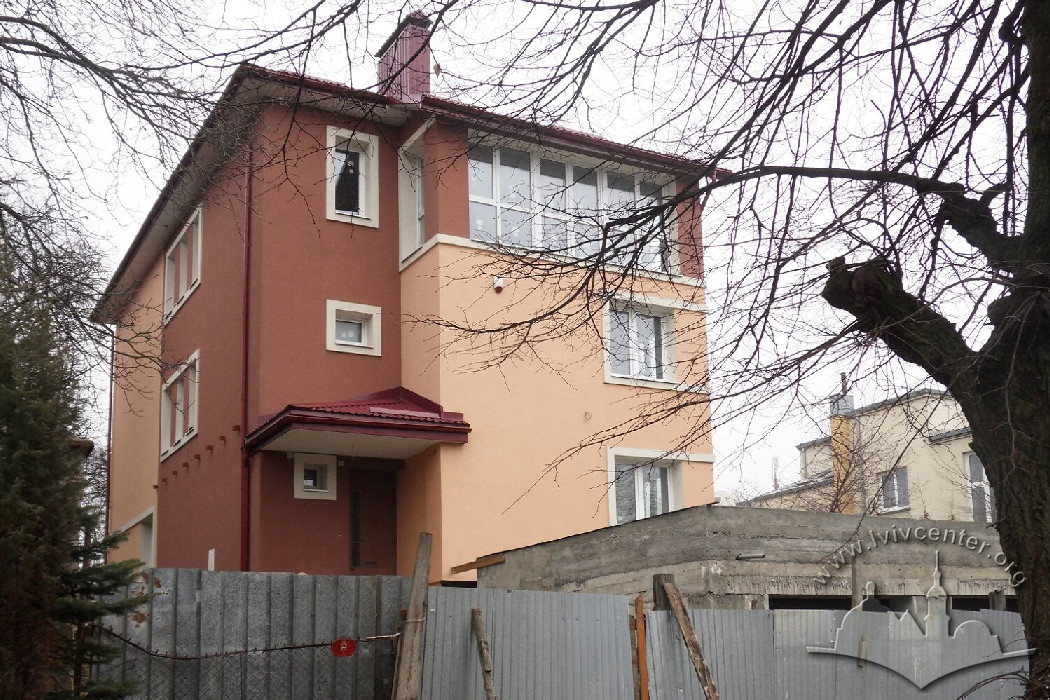
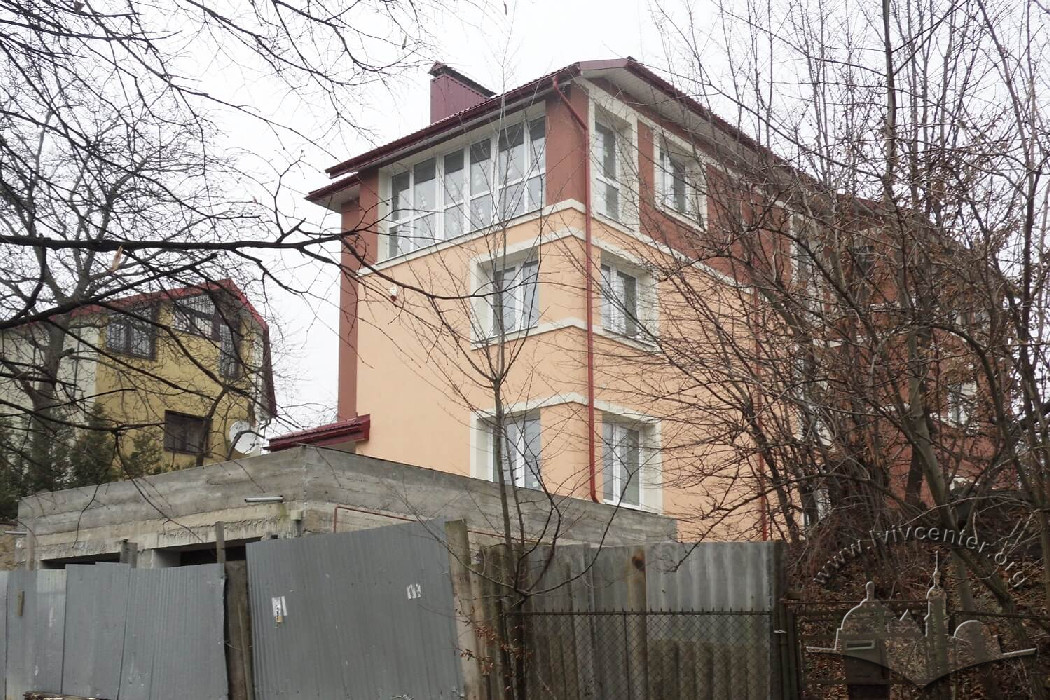
Today, this building has undergone extensive alterations, which have completely obliterated its three-volume spatial composition and stripped away its original architectural and figurative concept.
Architecture
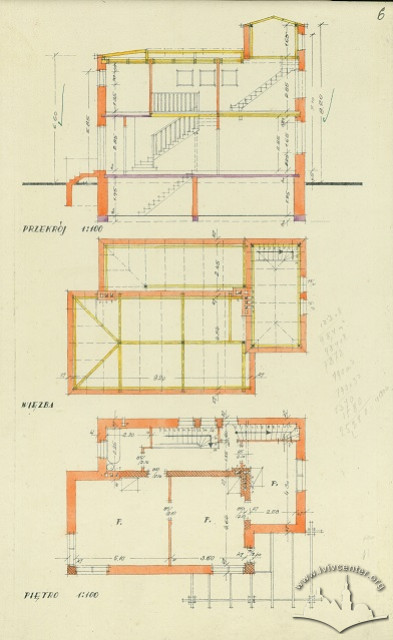
This two-story single-family villa with an attic and a basement was constructed between 1933 and 1934 according to standard design No. 3 by architect Tadeusz Wróbel. The brick building is rendered and consists of three volumes of varying heights. These are topped by metal-sheeted roofs with a minimal angle of slope, which created the illusion of using flat roofs.
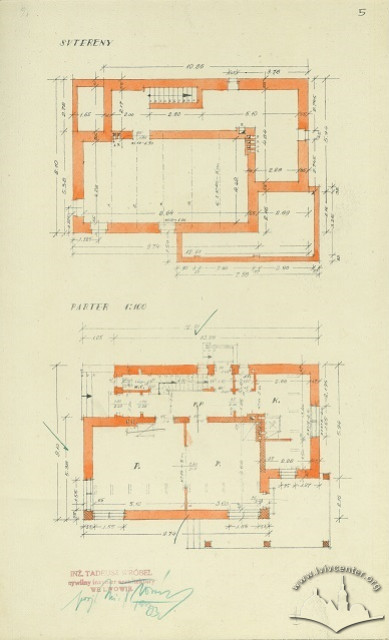
The footprint of the development covers 116.95 m², and the building volume is 1006.26 m³.
The house accommodates at the basement level: two pantries and a stairwell; at the ground-floor level: two rooms, an anteroom, a kitchen with a maid's room, a toilet, a pantry, a stairwell, and a terrace; at the first-floor level: three rooms, a bathroom, a stairwell, and stairs to the attic.
The principal entrance to the house faces west and is positioned on the side of vul. Zaporizka. Above it, at the first-floor level, is a small window that lights the bathroom. The block of residential rooms on both levels is consolidated into a separate volume located to the right of the entrance group. To provide natural light for this section, large corner windows facing the west and south sides were designed. The southeastern corner of the building is enveloped by a terrace, accessed through doors from one of the rooms. The kitchen, located on the ground floor, and one of the residential rooms on the first floor face east and are illuminated by large windows. The northern elevation is devoid of large window openings, with the only exceptions being small square windows on either side of the side entrance door to the house. At the first-floor level, this compositional technique is repeated, using a third square window instead of a door to light the anteroom.
People
Jan and Franciszka Chlamtacz –– the clients and original owners of the house.
Tadeusz Wróbel –– engineer-architect, project designer, prominent urban planner, and one of the most celebrated Lviv architects who championed and advanced the ideas of avant-gardism in architecture. In the 1930s, he initiated the development of the "Nowy Lwów" district with compact, comfortable villas enveloped by gardens. He was a pioneer of the advanced architectural and urban planning ideas of the "Werkbund" in Lviv. He developed six standard designs for the "Nowy Lwów" settlement, whose construction he actively advocated. As part of this project's execution, the municipal authorities allocated eight hectares (divided into one hundred and fifteen urban sites) within the existing "Zalizna Voda" residential colony.
Sources
2. Шишка О., Галицька Брама, 2001, № 11–12, 3.