Prosp. Svobody, 1–3 – cinema (no longer exists) ID: 1762
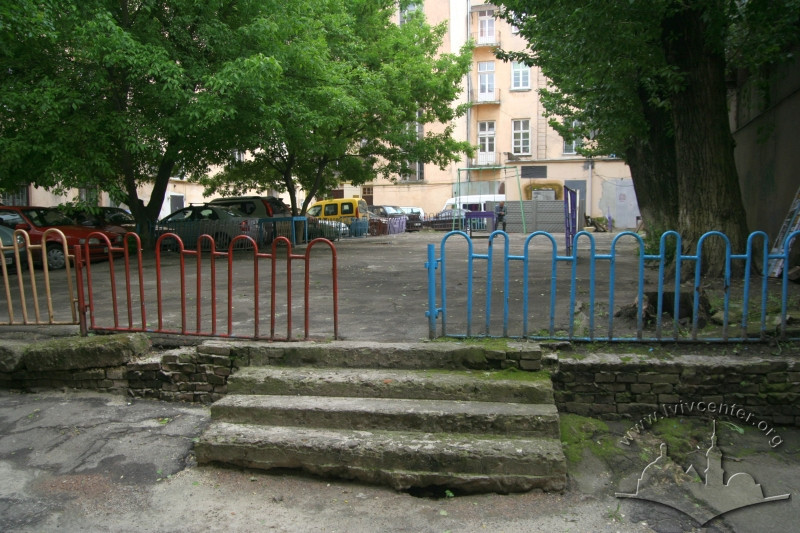
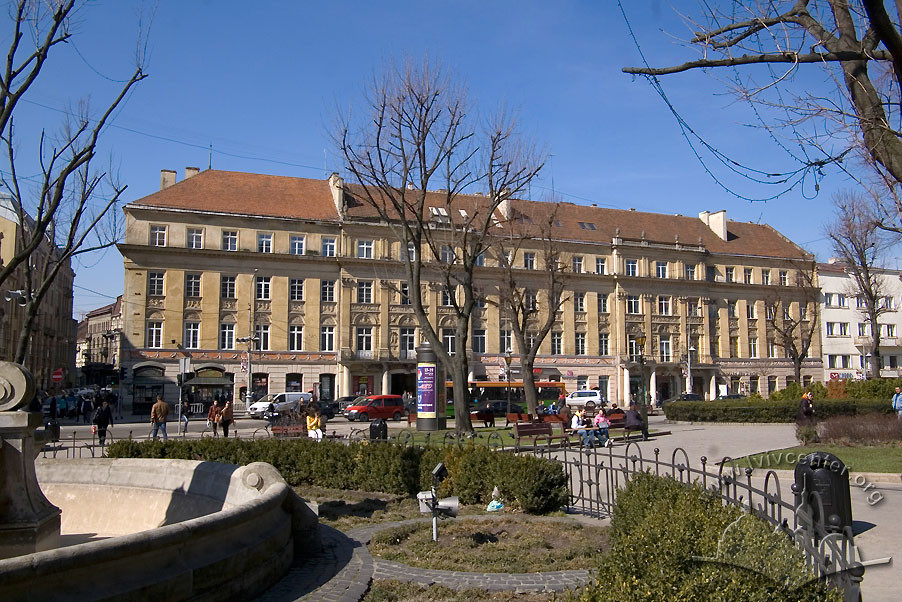
In the courtyard of the building at prosp. Svobody, 1–3, the "Palace" cinema building was located from 1926 to 1941. It was owned by a film association of the same name. It was the city's first sound cinema, as well as the largest and one of the finest cinemas in Lviv at the time. The building was destroyed during World War II.
Story
The "Palace" cinema opened in 1926 in a new building in the courtyard of the former Hausner Townhouse on ul. Hetmańska (present-day prosp. Svobody), which at that time belonged to the Land Credit Society (Pol. Towarzystwo Kredytowe Ziemskie). The lease agreement for the plot was concluded through 1945, with annual rent set at 4,000 USD.
In 1924, the cinema's owner founded the "Palace" film association. Its members included industrialist Zygfryd Weiss, who resided at ul. Sykstuska 35 (now vul. P. Doroshenka); Adolf Pariser; Zygmunt Reiss; and Stanisław Szczepański, who resided at ul. Pańska 3 (now vul. I. Franka). The owners constructed the cinema building at their own expense. In 1925, the interior was decorated by artist Feliks Wygrzywalski, who had formerly worked as a set designer for the Lviv Opera House (prosp. Svobody 28). In addition to film screenings, the venue was intended to host theatrical performances and other solemn events. Equipped with the latest technology, the "Palace" catered to an elite audience, screening the newest feature films and frequently updating its repertoire. During the interwar period, it was the largest cinema in the city, boasting a seating capacity of 1,114.
As of 1926, movie tickets cost between 2 and 3 zł. Occasionally, however, discounted screenings were held. For instance, in June 1926, the "Palace" screened Polish-produced films with ticket prices ranging from 50 gr to 1.50 zł.
On January 29, 1928, at 12:40 PM, a fire broke out at the "Palace" cinema due to the spontaneous combustion of film stock. This occurred while the projectionist had stepped out of the projection booth, leaving his assistant to run the film. There were no casualties, resulting only in mild panic.
The "Palace" was the first cinema in Lviv to screen sound films. On October 30, 1929, it premiered the talkie "Four Devils". This Hollywood film was directed in 1928 by German filmmaker Friedrich Wilhelm Murnau. Originally shot as a silent film, sound was added later. The sound film generated immense interest among Lviv residents and ran for a full month.
On May 27, 1935, the "Palace" was one of two cinemas in Lviv that hosted free screenings from 12:00 PM to 6:00 PM of a newsreel covering the funeral procession of Józef Piłsudski.
By 1939, the owners of the "Palace" cinema were Zygmunt Reiss, Izaak Weiss, the Leistyn family, and M. Katz from Kraków. A 1939 report by the Lviv Starostwo noted that the cinema was thriving.
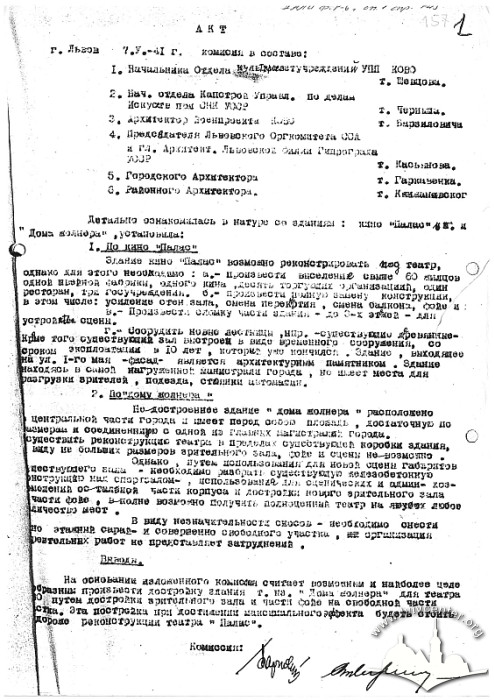
Following the entry of Soviet troops into Lviv on September 22, 1939, the cinema was nationalized. In 1941, plans were considered to convert the "Palace" cinema building into a theater.
The cinema building was damaged during World War II as a result of the bombing of Lviv on the night of June 22, 1941.
Architecture
The cinema operated in a temporary three-story structure designed for a ten-year lifespan. Entrance was arranged through the gateway at prosp. Svobody 3, while exit from the auditorium was routed through the gateway at prosp. Svobody 1.
The first floor, in addition to the hall and foyer, housed a 710-seat auditorium, utility rooms, four restrooms, and five stairwells. The second floor contained a hall, a projectionist room with auxiliary spaces, five restrooms, three stairwells, and a balcony seating 403 in the auditorium. The third floor housed administrative offices.
People
Adolf Pariser — co-owner of the cinema.
Zygmunt Reiss — co-owner of the cinema.
Stanisław Szczepański — co-owner of the cinema.
Zygfryd Weiss — industrialist, co-owner of the cinema.
Feliks Wygrzywalski — artist, author of the interior mural decorations.
Sources
- Kurjer filmowy, Kurjer Lwowski, 1926, №129, 6
- Kurjer Lwowski, 1926, №63.
- Kurjer Lwowski, 1926, №235.
- Prawo do grzechu, Gazeta Lwowska, 1933, №199, 7.
- Taschenjahrbuch 1943: Für den deutschen Generalgouvernement (Krakau: ZKW Druck, 1943).
- Державний архів Львівської області (ДАЛО) 1/56/1387.
- ДАЛО 7/3/638.
- ДАЛО110/4/625.
- Barbara Gierszewska, Kino i film we Lwowie do 1939 roku (Kielce: Wydawnictwo Akademii Świętokrzyskiej, 2006), 428.
- Ірина Котлобулатова, Кінотеатр, Енциклопедія Львова, Т. 3 (Львів: Літопис, 2010), 216-221.
- Приватна збірка П. Ґранкіна.
