Vul. Rusovykh, 2 – residential building ID: 2695
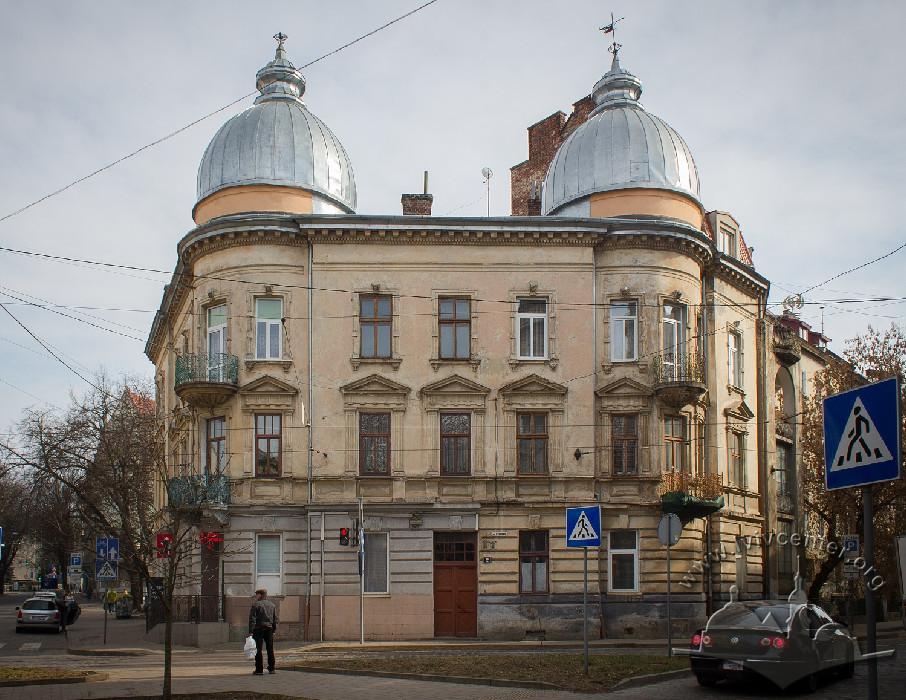
This three-story corner building in the Historicist style, built in 1895–1896 according to a design by architect Emanuel Jarymowicz, was commissioned by Alexander Lichtenheim. Today (2025), the building is residential, with a Nova Poshta post office on the ground floor.
Story
The plot on the corner of what is now vul. Rusovykh, vul. Konovaltsia, and vul. Kyivska was formed in the 1890s. It was separated from a large plot that was designated by conscription number 83 ¼ in the 19th century and occupied the territory between the contemporary vul. Bandery, vul. Kyivska, vul. Antonovycha, and vul. Konovaltsia.
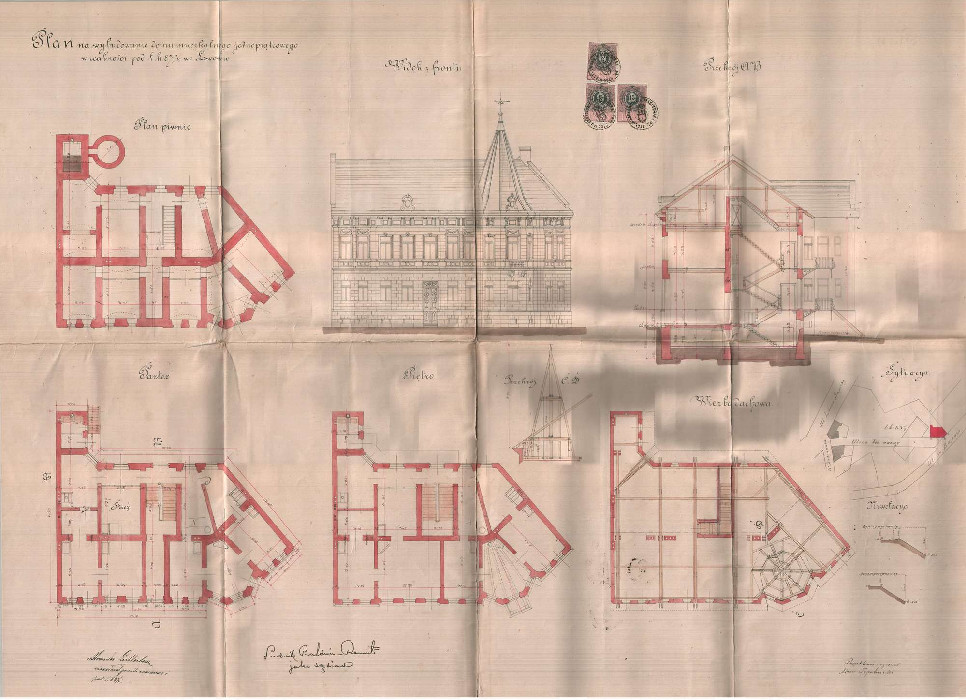
In 1890, Aleksander Lichtenheim became the owner of plot No. 83 ¼ and planned to build a two-story house there. At that time, vul. Konovaltsia, then called ul. 29 Listopada, began at the present-day vul. Kyivska (then ul. Na Bajkach), from where it continued southward, and did not yet reach vul. Bandery (then ul. Leona Sapiehy). On November 12, 1890, Lichtenheim received permission to build a townhouse on the allocated plot with conscription number 83 ¼ (ДАЛО 2/1/3362:3). The project for a four-apartment house was designed for him by Adam Topolnicki. The drawing was signed by architect Ludwik Baldwin-Ramułt, who owned the neighboring plot. It was supposed to be a fairly typical Neo-Renaissance building, except for the tall octagonal spire. Although the project was approved by the Lviv Magistrate, construction never began for unknown reasons. According to the Lviv Building Statute of 1885, in cases like this the building permit was automatically revoked after two years.
In 1892, the contemporary vul. Rusovykh, then called ul. Wiśniowieckich, appeared, laid along plot number 83 ¼.
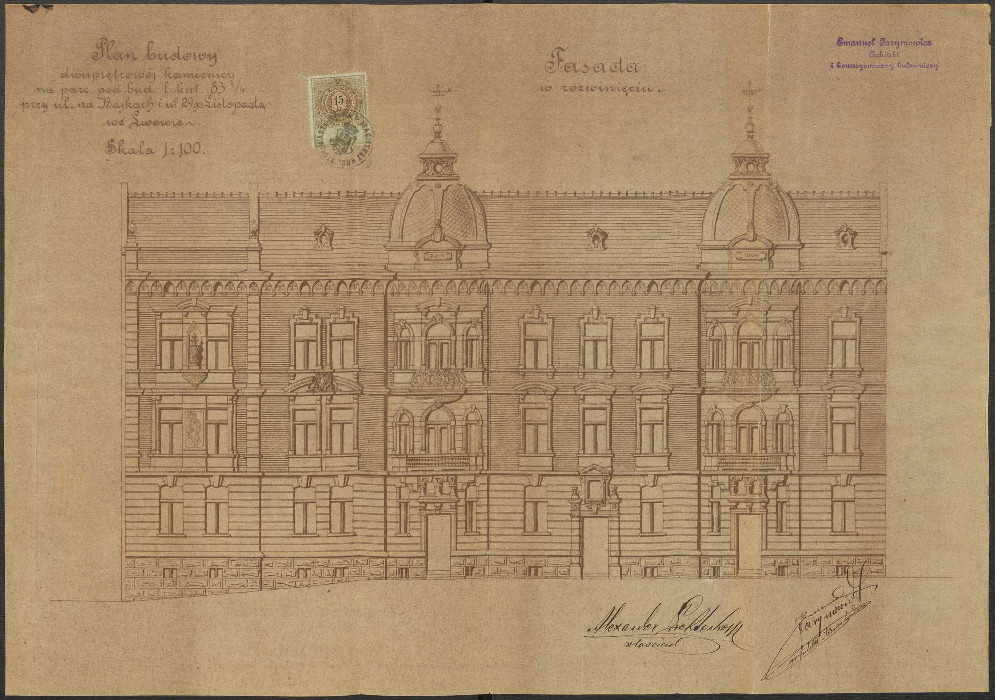
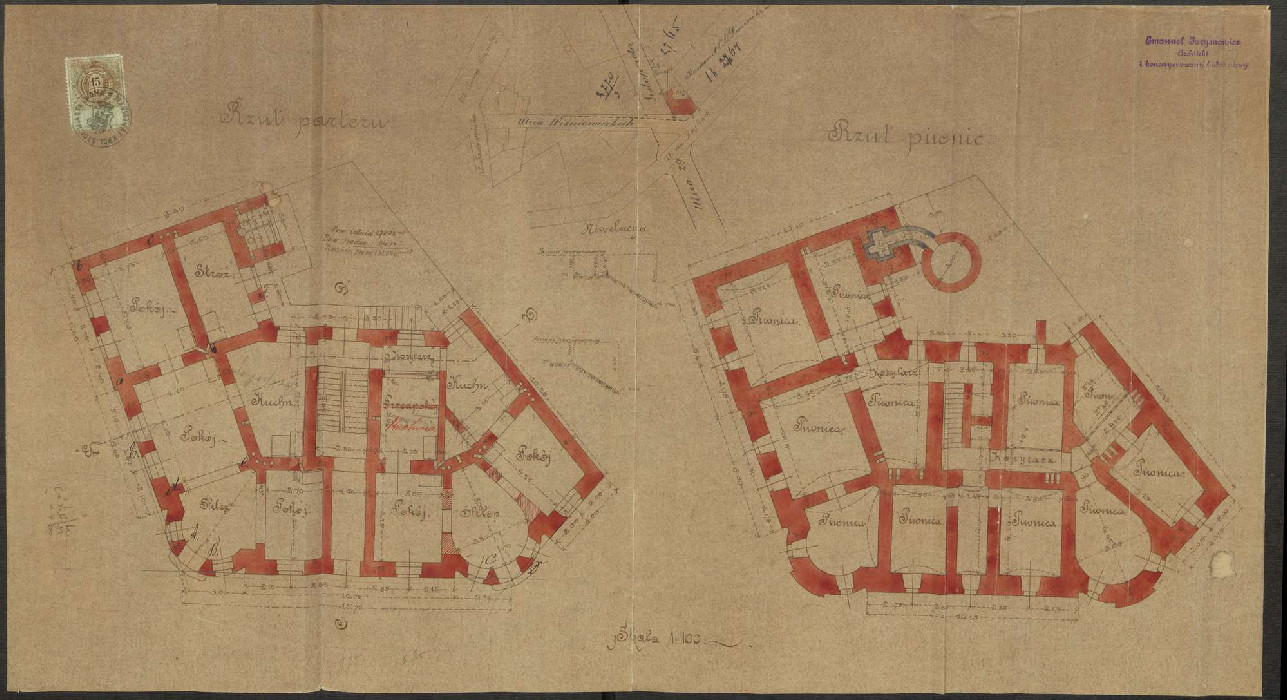
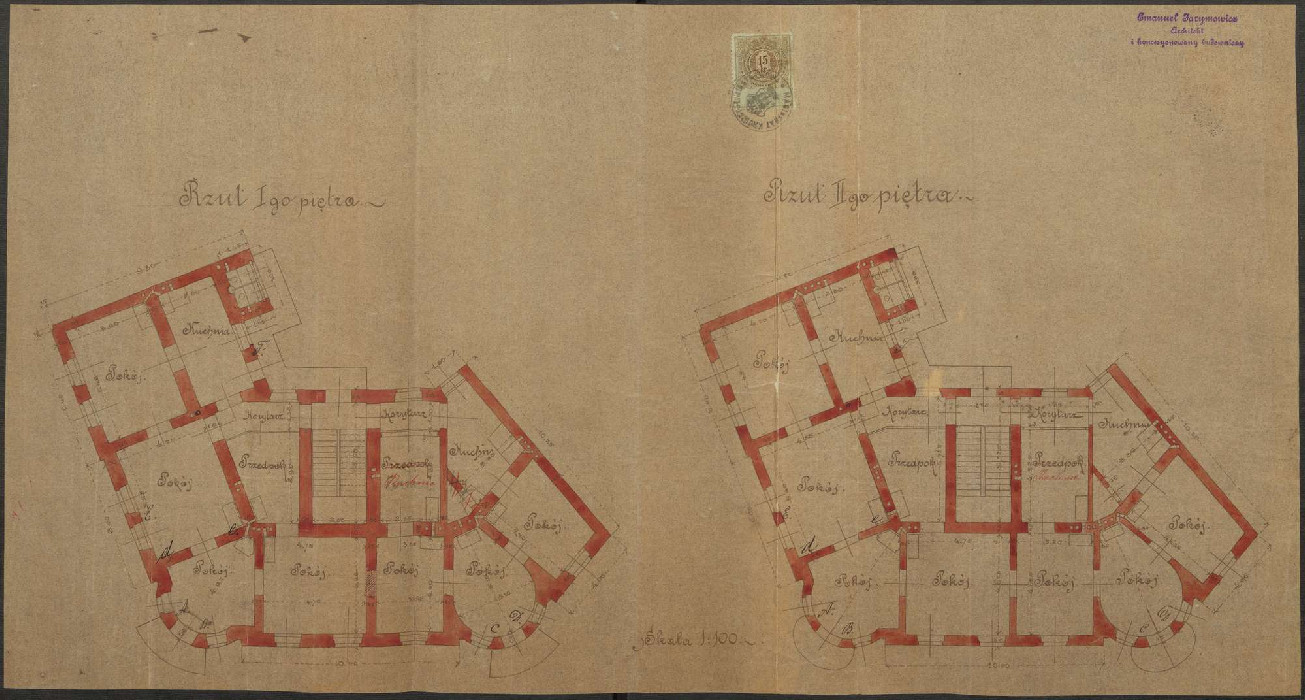
In 1895, Lichtenheim commissioned a new project from the constructor Emanuel Jarymowicz. At that time, they began to lay a road that later became the continuation of the contemporary vul. Konovaltsia to what is now vul. Bandery, although the new numbering was not introduced until 1912. Given the specific pentagonal configuration of the plot at the corner of three streets, the architect designed a building with two rounded corners covered by two domes. The three-story building was to accommodate six apartments (ДАЛО 2/1/3362:15-19). Compared to the project, the building was implemented in a somewhat simplified form, with less decoration. After the construction was completed, the plot was assigned a new conscription number 1341 ¼.
In 1906, the new owner, Jakób Schmalenberger, hired architect Artur Schleyen to design a connection for the building to the sewer system and received permission for this in May (ДАЛО 2/1/3362:6-9). In 1935, he remained its owner, together with Filipina and Franciszek Schmalenbergers. The address book from that year shows that Jakób worked as an employee of the Galician Savings Bank, while Franciszek was an employee of the state railways (Księga adresowa Małopolski, 1935). Their fate during the Second World War is unknown.
Today, the house remains residential. In 2017, its corrugated tin roof was completely replaced. While the original roof was painted dark red, the current one is made of simple galvanized sheet tin.
Architecture
The house stands on a pentagonal plot at the corner of three streets and has an irregular shape in plan. At the time of its construction, it stood apart from any other buildings; the project, however, envisaged adding other townhouses on both sides over time.
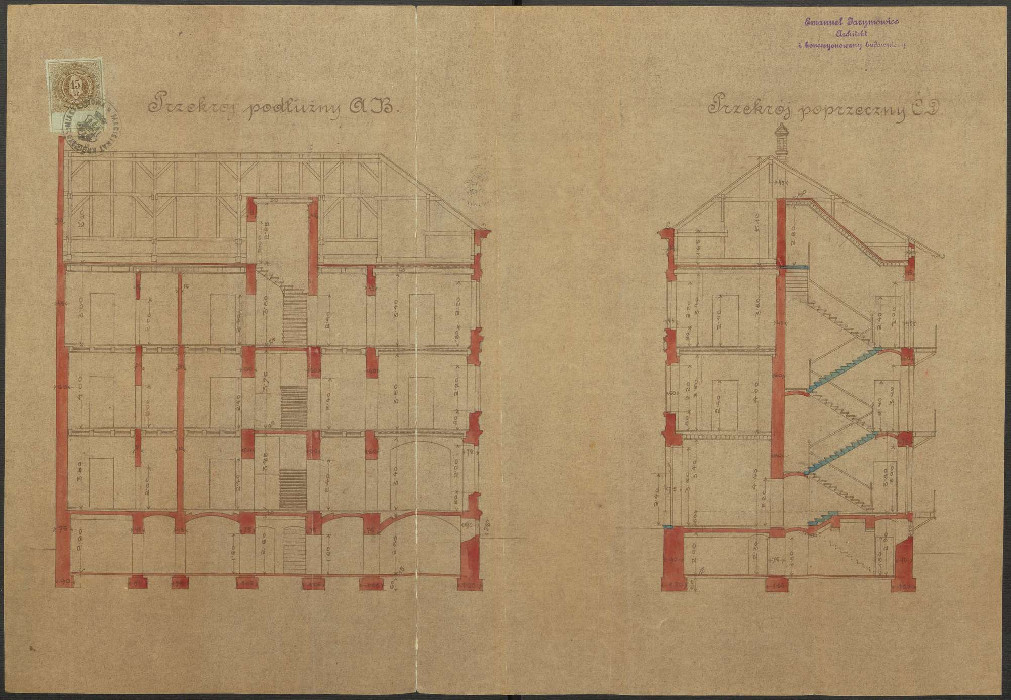
According to the 1895 design, the house was built using traditional materials and structures. The walls and foundations, as well as the basement ceilings, are made of brick; the staircases are built on brick vaults. The floors between stories are made of wooden beams; the gable roof has a wooden rafter-and-beam structure covered with sheet tin. The stairs are probably made of stone. The main entrance is located in the middle of the house and leads to a narrow hallway, and from there to the staircase. The stairs are of a typical shape, with two flights. From there, there is an entrance to two apartments on either side. At the rear, there were galleries for access to the outside toilets and the caretaker's room on the ground floor.
On the upper floors, there were to be two apartments, one with three rooms and the other with four, each with a kitchen and a large hallway. According to the original drawings, the rooms with rounded walls on the ground floor were to contain shops, but it is unclear how they were to function, as they were not separated from the living quarters. The basement was to contain storage rooms covered with segmental vaults. It is likely that during the 20th century, the building underwent significant redevelopment, starting in 1906, when the installation of sewage systems allowed for the installation of toilets and bathrooms inside the apartments.
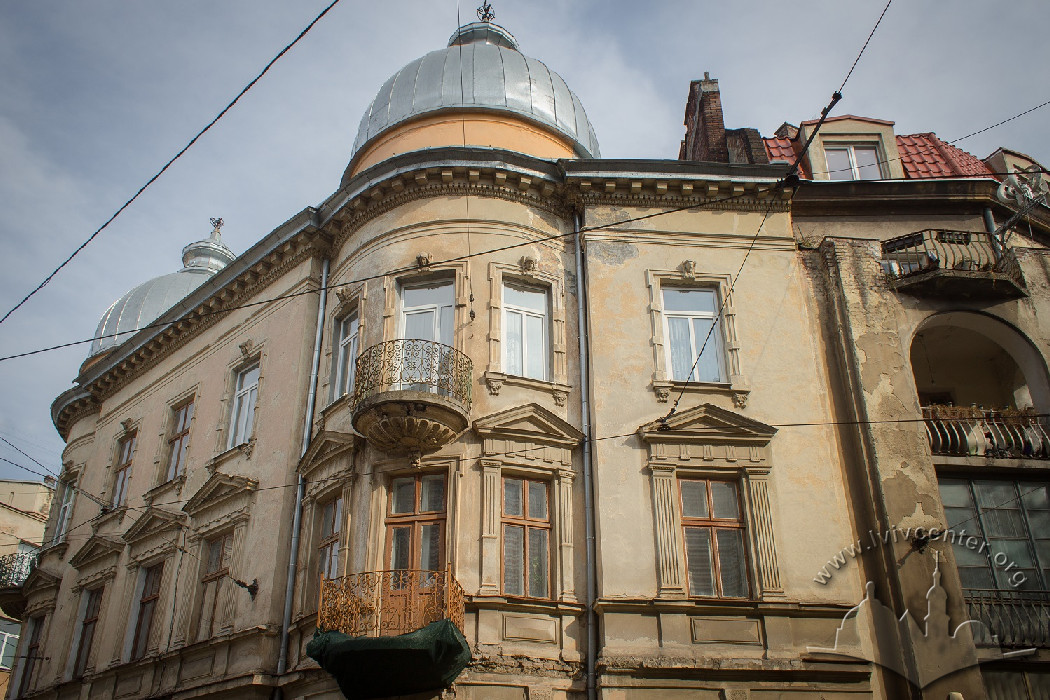
Neo-Renaissance and Neo-Baroque motifs were used in the design of the façades. The ground floor surface is rusticated and separated by an inter-floor stringcourse; the façade above is plastered and smooth. All windows are rectangular. On the ground floor, the windows have textured decorative keystones. The second floor windows are flanked by fluted pilasters and topped with triangular pediments featuring triglyphs. The third floor windows have profiled trimmings with "ears" and rustication, as well as keystones with mascarons. The façade is topped with a molded cornice. Above the façade’s rounded parts rise semicircular domes with oculi and metal weather vanes.
The rounded parts of the façade are the most decorated. In particular, there are rounded Neo-Baroque balconies supported by massive consoles. Probably, the consoles only imitate stone, being cast from metal and hollow inside. The balconies on the third floor are shell-shaped. All of them are fenced with openwork metal railings. Several rooms retain their historic window woodwork, whose division is rather characteristic of the Secession architecture of the early 1900s than that of 1895, when the building was constructed.
The façade designed by Emanuel Jarymowicz differs slightly from the one that was actually built. In particular, it was supposed to be much more varied and colorful. The walls on the second and third floors were to be faced with brick, the portals were to have a more elaborate Neo-Baroque design, the windows were to have different trimmings, and the façade was to be topped with an arcature, possibly with colored accents. The domes were also supposed to be much more elaborate; it is likely, however, that, as of 2017, the domes were already inauthentic, having been replaced sometime after the Second World War.
People
Aleksander Lichtenheim — owner of the plot who commissioned
the building's construction in the late 19th century.
Adam Topolnicki (1860–?) — an architect who worked
in the technical department of the governor's office in Lviv and designed a
project of a house to be built on the site of the present house (1890) that was
not implemented.
Ludwik Baldwin-Ramułt (1857–1929) — an architect who owned
a neighboring plot in 1890.
Artur Schleyen (1866–1912) — an architect who
designed a project for the connection of the building to the sewage system.
Jakób Schmalenberger — owner of the house from the 1900s
until 1939.
Filipina Schmalenberger — a co-owner of the house until the
Second World War.
Franciszek Schmalenberger — a co-owner of the house until the
Second World War.
Emanuel Jarymowicz (1865–?) — a constructor who designed
the project for this house.
Sources
- Державний архів Львівської області (ДАЛО) 2/1/3362. URL: https://e.archivelviv.gov.ua/file-viewer/230141#file-1352689
- Księga adresowa Małopolski, (Lwów. Stanisławów. Tarnopól, 1935–1936).