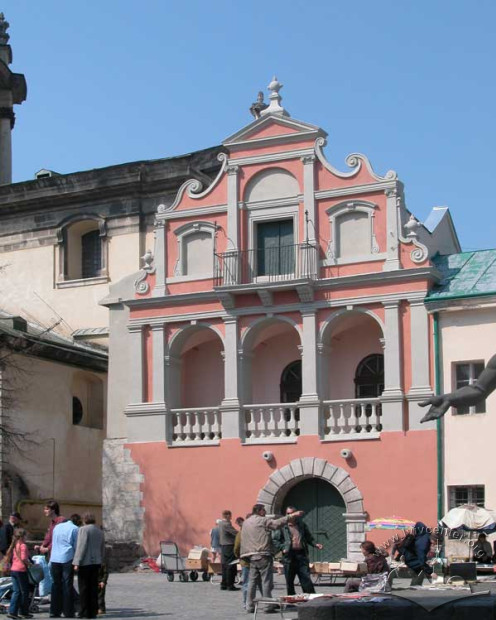
Vul. Pidvalna, 13 – State Archive of Lviv Region ID: 380
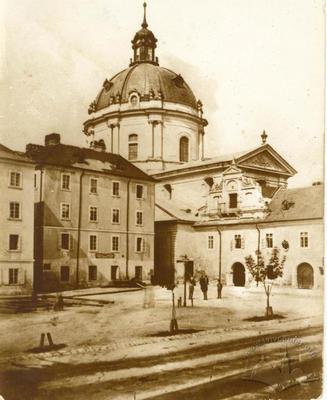
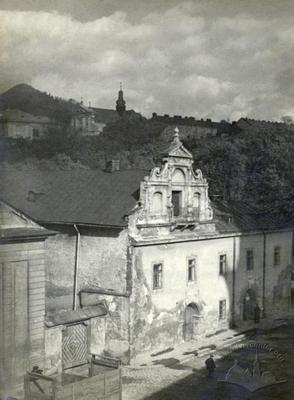
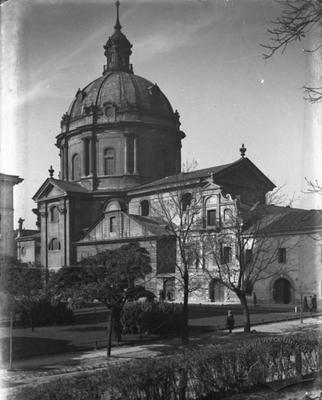
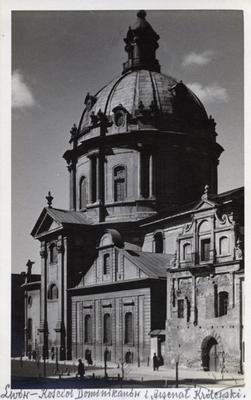
Former "Royal Arsenal" (today — the building of the State Archives of Lviv Region; 1639–1646, arch. P. Hrodzytskyi; 1824 — restoration). Baroque. Renaissance (courtyard portal). The building was erected between two lines of old city walls and adjoined the inner defense wall (eastern). The southern façade faces the square in front of the Church of the Dormition of the Theotokos. The portal in the courtyard is decorated with rusticated pilasters and volutes. The bronze sculptural group "Archangel Michael" originates from this portal (author — K. Frank, 1639, preserved in the Lviv History Museum). Since 1928, the holdings of the City Archives of Lviv Region have been housed here. Since 1939, the building has housed the State Archives of Lviv Region and the holdings of the Central State Historical Archives of Lviv.
Story
The Royal Arsenal is an armory, a complex of premises used for storing, maintaining, and repairing weapons, an architectural monument of the seventeenth century located in the central part of the city within medieval Lviv. The arsenal was part of the system of defensive fortifications, built against the inner or high wall, which retains stone corbels from the patrol gallery for guards. From present-day vul. Pidvalna, the arsenal was formerly separated by a low wall and a vaulted gallery attached to it from the courtyard side, which was later dismantled. As early as 1575, the so-called Small Arsenal stood on this site.
The Royal Arsenal was built in 1638–1639 funded by and according to a decree of King Władysław IV, who intended to use it to stockpile weapons and ammunition that might be needed during the planned war against Turkey. The arsenal in Lviv was the eighth royal arsenal of the Polish-Lithuanian Commonwealth. Only two cities in the Polish-Lithuanian Commonwealth had both a city arsenal and a royal arsenal simultaneously. Construction work was supervised by military engineer and general of artillery Paweł Hrodzytskyi. The bulk of the work cost the treasury 34,053 zł. The arsenal began operating as an armory even before all construction work was completed. In 1640, it housed 46 cannons. In 1646, the arsenal, along with workshops where weapons and bells were cast, was fully completed. In 1650, the arsenal possessed 14 heavy, 36 field, and 4 small cannons, as well as 5 mortars. The arsenal functioned until 1768.
In the middle of the eighteenth century, the arsenal underwent major reconstruction, and it was significantly rebuilt in the nineteenth century. It was restored three times — in 1824, 1929, and 1954. During the second and third restorations, a bricked-up loggia on the principal elevation was opened, and the resulting surface was plastered up to the level of the second floor.
Since 1928, the holdings of the City Archives of Lviv Region have been located here. Since 1939, the building has housed the State Archives of Lviv Region and the holdings of the Central State Historical Archives of Lviv. The square in front of the arsenal and adjacent fragments of the city wall were landscaped in 1977 due to the erection of a monument to Ivan Fedorov.
On the eve of the celebration of Lviv's 750th anniversary in 2006, the eastern and southern façades of the main building of the arsenal were restored.
Architecture
The building is stone, rectangular in plan, elongated from south to north, and two-story. Two wings enclose the inner courtyard on the east. Remains of the patrol gallery of the city wall (stone corbels) are preserved in the western part of the site. The vaults are barrel-shaped.
The principal elevation is topped with a Baroque pediment and complemented by a loggia. The windows facing the courtyard have decorative trims. The portal in the courtyard is decorated with rusticated pilasters and volutes. The bronze sculptural group "Archangel Michael" originates from this portal (author — K. Frank, 1639, preserved in the Lviv History Museum).
People
Sources
- Oпис чacткoвo опрацьований в межах проекту "Галіціана", 2001-2002
- Львів. Туристичний путівник. – Видавницво: Центр Європи. – Львів, 1999. – С. 74.
- Lwów. Ilustrowany przewodnik. – Lwów: Centrum Europy. – Wrocław: Via Nowa, 2001. – S. 46.