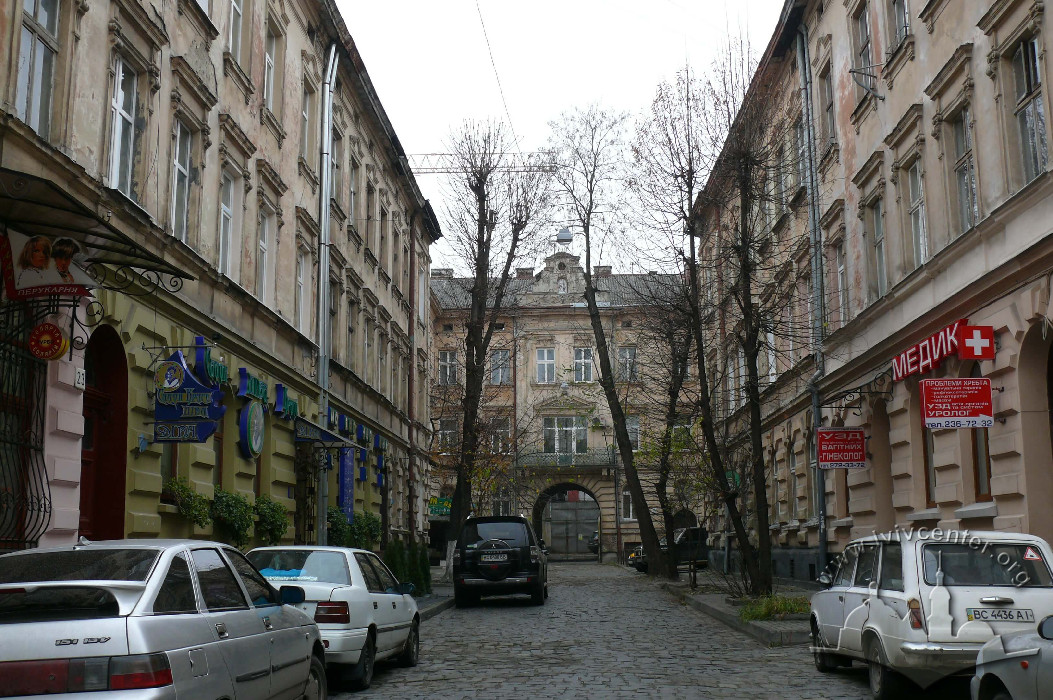
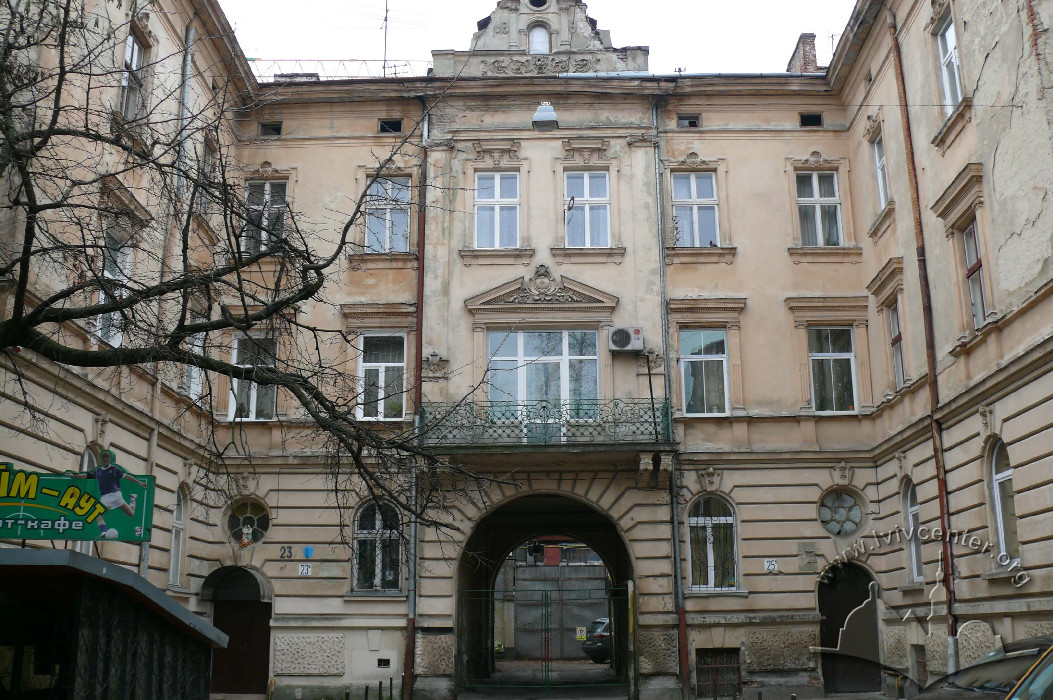
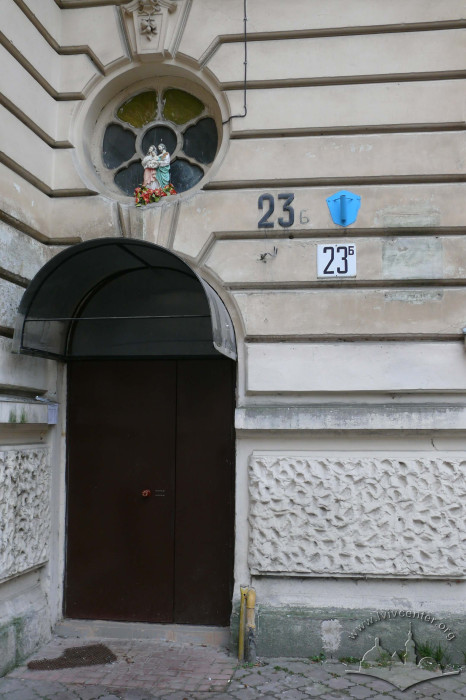
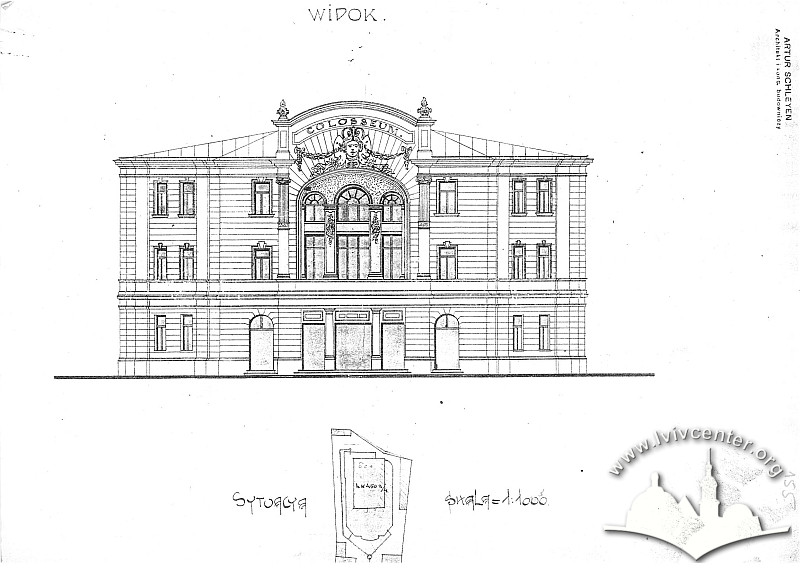
Vul. Panteleimona Kulisha, 23–25 – cinema (no longer in operation) ID: 1692
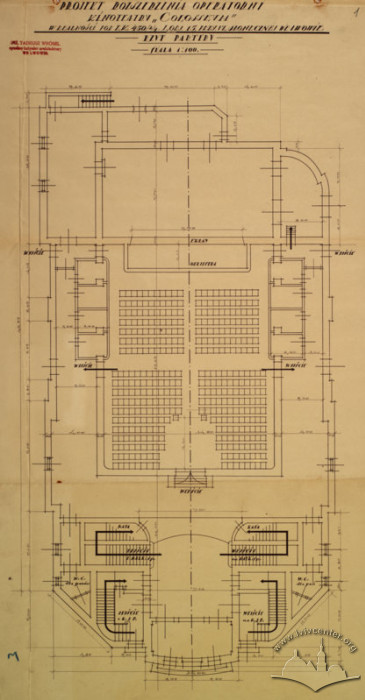
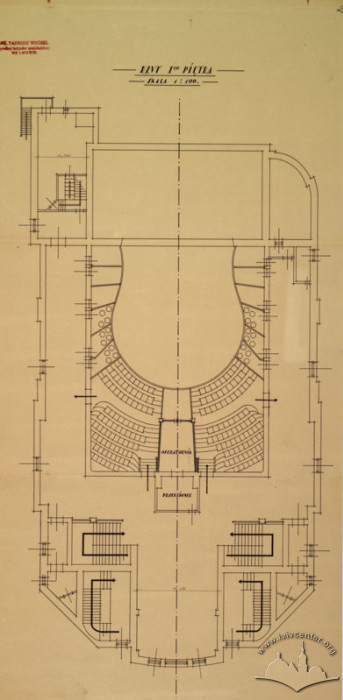
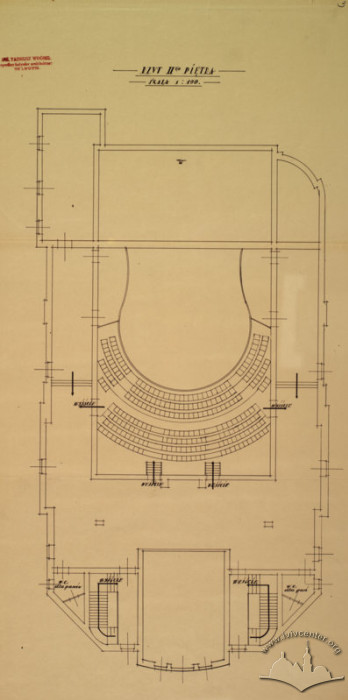
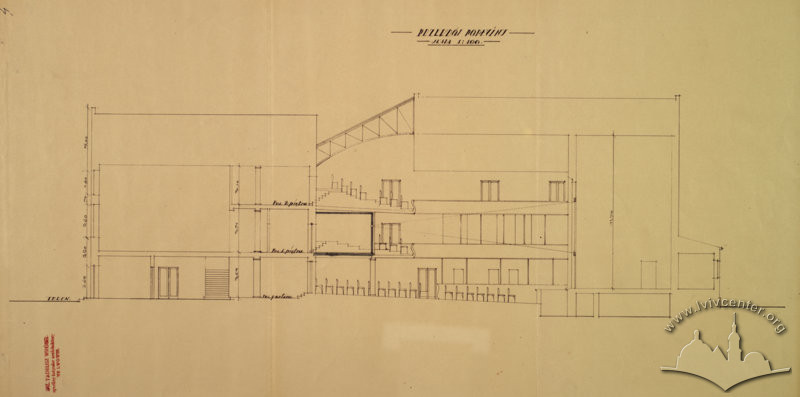
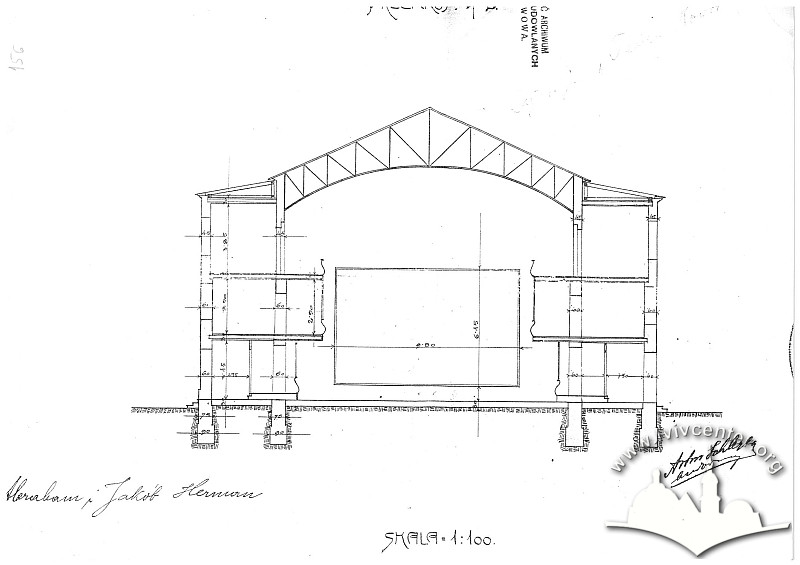
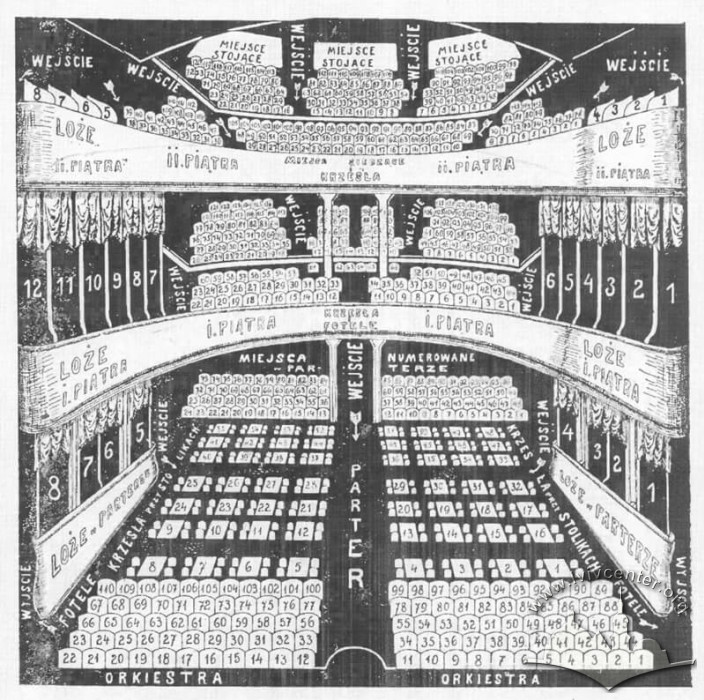
In the former Herman Passage, within a theater building that no longer exists today at vul. Kulisha 23/25, the "Colosseum" cinema operated from 1908 to 1917 and from 1927 to 1939. Its auditorium could accommodate 1,054 spectators. The cinema enjoyed significant popularity, especially among the poorer segments of the population. The building was destroyed during World War II.
Story
The building of the "Colosseum" theater in the former Herman Passage on vul. Kulisha (formerly vul. Bichna Soniachna) was constructed in 1898–1900. Starting in 1908, film screenings were held here in addition to theatrical performances. The auditorium of the "Colosseum" had a seating capacity of 1,054. Initially, screenings were conducted using a Vitascope apparatus.
In May 1913, the cinema hosted the Danish film star Asta Nielsen, who presented the mimodrama The Gypsy (Pol. "Cyganka") here. This took place because the Skarbek Theater (now the M. Zankovetska Theater) was undergoing roof repairs at the time. During her stay in Lviv, the actress stayed at the George Hotel (Pl. Mickiewicza 1).
During the 1913–1914 season, the troupe of the "Variety" (Pol. "Rozmaitości") Theater gave performances at the "Colosseum."
From 1917 to 1927, the "Novyny" Municipal Theater operated here instead of the "Colosseum". In 1920, free film screenings were held here for Polish soldiers participating in the Polish-Soviet War.
In 1928, the "Colosseum" cinema resumed its operations. From 1928 to 1939, it was owned by the Women's Civic Committee (Pol. Komitet obywatelski kobiet). Initially, Paweł Meller was appointed as its director, and from 1932, Czesław Dobrzecki took over the position. Profits from the "Colosseum's" operations went to the J. Piłsudski Kindergarten and Boarding School in Lviv. In addition to film screenings, the cinema premises hosted other entertainment events and cabarets.
As of November 1932, the cinema employed 34 people. The cinema was highly popular, particularly among the poorer working-class inhabitants of the city.
From 1939 to 1941, the State Polish Theater operated in this building.
The "Colosseum" building was destroyed during World War II.
Selected Repertoire:
01.01.1930 — Knights of Fire (Pol. Rycerze ognia)
17.03.1930 — Pat and Patachon (Pol. Pat i Patachon)
10.10.1933 — The Ruler of the Forest (Pol. Władca puszczy)
25.01.1934 — The Mad Widow (Pol. Szalona wdówka)
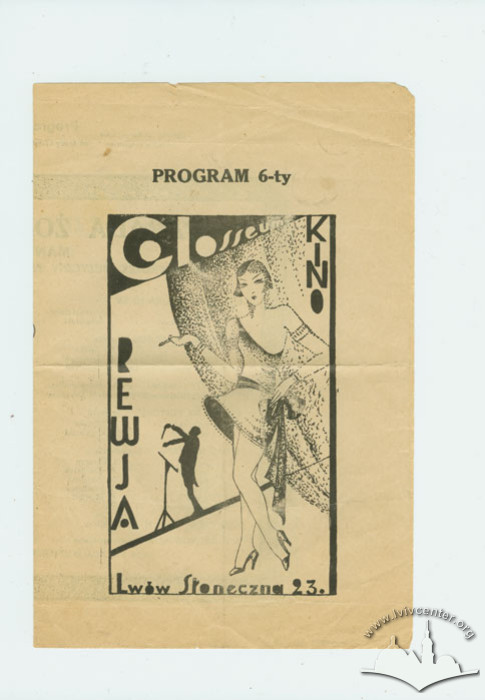
"1914 [Cinema] Variety Theater 'Colosseum' [...] acrobats and actors of all nations perform on this stage". (J. Piotrowski, Lemberg und umgebung: Handbuch fur Kunstliebhaber und Reisende (Lemberg: H. Altenberg; Leipzig: F. A. Brockhaus; Wien: Moritz Perles)).
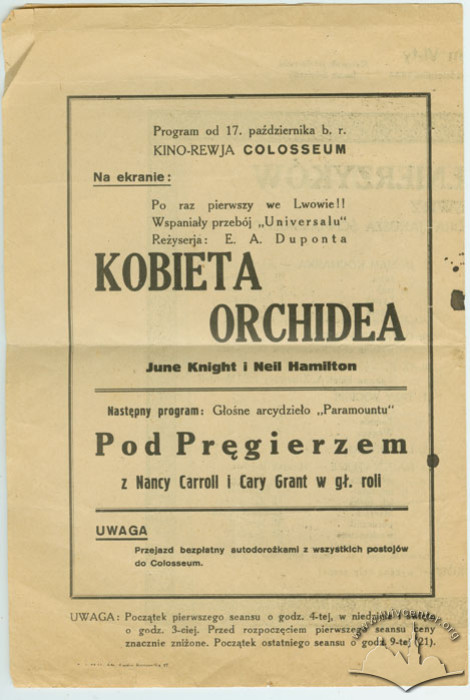
"Cinema-Variety 'Colosseum', 17.10.1934 Lviv premiere of Orchid Woman, dir. E. Dupont, starring June Knight and Neil Hamilton. [...]"
1934 Poster Announcement
"Attention! Free arrival by auto-cabs (taxis) from all Lviv taxi stands.
(According to the rates approved by the voivodeship government, the first kilometer in 1933 cost 1 zł., each subsequent 330 meters was metered at 20 gr., and an hour of waiting cost the customer 3 zł.; until 1934, a night tariff was also in effect from 11:00 p.m. to 6:00 a.m. with a fare of 1 zł. for the first 666 meters and 20 gr. for the next 222 meters. In addition, there were extra fees for traveling to the railway station, for luggage, and for a fourth passenger. For comparison: the price of a double room at the premium George Hotel was 10 zł.. Along with auto-cabs, in 1934 there were single-horse and two-horse cabs and fiacres. However, the most widespread means of transportation was the electric tramway. Starting from 1928, bus lines also operated in the city. — P. K.)
[...] The first screening begins at 4:00 p.m., and at 3:00 p.m. on Sundays and holidays; prices are significantly reduced before the start of the first screening. The final screening begins at 9:00 p.m.".
People
Czesław Dobrzecki — one of the directors of the Women's Civic Committee.
Paweł Meller — one of the directors of the Women's Civic Committee.
Asta Nielsen — Danish film star.
Sources
- Державний архів Львівської області (ДАЛО) 110/4/628.
- Gazeta Lwowska, 1934, №22.
- Barbara Gierszewska, Kino i film we Lwowie do 1939 roku (Kielce: Wydawnictwo Akademii Świętokrzyskiej, 2006), 428.
- Віктор Проскуряков, Архітектура українського театру. Простір і дія (Львів: Видавництво Національного університету “Львівська політехніка”, Видавництво “Срібне слово”, 2004), 584.
- Віктор Проскуряков, Юрій Ямаш, Львівські театри. Час і архітектура (Львів: Центр Європи, 1997), 132.