Vul. Konovaltsia, 7 – residential building ID: 1378
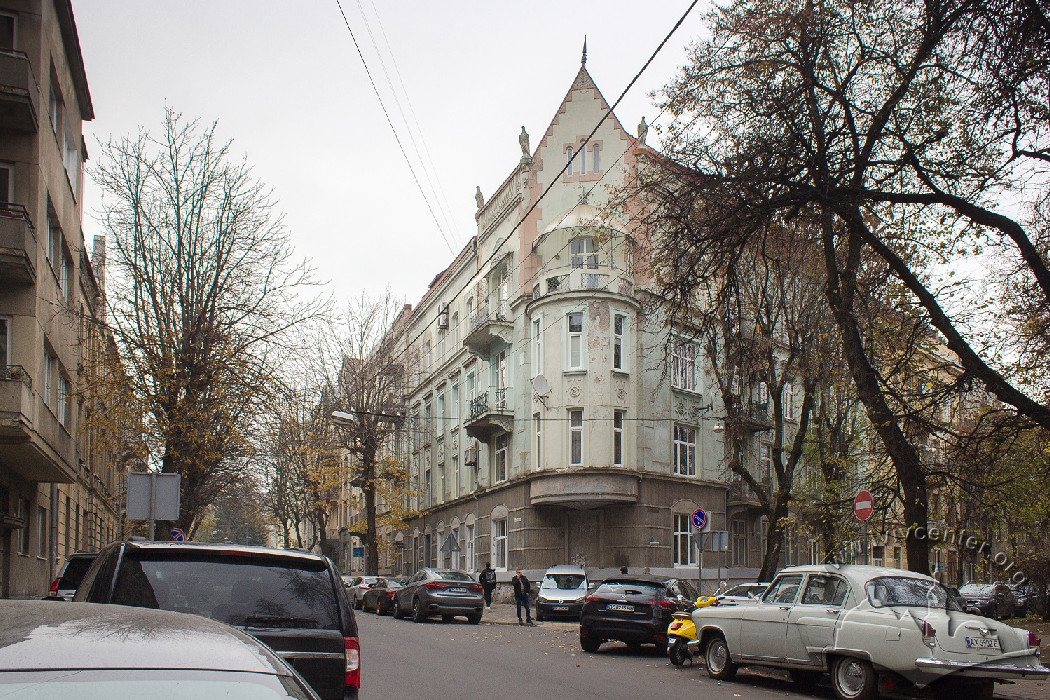
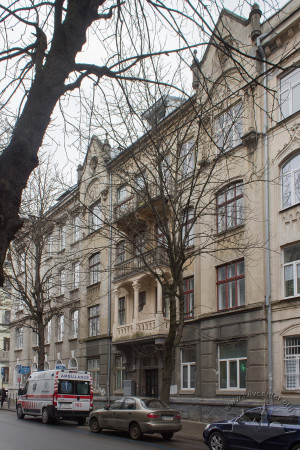
This four-story corner apartment house was built by Kasper Julian Draniewicz in 1911−1912. It is also known as the house "Under the Eagles".
Story
The house is located in the former suburb of Nowy Świat (New World), in its swampy area called Na Bajkach. This part of the city was planned for development in the late nineteenth century, its historical toponymy being preserved in the names of the streets laid there. Today, this area is part of Lviv's historic area.
Lviv architects and constructors began to develop this neighborhood in the 1890s. It was then that the property with the conscription number 81¼, which used to belong to the Dominican monastery, was divided. Part of it was acquired by the family of Kasper Draniewicz, a constructor and sculptor; the other part was acquired by the architects and constructors Józef Sosnowski and Alfred Zachariewicz (DALO 2/1/3552:13-14).
On 22 July 1911, the owner of the plot, Maria Draniewicz, filed an application with the magistrate for the construction of a four-story building on the parcel with cadastral number 2766/18 (DALO 2/1/3552:13-14). After the building permit was granted on 22 August 1911, an additional project was submitted by Kasper Draniewicz. The project was approved, but with a note to exclude the caretaker's dwelling in the basement as, being too deeply buried in the ground, it did not comply with the regulations (DALO 2/1/3552:5,13). The owners submitted an additional project in which they changed the caretaker's flat location. The project was approved on 20 September 1911 (DALO 2/1/3552:7-8, 12). This time, however, the magistrate made a comment about the courtyard, which accounted for only 11% of the total area of the plot (while the Building Code required at least 13%). The owners explained this was due to the unfavorable acute-angled shape of the plot: "That wedge is quite sharp and difficult to build on, and the courtyard is combined with the courtyards of two neighbouring houses on parcels 2776/17 and 2776/19 so that the surface of the common courtyard is 20% of the total building. And since the house has a staircase and only two kitchens facing the courtyard, there will be sufficient air and light there" (DALO 2/1/3552:15).
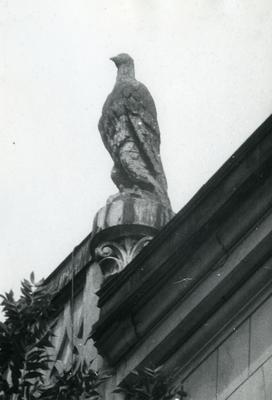
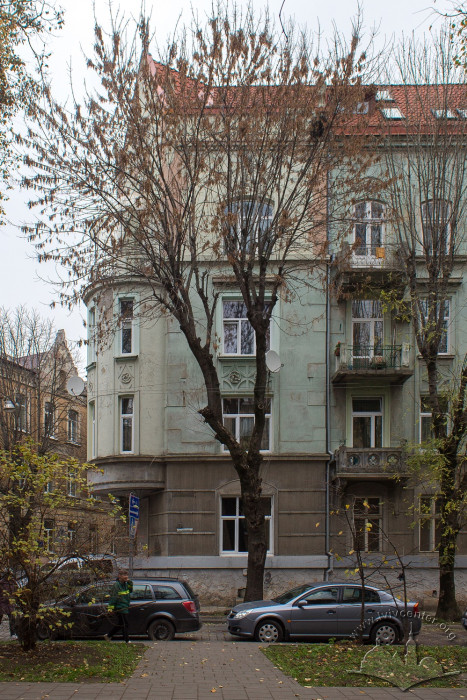
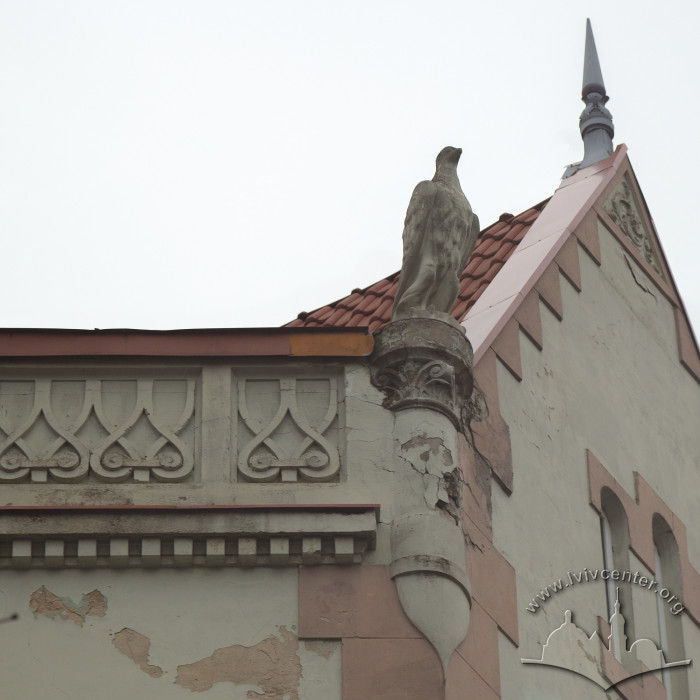
The house was constructed within a year, its façades decorated with Neogothic architectural elements and the corner attic crowned with sculptures of eagles. On 2 September 1912, Maria Draniewicz applied to the magistrate for permission to use the newly built townhouse. On 13 September 1912, the technical construction commission inspected it and noted that the house on the plot with conscription numbers 2128¼ and 81¼ on ul. 29-go Listopada had been built according to the approved project (DALO 2/3/374:1). The commission described the composition of the premises as follows:
"In the basements, there are 2 living quarters, a laundry, a toilet, and 7 cellars. On the ground floor, there are a staircase, an entrance hall, 1 porch, 4 hallways, 8 rooms, 3 kitchens, 1 service room, 1pantry, 4 bathrooms, 4 toilets. The first floor (which is the second in our understanding) contains a staircase, 1 porch, 4 hallways, 9 rooms, 3 kitchens, 1 service room, 1 pantry, 3 bathrooms, 4 toilets. The second floor (in our understanding, the third) contains a staircase, 1 porch, 4 hallways, 8 rooms, 3 kitchens, 1 service room, 1 pantry, 3 bathrooms, 4 toilets. The third floor (in our understanding, the fourth): the same as the second floor. The attic consists of a staircase and a loft” (ДАЛО 2/3/274:2).
On 17 September 1912, a permit was issued for the use of the newly constructed building, whose apartments were rented out.
Archival records from 1938 show that the tenant of one of the apartments, Wincenty Wolański, complained about the inappropriate condition of the courtyard façades, which were dirty and scratched, so the magistrate ordered the owner to bring them to a proper condition; for failure to comply within 14 days the latter otherwise risked being punished with a fine or three days of arrest.
After the Second World War, the layout of some premises was changed to create as much housing as possible. In 2003, the sculptural eagles on the building’s façade were restored (one was lost during the Second World War) under the direction of sculptor Lubomyr Kukil. During repair works carried out in the 2010s: authentic window carpentry was partially replaced with metal-plastic double-glazed windows; authentic entrance doors to the apartments were also replaced with new ones; a part of the roof facing vul. Yaponska was reconstructed and adapted for dwelling; the roof was covered with Spanish tiles.
Architecture
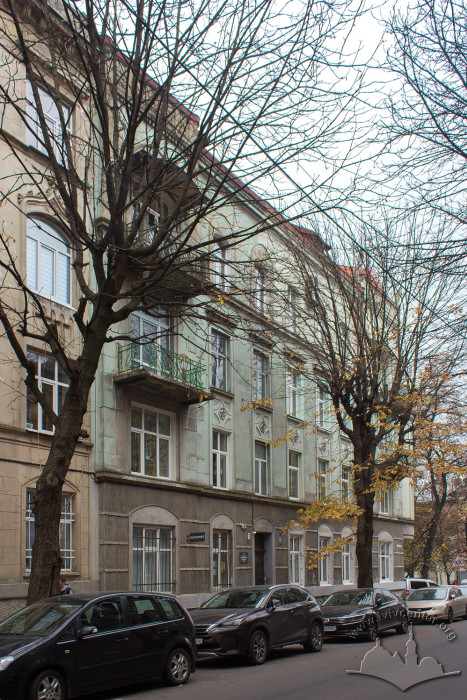
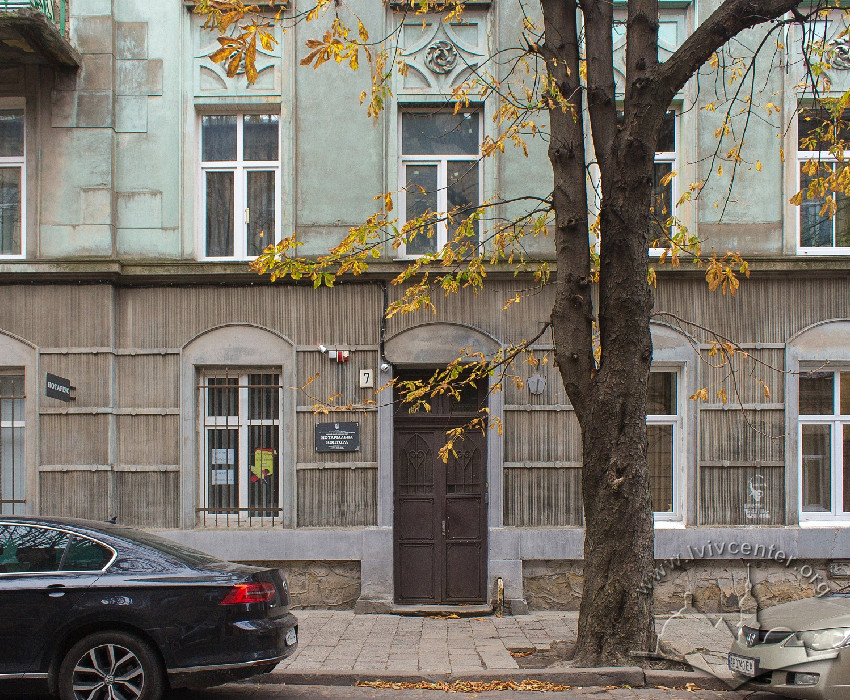
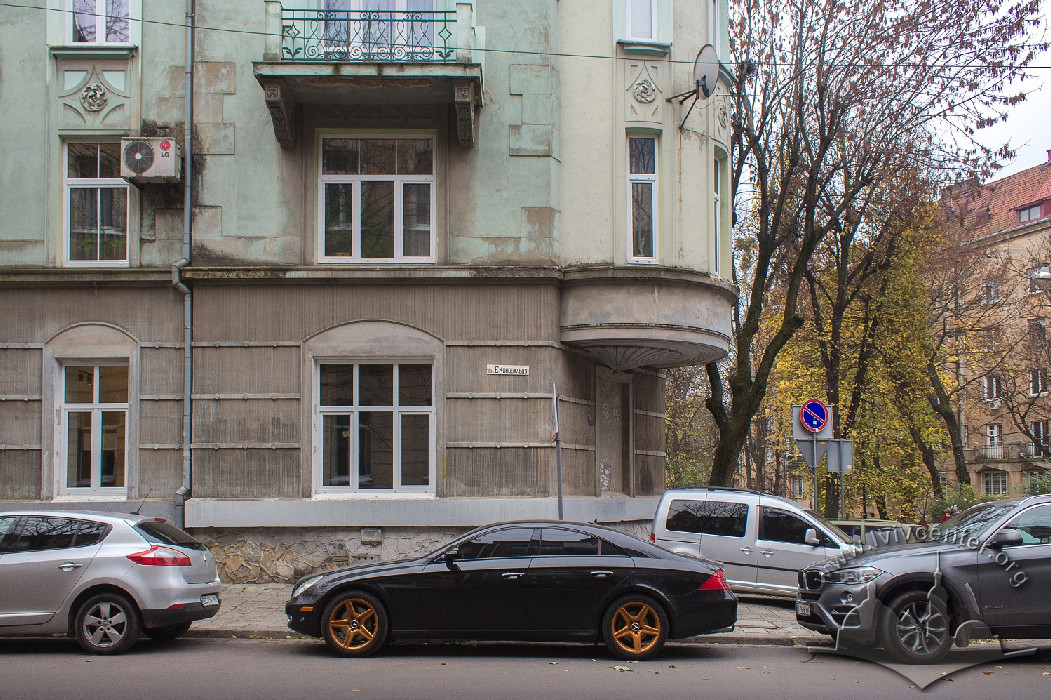
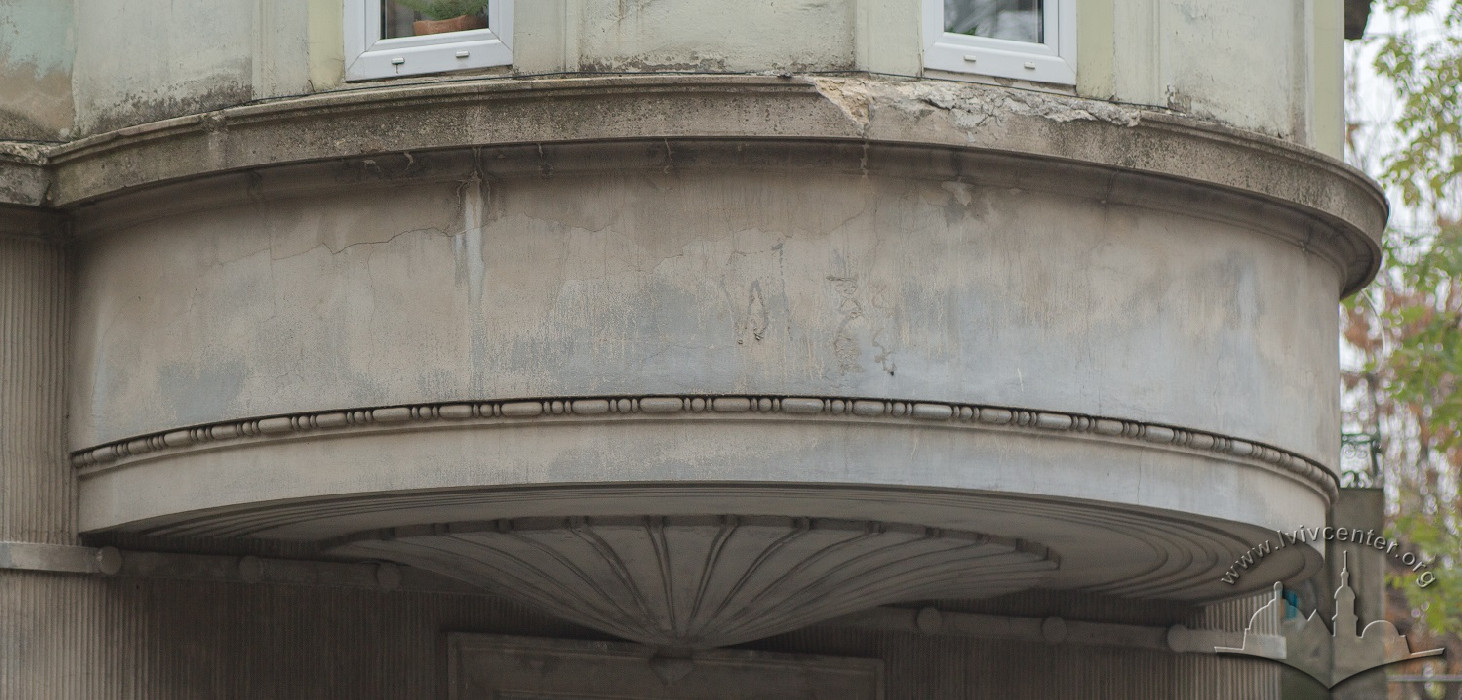
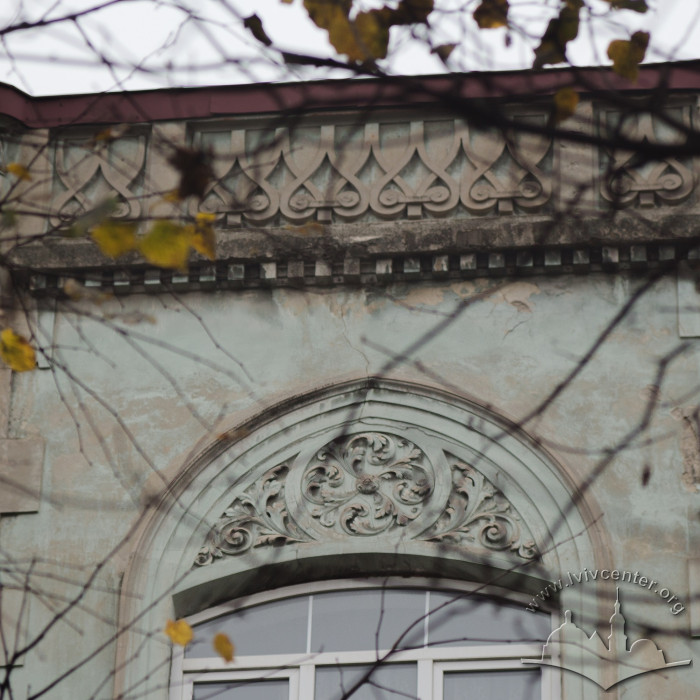
The Rational Secession house clearly marks the corner of Yaponska and Konovaltsia streets. The V-shaped building is built of brick on stone foundations, with a high semi-basement floor, and covered with a gable roof. The walls are plastered with cement mortar, the ground floor is decorated with textured plaster in the form of vertical corrugations with smooth horizontal bands; the high stone semi-basement floor has small rectangular cellar vents and is faced with cyclopean masonry. The architectural design is subordinated to the corner location as a cut corner, crowned with a gothic spire porch, connects two four-story façades with the same layout principle: a seven-axis one facing vul. Konovaltsia and a six-axis one facing vul. Yaponska, with the main entrance from vul. Konovaltsia. The two-panel main entrance door is made of wrought iron and has glazed lancet windows with a rather simple lattice pattern. The façades are flanked by one-window axis piers, which are emphasized along the edges with rustication and topped with blind attics accentuated by dentil belts and decorated with a guilloche pattern in the form of wavy curly lines intertwining with each other. The two corner part’s attics are crowned by sculptures of eagles on small semicircular towers. The overhanging crowning cornice of the façades is profiled. The semicircular bay on the cut corner has three axes of rectangular elongated single-pane windows; on the fourth floor it is topped with a terrace enclosed by a stone parapet with wrought-iron lattices. In the semi-basement floor part below the bay there is a blind window.
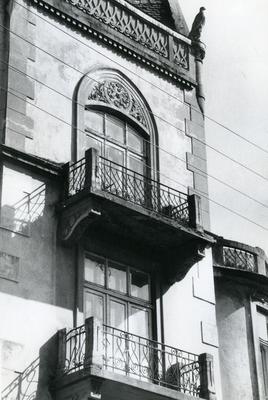
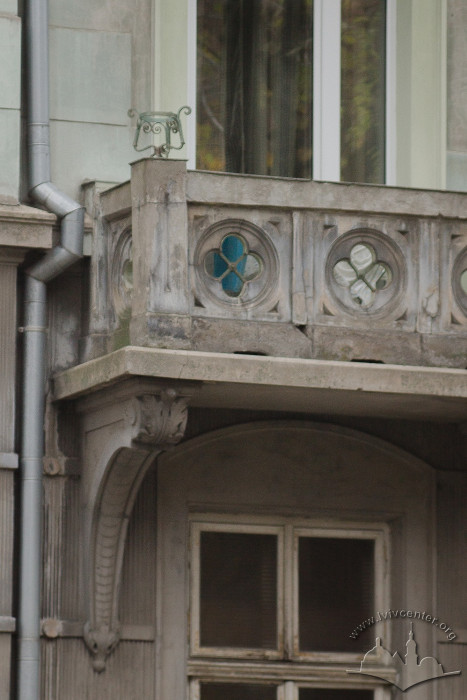
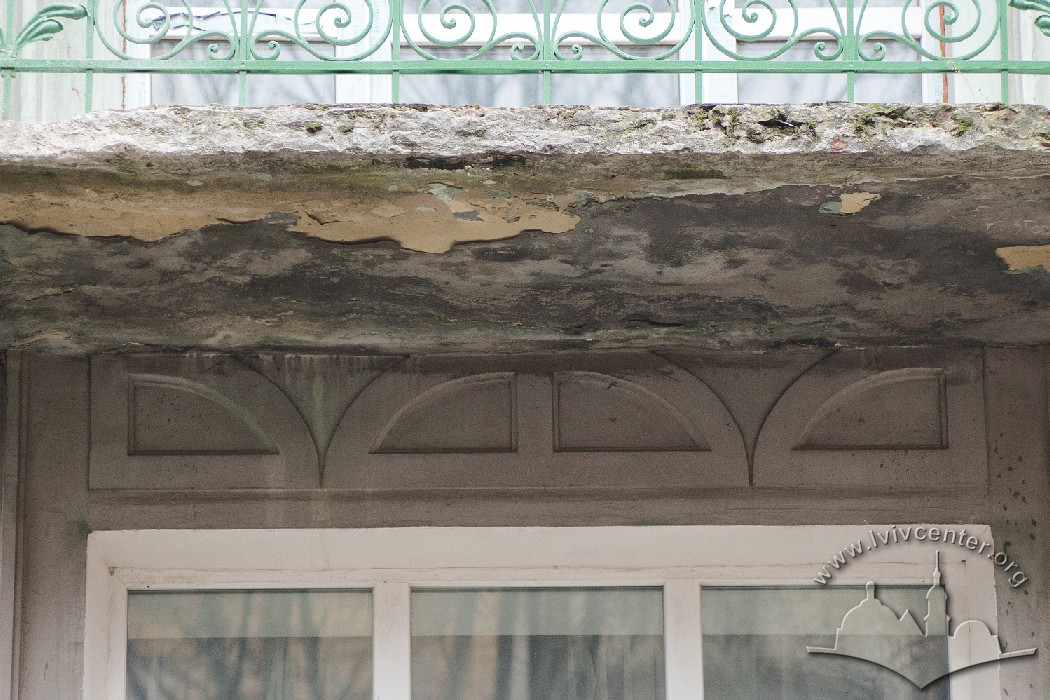
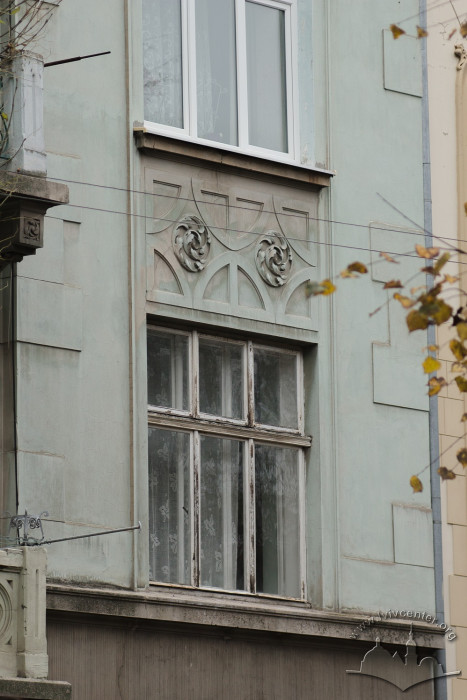
The windows are rectangular (floors 1-3) and with segmental lintels (floor 4), two-pane and three-pane (on the piers); the 2nd and 3rd floors' two-pane windows are accentuated by common simple platbands. The windows of the 2nd and 4th floors are accentuated underneath by common profiled cornices. The tympanums of the lancet niches on the 4th floor are decorated with moulded floral decoration; the windows of the 3rd floor are decorated with linear pediments having denticles. The niches between the windows of the 2nd and 3rd floors are decorated with diamond rosettes. The façade facing vul. Konovaltsia has four balconies (floors 3-4 on the extreme axes); the façade facing vul. Yaponska has six balconies (floors 2-4 on the middle extreme axes) with stylish wrought iron lattices on brackets decorated with stucco; two balconies (on the 2nd floor facing vul. Yaponska) have stone parapets with quadrifoliate rosettes. Three balconies have no brackets (two facing vul. Konovaltsia and one facing vul. Yaponska). The entire architectural design of the façades is made of artificial stone.
The house layout is determined by its corner location, where a large staircase in the form of a broken rectangle is located between the building’s two wings in the rear. The entrance area is located on the third axis facing vul. Konovaltsia and consists of an elongated porch with a flight of stairs and a spacious vestibule with a staircase, separated by a Secession wooden door with chamfered glazing, accentuated by a green diamond stained glass window. The panels in the hallway are decorated with marble slabs, the upper part of the walls is adorned with stucco decoration in the form of flowerpots with garlands in the fields, vertically accentuated by pilasters. The floor in the hallway and on the ground floor staircase landing is made of ceramic tiles with geometric ornaments (checkerboard diamonds) in three colours. The premises have an enfilade layout; exquisite tiled stoves in the Secession style have been preserved. The staircase is arranged in the form of an elongated, twice-bent rectangle with long segmental stairs, parquet floors and a stylish wrought-iron railing. The flat ceilings are wooden, with brick segmental vaults on metal rails covering the cellars and basements.
The Draniewicz house is an example of a respectable apartment building in Lviv in the Rational Secession style.
Related buildings and spaces
-
Vul. Konovaltsia, 3 – residential building
People
Wincenty Wolański — retired teacher who resided in this building in the 1930sKasper Julian Draniewicz— master mason and sculptor. He designed this building and lived here at least for a few years with his family
Marya Draniewicz — Kasper Draniewicz's wife and business partner, official house owner
Alfred Zachariewicz — famous architect who purchased building plots nearby
Lyubomyr Kukil — sculptor who restored the eagle sculpture on the house's attic
Józef Sosnowski — engineer who purchased building plots nearby together with his business partner Alfred Zachariewicz
Bronisław Ajdukiewicz — court advisor, father of philosopher Kazimierz Ajdukiewicz, resident of the building (1914)
Kazimierz Ajdukiewicz — doctor, high school teacher, later — renowned philosopher of the Lviv-Warsaw School, resident of the building (1914)
Józef Ajdukiewicz — Doctor of Law, resident of the building (1914)
Jadwiga Ajdukiewicz – teacher at the gymnasium, resident of the building (1914)
Władysław Bejm – employee of the Regional Office, resident of the building (1913)
Felicja Brzeska-Paszczuk — actress at the City Theater, resident of the building (1913, 1914)
Maria Błażej— widow, resident of the building (1913)
Wilhelm Wawreczka — employee of the Economic Society, resident of the building (1914)
Oskar Wohlman — sales agent, resident of the building (1914)
Edward Gołębiowski — engineer, resident of the building (1914)
Kazimierz Złotnicki — employee of the Regional Office, resident of the building (1913)
Franciszek Kołychanowski — school inspector, resident of the building (1914)
Teofil Kozak — postal worker, resident of the building (1914)
Ludwik Kozik — employee of the Regional Bank, resident of the building (1914)
Paweł Kozłowski — accountant at the bank, resident of the building (1914)
Malwina Kriwer — employee of the Joint Stock Company, resident of the building (1913)
Zofia Kukowska — widow of an insurance clerk, resident of the building (1913-1914)
Alois Neudeck — real estate owner, including a lumberyard for construction, resident of the building (1913)
Ludwik Orosz — postal worker, resident of the building (1914)
Jadwiga Paqueta — widow, resident of the building (1913-1914)
Leon, Barbara Recheński — artists of the Municipal Theater, resident of the building (1913-1914)
Norbert Syczewski — opera prompter, resident of the building (1914)
Michał Sosenko — tax inspector, resident of the building (1914)
Stanisław Faliszewski — ballet master, resident of the building (1913-1914)
Franciszek Cywiński — bank clerk, resident of the building (1914)
Stanisław Szefer — postal worker, resident of the building (1914)
Marya Szeligiewicz — wife of a tax advisor, resident of the building (1914)
Tadeusz Szymonowicz — pharmacist, resident of the building (1914)
Michał Schneider — postal worker, resident of the building (1913)
Walerya Strobel — resident of the building (1913-1914)
Józef Jurkowski — railway clerk, resident of the building (1914)
Gustaw, Leonia Jasiński — artists of the City Theater, residents of the building (1913)
Sources
- Державний архів Львівської області (ДАЛО) 2/1/3552
- ДАЛО 2/3/274 Будівельна справа будинку на вул. Японська, 18
- ДАЛО 2/1/7086 Будівельна справа будинку на вул. Ол. Степанівни, 31
- Кадастровий план Львова 1849 року
- Księga Adresowa król. Stoł. miasta Lwowa, 1900, 1901, 1913, 1914
- Księga adresowa Małopołski, Wykaz domów na obszarze miasta Lwowa (Lwów. Stanisławów. Tarnopól, 1935–1936).
- Pierwsze sprawozdanie c. k. Państwowej Szkoły Przemysłowej we Lwowie za rok szkolny 1892/1893, (Lwów, 1893), s. 40.
- Trzecie sprawozdanie c. k. Państwowej Szkoły Przemysłowej we Lwowie za rok szkolny 1894/1895, (Lwów, 1895)
- Skorowidz adresowy król. Stoł. miasta Lwowa, 1916
- Jakub Lewicki. Między tradycją a nowoczesnością. Architektura Lwowa lat 1893–1918, (Warszawa: Neriton, 2005)
- Юрій Бірюльов "Драневич Каспер Юліан", Енциклопедія Львова, ред. А. Козицький та І. Підкова, Т. 2, (Львів: Літопис, 2007), 150.
- Борис Мельник, Довідник перейменувань вулиць і площ Львова, (Львів: Світ, 2001)