Vul. Konovaltsia, 6 – boarding school building ID: 1380
The building was constructed in 1903–1904 as the Grzegorz Piramowicz Boarding School. The project was designed by the engineer and architect Antoni Fleischl, with Kazimierz Mokłowski contributing to the interior design. An example of Historicism with elements of the Zakopane style in the interiors. Today (2025), the building is part of Secondary School No. 55.
Story
The plot for this building was formed as a result of the parcellation of plot with conscription number 925 ¼. From the 1860s, this larger plot belonged to ul. Nowy Świat (from 1886 ul. Sapiehy, now vul. Bandery) and was owned by the family of Jacob and Ewa Arkiel, who kept two small tenement houses here and had a large garden. For more details about their property, see the description of the house at vul. Bandery 57.
In 1901, this property was in poor technical condition, as revealed by a commission from the Lviv Magistrate (ДАЛО 2/1/3357:29). The Arkiels, being elderly and in debt, gifted the plot to their relative Szymon Dawid Arkiel (Kurjer Lwowski, 1901, No. 71:3). The following year, he resold the plot for 40,000 Austrian crowns to the Association of Public School Teachers (Kurjer Lwowski, 1902, No. 320:3). Not starting any works there, in 1903 the association sold the plot further for a lower amount of 34,727 crowns to the Society for the Care of the Piramowicz Boarding School (Kurjer Lwowski, 1903, No. 261, p. 9).
The Society was founded in 1901 by decree of the Galician Sejm and was intended to house poor students of the male teacher training college, which was then located at ul. Kalecza 5 and moved to ul. Nabielaka 67 (now vul. Kotliarevskoho) around 1913. The Provincial School Council contributed to its establishment, while Countess Krystyna Potocka, wife of Andrzej Potocki, the future governor of Galicia, became the institution’s patroness. Initially, the society only rented accommodation for students: in its first year of operation, it paid for housing for 51 students, and in the second year, for 60. In view of growing demand, the society’s leaders decided that it would be more expedient to build their own building (Gazeta Lwowska, 1903, No. 159:3). Although there were teacher training colleges for men and women in Lviv, this boarding school was intended only for boys who studied in the building at Blyzko.The boarding school construction committee was headed by Ignacy Dembowski, a member of the Provincial School Council, with Fr Wałenty Wolcz, director of the teacher training college, as vice-president, Józef Piórkiewicz as secretary, and Stefan Skorabahaty as treasurer. Training college professor Ferdynand Szczurkiewicz was elected director of the boarding school. An apartment in the building was provided for him and his family. The Galician Provincial Department provided a subsidy of 12,000 crowns, which helped the Society purchase the land. However, other sources of funding were also needed. In particular, the Society collected membership fees and donations. The construction, carried out by engineer and architect Antoni Fleischl, cost about 152,000 crowns (Gazeta Lwowska, 1903, No. 159: 4).
In April 1903, the Society received permission to demolish the old houses owned earlier by the Arkiels at what was then ul. Sapiehy 33 (ДАЛО 2/1/3357:36). The Magistrate sent the permit to the secretary, Józef Pjurkiewicz. In 1904, after the construction was completed, he published an article about the boarding school in the Polish Pedagogical Society's magazine Szkoła (Sprawozdanie, 1907: 203).
The grand opening of the boarding school took place on October 26, 1904. It all began with a solemn mass at the church of Mary Magdalene, after which the celebrations moved to the festively decorated hall of the boarding school. A bust of Grzegorz Piramowicz, after whom the boarding school was named, was embedded in the right wall, and portraits of Ignacy Dembowski and Fr Wałenty Wolcz were hung on the wall to honor their contributions to the boarding school establishment and construction. The premises were consecrated by Roman Catholic Archbishop Józef Bilczewski, accompanied by mitred bishop Bielecki and prelate Lenkiewicz. Numerous representatives of the authorities were present: Marshal Stanisław Badeni and Governor Leon Piniński, President of Lviv Godzimir Małachowski, his deputy Michał Michalski, and many others. Between several solemn speeches, a choir sang, and two students — Płesiński, a Pole, and Szczerbaty, a Ruthenian, — expressed their gratitude in the two regional languages of Galicia (Gazeta Narodowa, 1904, No. 245:2). The boarding school residents were both Poles and Ruthenians, roughly half and half (Nowości illustrowane, 1905, No. 50:3).
The boarding school building was designed to accommodate 100 students. For example, in 1906, 78 of the 324 students who studied at the men's teacher training college that year lived here (Legeżyński, 1907:216). In order to settle in the boarding school, they had to present a "poverty certificate". The accommodation was still paid for and cost between 10 and 14 crowns per month in 1906 (Dziennik urzędowy, 1906, No. 15:316). After the training college moved from ul. Kalecza to ul. Nabielaka (now vul. Kotliarevskoho), it lacked teaching facilities, and the boarding school's assembly hall was often used for regular daily classes (Dziennik urzędowy, 1923, No. 3:145).
In the interwar period, the boarding school began to accept students from various secondary schools. This is evidenced, for example, by a newspaper advertisement, which also indicates the cost of accommodation: 65 zlotys per month and 20 zlotys for registration (Kurjer Lwowski, 1932, No. 240:15).
The press repeatedly emphasized that the Piramowicz Boarding School — a modern, well-equipped building — was the first of its kind in Lviv and Galicia. Thus, it differed from the traditional boarding schools, of which there were several in Lviv at that time. For example, Józef Wiczkowski's 1907 Guide to Lviv lists the Tadeusz Kościuszko Dormitory and the Resurrectionist Boarding School for Boys, as well as the boarding school for female teacher training college students, which was run by the nuns of the Family of the Virgin Mary. To these can be added the example of the dormitory in the Ruthenian People's House, which the Ukrainian architect Vasyl Nahirny mentioned in his memoirs as the place where he lived in the late 1860s. He described the premises as "three dimly lit rooms", two of which were intended for students and had only oak tables with benches. In the absence of other furniture, he and his companions used the tables for sleeping (Nahirny, 2000: 68). Thus, Piramowicz's boarding school had more in common with the first student dormitory in Lviv — the House of Technicians, built in 1895, where, in addition to living quarters, there were many service rooms: a kitchen, a dining room, a laundry room, and rooms for leisure activities.
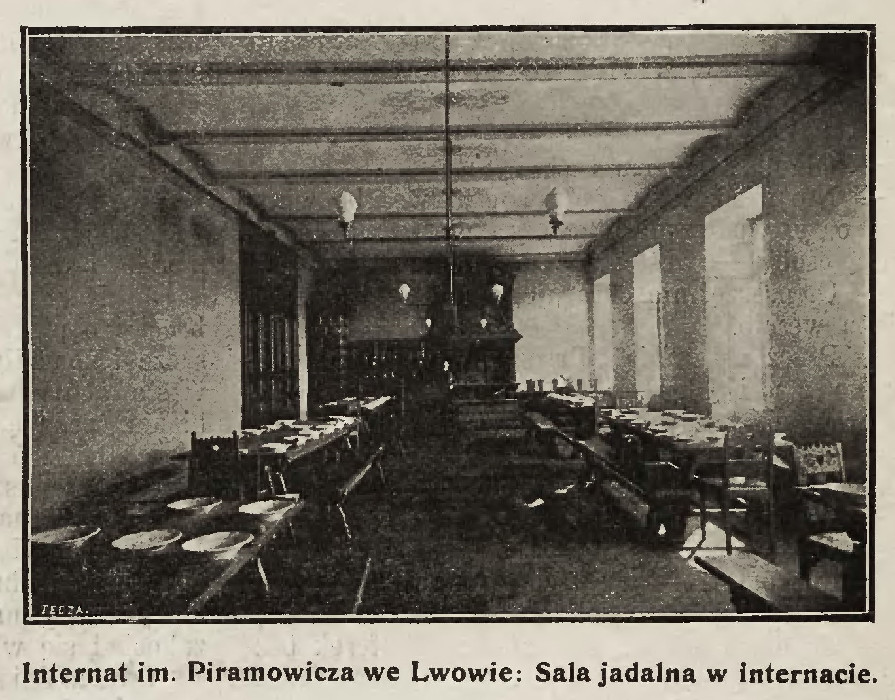
According to the Krakow newspaper Nowości Illustrowane, the architect Kazimierz Mokłowski was involved in designing the building. He designed furniture in the Zakopane style, which can be seen in the published photos. However, the drawings have not been preserved in the building’s archive file, as the interior design did not require approval by the Magistrate. Mokłowski had been a staunch socialist since his student years and later joined the Polish Social Democratic Party of Galicia and Silesia (PPSD). His political activity prevented him from finding employment as an architect in Lviv, so he is better known as a politician and researcher of folk wooden architecture, thanks to his book Sztuka Ludowa w Polsce (1903) (Bieńkowski, 1976; Kravtsov, 2024). Therefore, the boarding school’s interiors are one of the few objects where Mokłowski worked as a designer.
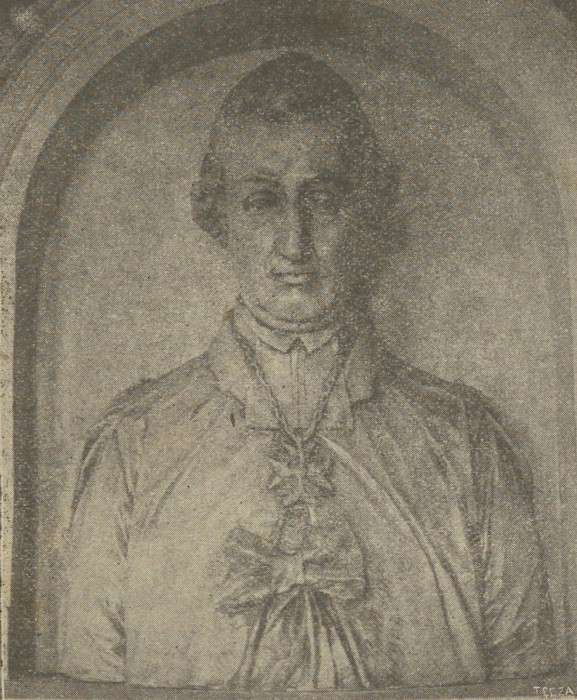
The main hall of the boarding school housed a statue of Grzegorz Piramowicz, created by the sculptor Juliusz Bełtowski — a photo of it was published in reprints of Piramowicz's work (Piramowicz, 1923; Piramowicz, 1927).
During the Soviet period, the building housed Children's Home No. 7 of the City Department of Public Education (Reference Book, 1955). Later, the building was used to expand general education school No. 55. In 1985, it was added to the list of architectural monuments of local significance under No. 381.
Architecture
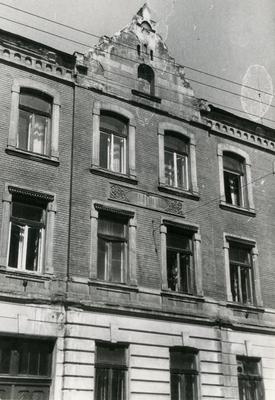
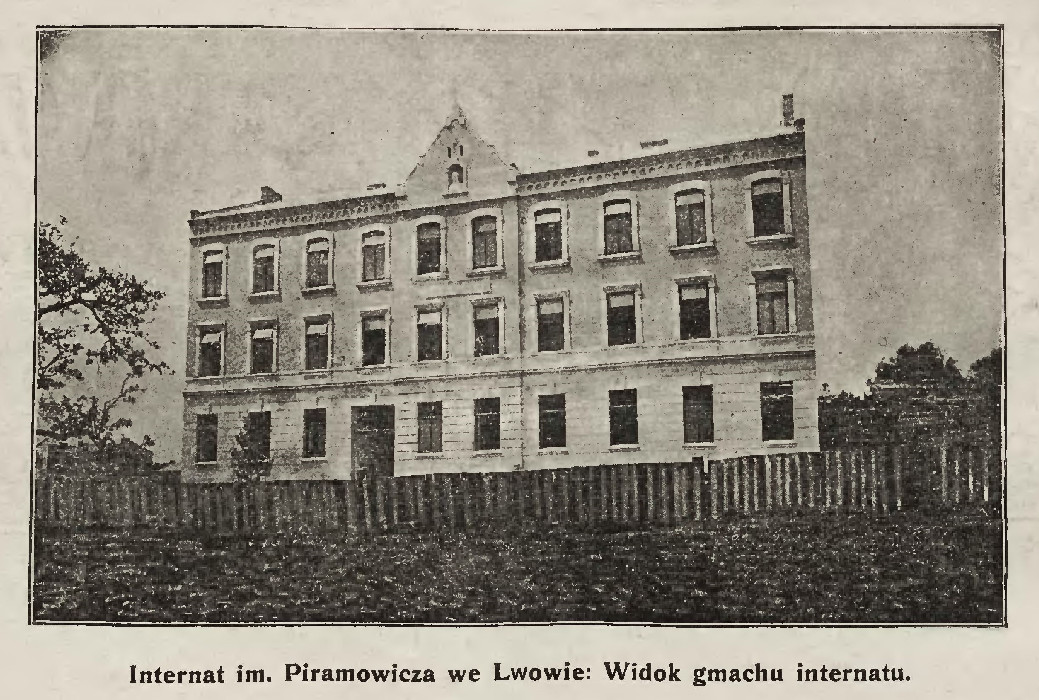
The building is located in the middle of a row of buildings on the street. Built of brick, it has an L-shaped layout and brick ceilings on metal beams. It has three floors and basements with utility rooms. The main ten-axis façade, designed in the Historicist style, is close to symmetrical.
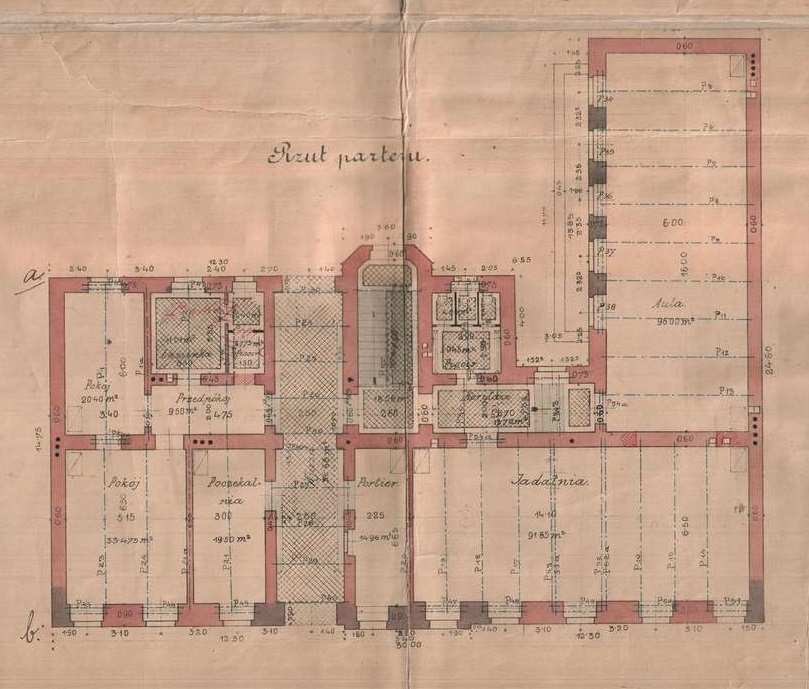
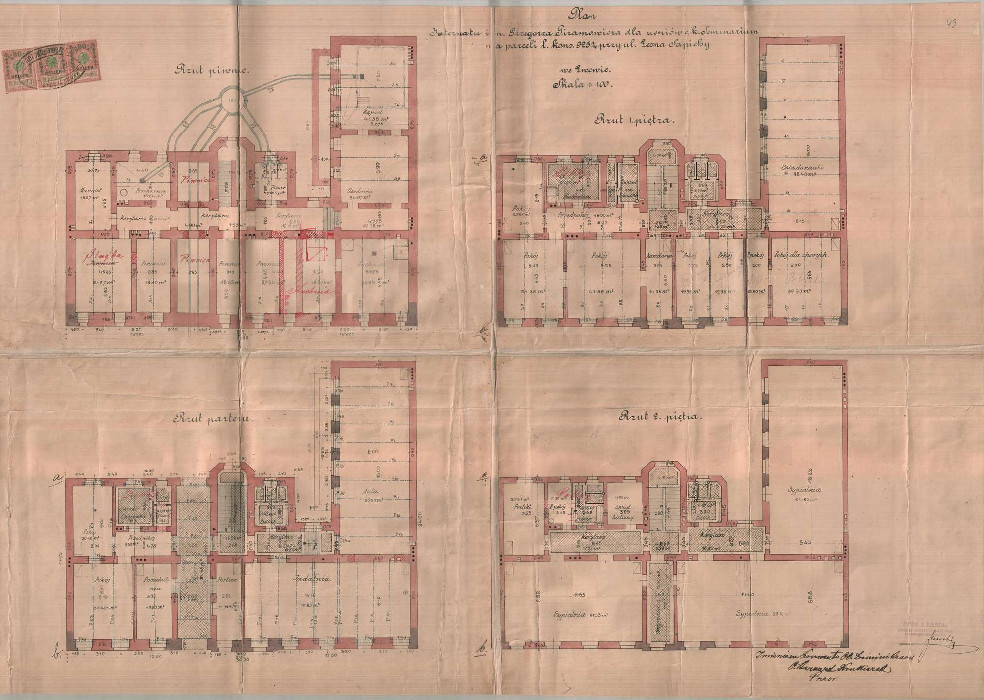
According to the original layout, the entrance to the building was through a passageway to the courtyard. On the right side of the passageway was the caretaker's room; behind it was the entrance to the corridor and from there to the staircase. From the corridor, there was an entrance to the spacious dining room on the right and straight ahead to the assembly hall located in the wing. To the left of the corridor, there was a block of bathrooms. To the left of the passageway, there were rooms for the prefect and the cook, with a kitchen and a toilet, as well as a waiting room nearby.
Approximately half of the second floor was occupied by the apartment for the boarding school director and his family. It consisted of three spacious rooms, a kitchen, a toilet, and a storage room. At the edge, with a separate entrance, there was a narrow room called the "office". The rest of the floor was occupied by three narrow rooms for students and one larger room for the sick.
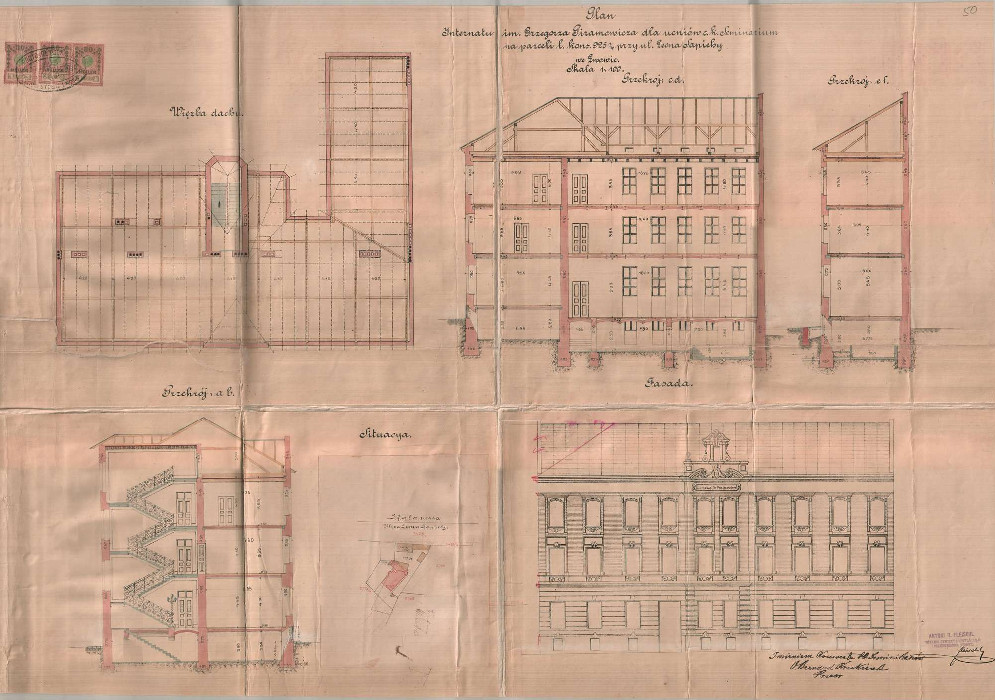
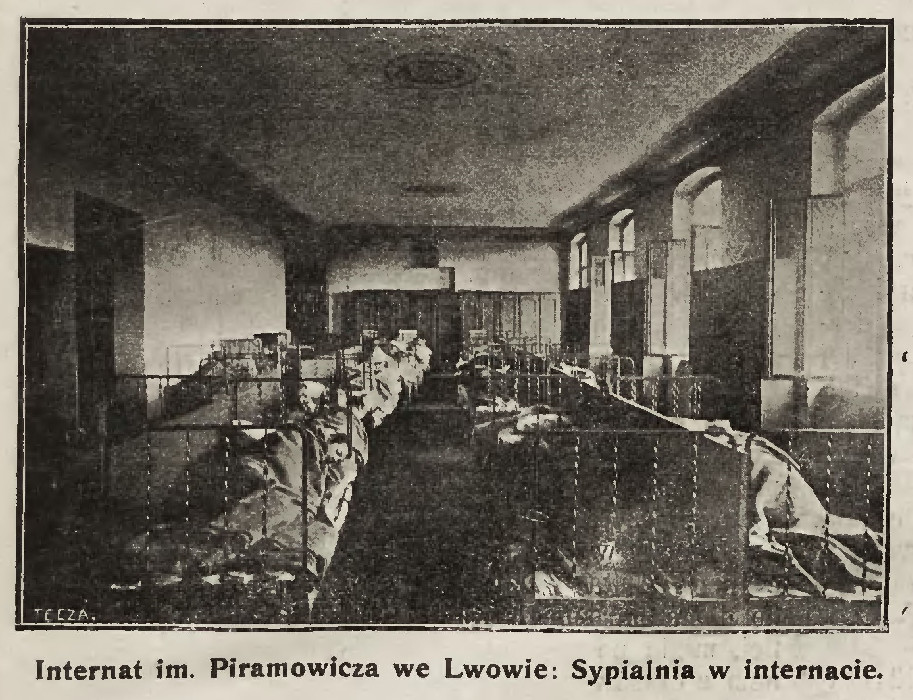
The entire wing was occupied by a large common classroom located above the assembly hall on the ground floor. On the third floor, there were three large shared bedrooms with an area of over 100 m2, two toilet blocks, the prefect's room, and a linen storage room. The basement housed utility rooms: a kitchen and storage rooms under the dining room; a laundry room, a drying room, and an ironing room under the prefect's and cook's rooms; there also were a bathroom and a dressing room under the assembly hall. This is depicted in Antoni Fleischl's 1903 design (ДАЛО 2/1/3357: 50-51) and generally corresponds to the description in the magazine Nowości Illustrowane (1905, No. 52:3). The article states that there were also a library and a reading room on the second floor, which are not shown on the drawing.
The building had centralized water supply and sewage systems. The building was lit not by electricity but by gas: Auer lamps were used. The founders of the boarding school advertised in every way that they used modern technologies and devices to create the healthiest environment possible for students.
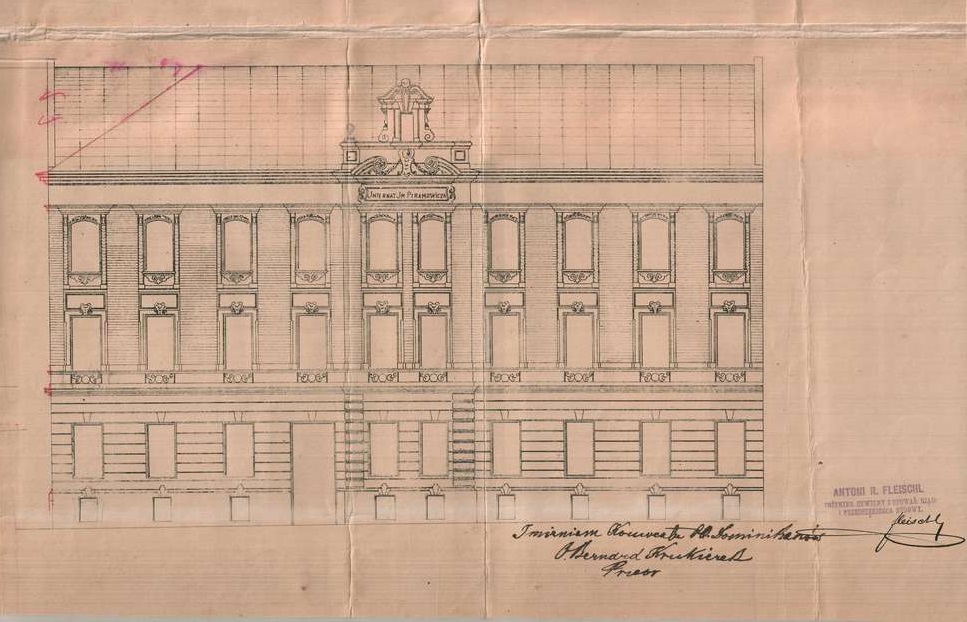
The façade is designed so that the building resembles a residential townhouse from the outside. The façade with ten window axes is symmetrical, except for the location of the entrance to the courtyard. In the center, there is a thin avant-corps crowned with an attic. At the ground floor level, the façade is rusticated. Above, the walls are unplastered and faced with brick. The rectangular windows have trimmings with pediments. Above the second floor windows, in the center, there is a molded decorative board, which may have contained the name of the establishment.
Compared to the project, the façade is simplified. The drawings show a Neo-Baroque attic with volutes while in reality it is triangular in shape, with a niche where a bust of Grzegorz Piramowicz (not preserved) was installed. The windows were made with trimmings, but without molded keystones and inter-window inserts. The façade is crowned with a cornice. A 1905 article about the building describes it as "modest, but solid and practical. The only decoration on the façade is the bust of the educator Piramowicz" (Nowości Illustrowane, 1905, No. 50: 3). Based on drawings by Kazimierz Mokłowski, furniture in the Zakopane style was made—it can be seen in the photograph of the dining room.
Related buildings and spaces
-
Vul. Kalicha Hora, 5 – an abandoned building
-
Vul. Horbachevskoho, 18 – university building

-
Vul. Bandery, 57 – residential buildings (non-existent)

People
Jacob and Ewa Arkiel — the owners of the plot in the
1860s–1901, before the boarding school building was erected here. Jacob worked
as a railway conductor.
Stanisław Badeni (1850–1912) — a count, Marshal of
Galicia in 1895–1901 and 1903–1912.
Juliusz Bełtowski (1852–1926) — sculptor, author of
the bust of Piramowicz.
Bielecki — a mitred bishop; probably Fr Andrzej Bielecki is
referred to here (1847–1926).
Józef Bilczewski (1860–1923) — a Roman Catholic
archbishop.
Ignacy Dembowski (1861–1942) — a court advisor and member
of the Regional School Council, president of the Piramowicz Society.
Zygmunt Lenkiewicz (1845–1913) — a Roman Catholic
prelate, a member of the City Council and many societies.
Godzimir Małachowski (1852–1908) — president of Lviv in
1896–1905.
Michał Michalski (1846–1907) — vice president of
Lviv in 1895–1905.
Kazimierz Mokłowski (1869–1905) — an architect and a
socialist politician, a historian and an architecture critic who participated
in the design of the boarding school interior and furniture.
Leon Piniński (1857–1938) — a count, governor of
Galicia in 1898–1903.
Krystyna Potocka (1866/1869–1952) — a countess, wife
of Andrzej Potocki, the governor of Galicia and patron of the Piramowicz
Society.
Józef Piórkiewicz — director of the Stanisław Staszic
School in Lviv, a representative of the Piramowicz Society, who was involved in
the construction of the boarding school.
Antoni Fleischl (1862–1921) — an engineer and an
architect, author of the building design.
Ferdynand Szczurkiewicz — professor at the men's teacher
training college in Lviv, a member of the Polish Pedagogical Society, director
of the boarding school.
Sources
- Державний архів Львівської області (ДАЛО) 2/1/3357. URL: https://e.archivelviv.gov.ua/file-viewer/230136#file-1352462
- "Ogłoszenia", Dziennik Urzędowy C. K. Rady Szkolnej Krajowej w Galicyi, 1906, Nr. 15.
- "Seminarja nauczyczelskie. Lokale najęte", Dziennik Urzędowy dla Okręgu Szkolnego Lwowskiego, 1923, Nr. 3.
- "Kronika. Internat imienia Grzegorza Piramowicza", Gazeta Lwowska, 1903, Nr. 159, s. 3-4.
- "Kronika. Poświęcenie internatu im. G. Piramowicza", Gazeta Narodowa, 1904, Nr. 245, s. 2.
- "Wykaz sprzedanych realności w styczniu 1901", Kurjer Lwowski, 1901, Nr. 71, s. 3.
- "Wykaz sprzedanych realności w sierpniu 1902", Kurjer Lwowski, 1902, Nr. 320, s. 3.
- "Wykaz sprzedanych realności we Lwowie", Kurjer Lwowski, 1903, Nr. 261, s. 9.
- Kurjer Lwowski, 1932, Nr. 240, s. 15.
- "Internat im. Piramowicza we Lwowie", Nowości Illustrowane, 1905, Nr. 50, s. 3.
- Sprawozdanie C. K. Rady Szkolnej Okręgowej Miejskiej ze Stanu Szkół Ludowych Król. Stoł. Miasta Lwowa za lata szkolne 1904/15 i 1905/6 (Lwów, 1907).
- Wiktor Legeżyński, Stosunki zdrowotne w mieście Lwowie w roku 1905 i 1906 (Lwów: Szyjkowski, 1907).
- Grzegorz Piramowicz, Powinności nauczyciela, (Lwów, 1923).
- Grzegorz Piramowicz, Powinności nauczyciela, (Lwów, 1927).
- Wiesław Bieńkowski, "Mokłowski Kazimierz Julian", Polski Słownik Biograficzny, vol. 21 (Warsaw, 1976), 582–585.
- Sergey R. Kravtsov, "The Jewish Hospital in Lemberg/Lwów/Lviv: Its Architecture and Architects", Visionaries from Lviv: The Story of a Jewish Hospital, ed. Ewa Herbst, (Academic Studies Press, 2024).
- Василь Нагірний, "Мої спомини", Нагірні, Леви: Історія родини, упор. Христина Лев, Наталя Філевич, Василь Лев-молодший, (Львів, 2000).