Vul. Konovaltsia, 27 – residential building (former villa) ID: 1396
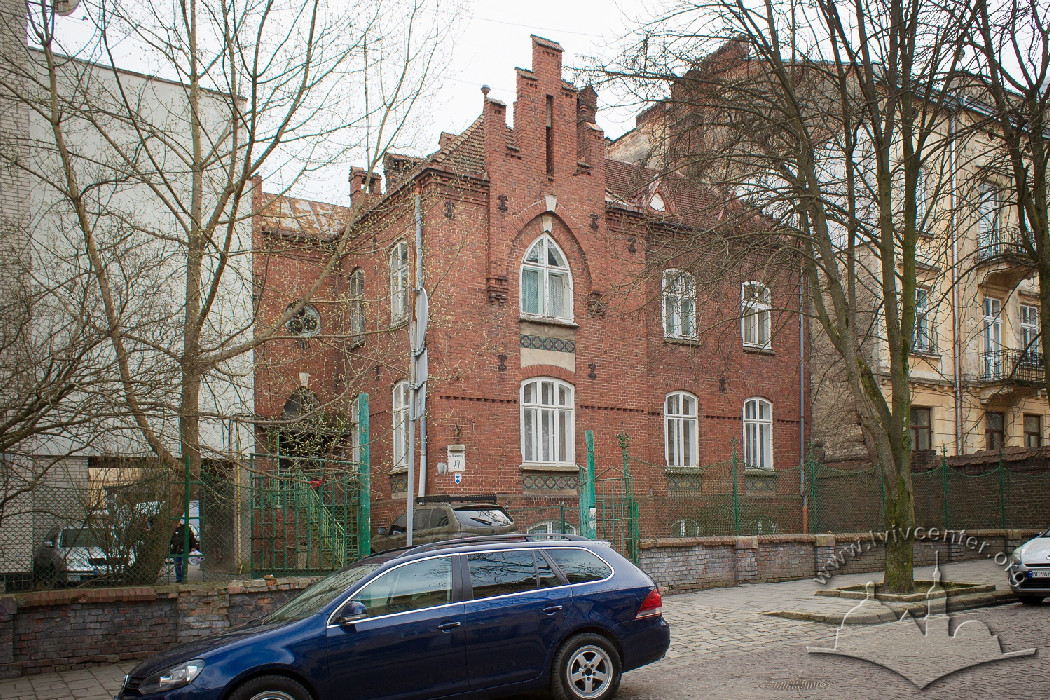
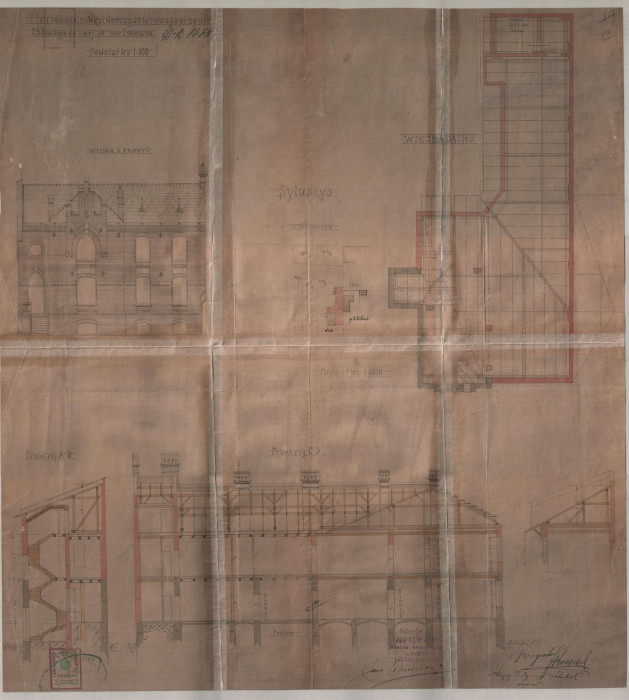
The villa was built in 1898-1899 by Helena Bromilska, an entrepreneur, according to a project designed by Stanisław Majerski; the construction was carried out by Stanisław Dec. In 1908, at the request of Krzysztof Köppel, Ivan Levynsky's company added a second floor. An example of Neo-Gothic architecture, it is a local architectural landmark. Today (2025), it is an apartment building.
Story
During the 19th century, a larger plot of land with conscription number 104 ¼, which belonged to ul. Murarska (now vul. Yefremova), was located here.
At the end of 1892, a street called vul. Konovaltsia today began to be laid; later it was named 29 Listopada in honor of the anti-Russian uprising of 1863-1864. This was due to the initiative of the Franz family: Józefa and her son Antoni, who owned nearby gypsum quarries and sought to modernize the entire neighborhood. The construction of the street began when the Franz family started building two villas, today located at vul. Konovaltsia 47 and 46. Among others, Mikołaj Rybowski, who built a villa for himself at what is now vul. Konovaltsia 26, and architect Ivan Levynsky joined the initiative.
In October 1897, part of plot 104 ¼, which was owned by Henryka Kupczyk, was purchased by Helena Bromilska. The plot cost was 5,369 Rhenish guldens (Lwowianin, 1898, 123).
According to research by Iryna Kotlobulatova, Helena Cecylia Hawranek (her maiden surname) was born into the family of Lviv businessman Edward Hawranek, who traded in paper and stationery. The family came from the town of Frýdek-Místek in Moravia, modern-day Czech Republic (Kotłobułatowa, 2022, 24). In 1886, 18-year-old Helena married Jan Bromilski, who worked in her father's shop and opened his own shop on the eve of their wedding. The shop was located in the Grand Hotel building.
"Kolokolyn — Helena Bromilska's Gypsum Factory"
Helena started her own business: ten years after her marriage, in 1896, she purchased a gypsum quarry in the village of Kolokolyn near Rohatyn, now in the Ivano-Frankivsk oblast. This village still exists, but the quarries have probably been exhausted, as today (2025) there is no mention of the presence of such industry there. The initial development of the quarry was carried out by Józef Pokutyński, an architect from Krakow. In 1891, a union was registered in Krakow, which included, in addition to Pokutyński, Józef Niedzwiedzki, Helena Rydel née Kremer, Marya Nitschowa, and Baron Aleksander Gostkowski (Gazeta Lwowska. 1891, No. 165, p. 8). Their enterprise was called “The First Provincial Factory of Gypsum, Roman and Portland Cement in Kolokolyn — A. Gostkowski, J. Niedzwiedzki and Co.” After acquiring the quarry, Bromilska renamed the enterprise: “Kolokolyn — Helena Bromilska’s Gypsum Factory.”
Although Helena Bromilska included her own name in the name of the factory, its only representative office in Lviv was located in the stationery shop run by her husband Jan. Moreover, she sold the right to deliver materials from her factory to the firm J. Wolgner i Sp. (J. Wolgner and Co.), while retaining the right to supply materials exclusively to Lviv (Kurjer Lwowski, 1897, No. 128, p. 6).
First and foremost, the company dealt with gypsum and alabaster. Kolokolyn alabaster had previously been used by Lviv sculptors, such as Leonard Marconi, to decorate the interior of the Galician Savings Bank and the Franciscan nuns’ church, as well as by Anton Schimser (Sołtyński, 1896, 276). In 1898, Helena Bromilska supplied materials for the construction of the National Casino in Lviv (Dodatek do Nr. 163 Kurjera Lwowskiego, 1898, p. 3). The Kurjer Lwowski newspaper also reported on an allegedly large order of alabaster from a Viennese company for pedestals for a bust of Emperor Franz Joseph I to mark the fiftieth anniversary of his reign in 1898 (Kurjer Lwowski, 1897, No. 311, p. 3).
In 1896, Kolokolyn was visited by a delegation from Lviv, which included professors from the polytechnic and industrial school: Julian Zachariewicz, Leonard Marconi, Jan Nepomucen Franke, Zygmunt Gorgolewski, and several others. Based on what he saw, August Sołtyński, an engineer and promoter of industrialization in Galicia, wrote a favorable article in the professional press, and Lviv daily newspapers reprinted short versions of his report. Sołtyński described the landscape of a small village with a worndown road and houses under thatched roofs, with factory chimneys, obviously built quite recently, standing amidst them. He noted that the delegation did not see any Roman or Portland cement there (materials that could be read about in advertisements), but compared the alabaster found there to the world-famous Carrara marble. He praised the quality of the materials, including gypsum, and expressed hope that Kolokolyn gypsum — if Bromilska's management was successful — would replace German counterparts on the local market, which would be beneficial for the economy of Galicia (Sołtyński, 1896, 276–278).
It seems that Bromilska's company existed for less than ten years. In 1904, Helena obtained the right to represent her husband's company (Przegląd prawa i administracyi, 1904, No. 5, p. 62), and after his death in 1909, she continued his business (Kurjer Lwowski, 1909, No. 414, p. 5). She sold the factory in Kolokolyn. The 1906 Galician Industry Directory reports that the factory became the property of Hersch Mund, apparently a member of the Lviv tile-making family (Skorowidz przemysłowy, 1906, 166). From then on, materials from this factory could be purchased not only from the Mund family, but also from other intermediaries in Lviv (Kurjer Lwowski, 1905, No. 170, p. 7).
Helena Bromilska's villa
According to Lviv address books, the Bromilskis' first address in the 1880s was ul. Karla Ludwika 13 (now prosp. Svobody). The Grand Hotel was located at this address, but in the 1880s, there was a previous building here, built in the Classicist style in the mid-19th century. Jan Bromilski's shop operated in this building. In 1890, the Bromilskis built a villa for themselves at Kastelivka, at vul. Henerala Chuprynky 5.
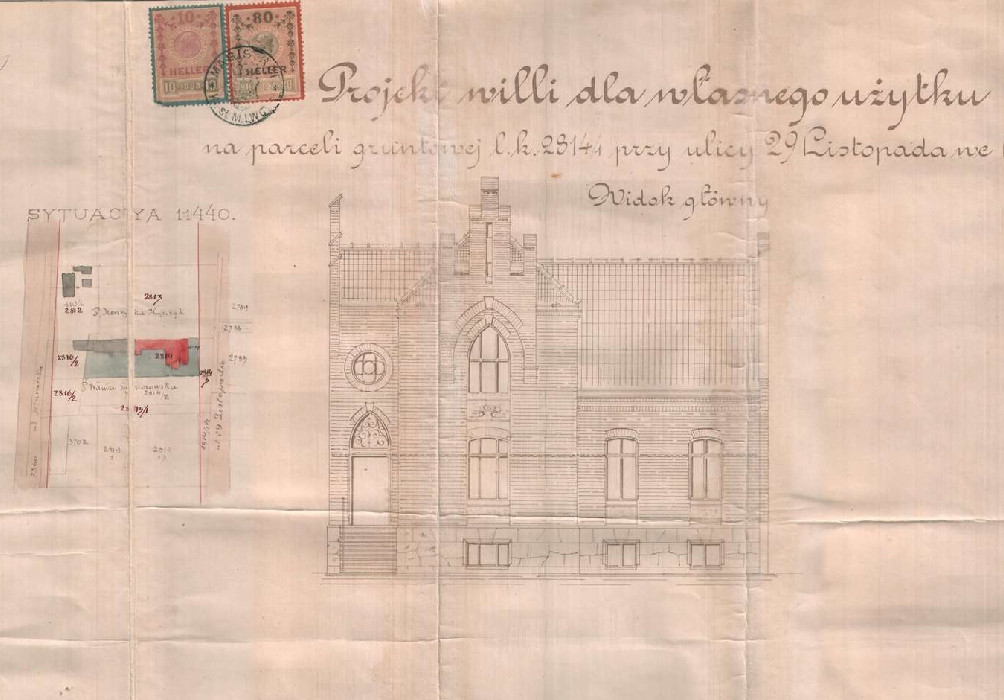
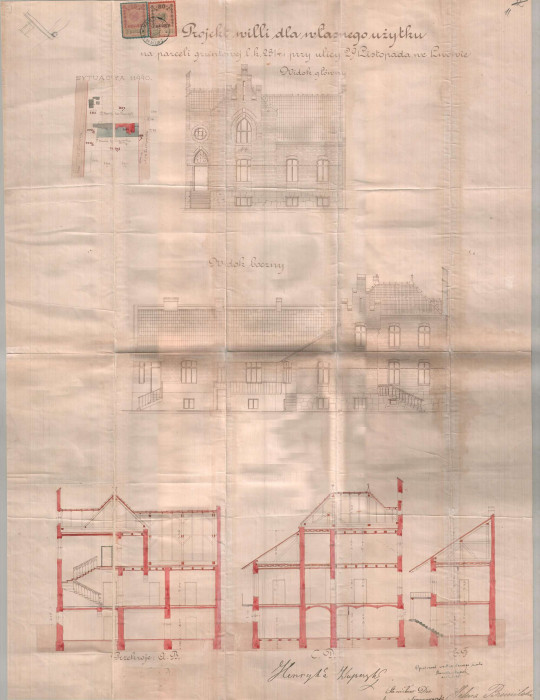
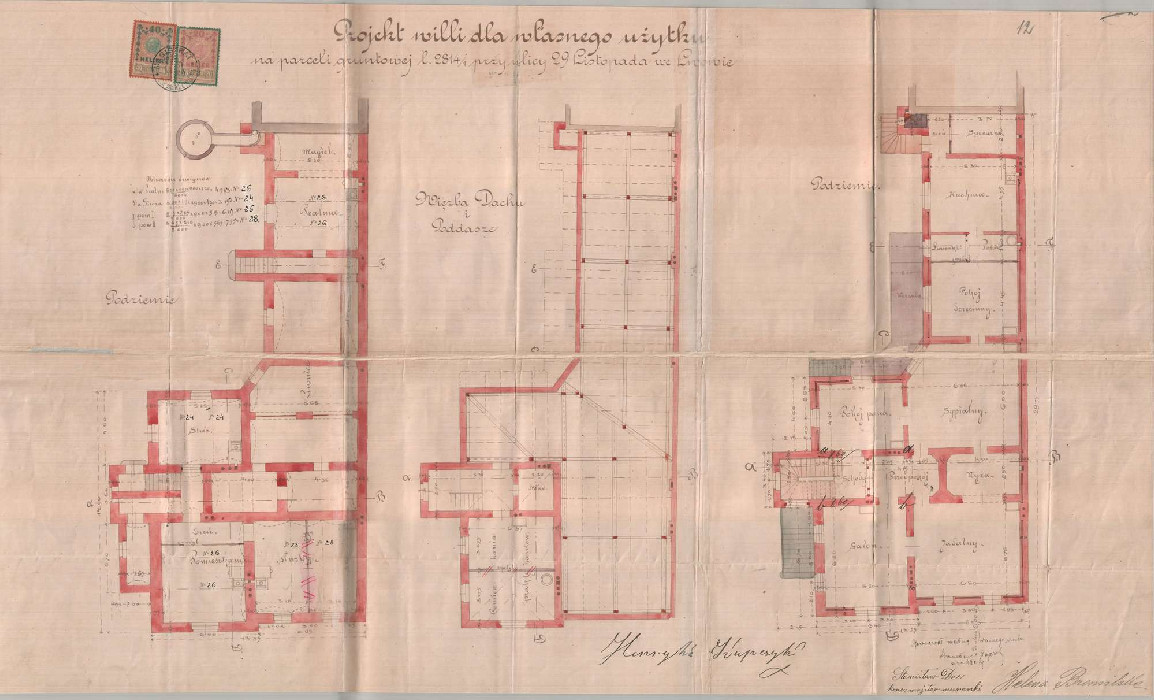
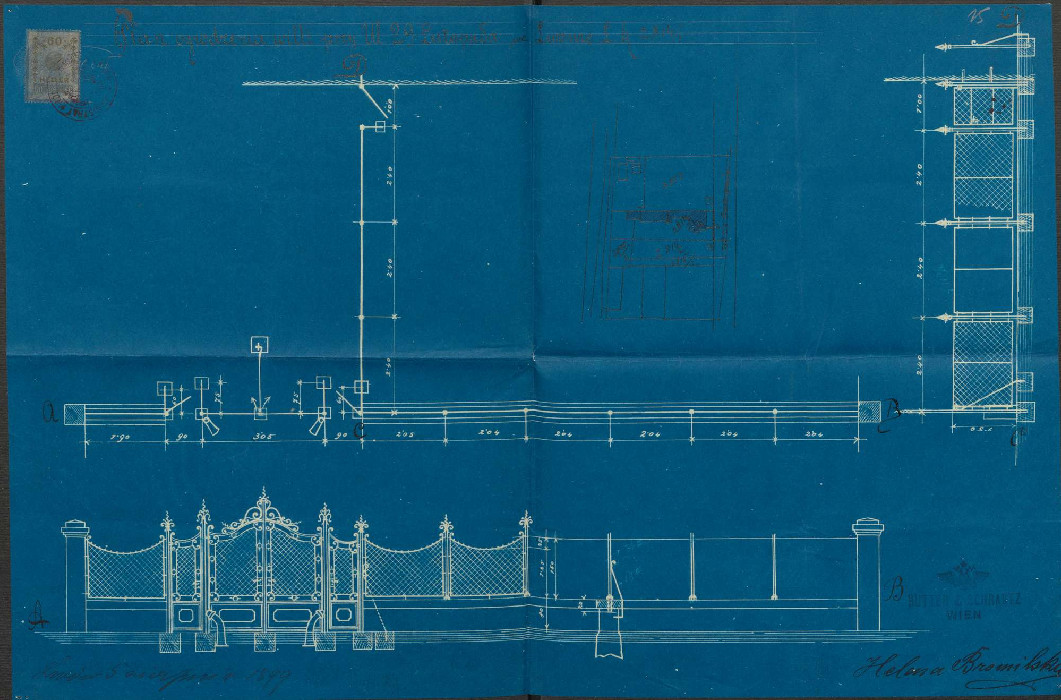
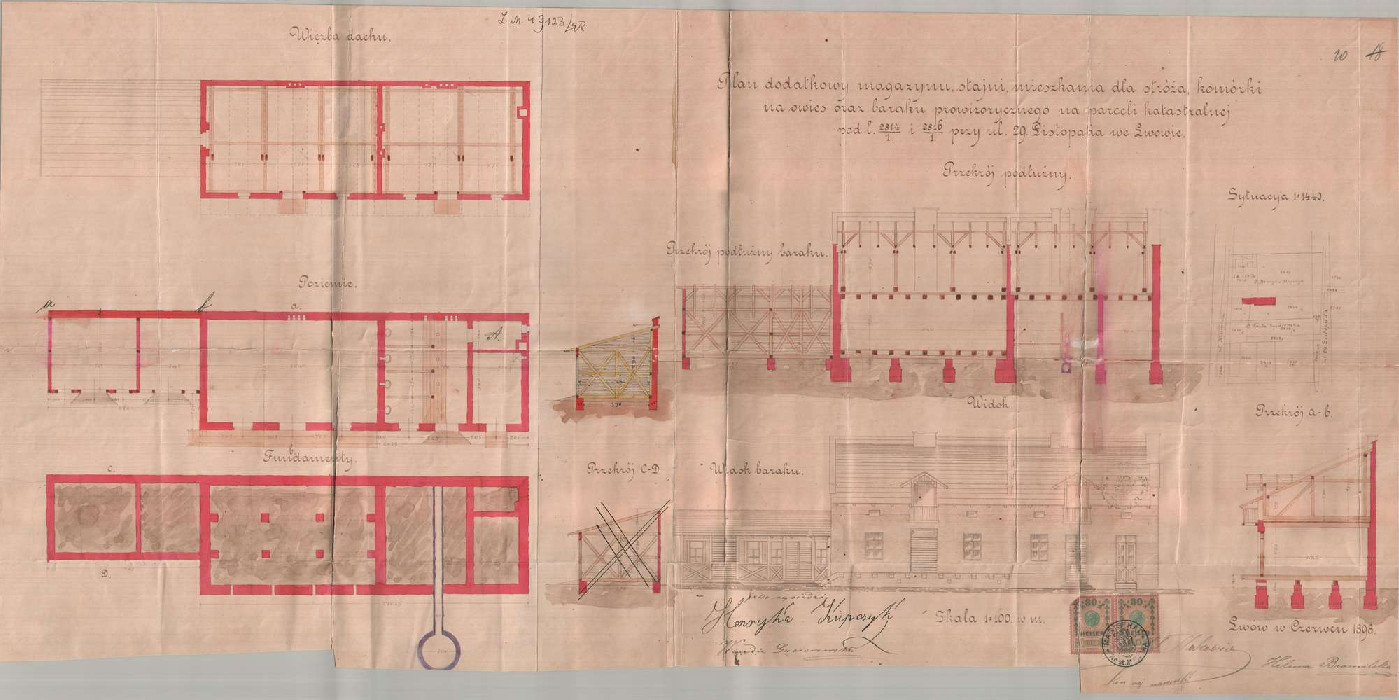
In 1897, Helena Bromilska purchased a plot of land on the newly laid ul. 29 Listopada (now vul. Konovaltsia), where she decided to build a villa. She commissioned the project from architect Stanisław Majerski, who suggested a Neo-Gothic design that was somewhat unusual for Lviv. The contractor who carried out the construction was Stanisław Dec, a Lviv master builder (ДАЛО 2/1/3379:11-12). At that time, it was a single-story house with a small superstructure on the second floor. During the construction, Dec made minor changes to the layout of the wing (ДАЛО 2/1/3379:14). An elongated utility wing with a stable for four horses was also added to the villa. It was first designed by Henryk Salwer, a Lviv architect (ДАЛО 2/1/3379:13), but then the project was reworked by another builder, Michał Makowicz (ДАЛО 2/1/3379:10). Bromilska ordered a decorative metal fence from the Viennese company Hutter i Schrantz (ДАЛО 2/1/3379:15). Most of these drawings bear the signatures of neighbors: Henryka Kupczyk, who owned house 29 on vul. Konovaltsia, and Wanda Gąsiorowska, the owner of the then undeveloped plot No. 25a.
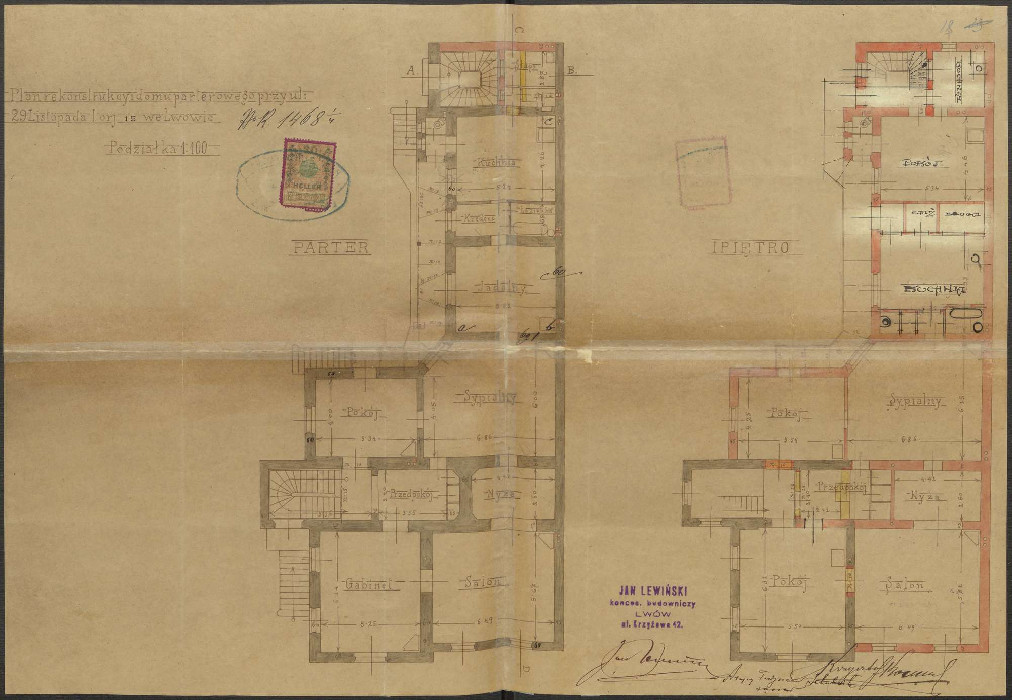
During the construction, the house was located at ul. 29 Listopada 15. It was assigned conscription number 1468 ¼. The villa was designed for one family. It had a spacious living room and dining room with windows facing the street; a study, a large bedroom for parents, and a children's room with windows facing the courtyard. The utility premises were located at the edge of the wing and in the basement. A staircase led to a single room on the second floor, designated as a room for trainees, probably due to business needs. Lviv address books from 1901–1904 list this house as the residence of Jan Bromilski.
The house of Krzysztof Köppel
The press reported that in 1903, Helena Bromilska sold the house at ul. Murarska 4a — ul. 29 Listopada 17 to Krzysztof Köppel for 66,000 crowns (Lwowianin, 1903, 52). This price is approximately six times higher than the price Bromilska paid for the undeveloped plot in 1897. However, it seems that this was not the only Bromilskis’ property on this street: in 1906, Jan Bromilski put another plot on ul. Murarska and ul. 29 Listopada up for sale (Kurjer Lwowski, 1906, No. 155, p. 4).
Krzysztof Köppel, who is mentioned in the address books of Lviv only as a real estate owner, was apparently also a landowner outside the city, in particular in Velykyi Sknyliv (probably part of the modern village of Sknyliv). In one newspaper report, he is mentioned as the administrator of the real estate of Count Siemieński-Lewicki (Słowo polskie, 1902, No. 600, p. 4).
In 1905, Köppel paid 500 crowns to the city treasury as a contribution to the construction of a sewer system on ul. 29 Listopada (now vul. Konovaltsia), and then had to pay 149 crowns to connect his villa to it (ДАЛО 2/1/3379:7). The connection project was prepared by constructor August Bogochwalski (ДАЛО 2/1/3379:16).
In 1908, Krzysztof Köppel commissioned Ivan Levynsky (Jan Lewiński) to expand the villa. The drawings bear the latter's handwritten signature; therefore, it is unknown whether any other architects from his office were involved in the design. The style of the villa was preserved, and the extension was made in such a way that the difference between the old and new parts is virtually invisible. Anchors with decorative ends and Levynsky's signature majolica panels were added to the façade. The project was approved by the neighbor, the owner of house 29, Alojzy Ferdynand Schubert (ДАЛО 2/1/3379:17-18). The layout of the ground floor was changed, for example, the living room was replaced by a study, and the dining room was located at the rear, next to the kitchen. In general, thanks to the second floor, two equal spacious and comfortable apartments were arranged in the villa; also, due to the installation of centralized water supply and sewage systems, bathrooms appeared in the house.
According to the address books of 1910-1914, the owner settled in this villa. It seems that he rented out the apartment on the second floor, because according to the address books of 1913-1914, there were three residents in the villa. The two tenants were Marian Rastawiecki and Stanisław Bartkowski. The former worked as an advisor in the Provincial Court, while the latter was a tax officer.
Probably around the same time as the villa was extended in 1908, Krzysztof Köppel built a three-story tenement townhouse behind this plot, at what is now vul. Yefremova 36. As already mentioned, in 1903 he bought a plot stretching between two streets; in 1916 he was listed as the owner of both buildings (Skorowidz, 1916).
The archive file for this house (ДАЛО 2/1/3379) has been preserved in fragments. In particular, it is unknown when and how the utility wing with a stable was converted into a dwelling. However, this must have happened before 1935, as the address book from that year lists as many as eight residents at this address, including two teachers, an electrical engineer, a hairdresser, and a house administrator. In the 1930s, the villa was owned by Władysław Stesłowicz, an economist, financier, and politician who was later repressed by the Soviet authorities.
In the post-war period, the former stable housed the Housing and Communal Services Department, later transformed into the Lviv Lantern Municipal Enterprise, which moved to another location as of 2025.
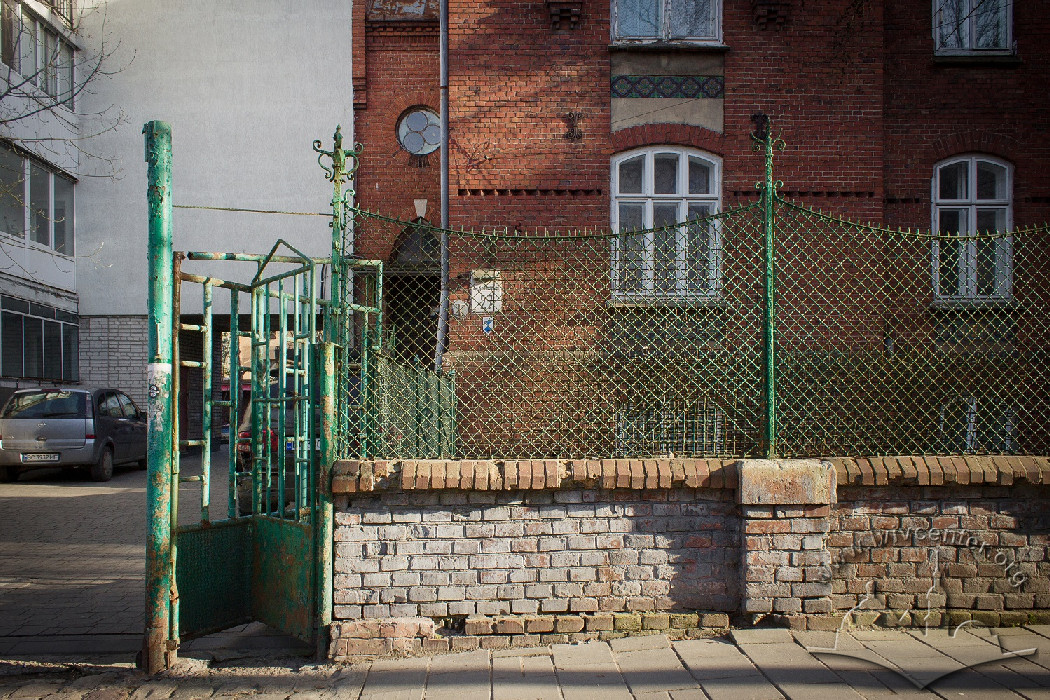
The neighboring plot remained undeveloped until, in the early 1970s, a five-story apartment building was erected on it (commissioned in 1974). Fitting into the historical architectural environment — between a villa and a three-story Secession-style townhouse — the building has a somewhat unusual layout. The passage to the courtyard, which became shared by houses 25a and 27, was preserved. At the level of its floors 2-4, the building adjoins the villa, namely its protrusion with a staircase, obscuring the latter and closing the porch, which is similar to the one on the main façade. The courtyard houses a playground and garages. It is likely that during the Soviet period, the villa was redesigned and divided into several smaller apartments. It is possible that the decorative Neo-Baroque entrance gate, made in Vienna, was lost at that time. In its place, a Soviet gate made of welded metal pipes was installed. As of August 2025, it is being replaced with a new one.
The villa remains a residential building and is a local architectural landmark. Today, in 2025, it retains many authentic elements and even most of the window woodwork.
Architecture
Location on the site. The villa was built on an elongated plot that once stretched between vul. Konovaltsia and vul. Yefremova, from which a plot for the house at vul. Yefremova 36 was later separated.
The street began to be laid here in 1892, and this was one of the first buildings on it. The villa was designed so that it would adjoin the neighboring house (vul. Konovaltsia 29) with a firewall when the latter was built, and on the other side it had a passage to the back of the courtyard. It was built at the same time as Joanna Lorenz's villa (No. 21, no longer in existence), but, unlike that villa, which was built quite far from the street, Helena Bromilska's villa was set back 6 meters from the street’s frontage line. Later, 6 meters became the standard for further development of the street: this was the distance required by the Lviv Building Authority from those wishing to build townhouses nearby.
Initially, the building had a single story with a small second floor. Its shape is close to an L-shape: it has an approximately square "front" part and an elongated side wing. Thus, it had two façades: a street one and a side one. It is built of brick, its façades featuring open brickwork. The semi-basement premises have brick ceilings on metal beams; in the rest of the rooms, the ceilings are wooden (according to the original drawings). The decor features ceramics, primarily majolica, and decorative metal. The original ceramic roof tiles, which can be seen in the drawings, have not been preserved. As a result of the 1908 reconstruction, the villa became a two-story house with two apartments, and after that, no significant alterations took place. However, its appearance was significantly altered by the Soviet five-story residential building (No. 25a). Built in the 1970s, it adjoins the villa on one side, encroaching on its plot, but preserving access to the courtyard, which became shared by the two buildings.
Layout of the villa. According to the 1898 plans, the external stone stairs on the side led to the staircase from where it was possible to go directly to the study ("husband's room") on the left or to the windowless hallway leading to the living room and the dining room on the right (with windows facing the street) or to the bedroom on the left. The bedroom was connected to the study behind which there was a children's room, a bathroom, and a kitchen with a separate entrance from the courtyard. The small second floor, which only occupied the space above the living room, could be accessed via the main staircase. The basement, under the living room and the dining room, housed the utility premises; under the study, there was a room for the caretaker. The rest of the basement was occupied by storage cellars and a laundry room. Initially, it was planned to place a storage room behind the kitchen, but this idea was later abandoned, and a storage room was built under the kitchen instead. Next to the wing, a stable for four horses with utility premises was added.
As a result of the addition of a second floor in 1908, the layout was partially changed. The living room was replaced by a study, the dining room was moved to the wing to the place of the children's room (next to the kitchen), and the living room took the place of the dining room. At the edge of the wing, behind the kitchen, an additional staircase to the second floor was built. The layout of the second floor was generally repeated. However, instead of five habitable rooms, there were four there. Above the kitchen on the ground floor, there was a one-room apartment with a small kitchen and access to a toilet. In the large apartment, the bathroom and the toilet were moved. Thus, the ground floor became the owner's apartment, and the apartments on the second floor became tenants' dwellings. The latter is confirmed by Lviv's address books, which record two tenants in addition to the owner himself.
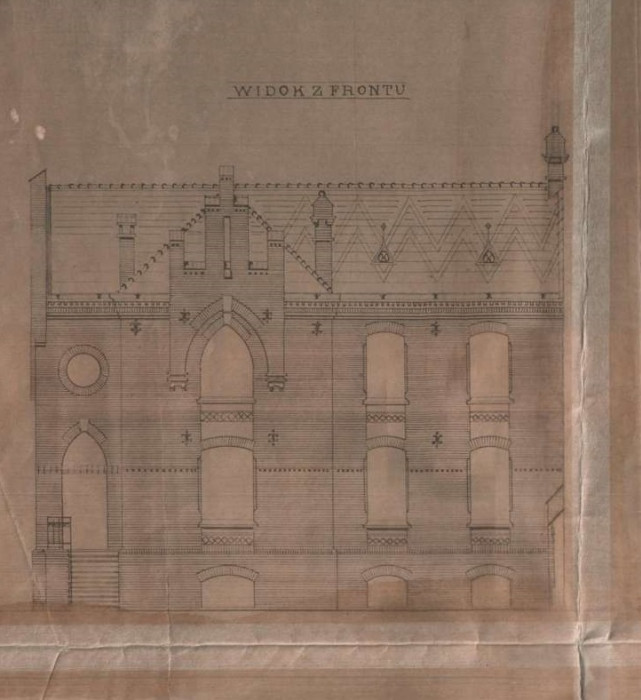
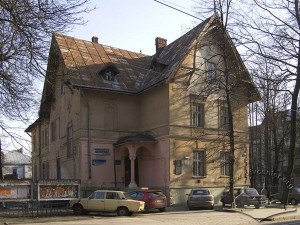
Appearance, façades, and decor. The villa was built in the Neo-Gothic style, and its appearance is quite restrained. The brickwork is exposed everywhere — on the base and on the walls. The windows are mostly arched. On the ground floor, the windows are visually connected by a brick belt. Below them are colorful majolica panels, added during the reconstruction of the villa by Ivan Levynsky in 1908. The most striking decorative element is the tall brick stepped gables with long windows — stylized arrow slits. There were three of them: on the main façade, on the side one (covered by an extension of the Soviet-era five-story building), and on the back one. Below these gables, there are Gothic lancet windows. Above the main entrance, there is a small round rose window with a metal frame.
The style of the house imitates William Morris' Red House, built by Philip Webb in the suburbs of London. Built in 1859-1860, this building became famous much later with the spread of the Arts and Crafts movement. It was an attempt to creatively reinterpret medieval architecture instead of accurately reproducing ancient models; to borrow certain architectural principles, but also not to overload the building with decor. In Lviv, this villa can be compared to several buildings designed by Julian Zachariewicz, in particular his own villa at vul. Metrolohichna 14a and Jan Styka's villa at vul. Lystopadovoho Chynu 11. Stanisław Majerski, the architect of Helena Bromilska's villa, was a recent graduate of the Polytechnic in Lviv at the time of the design — in 1891–1897, he was a student of Julian Zachariewicz (Księga pamiątkowa, 1897).
Fence. Helena Bromilska ordered the fence from the Viennese company Hutter i Schrantz, which manufactured the metal part: a total of seven sections with metal posts and mesh, a decorative gate with restraints and wickets on the sides. The sections were installed on a foundation made of the same bricks as the house. The original gate has not been preserved. The neighboring plot at vul. Konovaltsia 25a, where the Soviet-era five-story building was later erected, has the same fence.
Related buildings and spaces
-
Vul. Henerala Chuprynky, 5 – office building (former villa)
People
Stanisław Bartkowski — a tax officer who lived in
the house on the eve of the First World War.
August Bogochwalski (1864–1909) — a constructor.
Helena Bromilska, née Hawranek — a Lviv entrepreneur who
owned a gypsum and alabaster factory in Kolokolyn (now Ivano-Frankivsk oblast)
and initiated the construction of the villa where she later lived for several
years with her husband Jan and four children.
Jan Bromilski — a Lviv entrepreneur who
owned a paper and stationery shop, husband of Helena Bromilska and resident of
the villa.
Michał Walczak — an electrical engineer who
lived in the house (1935).
Stanisław Dec (1862–1943) — a licensed
master builder from Lviv who built the villa.
Stanisław Drozdowski — a retired court employee
who lived in the house (1935).
Kazimierz Kulczycki — a chemical engineer who
lived in the house (1935).
Krzysztof Köppel — owner of the villa from
1903 (unknown until when), property manager for Count Siemieński-Lewicki (?), property owner.
Ivan Levynsky (Jan Lewiński, 1851–1919) — an architect and construction
entrepreneur whose company added a second floor to the villa (1908) and
probably built Köppel's house at vul. Yefremova 36.
Stanisław Majerski (1872–1926) — an architect
from Przemyśl who designed the single-story villa (1898).
Michał Makowicz (1862–1920) — a licensed
master builder.
Henryk Milko — a barber who lived in the
house (1935).
Joanna Michl — a teacher who lived in the
house (1935).
Józefa Nakoneczna — a teacher who lived in the
house (1935).
Marian Rastawiecki — a councilor at the
Provincial Court who lived in the house on the eve of the First World War.
Henryk Salwer — a constructor who designed
the utility wing.
August Sołtyński (1842–1915) — a railway
employee, member of the City Council and supporter of the industrialization of
Galicia, who wrote an article about Helena Bromilska's factory in 1896.
Władysław Stesłowicz (1867–1940) — an economist
and politician who owned and lived in the villa during the interwar period and
until the Second World War.
Sources
- Державний архів Львівської області (ДАЛО) 2/1/3379. URL: https://e.archivelviv.gov.ua/file-viewer/230158#file-1350834
- Gazeta Lwowska, 1891, Nr. 165, s. 8.
- "Gospodarstwo, przemysł i handel. Fabryka gipsu w Kołokolinie", Dodatek do Nr. 163 Kurjera Lwowskiego, 1898, s. 3.
- Księga adresowa król. stoł. miasta Lwowa, 1897; 1900; 1901; 1902; 1904; 1913; 1914; 1916.
- Księga adresowa Małopolski, 1935.
- Księga pamiątkowa towarzystwa "Bratniej pomocy" słuchaczów Politechniki we Lwowie, (Lwów, 1897).
- "Kronika. Nowy sklep", Kurjer Lwowski, 1885, Nr. 256, s. 4.
- "Kronika. Zmina własności", Kurjer Lwowski, 1896, Nr. 316, s. 4.
- "Kronika. Uznanie dla przemysłu krajowego", Kurjer Lwowski, 1897, Nr. 311, s. 3.
- Kurjer Lwowski, 1897, Nr. 128, s. 6.
- Kurjer Lwowski, 1905, Nr. 170, s. 7.
- Kurjer Lwowski, 1906, Nr. 155, s. 4
- "Kronika. Osobiste", KurjerLwowski, 1909, Nr. 414, s. 5.
- "Wykaz sprzedanych realności w październiku 1897", Lwowianin, 1898, s. 123
- "Wykaz sprzedanych realności w maju 1903", Lwowianin, 1903, Nr. 6, s. 52.
- August Sołtyński, "Kołokolin, fabryka gipsu", Przemysł krajowy, 1896, s. 276–278.
- Skorowidz adresowy król. stoł. miasta Lwowa, 1910; 1916.
- "Gipsu fabryki", Skorowidzprzemysłowo-handlowy Królewstwa Galicyi, 1906, s. 165–166.
- "Wiadomości bieżące. Sprzedaż ziemi polskiej", Słowo polskie, 1902, Nr. 600, s. 4.
- Przegląd prawa i administracyi, 1904, Nr. 5, s. 62.
- Iryna Kotłobulatowa, "Lwowskie pocztówki – ich wydawcy i nakładcy", Nowy Kurier Galicyjski, 2022, Nr. 23-34 (411-412), s. 24.