Vul. Konovaltsia, 26 – hospital building (former villa) ID: 1394
This two-story Historicist villa was built for Mikołaj Rybowski according to a design by Jan Karasiński in 1894–1895. In 1905, it became the residence of professor Wilhelm Rolny and his family. It was rebuilt several times. Today, it houses the 5th Municipal Hospital.
Story
From the late 18th century, there was a plot of land around four times larger here with conscription number 128 ¼. It reached what is now vul. Antonovycha, and on that side there was a small wooden house, with the rest occupied by a garden. In 1871, it was owned by Elżbieta Wiche.
In 1894, after this section of the contemporary vul. Konovaltsia was laid through the gardens (1892), half of plot 128 ¼ was purchased by Mikołaj Rybowski, the railway school director (Lwowianin, 1894, No. 10, p. 103). He was also a public figure, engaged in ethnography and published books on folk songs, legends, and beliefs.
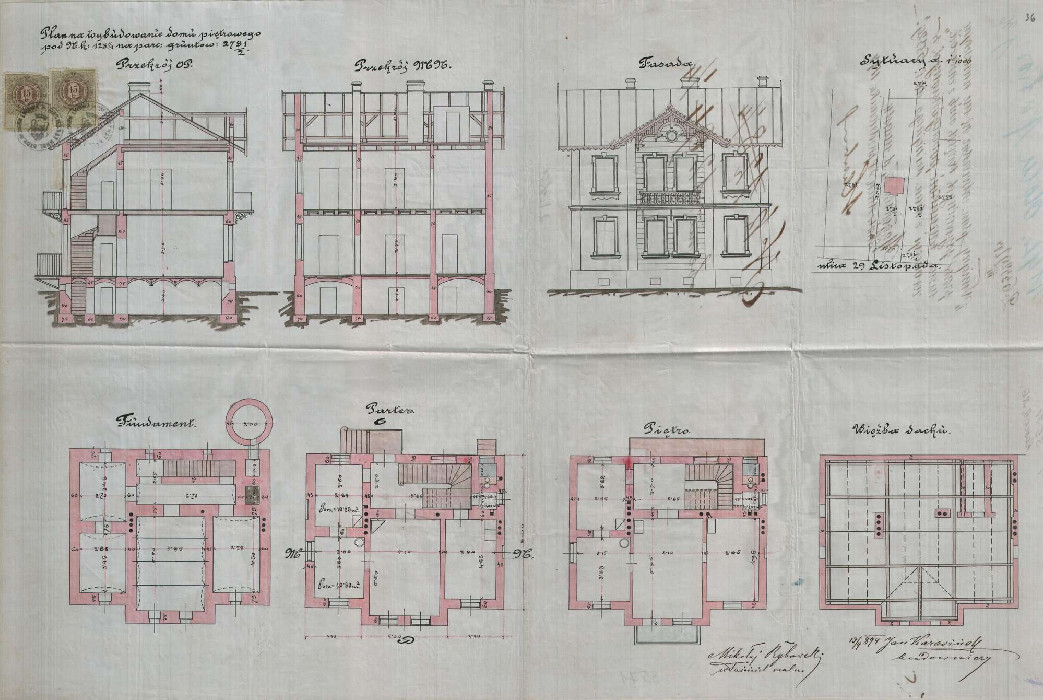
It was at his request that Jan Karasiński, a constructor, designed a project for a two-story villa in 1894 (ДАЛО 2/1/3376:36). The villa, a fairly small building, had an entrance at the rear. Each floor contained three rooms and a kitchen, storage rooms, and stairs. There was no sewage system on the street yet, so the toilets were built outside, on the second floor, with a small gallery provided to access them; also a cesspool was built. From the outside, the four-axis house was symmetrical, with a thin central avant-corps topped with a gable, with a terrace on the ground floor and a balcony on the second floor. Actually, it was a dwelling for two families: perhaps Rybowski had this house built for himself and his wife and for the family of one of his children.
On July 30, 1895, the completed house was inspected by a commission from the Magistrate, which allowed it to be inhabited (ДАЛО 2/1/3376:4). It was assigned a new conscription number, 1294 ¼. The sequential numbering of the house changed several times. On the eve of 1912, when the house received its current number 26, it had the address ul. 29 Listopada 12 (vul. Konovaltsia) as the street began just from what is now vul. Kyivska at that time.
In 1905, Rybowski sold half of his plot, thus creating a new plot, now vul. Konovaltsia 24. Here he had a smaller villa built and moved there. He sold the older and larger villa to the Rolny family. Dr. Wilhelm Rolny, a lawyer, historian, and librarian, as well as Henryka and Stefania Rolny, became its new owners, each owning one third. Wilhelm Rolny and his family probably continued to live here until his death in 1941, although with the Soviet annexation in 1939, the house was to be nationalized.
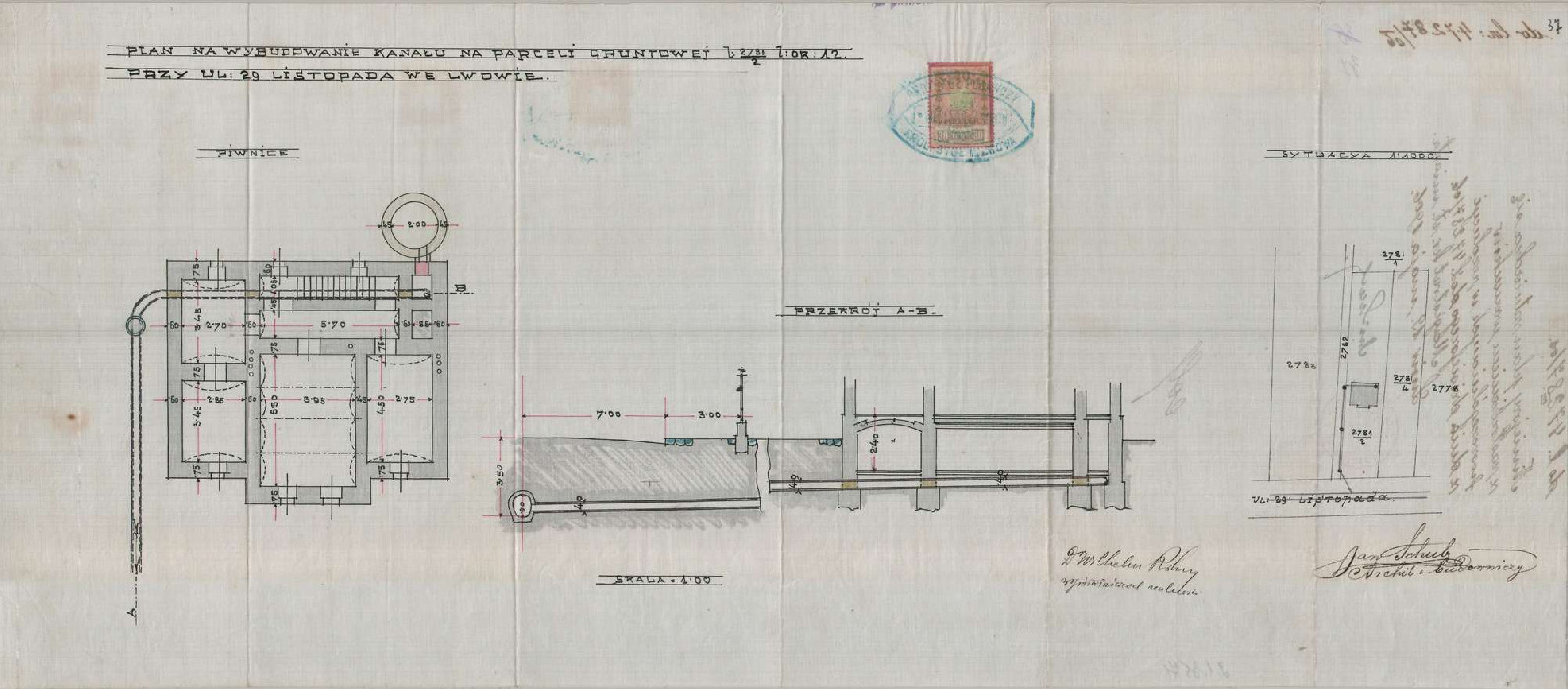
In 1906, the Rolny family connected the house to the city's sewer system; the project was designed by architect Jan Schulz (ДАЛО 2/1/3376: 9, 11, 37).
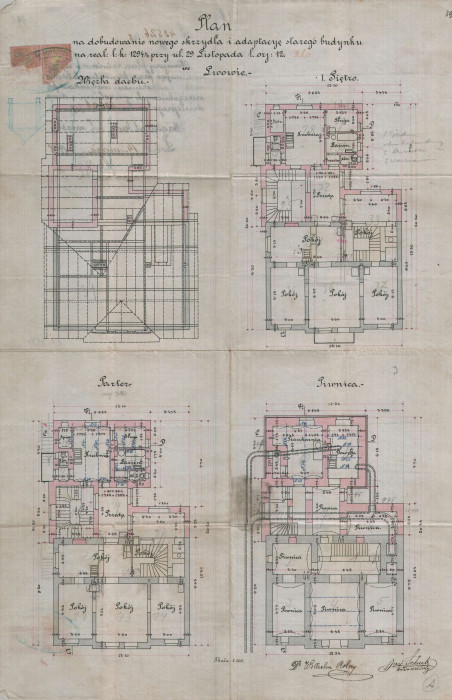
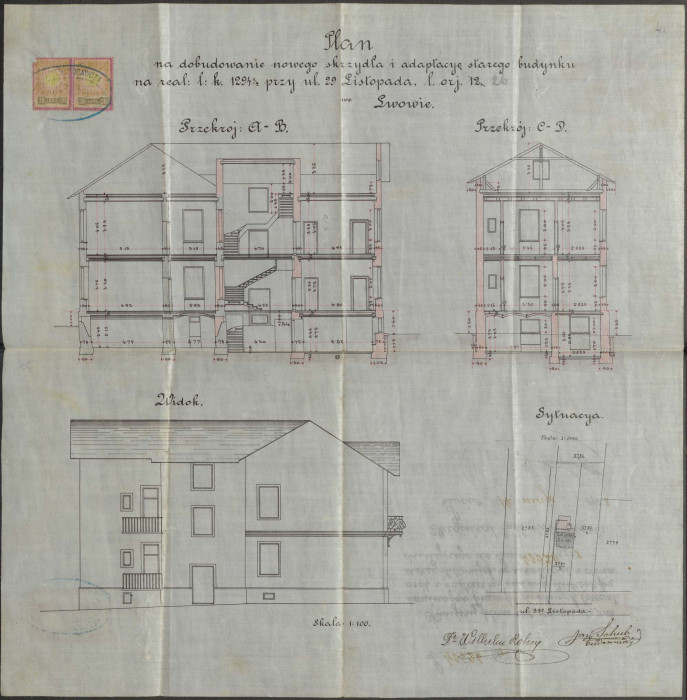
As early as 1908, the Rolny family expanded the villa at the rear, also according to a project designed by Jan Schulz. They had the old staircase and toilet demolished, a new three-flight staircase built, a spacious entrance hall, a kitchen with a pantry and a maid's room added, as well as two toilets and a bathroom. Thus, the entire older part of the villa became purely residential, with five large rooms on each floor, while all the utility premises were located in the newly built rear part. The changes did not affect the exterior style of the house (ДАЛО 2/1/3376: 16-25, 39-41).
In 1914, the Rolny family decided to add a guest room within the attic above the kitchen. To access it, a spiral staircase had to be added at the rear of the house, with a small gallery leading to it. Initially, the construction authority refused to approve the project, designed by architect Czesław Müller. Its engineers cited the thin walls, the fact that the attic floor was not strong enough to support a habitable story above, and that the spiral staircase was unacceptable for fire safety reasons (ДАЛО 2/1/3376:26). However, an additional project was developed in which the comments were taken into account; it was approved (ДАЛО 2/1/3376:28-30). The reconstruction was carried out (ДАЛО 2/1/3376:35).
It is possible that some renovation work was carried out in the interwar period, but no documents regarding this has been preserved. Around 1927-1935, the apartment in the villa was rented by Roman Koczarski, a co-owner of the timber company Roman Koczarski i Ska, which had its office there. From 1935, numerous advertisements for the rental of a five-room apartment in the middle of a garden can be found in the Lviv press.
The first Soviet telephone book of Lviv from 1940 makes no mention of this address or professor Rolny (List of subscribers, 1940).
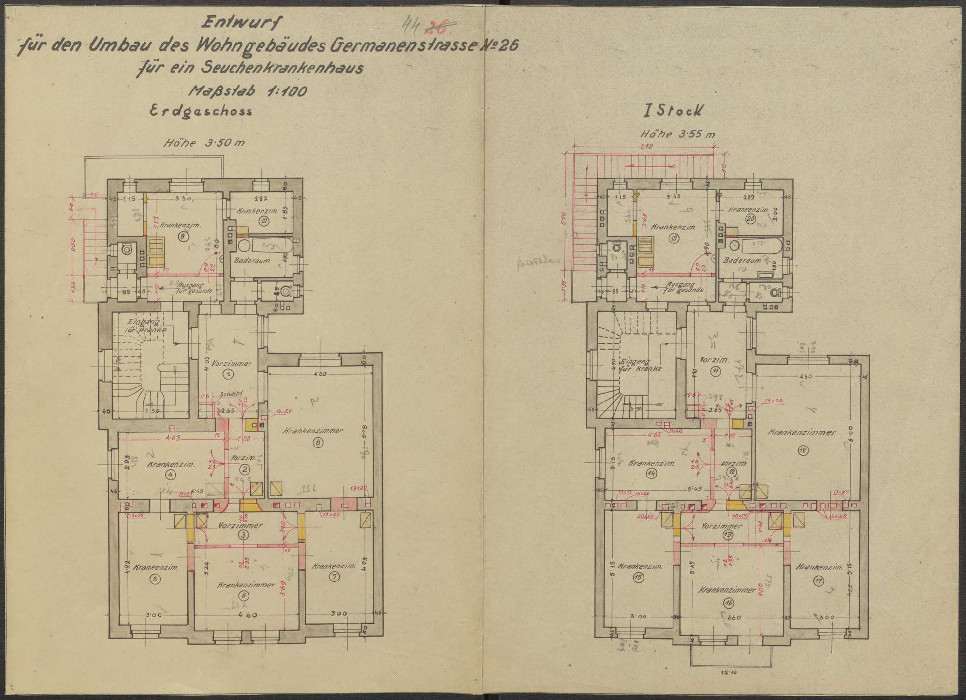
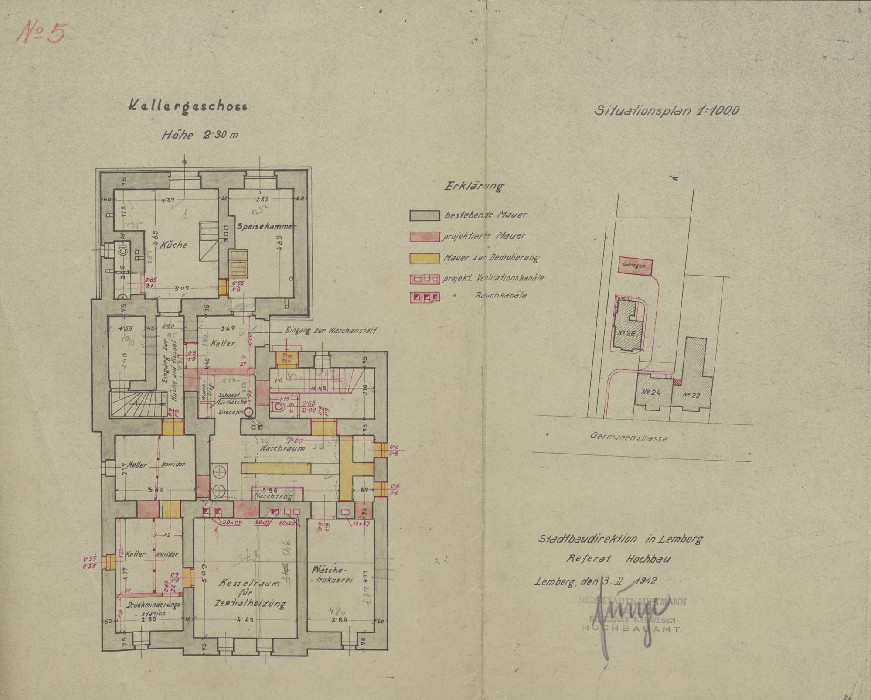
In 1942, during the occupation of the city by the Third Reich, after the death of Wilhelm Rolny, the house was used to expand the infectious diseases hospital, which was located in the former gynecological sanatorium at No. 22. The villa was redesigned to accommodate more wards and central heating was installed, with the boiler room located in the basement. Utility premises for the kitchen and for the bath, as well as for laundry were also located in the basement. A garage was designed at the rear of the site (ДАЛО 2/1/3376: 44).
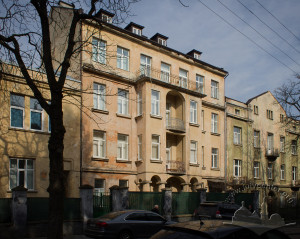
Today (2025), the building still houses a hospital. Its main façade retains its recognizable shape and style from the 1890s. However, many authentic elements have been lost: window and door woodwork, decorative wood carvings under the roof, and authentic stone fence grilles. Extensions have been added to three sides of the building. Expectedly, the authentic interiors have not been preserved.
Architecture
Originally, the villa was designed in the Historicist style with Neo-Baroque elements. It was complemented by wooden carvings in the spirit of Swiss wooden architecture, which was very popular in the middle and second half of the 19th century, until they were replaced by architecture inspired by Zakopane or Hutsul motifs.
The villa, built in 1894–1895, is one of the first buildings on this section of vul. Konovaltsia. Most of the buildings that can be seen there now appeared a decade later. The villa stands well away from the frontage line; at that time, this was only allowed in the city’s “suburban” areas, being prohibited in the “central” areas.
According to the original plan of the villa, preserved in the 1894 project, it can be assumed that the house was designed for two families. Both floors have an identical layout: three rooms and a kitchen, a storage room, and a toilet. The main façade is symmetrical, with a larger room in the middle, probably a living room, protruding from the façade as an avant-corps. On the second floor, this larger room has access to a balcony. The avant-corps is decorated with thin rustication and topped with a pediment. The floors are separated by cornices; the windows have profiled trimmings with decorative keystones.
As a result of the 1908 reconstruction, the house was extended at the rear, with utility premises and a new staircase located on that side. The front of the building remained visually unchanged, while the side and rear façades were not decorated. According to the 1942 reconstruction project, the building was redesigned and refurbished inside, and a new entrance porch and stairs to the second floor were to be added outside.
Today (2025), the building has several extensions on the sides and at the rear.
Related buildings and spaces
-
Vul. Konovaltsia, 22 – hospital building (former residential)
People
Jan Karasiński (1838–1916) — a constructor who designed
the project of the villa in 1894.
Roman Koczarski — a co-owner of a wooden products
company who rented space in the villa for his home and office.
Włodzimierz Krzeczunowicz — according to the 1914 Lviv
address book, a resident of the house.
Czesław Müller (1885–?) — a constructor who designed
the guest room in the attic in 1914.
Aleksander Paszkowski — an army major who, according to
the 1914 address book of Lviv, lived in the house.
Mikołaj Rybowski (1839–1914) — first owner of the
villa.
Rozalia Rybowska — wife of the first owner of the
villa.
Wilhelm Rolny (1872–1941) — a lawyer, historian, librarian, professor at
the University of Lviv, a co-owner and resident of the house from 1905 to 1939,
possibly until 1941.
Stefania Rolna — a co-owner and resident of the
house.
Henryka Rolna — a co-owner and resident of the
house. The 1914 address book lists her as the widow of a customs officer.
Edward Sedlaczek — according to the 1914 address
book of Lviv, a resident of the house.
Jan Schulz — an architect and constructor,
author of the project to connect the villa to the sewage system (1906) and its
expansion (1908).
Lieber Judenberg — a dairy producer who rented the
apartment in the villa in 1939.
Sources
- Державний архів Львівської області (ДАЛО) 2/1/3378. URL: https://e.archivelviv.gov.ua/file-viewer/230157#file-1352154
- ДАЛО 2/1/3376. URL: https://e.archivelviv.gov.ua/file-viewer/230155#file-1350513
- Chwila, 1939, Nr. 7194a, s. 6.
- "Ogłoszenia. Mieszkania", Dziennik Polski, 1938, Nr. 91, s. 12.
- Księga adresowa król. stoł. miasta Lwowa, 1914.
- Księga adresowa Małopolski (Lwów – Stanisławów – Tarnopol, 1935).
- "Mieszkania", Kurjer Lwowski, 1935, Nr. 307, s. 10.
- "Wykaz sprzedanych realności we wrześniu 1894", Lwowianin, 1894, Nr. 10, s. 103
- Polski przemysł i handel: rynek polski. Księga adresowa i informacyjna (Warszawa, Lwów, 1930).
- Rocznik Polskiego przemysłu i handlu (Warszawa, 1934).
- Skład Uniwersytetu w latach akademickich 1923/1924 i 1924/1925 (Lwów: 1 Związkowa drukarnia, 1924).
- Skorowidz król. stoł. miasta Lwowa, 1871.
- Skorowidz król. stoł. miasta Lwowa, 1879.
- Skorowidz król. stoł. miasta Lwowa, 1889.
- Skorowidz król. stoł. miasta Lwowa, 1916.
- Spis Abonentów sieci telefonicznych Państwowych i Koncesjonowanych w Polsce z wyjątkiem m. st. Warszawy, 1939.
- Список абонентів львівської АТС, 1940.