Vul. Konovaltsia, 23 – residential building ID: 2701
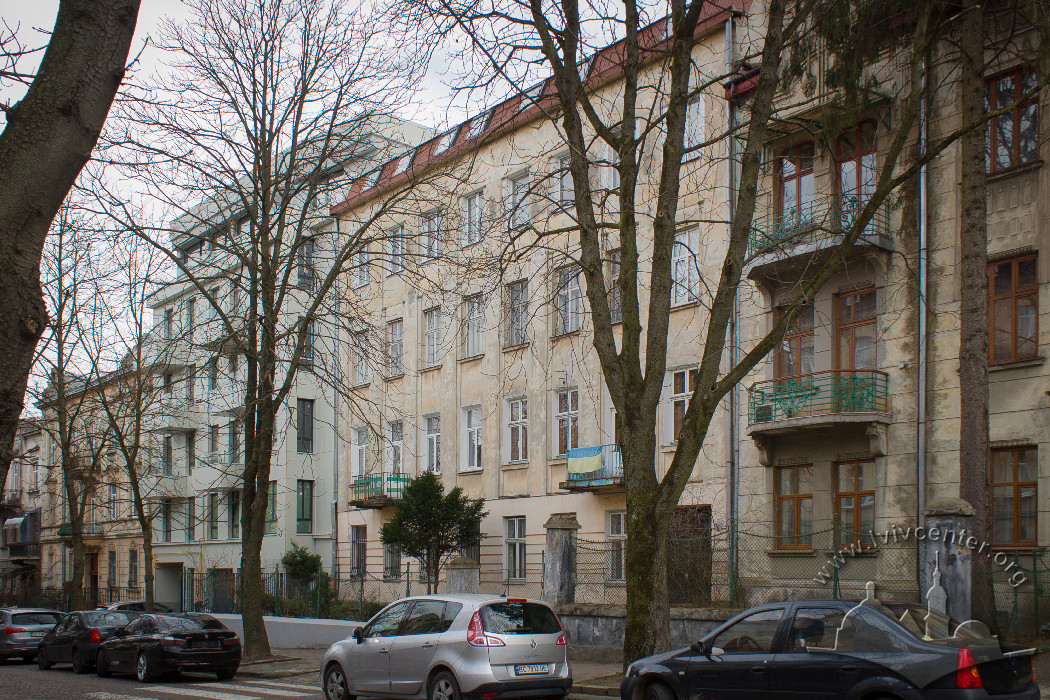
This four-story residential building, constructed in 1906–1907, was originally a three-story one in the Secession style. It was designed by Józef Linder and built with the help of Michał Fechter. In the interwar period, the building was purchased by Leopold Diamandstein, an oil mine owner. In 1938, a fourth floor was added according to a project designed by Artur Stahl, the façade losing its Secession features.
Story
In 1906, this plot of land intended for construction was purchased by Józef and Laura (Lola) Linder. At that time, they lived in Lviv at ul. Dzialińskich 11 (now vul. Ally Horskoyi) in a rented apartment on the third floor.
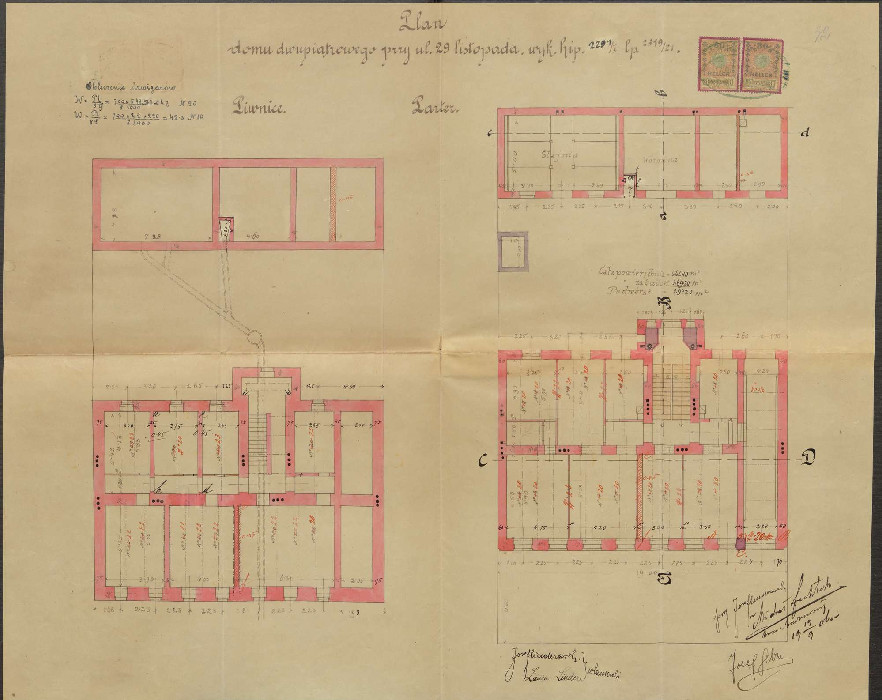
Linder was probably a recent graduate of architecture at the Polytechnic in Lviv. Since he was 32 in 1908, he was born in 1875/1876. Yuriy Biriuliov suggests that he worked in Michał Fechter’s architectural bureau (Biriuliov, 2022, 550). In September 1906, Linder submitted the design for house 23 for approval to the Lviv Magistrate (ДАЛО 2/1/3375:1). He signed the drawings twice — as the owner and as the designer. Another signature is that of Michał Fechter, a well-known Lviv architect and constructor. After reviewing the submitted project, the construction authority engineers Stanisław Krzyżanowski and Wincenty Górecki recommended that the Magistrate approve it (ДАЛО 2/1/3375:1). The building permit was granted a few weeks later (ДАЛО 2/1/3375:3).
As of August 1907, the construction was completed, and the Magistrate, based on an inspection, allowed the house to be occupied, with the exception of the caretaker's room, which was found to be damp — therefore, it was allowed to be occupied with a one-month delay (ДАЛО 2/1/3375:7).
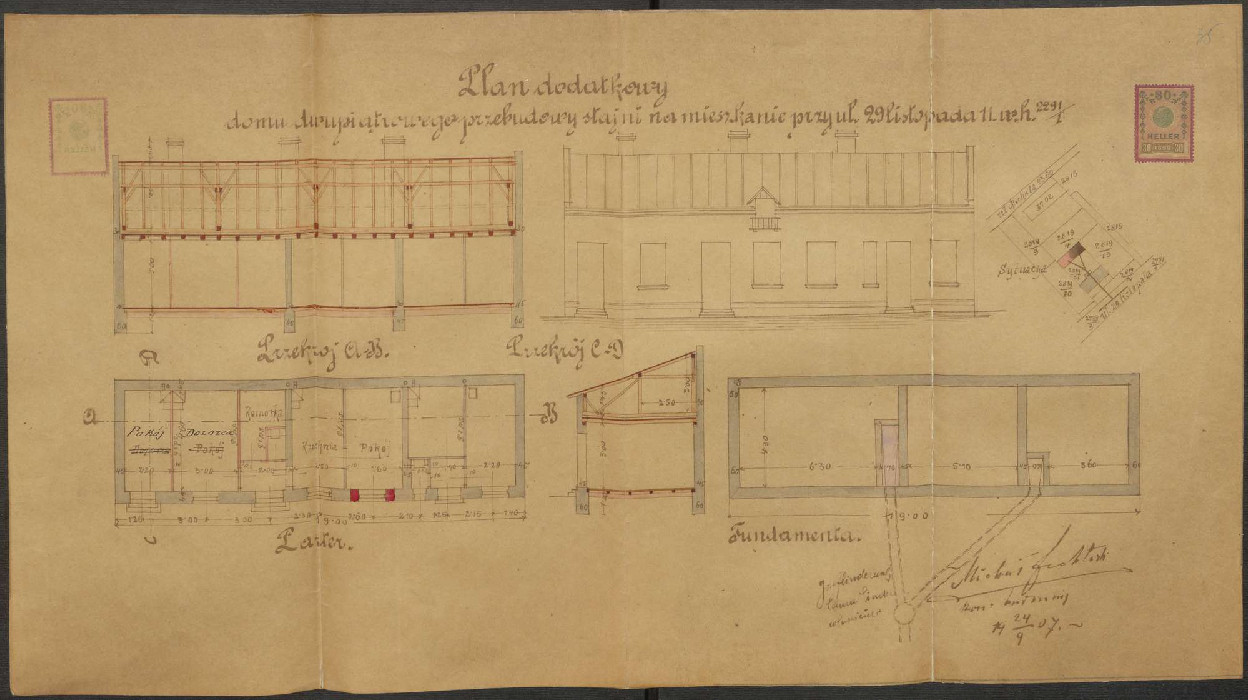
In September 1907, the Linders appealed to the Magistrate with a request to arrange living quarters in the wing of house 23, which contained a stable with a carriage house. The drawings were again signed by Michał Fechter. Krzyżanowski reacted negatively, pointing out the carelessness of the project's design, the absence of some of the necessary documents, and made demands that it be corrected (ДАЛО 2/1/3375:9). Correspondence about this and then about charging the Linders for connecting another sewer pipe continued for months. Meanwhile, the house was assigned a new conscription number, 1746 ¼.
The list of property owners for 1916 indicates that the owner of this house was the Polish Society of Lviv Teachers (Skorowidz, 1916).
Shortly after the end of the First World War, the house was purchased by Leopold and Zofia Diamandstein. The first mention of them at this address was found in 1921 (Chwila, 1921, No. 725, p. 8). Diamandstein owned several oil companies which, according to statistics, were not very profitable. One of them was the Emilia company with deposits in Tustanovychi and Boryslav (Polski przemysl naftowy, 1927). In 1927, together with Ludwik Keler, he founded a new union called "Jadwiga" with its administration based in Drohobych and production in Boryslav (Rocznik, 1936). In the summer of 1938, Leopold Diamandstein died (Chwila, 1938, No. 6942, p. 2).
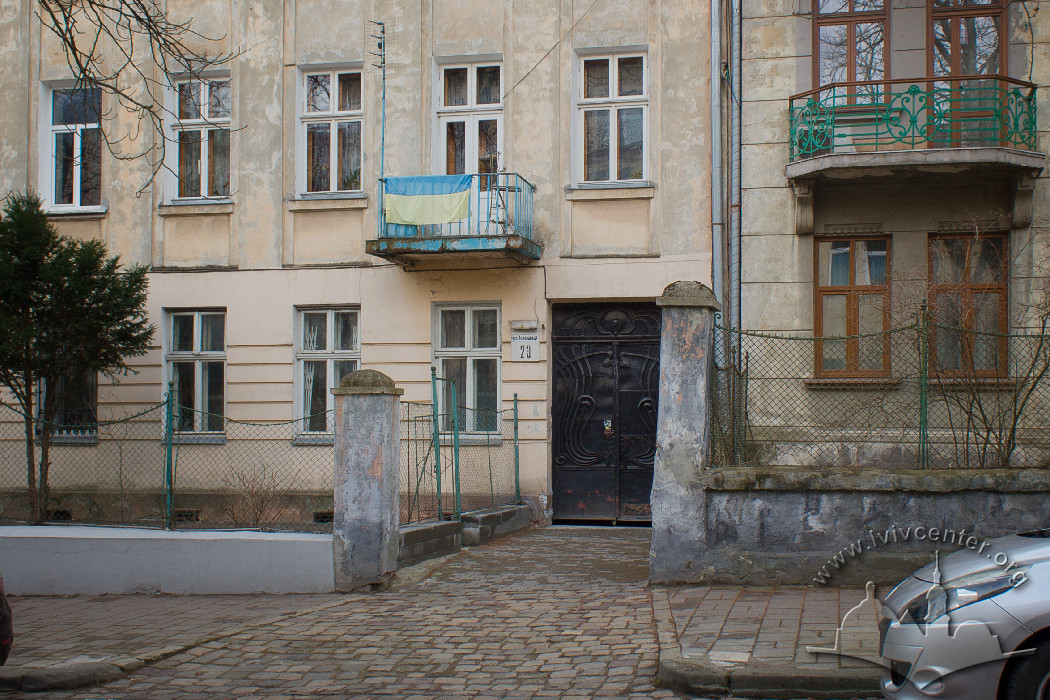
In 1930, the Lviv city administration received a complaint about the heavy iron gate of this building, which banged loudly every time it was opened or closed. The Diamandsteins were forced to repair the door, but they ignored the demands, as indicated by repeated appeals a year later (ДАЛО 2/1/3375:16-18).
In the fall of 1938, after Leopold's death, Zofia Diamandstein undertook the reconstruction of the entire building. The project was designed by architect Artur Stahl. According to it, a fourth floor was to be added, almost all the decor was to disappear from the façade, and the old wing in the courtyard was to become a garage for six cars, this suggesting that the tenants of the house were expected to be exclusively wealthy people. On November 25 of that year, an inspection team consisting of the head of the construction department, Marian Helm-Pirgo, engineer Frydecki, and engineer Ruebenbauer was sent to the building. They decided to allow the reconstruction but ordered that the Secession decor of the façade be preserved as much as possible. They rejected the idea of building a garage, citing the narrow driveway (2.2 m). It seems that "engineer Frydecki" was actually Wiktoria Kańska-Frydecka who worked in the city administration in the 1930s, and not her husband Andrzej, also an architect (Majczyk, 2024).
The owners were allowed to preserve the old townhouse’s roof. The archive file contains a document stating that architect Stahl appealed to the provincial authorities asking to clarify how he should design the reconstruction. This was due to a recent regulation requiring the replacement of old wooden roof structures with reinforced concrete ones. The provincial authorities replied that in this case he had every right to leave the roof as it was, citing the precedent of the reconstruction of the hospital on ul. Pijarów (now vul. Yuriya Rufa). At that time, the head of the province, Welczer, asked the Ministry of Public Works in Warsaw for clarification (ДАЛО 2/1/3375:24).
The reconstruction project was carried out, as can be clearly seen. The Secession elements on the building’s façade have been almost completely lost, except the massive wrought-iron gate. During the Soviet era, the building was nationalized and the apartments were probably divided and redesigned. A mansard was added above the fourth floor, probably during the period of independence. The wing remained residential and still resembles a stable in appearance.
Architecture
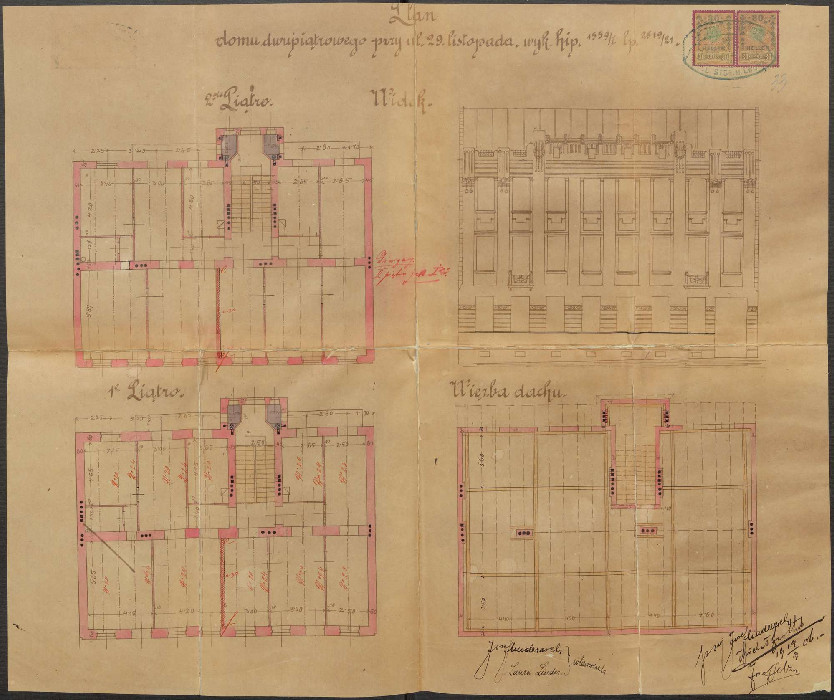
ccording to the original design by Józef Linder and Michał Fechter, it was a three-story brick building with metal beam and brick vault ceilings (the so-called Klein system). The same system was used for the stairs.
The layout followed a typical planning scheme, similar to that used, for example, in the building designed by August Bogochwalski at vul. Bohuna 3. Its core is a staircase with a hallway, with one apartment on each side of each floor. While one of them included a bathroom, the toilets were planned on both sides of the staircase, with access through the kitchen and an external gallery. For those times, when there was no centralized sewage system in the city, such a layout was logical, but for vul. Konovaltsia in 1906-1907, it seemed already outdated.
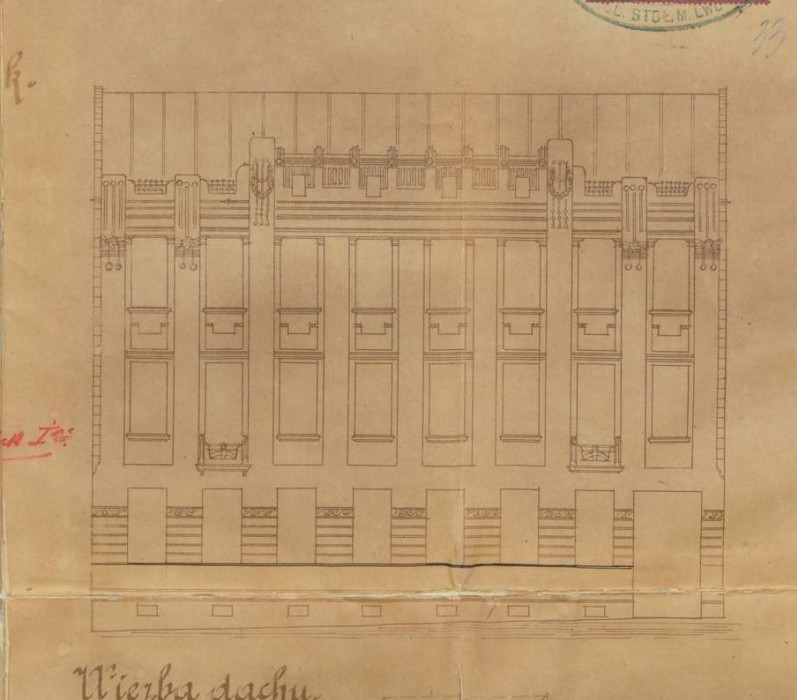
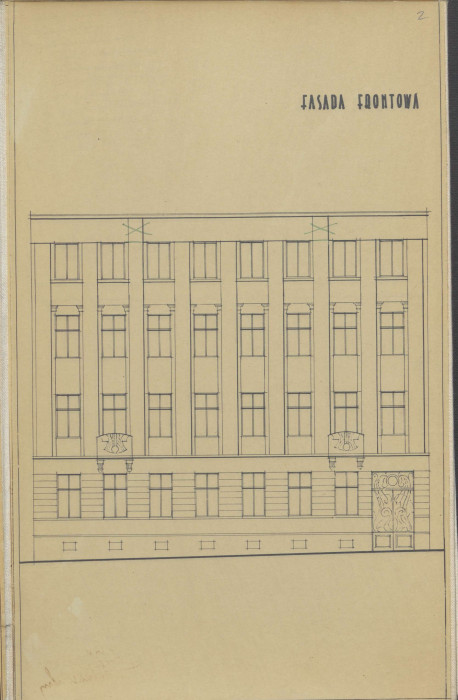
The Secession-style façade of the building, which has not been preserved, can be seen in a drawing from 1906 (ДАЛО 2/1/3375:33). The building at vul. Konovaltsia 15 was designed in a very similar way (except that No. 23 has eight window axes instead of six). Like No. 15, No. 23 had a rusticated surface up to about ¾ of the height of the ground floor windows, crowned with a molded frieze. Above, the façade was smooth, divided by lesenes, which had molded Secession wreaths, ribbons, and mascarons at the top cornice level. Thus, a significant part of the decor was concentrated at the top of the façade, such atectonicity being a characteristic feature of the Secession style.
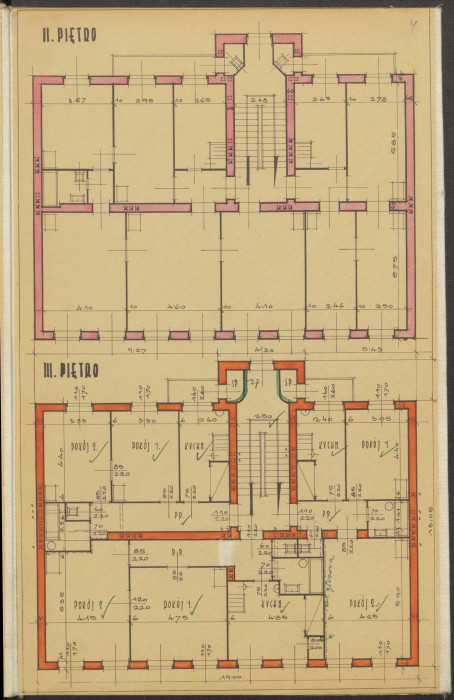
During the 1938 reconstruction, the building lost its Secession decor, although the technical department of the city administration had insisted on its preservation. A fourth floor was added where Artur Stahl placed three two-room apartments with kitchens, bathrooms, and niches for maids in each.
Related buildings and spaces
-
Vul. Konovaltsia, 15 – residential building

People
Marian Helm-Pirgo (1897–1995) — an architect and the
head of the construction supervision department in 1932–1939, emigrated to
Great Britain during the Second World War.
Wincenty Górecki — an engineer who worked in the
construction department of the Lviv City Council before the First World War.
Zofia Diamandstein — a co-owner of the building during
the interwar period.
Leopold Diamandstein (1891/1892–1938) — owner of oil
mines and a co-owner of the building in the interwar period.
Stanisław Krzyżanowski — an engineer-architect who worked
in the city construction authority before the First World War.
Laura "Lola" Linder — a co-owner of the building from
1906.
Józef Linder — an architect, who designed the
building, and its co-owner.
Tadeusz Mossor (1898–1929) — a soldier and athlete
of the Pogoń team who lived in the building in the 1920s.
Kazimierz Runge — an official of the Provincial Department
and an artist who lived in the building and died there in 1918.
(Alfred?) Ruebenbauer — a reference engineer for the
construction supervision department in the 1930s.
Michał Fechter (1843–1908) — an architect and
constructor who signed the building drawings and probably supervised the
construction in 1906–1907.
Wiktoria Kańska-Frydecka (1901–1992) — an architect and
employee of the Lviv construction supervision department in the 1930s.
Artur Stahl (1895-1950) — an architect who
designed the building reconstruction project.
Sources
- Державний архів Львівської області (ДАЛО) 2/1/3375. URL: https://e.archivelviv.gov.ua/file-viewer/230154#file-1349105
- "Wolne posady", Chwila, 1921, Nr. 725, s. 8.
- "Ogólno-polskie zawody lekkoatletyczne we Lwowie", Chwila, 1927, Nr. 2915, s. 8.
- Chwila, 1938, Nr. 6942a, s. 2.
- Księga adresowa przemysłu, handlu i finansów 1922.
- "Nekrologia", Kurjer Lwowski, 1918, Nr. 400, s. 5.
- Polski przemysł naftowy w roku 1927: sprawozdanie statystyczne Izby pracodawców w przemyśle naftowym w Borysławiu (Borysław : Izba pracodawców, 1928), s. 50.
- Rocznik Polskiego Przemysłu i Handlu, 1936.
- Skorowidz król. stoł. miasta Lwowa, 1916.