Vul. Konovaltsia, 20 – hospital building (former residential) ID: 2699
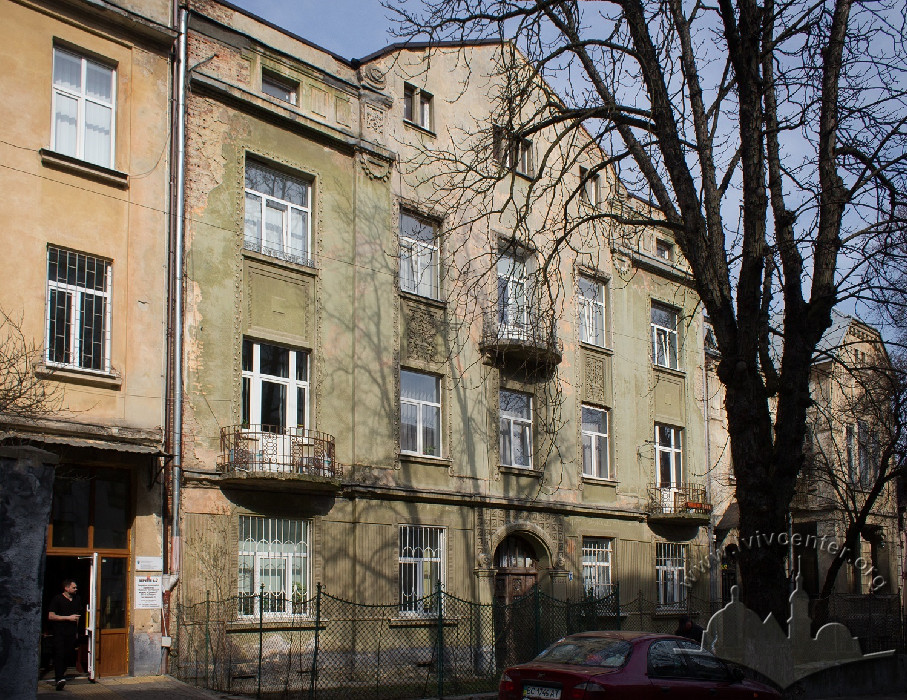
This two-story residential building was constructed in 1895–1896 for Jadwiga Eckert. In 1912-1913, it was renovated with the addition of a third floor, designed by the Sosnowski and Zachariewicz bureau for the new owner, Jan Rucker. Today (2025), it houses the 5th municipal hospital. It is an architectural monument of local significance.
Story
From the late 18th century, there was a large plot of land here with conscription number 129 ¼, which belonged to ul. Sadownicka (now vul. Antonovycha) faced by a small wooden house. In the mid-19th century, this plot was owned by Norbert Stajnik (Wegweiser 1856, Neu verbesserter Wegweiser 1863). Around 1871, Maria and Michał Eckert became the new owners (Skorowidz, 1871).
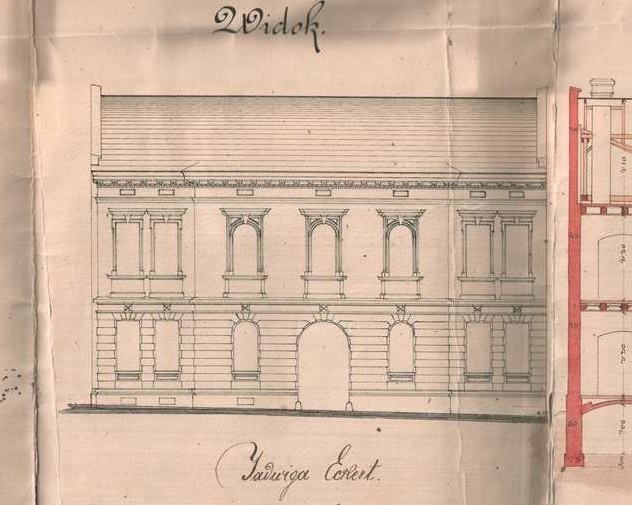
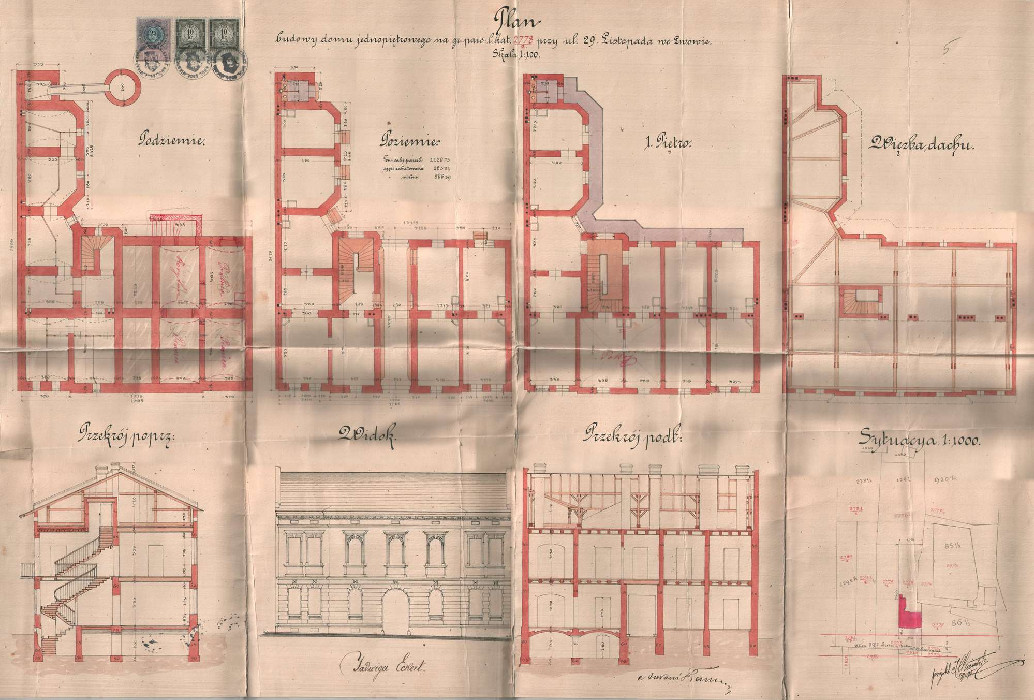
In May 1895, Jadwiga Eckert applied to the Lviv Magistrate with a request to approve the design of a two-story tenement house on this plot (ДАЛО 2/1/3372: 1-3). Her signature can be seen on the relevant drawing; the designer’s name, however, could not be deciphered (ДАЛО 2/1/3372: 5). Jadwiga's name appears in the 1895 minutes of a meeting held at the Magistrate's construction department. At that time, the regulation (leveling) of the newly laid ul. 29 Listopada (now vul. Konovaltsia) was discussed. According to the minutes, the owner undertook to transfer a piece of her land to the city free of charge (ДАЛО 2/1/3372: 4). However, in 1896, in a request to allow the completed building to be occupied, the owner signed as Jadwiga Teresa Eckert (ДАЛО 2/1/3372: 10). It is not certain whether this is the same person or two different people.
According to the original drawing, the building had nine apartments: a three-room one and a two-room one with kitchens, five single-room apartments with kitchens, and two “bachelor apartments.” This layout is typical of suburbs. Two toilets were arranged outside with access via a wooden gallery on the second floor. The house was assigned a new conscription number 50 ¼ (ДАЛО 2/1/3372: 10-11).
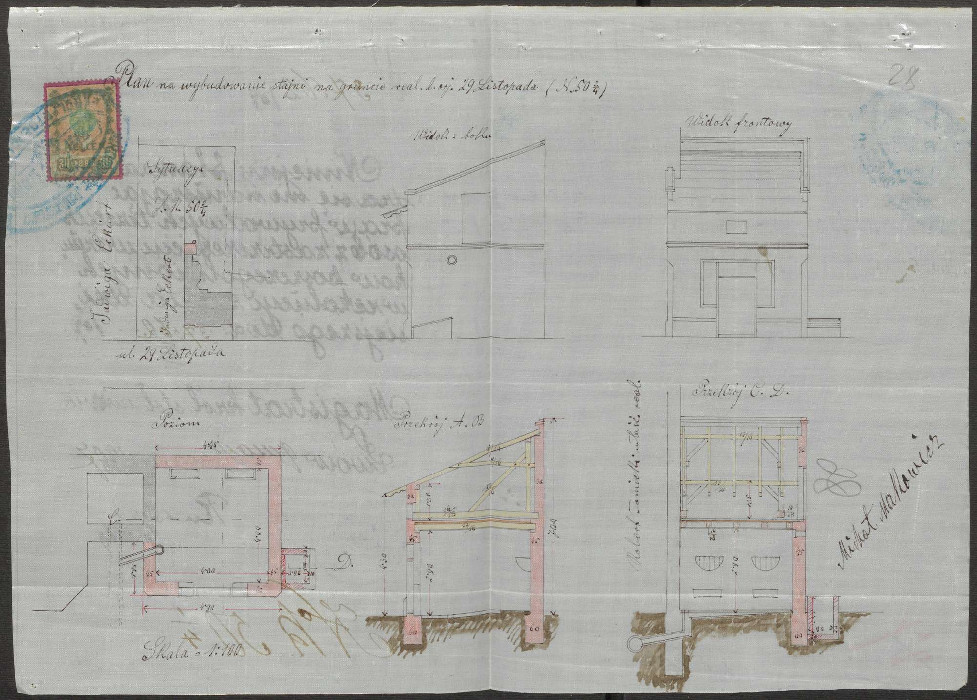
Around 1905, the house was purchased by Robert Tomicki, a restaurateur. In November of that year, he began connecting the house to the city sewer system, which had been laid on the street a year earlier. The project was carried out by Michał Makowicz, a master builder (ДАЛО 2/1/3372: 19, 23). In 1907, the owner began constructing a half-timbered stable and completed it in August 1908 (ДАЛО 2/1/3372: 26-31). This small single-story building for two horses was an extension to the side wing, also designed by Makowicz.
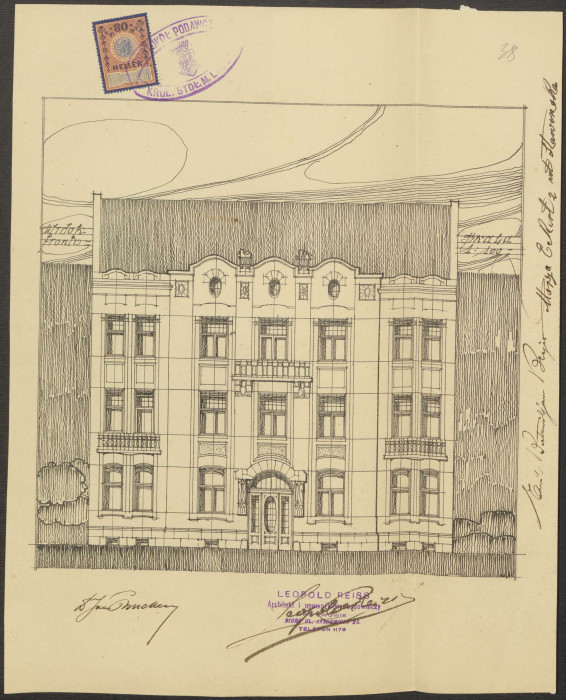
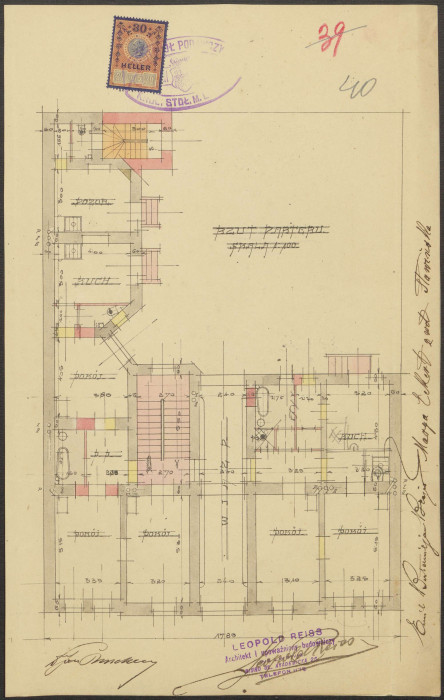
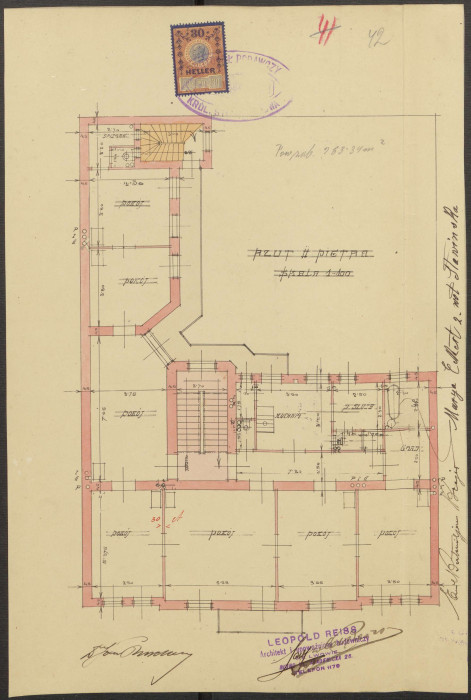
In 1912, the house was already owned by Dr. Jan Rucker, a pharmacist who also owned a well-known canning factory located at Znesinnia near Lviv. At that time, he lived at ul. Długosza (now vul. Kyryla i Mefodiya) in a rented apartment. He commissioned a project for the reconstruction of the house with the addition of a third floor from Leopold Reiss, a young Lviv architect, and submitted it for approval in May 1912 (ДАЛО 2/1/3372: 35). The drawings were signed by neighbors Emil Bertemiljan Brajer and Marya Ekert Sławińska.
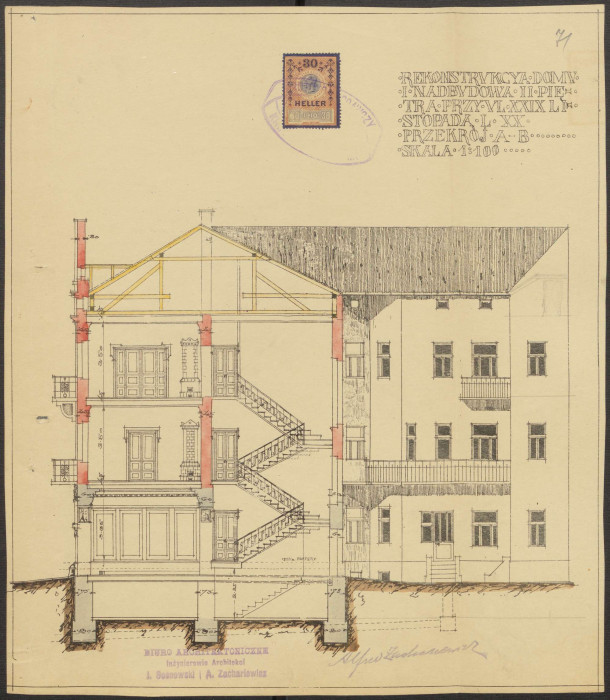
The reconstruction involved replacing the old wooden staircases with new stone double staircases and installing toilets and bathtubs inside the apartments. The apartments on the first two floors became larger, aimed at wealthier tenants — now there were to be two per floor; next to each kitchen a small “niche” room for a maid was planned. The newly built third floor housed one seven-room apartment, probably for the owners, especially since there was only one kitchen and bathroom for the entire apartment. Although it still had two entrances, another back one was added at the end of the wing. The city building authority did not approve these drawings, citing “too thin walls,” but Rucker appealed that such thickness was common practice in Lviv (ДАЛО 2/1/3372: 35-37). It is likely that some changes were made to the project, as Rucker received a building permit in July 1912 (ДАЛО 2/1/3372: 44); however, no revised drawings have been preserved.
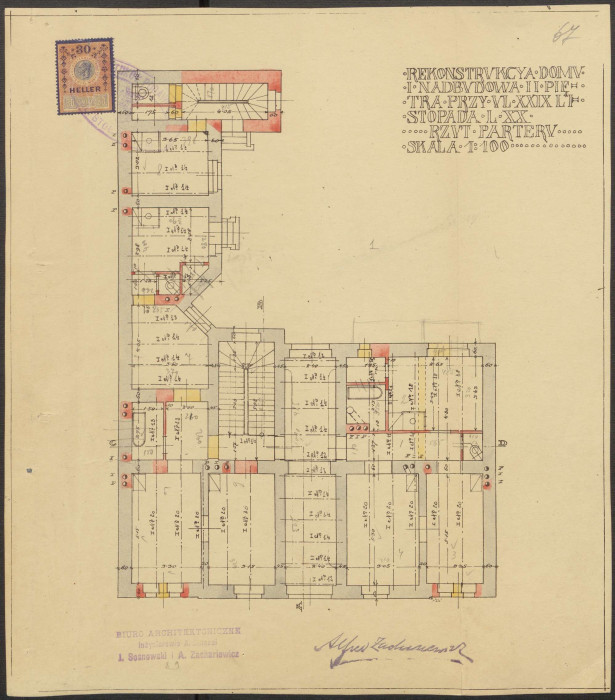
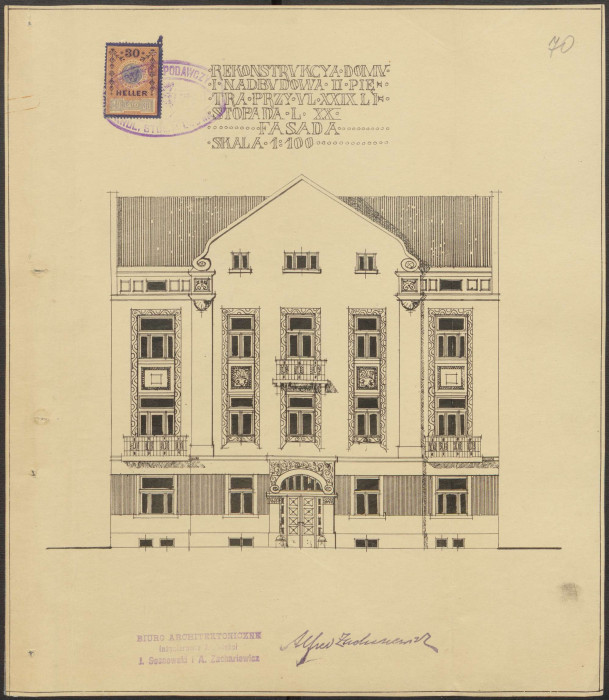
On January 11, 1913, additional reconstruction drawings designed by the Sosnowski and Zachariewicz bureau were approved. The general idea of the reconstruction remained the same as in Leopold Reiss's project, but Alfred Zachariewicz planned the same premises much more efficiently, adding several more storage rooms, etc. The second floor was dismantled and rebuilt. On the third floor, the kitchen was moved to the far end of the building at the end of the corridor. A wardrobe was placed next to the more spacious bathroom. The windows on the outer axes of the façade were changed from bifora to single windows but larger in area (ДАЛО 2/1/3372: 66-73).
In the 1920s, Jan Rucker sold the house, possibly due to financial difficulties amid the economic crisis, and began living in rented apartments. The exact date of the change of ownership is unknown. The new owner, Filip Ganz, appears in the archive file for house 20 from 1933; however, his signature appears on the project for the neighboring house 22 as early as 1925. This may be related to Rucker's financial difficulties.
Before the First World War, Filip Ganz worked as a waiter, later as a restaurant administrator, and then as the administrator of the entire Imperial Hotel at ul. Trzeciego Maja 3 (now vul. Sichovykh Striltsiv). Over the years, he accumulated a certain amount of wealth and in 1924 was elected as a jury judge, which required a certain financial qualification (Chwila, 1924, No. 2042, p. 4).
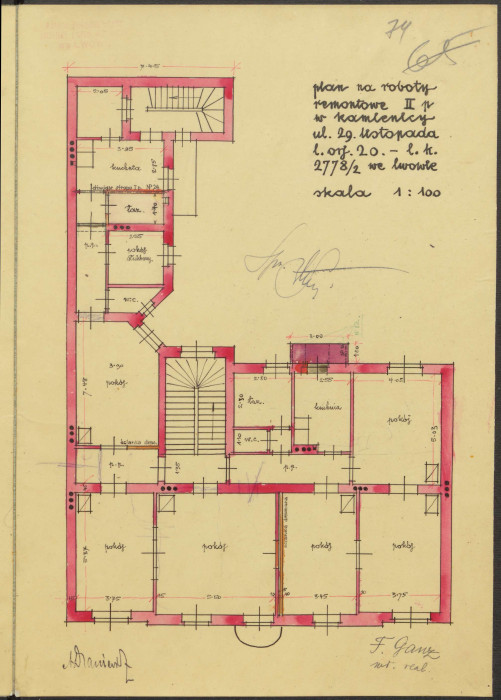
In 1933, Ganz hired Adam Draniewicz to redesign Jan Rucker's large apartment on the third floor back into two apartments. The drawings were approved in July (ДАЛО 2/1/3372: 63) and implemented by early September 1933 (ДАЛО 2/1/3372: 64). Meanwhile, the owner moved out of the hotel he managed and settled in this building.
In October 1933, Filip Ganz complained to the Lviv Magistrate about the nearby garages. They were located on a plot at ul. Na Bajkach (now vul. Kyivska where the ambulance station is located today). Some of them were directly adjacent to the boundary of Ganz's plot, where an orchard grew (ДАЛО 2/1/3372: 62). According to the owner, one of the garages housed a workshop without a chimney, and smoke was coming out of it, making it impossible to open the windows in his house; apart from that, the blossoms of the fruit trees in spring were completely destroyed. After inspecting the garages, the city authorities confirmed that one of the garages was indeed heated with wood, but the owners had every right to do so, and therefore the complaint was deemed unfounded.
It appears that Filip Ganz remained the owner of the house until 1939, after which his fate is unknown. From around 1939, the house was home to the Ukrainian composer, conductor, and director of the Lviv Opera Lev Turkevych, probably until he emigrated in 1944.
In 1942, the neighboring house 22 was converted into an infectious diseases hospital. The 1955 Lviv reference book indicates that this building housed a “paid resort clinic.” Today (2025), it is a branch of the 5th municipal hospital.
Architecture
Two-story building, 1895-1912
Originally, the building was constructed as a two-story building housing apartments of various sizes, designed for a variety of tenants. It had an L-shaped layout, with a rectangular front section and a single side wing. It was built of brick and plastered on the outside. It had wooden floors, stairs, and roof structure, as well as brick vaults on metal beams in the basements. There were nine apartments in total: one three-room and one two-room apartment with kitchens, five single-room apartments with kitchens, and two “bachelor apartments.” Two toilets were arranged outside with access through the courtyard or via the wooden gallery on the second floor. The basements contained cellars, i.e., storage rooms.
The house is symmetrical with a passageway into the courtyard in the center of the façade. The façade, designed in the Historicist (Neo-Renaissance) style, had two thin side avant-corpses. Its composition was traditionally tectonic: a thickened base, rustication of the ground floor surface, separation of floors by a cornice, and the façade being topped with an entablature featuring a row of attic windows in the frieze. The windows were rectangular on the avant-corpses and semicircular in the central part. On the ground floor, the windows were complemented by decorative pedestals at the bottom and keystones at the top. The second floor windows had profiled trimmings and linear pediments.
Three-story building, after 1912
According to the reconstruction project initially developed for Jan Rucker by Leopold Reiss, the building’s apartments became significantly larger, aimed at a more affluent public than before, and a floor was added to accommodate one large apartment.
As for the façade, Reiss suggested preserving the existing composition. The restrained forms of modernized Baroque (colossal pilasters, wavy attics, oval shapes) were to be combined with Secession elements (floral inserts and panels with textured plaster).
However, the reconstruction was carried out according to Alfred Zachariewicz's design. He improved the layout of the apartments, suggested dismantling and rebuilding the second floor, as well as a different façade.
According to the drawing, the façade remained strictly symmetrical. In the middle, there was a three-window avant-corps topped with a high attic. The windows on the outer axes were enlarged by replacing the lintels. Textured plaster with accentuated vertical lines was added to the ground floor surface. The windows on the second and third floors were to be compositionally united by a common trimming with geometric ornamentation. Sculptural inserts were to appear between the windows. Balconies on massive consoles with metal railings were also added. The façade was implemented in accordance with this project.
A similar style to that of this building can be seen in Lviv in the designs of Józef Avin. The architect belonged to the Jewish community and often designed townhouses for wealthy Jews in Lviv. For example, the façades of the townhouses of merchants Aron and Herman Nacht on vul. Konopnytskoyi 2 and 4 are designed almost identically. Yuriy Biriuliov, referring to Avin's article from 1909, claims that the architect sought to develop a “new Jewish style” in architecture (Biriuliov, 2005, 42). Other researchers, in particular Jakub Lewicki, consider this statement to be somewhat unfounded (Lewicki, 2009, 306). In any case, this style could have been borrowed by Sosnowski and Zachariewicz, since Rucker's house is a later project.
Today (2025), the building houses a hospital; it was probably redesigned several times during the second half of the 20th century.
People
Filip Ganz — first a waiter, then a restaurant
manager, then the administrator of the Imperial Hotel at ul. Trzeciego Maja 3
(now vul. Sichovykh Striltsiv), owner of the house in the 1930s.
Adam Draniewicz — an architect who carried out
minor reconstruction work in 1933.
Marya Eckert — owner of a large plot of land at
129 ¼, from which a smaller plot was allocated for the house at vul.
Konovaltsia 20. In the late 19th century, this plot was located at ul. Sadownicka
5 (now vul. Antonovycha). In the early 20th century, it was located at ul. Sadownicka
17.
Jadwiga Tereza Eckert commissioned the construction of a
two-story house for rent here in 1895. Like Maria Eckert, she lived at ul. Sadownicka
5.
Maria Ekert Sławińska — a midwife who owned the house at ul.
Sadownicka 17 (now vul. Antonovycha) in the early 20th century.
Alfred Zachariewicz — an architect and co-owner of the
Sosnowski i Zachariewicz bureau who finalized the project for the
reconstruction of the house with the addition of a third floor in 1913.
Michał Makowicz (aka Mykhailo Makovych) — a master builder who designed the project to
connect the house to the sewer system and to build a stable.
Leopold Reiss — an architect who designed the
project for the reconstruction of the house with the addition of a third floor
in 1912.
Jan Jerzy Rucker (1867-1945) — a pharmacist and
founder of a canning factory in Lviv, a member of the City Council and many
societies who owned the house from 1912 until approximately the end of the
1920s. After that, he lived in Lviv at ul. Akademicka 5 (now prosp. Shevchenka),
ul. Kraszewskiego 5 (now vul. Krushelnytskoyi), and ul. Zyblikiewicza 27 (now
vul. Franka 55). He added a third floor to the building.
Stefania Ruckerowa née Markheim (1860-1945) — wife of Jan Rucker
who co-owned and lived in the house.
Józef Sosnowski — an engineer and co-owner of the
Sosnowski i Zachariewicz bureau, which carried out the reconstruction of the
building in 1913.
Robert Tomicki (c. 1859 – ?) — a Lviv restaurateur
born in Sanok who owned a summer restaurant on vul. Lychakivska, at pl. Rynok
27 (in the late 19th – early 20th centuries), at vul. Halytska 10 (1912), and
elsewhere. He was the owner of the building at vul. Konovaltsia 20 around
1905-1912, when it was still a two-story structure.
Sources
- Державний архів Львівської області (ДАЛО) 2/1/3372. URL: https://e.archivelviv.gov.ua/file-viewer/230151#file-1351678
- ДАЛО 2/1/3374. URL: https://e.archivelviv.gov.ua/file-viewer/230153#file-1348810
- Amtliches Fernsprechbuch für den Distrikt Galizien (Deutsche Post Osten, 1942).
- "Kronika. Nowa kadencja sędziów przysięgłych", Chwila, 1924, Nr. 2042, s. 4.
- "Rozprawa karna o oszustwa i sprzeniewierzenia w gal. Kasie oszczędności. Dzień dwudziesty trzeci", Gazeta Narodowa, 1899, Nr. 299, s. 1.
- "Restauracya Hotelu Imperial", Gazeta Narodowa, 1909, Nr. 296, s. 1.
- Księga adresowa król. stoł. miasta Lwowa (1897; 1900; 1901; 1902; 1904; 1913; 1916).
- Księga adresowa Małopolski (1935).
- Neu verbesserter Wegweiser der Kön. Haupstadt Lemberg (Lemberg, 1863).
- Skorowidz król. stoł. miasta Lwowa (1871).
- Skorowidz król. stoł. miasta Lwowa (1889).
- Skorowidz król. stoł. miasta Lwowa (1916).
- Skorowidz przemysłowo-handlowy królewstwa Galicyi (1912).
- Wegweiser der Kön. Haupstadt Lemberg (Lemberg, 1856)
- Jakub Lewicki, Między tradycją a nowoczesnością. Architektura Lwowa lat 1893-1918, (Warszawa: Neriton, 2005), 590.
- Юрій Бірюльов, Мистецтво львівської сецесії (Львів: Центр Європи, 2005), 184.