Vul. Konovaltsia, 17 – residential building ID: 1391
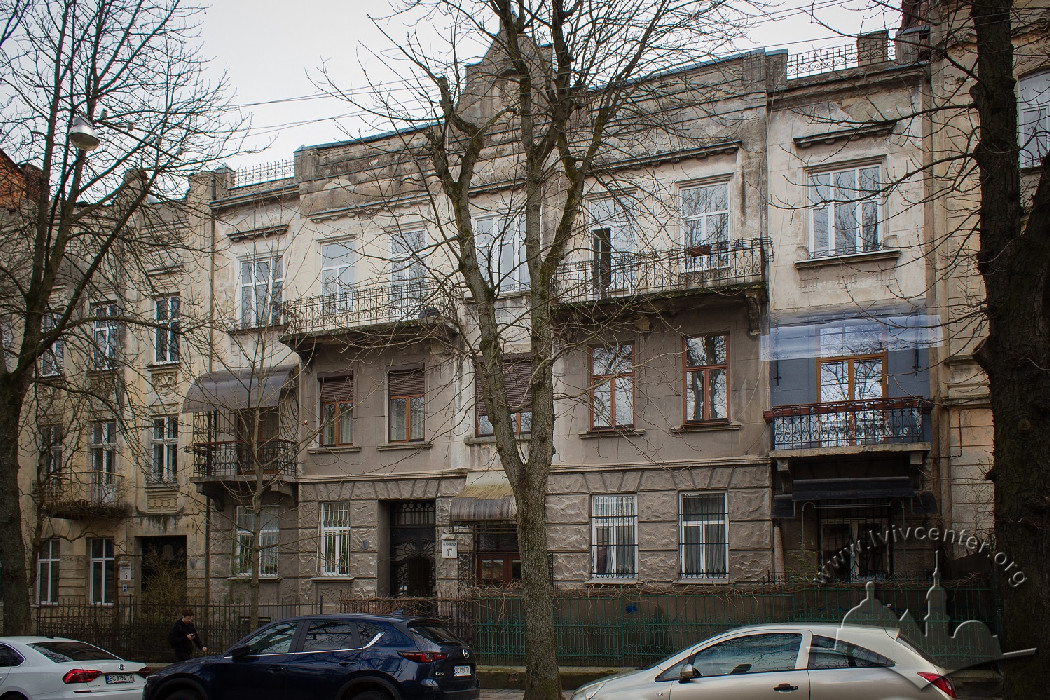
This three-story building was constructed in 1910–1911 for Izrael Hirsch Kessler, a baker. The project was developed and implemented by Włodzimierz Sawczak. The Secession façade was designed by Bronisław Bauer. Today (2025), the building is residential, with a beauty salon on the ground floor.
Story
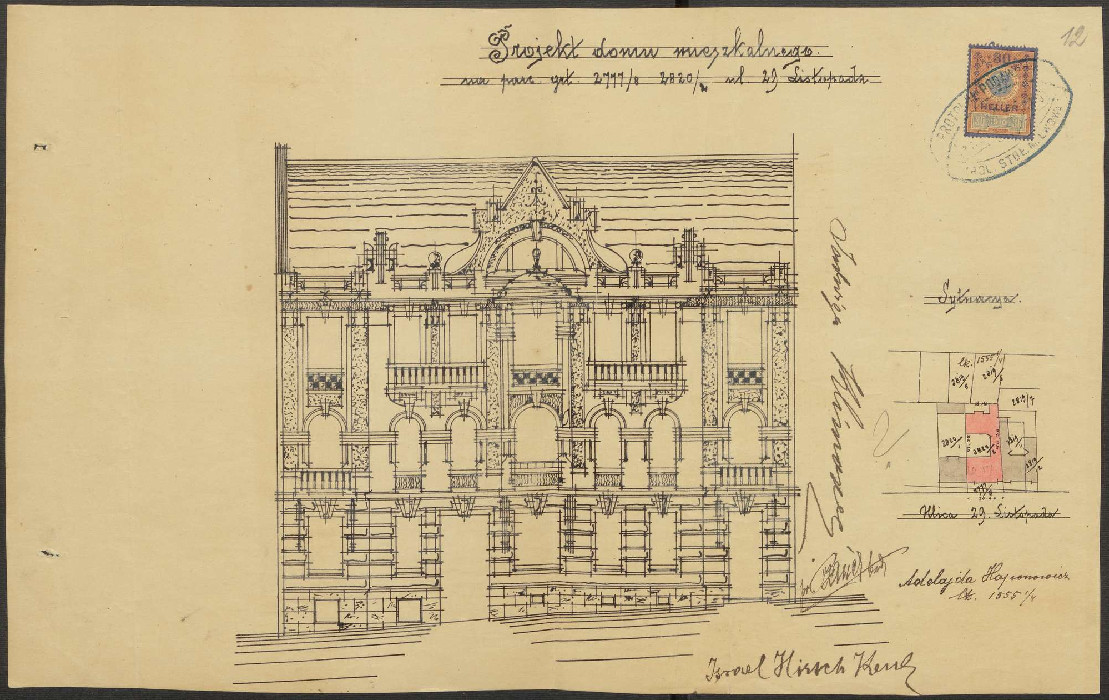
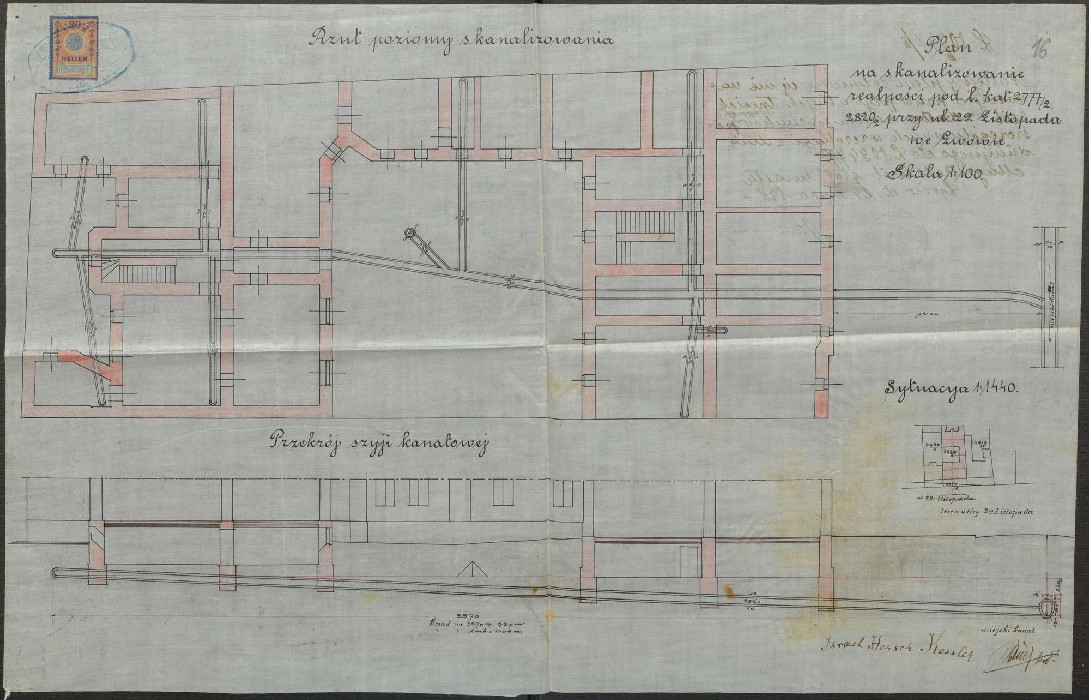
During the 19th century, a large plot of land with conscription number 87 ¼ was located here, occupying the area between what are now vul. Konovaltsia, vul. Kyivska, and vul. Yefremova, not reaching vul. Melnyka. After it was divided up, a small part was purchased by Izrael Hirsch Kessler, a baker, who lived at ul. Roberta Domsa 14 (now vul. Vytovycha). In November 1910, he received permission to build a three-story townhouse (ДАЛО 2/1/3369:1). The drawings were signed by Włodzimierz Sawczak, an engineer and licensed constructor, as well as by Bronisław Bauer, an architect involved in the design too. It was the latter who designed the townhouse’s façade (ДАЛО 2/1/3369:12), as well as the connection of the house to the sewage system (ДАЛО 2/1/3369:16). The façade designed by Bauer and the one that was actually built are quite different. The project features more Secession decor, which was not implemented; in the implemented version, the building has a sculptural coat of arms Pogoń on the attic, which was not originally planned. The connection between the Pogoń and the owner Kessler is not obvious.
The archive file on the construction does not contain any documents indicating any involvement of Ivan Levinsky's firm, which has sometimes been hypothesized in the relevant literature (Cielątkowska, Onyszczenko-Szwec, 2006). Perhaps the error is due to the change in the numbering of houses on this street in 1912.
After the construction was completed, the property received a new conscription number — 2118 ¼.
This house is mentioned in a newspaper report dated October 1914. In the column "Funny People", a journalist claims that a sculpted falcon was placed above the gate of this townhouse, which the owner ("a Polish patriot") smashed with an axe, fearing repressive actions by the occupying Russian troops (Herold Polski, 1914, No. 238, p. 3). The original drawing of the façade does not show such a sculpture, but even today it is impossible to see any traces on the building’s façade confirming that this is the townhouse in question.
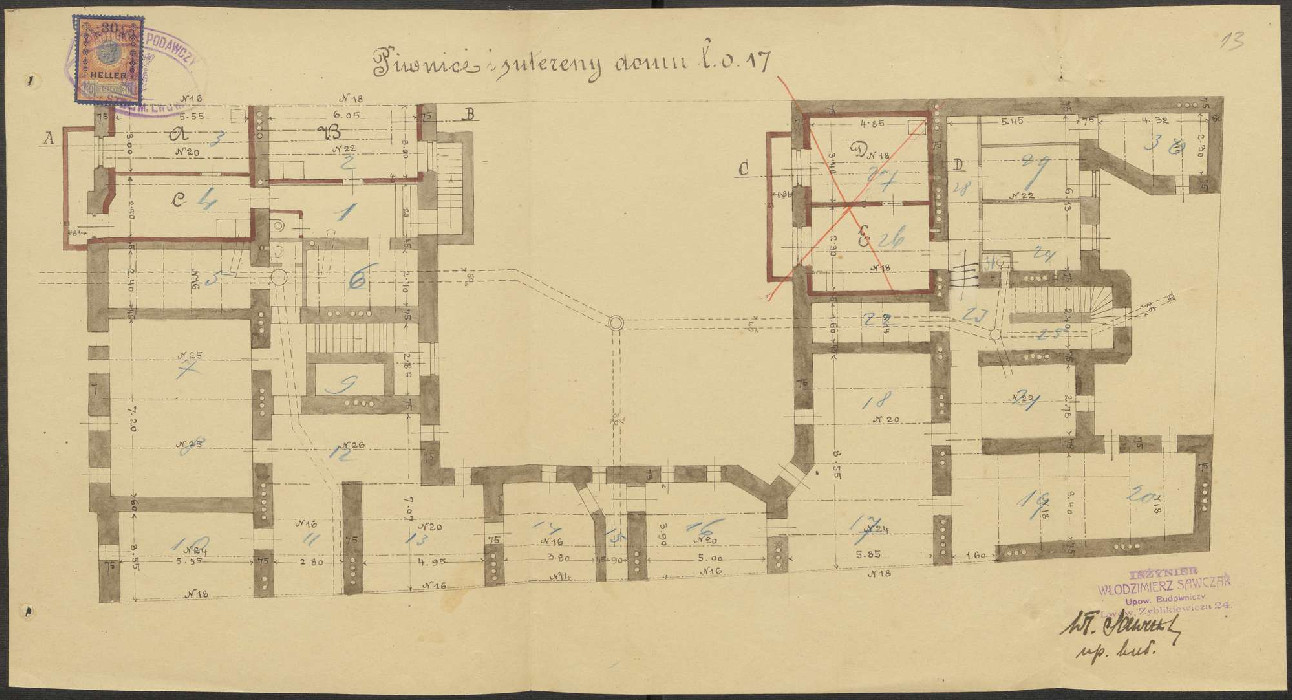
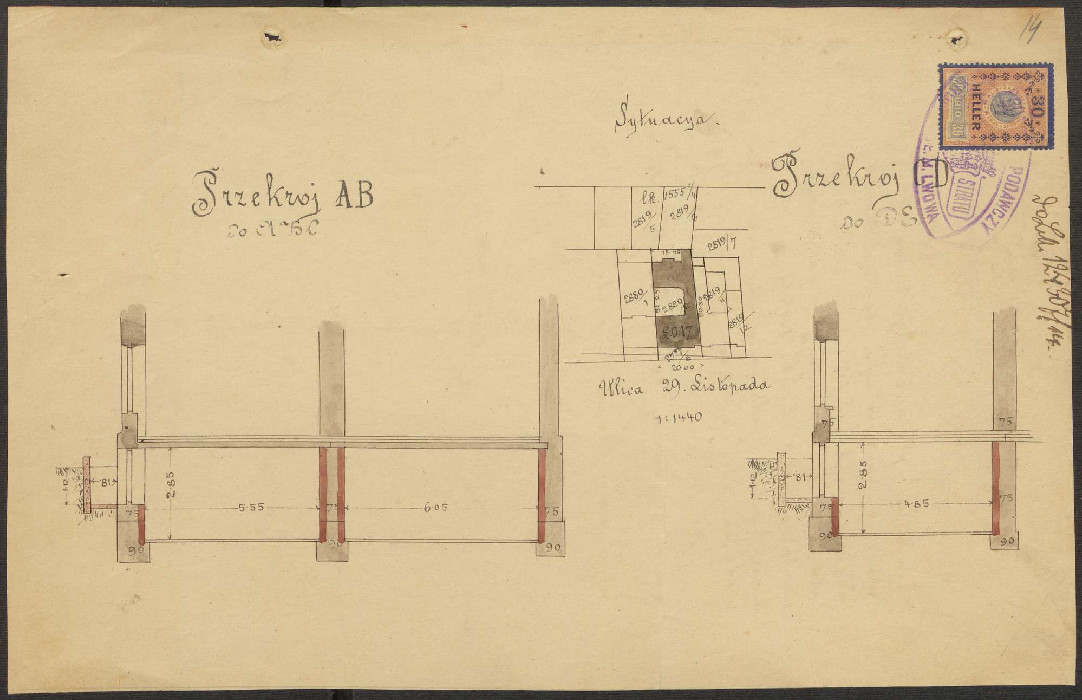
According to the 1916 property owners index, this building became the property of Wanda Nowotna née Schlaut. That year, Włodzimierz Sawczak designed a project for waterproofing works for several basement rooms, the fact indicating that there were plans to convert them into living quarters. The drawings were signed and approved by the government commissioner of Lviv, Adam Grabowski (ДАЛО 2/1/3369:13-14). It was probably at that time that the windows in those rooms were enlarged, for which purpose some soil was dug out and shallow window wells, which still exist today, were constructed.
The 1935 address book lists Paulina and Ber. Wittlin as the owners of the building. According to the building's archive file, in 1937 its owner was Zygmunt Grünstein. Along with the then Lviv press, he began living and seeing patients in this building at least as early as 1927 and was a therapist (specialist in internal medicine) (Chwila, 1927, No. 3119, p. 6). The first Soviet telephone directory of Lviv (1940) mentions a doctor named "Z. Grinshtein" at this address, so it seems that he remained in the city after the Second World War erupted. He could no longer own the nationalized house, but he could still live there for some time. His further fate during the war and the Holocaust is unknown.
In April 1937, the city government asked Grünstein to repair the neglected façades of the townhouse and the wing (ДАЛО 2/1/3369:4). The owner, however, "felt aggrieved" by this decision, emphasizing in his appeal that the façade was in good condition thanks to the partial repairs that had been carried out. He asked to be allowed to postpone some of the repairs until 1938, citing, in particular, the low income from renting out apartments, but both the city and the provincial governments, as the higher authority, were against the postponement.
Throughout the 20th century, the building remained residential and did not undergo any radical changes on the outside. The window woodwork was replaced with metal-plastic; metal canopies appeared above the entrance and balconies. The apartments inside were most likely redesigned in the 1940s and 1990s. An entrance was made instead of one of the windows to the right of the passageway, where a beauty salon is now located.
Architecture
The three-story building is constructed of brick and plastered on the outside. It has a U-shaped layout, an L-shaped wing adjoining the main "front" section. There are virtually no surviving documents about the construction, which complicates the analysis of the building's layout and structures. Judging by the surviving drawing of the semi-basement floor, it appears that, initially, each of the three main floors housed four apartments — two in the front building and two in the rear one (a total of 12 apartments originally). Given the year of construction (1910–1911), the building was immediately connected to the central sewage system and had toilets and bathrooms inside the apartments as well as, most likely, electricity and gas. It most probably also has reinforced concrete ceilings.
The composition of the main façade generally corresponds to the 1910 design, but it is much simpler, probably to reduce construction costs. Its overall composition is quite traditional: tectonic, typical of the 19th-century Historicism. In particular, the ground floor is rusticated and separated by an inter-floor cornice. The façade is symmetrical except for the location of the gate and passageway; it’s emphasis is the central axis on which a wide, thin avant-corps with an attic is located.
The façade was designed under the strong influence of Secession, which was to be manifested in stucco decorative details, the use of tiles and planes with several types of textured plaster, as well as an upward increase in the amount of decoration, culminating in the cornice. A single-window bay was to be placed in the center, but all these details were abandoned during construction. Thus, the façade surface on the second and third floors is smooth, enlivened only by the placement of balconies, cornices under the windows, and pediments. Instead of a lunette window, a sculptural composition with the Pogoń coat of arms was placed on the attic.
People
Wiktor Arlett — a resident of the building
(1932).
Bronisław Bauer — an architect who designed the façade
and the building’s connection to the sewage system.
Stanisław Biesiada — a merchant who lived in the
building (1914).
Michał Alojzy Borysławski — a senior postal advisor who lived
in the building until 1917.
Seweryn Wasilewski — a retired starosta who lived in
the building (1914).
Aleksander Warzenica — a teacher who lived in the
building (1914).
Stanisław Wierzbicki — an employee of the Agricultural
Circles (Kółka rolnicze) who lived in the building (1914).
Paulina and Ber. Wittlin — owners of the building (1935).
Karol Wolf — a tax collector who lived in the
building (1914).
Adam Grabowski — a government commissioner of the
city of Lviv from 1915, whose position replaced the powers of the president
(mayor) of the city.
Zygmunt Grünstein — a doctor who owned the building
in 1937-1939 and lived there from the late 1920s.
Feliks Detkowski — a private employee who lived in
the building (1914).
Franciszek Dobrzyński — a senior inspector who lived in
the building (1914).
Adolf Zbydniowski — an engineer who lived in the
building (1914).
Marja Zielińska — a caretaker and resident of the
building (until 1933).
Izrael Hirsch Kessler — a baker who commissioned the
building and was its first owner.
Wacława Kinel née Tłuchowska — an engineer's wife who lived in
the building until 1913.
Knoll — an entrepreneur who owned the Knollówka guesthouse
in the village of Zelena near Nadvirna and lived in the building in the 1930s.
Emilia Kulka — a railway employee’s widow who
lived in the building (1914).
Zofia Krzyżagórska — a resident of the building (1914).
Franciszka Matias — a council member’s widow who
lived in the building (1914).
Iza Motal — a court clerk’s widow who lived in the building
(1914).
Wilhelm Muller — a property manager who lived in
the building (1914).
Wanda Nowotna née Schlaut — owner of the building (1916).
Włodzimierz Sawczak — a constructor who carried out the
construction.
Władysław Skałkowski — a starosta who lived in the
building (1914).
Konstanty Sobolski — an assistant at the Institute of
Anthropology and Ethnology at Jan Kazimierz University who lived in this house
in the 1920s.
Adalbert Skrabek — a resident of the building
(1914).
Marian Turus — an employee at the Sick Fund who
lived in the building (1914).
Oskar Fabian — a trade advisor who lived in the
building (1937).
August Zeitleben — a railway employee who lived in
the building (1914).
Marya Czajkowska — a resident of the building
(1914).
Alojzy Schlesinger — an entrepreneur who lived in the
building (1929).
Józef Jarmelski — a property owner who lived in the
building (1914).
Ksawery Jaruzelski — a property owner who lived in the
building (1914)
Sources
- Державний архів Львівської області (ДАЛО) 2/1/3369. URL: https://e.archivelviv.gov.ua/file-viewer/230148#file-1352580
- "Kronika. Podziękowanie", Chwila, 1927, Nr. 3119, s. 6.
- "Śmiertelny skok z 3. piętra przy ul. Kołłątaja. Znalazła śmierc pod kołami pociągu", Chwila, 1933, Nr. 5134, s. 11.
- "Śmieszni ludzie", Herold Polski, 1914, Nr. 238, s. 3.
- Ilustrowany informator miasta Lwowa, 1939.
- Księga adresowa król. stoł. miasta Lwowa, 1904.
- Księga adresowa król. stoł. miasta Lwowa, 1913.
- Księga adresowa król. stoł. miasta Lwowa , 1914.
- Księga adresowa Małopolski, 1935.
- "Kronika. Z żałobnej karty", Kurjer Lwowski, 1913, Nr. 90, s. 4.
- Skład uniwersytetu w roku akademickim 1923/1924 – 1924/1925 (Lwów: Z I Związkowej drukarni, 1924).
- Skorowidz adresowy król. stoł. miasta Lwowa, 1910.
- Skorowidz adresowy król. stoł. miasta Lwowa, 1916.
- "Świadkowie w procesie Gorgonowej", Chwila, 1932, Nr. 4697, s. 6.
- Список абонентів Львівської міської телефонної сіті, 1940.
- Romana Cielątkowska, Lilia Onyszczenko-Szwec, Detal architektury mieszkaniowej Lwowa XIX i XX wieku, (Gdańsk: Wydział Architektury Politechniki Gdańskiej, 2006).