Vul. Konovaltsia, 15 – residential building ID: 1390
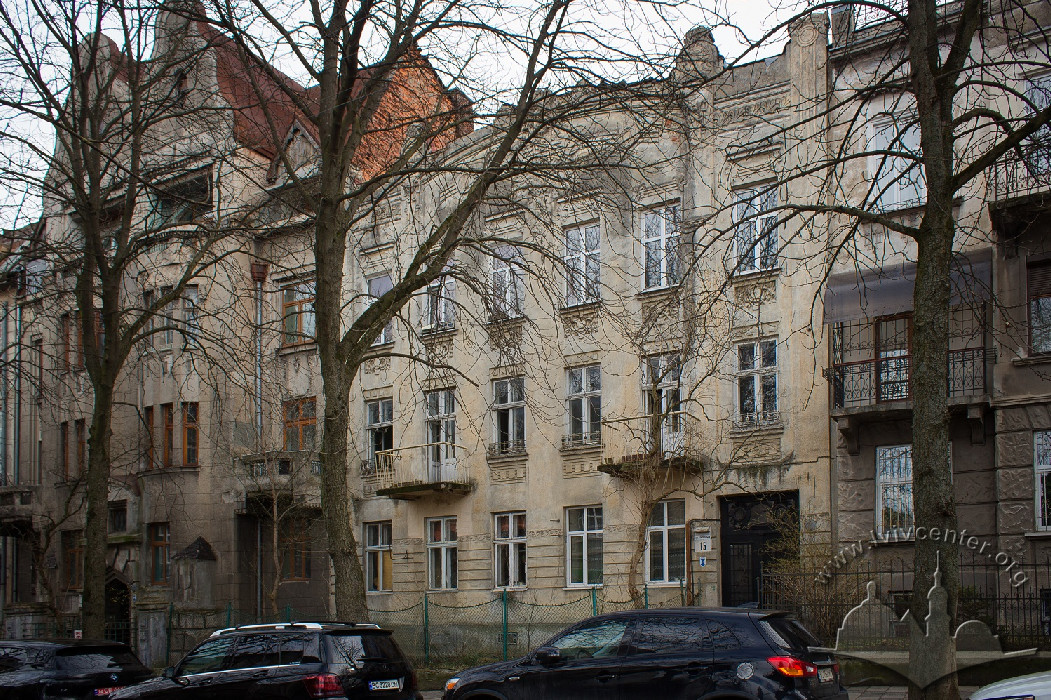
This three-story Secession-style building was constructed in 1907–1908. The project was signed by Michał Fechter, the architect who carried out the construction. However, the project was actually designed by the owner, architect Józef Linder, himself. Later, the building was owned by the lawyer Nussbrecher, the merchant Adolf Baum, and the pharmacist Józef Kimmelman. Today (2025), the building remains residential. It is an architectural monument of local significance.
Story
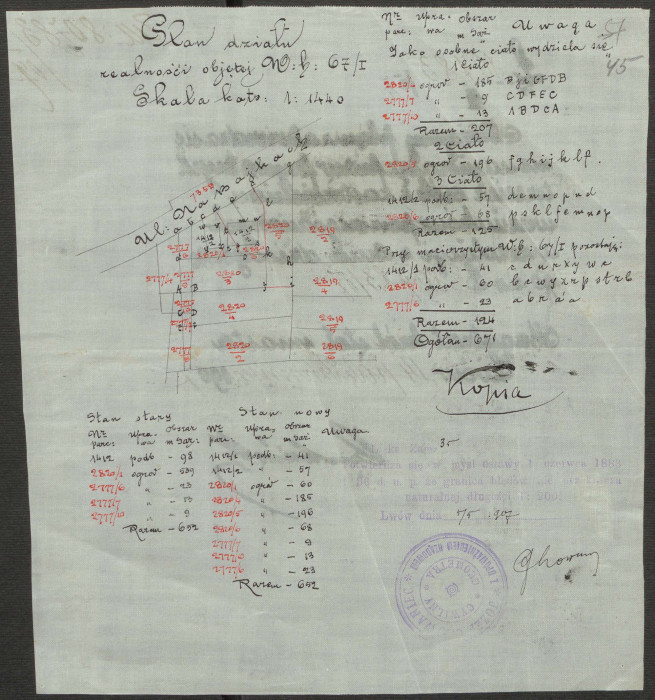
The plot for this building was allocated in the early 20th century from a large plot with conscription number 87 ¼, which belonged to ul. Na Bajkach (now vul. Kyivska). This section of vul. Konovaltsia was only laid in 1892; there was no road in its place before.
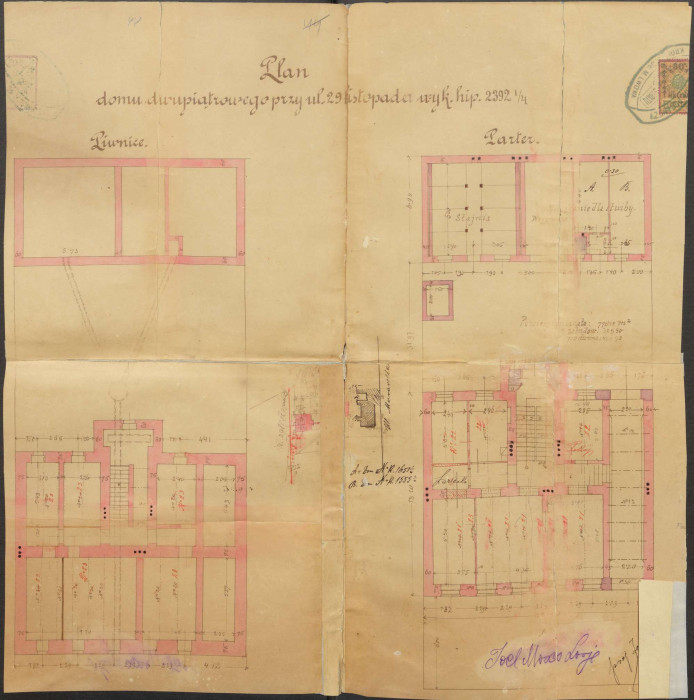
The plot for house 15 was purchased by the architect Józef Linder and his wife Laura (also known as Lola). In the summer of 1907, they submitted a project for the construction of a three-story house with a wing in the courtyard. Józef signed the drawings twice — as the owner and as the designer, while another signature belongs to Michał Fechter (1843-1908). The latter was a well-known and experienced architect and constructor. Art historian Yuriy Biriuliov suggests that Linder was an employee of Fechter's architectural bureau (Biriuliov, 2022: 550).
When the construction of this townhouse began, the Linders had already built another house on this street (it’s current address is vul. Konovaltsia 23). The two houses were quite similar in terms of layout and façade design, differing only in width. In 1906, the design of house 23 was approved by the Lviv Magistrate with virtually no comments, while the design of house 15 raised a number of questions. Engineer Stanisław Krzyżanowski, who worked in the construction department and reviewed both projects, stated that the façade of house 15 “did not meet the requirements of good taste” and that more detailed drawings of the three-meter attic structure were needed, indicating the potential instability of such an element. In addition, he called the 8 cm thick basement vaults unacceptable and recommended that they be thickened up to 15 cm. As arguments, he cited “new climatic conditions,” unpleasant odors from the cellars penetrating the apartments, and the difficulty of heating the rooms (ДАЛО 2/1/3367:1-2). He had not made such comments about house No. 23 a year earlier (ДАЛО 2/1/3375:1-2).
Before approving the project, the Magistrate also heard Linder's neighbors, as required by the Lviv Building Statute of 1885. Dr. Dionizy Kułaczkowski, on behalf of his wife Olena, and Jan Haponowicz, the owners of the houses at the current address of vul. Yefremova 24 and 26, spoke out against the construction of a wing with a stable. They were joined by Teodor Rudziński, on behalf of his wife Teofila, who had recently purchased a plot of land at the corner of what are now vul. Kyivska and vul. Konovaltsia, but had not yet built anything there. They claimed that the stable would cause a stench and attract flies and horseflies, scaring away tenants. They demanded that Linder install ventilation in the stable and build chimneys higher than the three-story townhouses (ДАЛО 2/1/3367:2-3). Stanisław Krzyżanowski rejected the demand as unfounded, as it did not comply with the norms of the Lviv Building Statute. He noted that there were many stables in the neighborhood that no one had ever protested against, and that this demand sounded as if Linder should build a factory chimney, which would be both expensive and technically difficult. In the building permit, Krzyżanowski noted that the stable should be kept in exemplary cleanliness, that its drains should be connected to the sewer system, and that the horse manure pit should be at least 2 meters away from the neighboring plots and tightly closed (ДАЛО 2/1/3367:5).
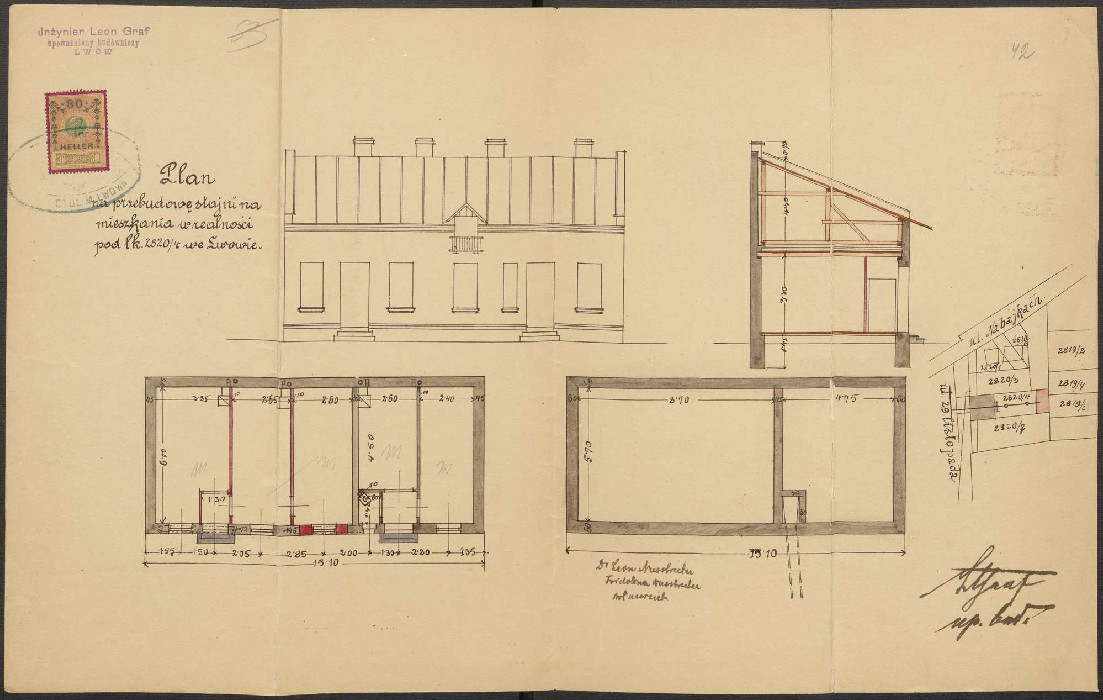
As soon as the wing was built, the Linders decided to convert it into a dwelling and to add another floor. A year earlier, they wanted to do the same with the house at vul. Konovaltsia 23.
The three-story house itself was completed in August 1908, and in September the owners received permission to move in (ДАЛО 2/1/3367:14-16). The Linders — 32-year-old Józef, his wife Laura, and their two children — moved into the house. However, they did not stay there long: at the end of the year, they sold the building to Leon Nussbrecher, a lawyer, and his wife Fridolina.
The reconditioning of the wing was delayed, and the Linders began the reconstruction work without permission, later justifying themselves by citing the Magistrate's delay in issuing permits. The case reached the Governor's Office, where it was decided to punish the former owner of the house with a fine of 50 crowns or five days' imprisonment. The Nussbrechers received permission to use the two-story residential wing in the summer of 1909 (ДАЛО 2/1/3367:32-33). This concludes the archival case on the construction of the building.
According to address books, in 1916 the building was owned by Adolf Baum. In 1935, it was owned by Józef Kimmelman, a pharmacist, and his wife Anna.
The exterior of the house has largely retained its authentic appearance, except that most of the original window woodwork is now (2025) lost. In terms of layout, the house had to undergo changes in the 1940s and 1990s as a result of nationalization and privatization, respectively. Today, it remains entirely residential. The single-story building in the courtyard retains the recognizable original form of a stable, converted into a residential building.
Architecture
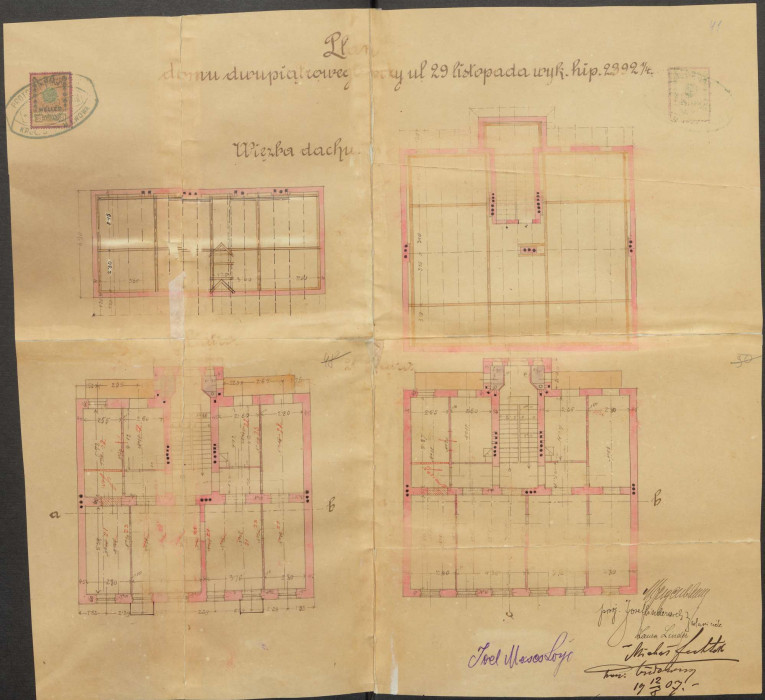
The house is rectangular in plan, except for the staircase protrusion on the rear façade. According to the original design, each floor contained two three-room apartments with kitchens; toilets were arranged outside with access through the kitchens and external galleries. This layout is more typical of a period when Lviv did not yet have a centralized water supply and sewage systems. However, a bathroom was added in red ink to the design for one of the apartments. Perhaps this correction was suggested by the engineers of the city building authority. The building was constructed at a time when the sewage system had already been laid on ul. 29 Listopada (now vul. Konovaltsia), and the project provided for a connection to it. Therefore, the decision to install such toilets seemed outdated and could not be considered comfortable.
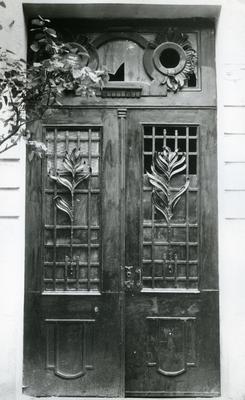
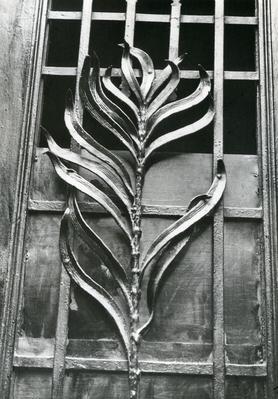
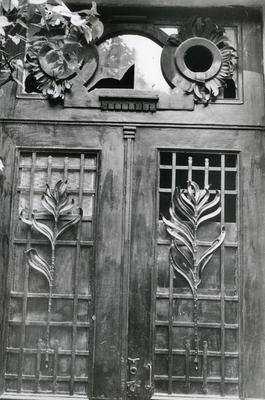
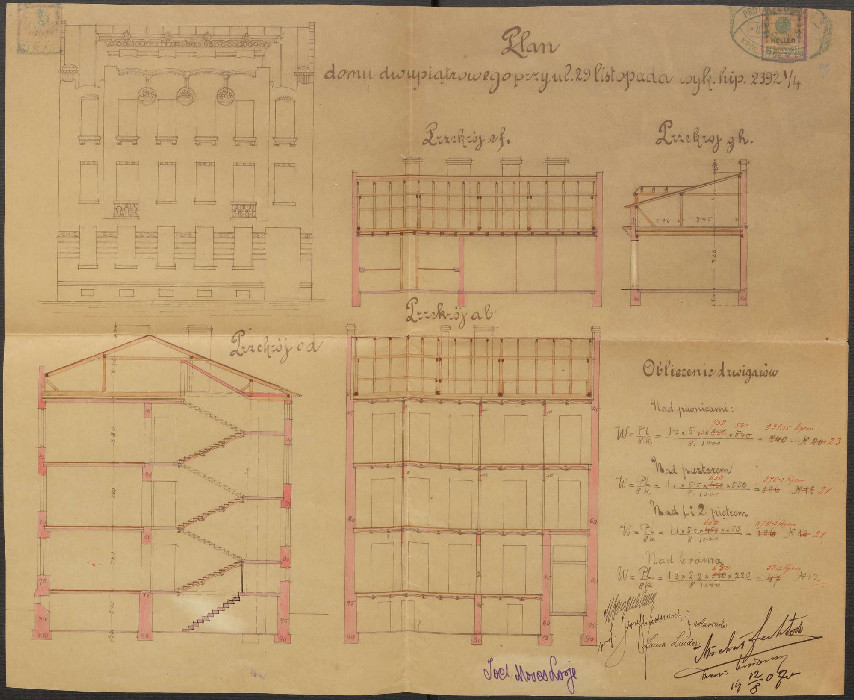
The building is made of brick and plastered. According to a cross-section from 1907, all ceilings are made of brick and supported by metal beams; the same construction is actual for the staircase. The stairs themselves are wooden, with wrought iron Secession railings; the staircase floor is made of terrazzo. The walls of the passageway are plastered (now whitewashed); the walls and partially the ceilings are decorated with Secessionist stucco moldings in the shape of leaves. The interior has preserved some of the apartment doors with decorative wooden overdoors having mascarons on them.
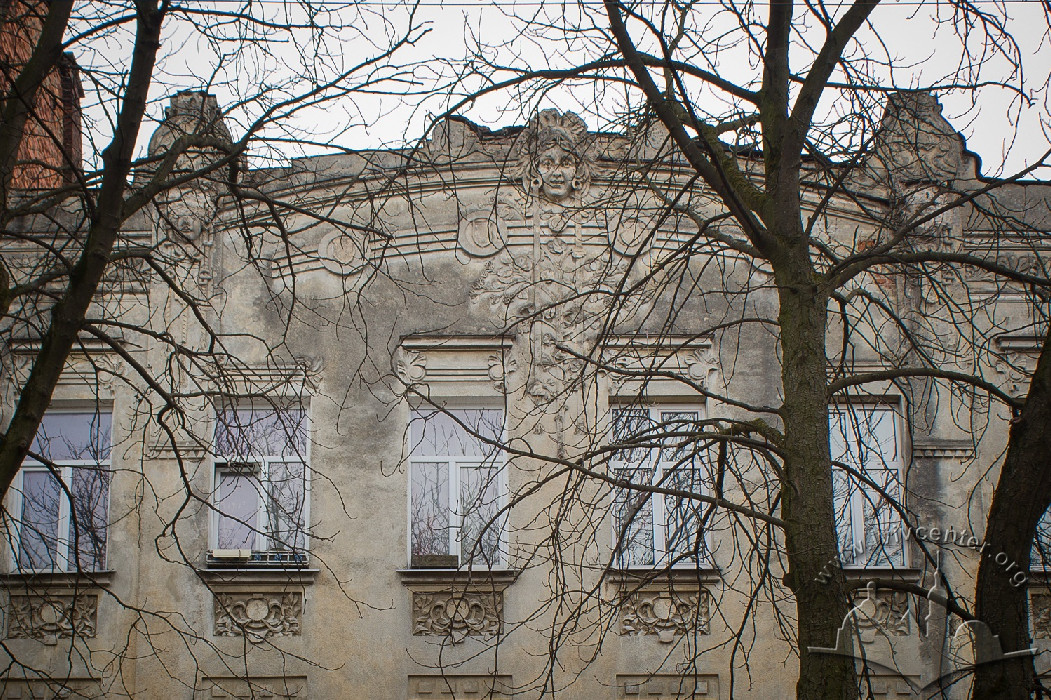
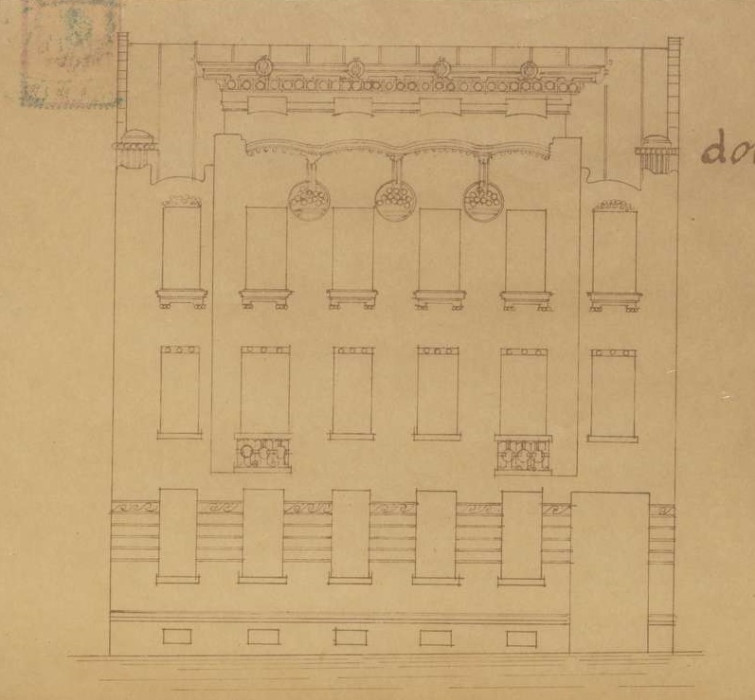
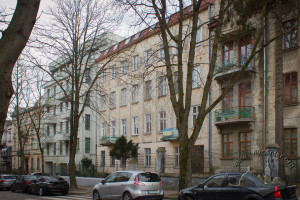
The six-axis façade of the building is symmetrical, except the passage gate placed at the edge. Atectonic, it is designed in the Secession style. In the middle, there is a four-window thin avant-corps, topped with an attic featuring rich Secessionist decor, in particular three mascarons, the so-called Wagner wreaths, as well as a branch of a blossoming tree, which differs significantly from the design drawn on the preserved façade drawing from 1907. Yuriy Biriuliov believes that this decoration was made by Edmund Pliszewski (Biriuliov, 2022: 379).
The ground floor is only partially rusticated, with a molded narrow belt at the top of the rustication. All openings are rectangular and without trimmings. The second floor windows have recessed inserts above the lintels with four squares and similar geometric inserts below them. Authentic metal jardinières combining geometric and floral shapes have also been preserved. The third floor windows have molded inserts below them with stylized cartouches and stylized Secession linear pediments above. One window has preserved its jardinière.
Two balconies have completely lost their authentic form. Traces of their once massive consoles remain on the façade, and the railings have been replaced with styleless ones made of reinforcement bars. On the façade drawing, the balconies are sketched schematically and without consoles, so they were probably made in a different form.
Related buildings and spaces
-
Vul. Konovaltsia, 23 – residential building
People
Adolf Baum — a merchant who owned the building
(1916).
Maryan Westreich — a resident of the building
(1914).
Jan Haponowicz — owner of a single-story villa at vul.
Yefremova 26 (no longer exists).
Zygmunt Gawroński — a judge who lived in the building
(1914).
Franciszek Rawita-Gawroński (1846−1930) — a Polish writer,
publicist and amateur historian who lived in the building (1912−1914).
Władysław Goździkowski — an insurance company intern who
lived in the building (1910).
Leon Graf — an engineer who designed the project of converting
the wing into a residential building.
Adam Zajączkowski — an artist and painter who lived in
the building (1914).
Józef Zajączkowski — a retired engineer who lived in
the building (1914).
Jan Kania — an employee at the Provincial Department who lived
in the building (1914).
Mikołaj Kyryk — a railway employee who lived in
the building.
Stanisław Kościelecki — a retired tax officer who lived
in the building (1914).
Olena & Dionizy Kułaczkowski — co-owners of the building at vul.
Yefremova 24.
Stanisław Krzyżanowski — an engineer-architect who worked
at the Lviv City Construction Authority.
Franciszek Lederer — a railway engineer who lived in
the building (1914).
Laura “Lola” Linder — a co-owner of the building
(1907–1908).
Józef Linder (appr. 1876 - ?) — an architect, a co-owner
of the building (1907−1908) and its designer.
Jakób Linder — a master builder, probably a
relative of Józef Linder, who is mentioned in the building's archival
documentation.
Leon Nussbrecher — a lawyer who purchased the
building at the end of 1908.
Fridolina Nussbrecher — wife of the lawyer Nussbrecher
and a co-owner of the building.
Teodor and Teofila Rudziński — owners of the neighboring
undeveloped plot (current address vul. Konovaltsia 11b).
Marian Terlikowski — an engineer who lived in the building
(1910).
Joachim Tisch — an architect who lived in the building
(1914).
Antoni Poznański — a commissioner of the Chamber of
Crafts who lived in the building (1914).
Helena Praschil — a teacher who lived in the
building (1914).
Michał Fechter — an architect and constructor who
signed the building drawings and probably supervised the construction in
1907–1908.
Mieczysław Jabczyński — a gymnasium teacher who lived in
the building (1914).
Sources
- Державний архів Львівської області (ДАЛО) 2/1/3367. URL: https://e.archivelviv.gov.ua/file-viewer/230146#file-1350340
- ДАЛО 2/1/3375.
- Księga adresowa król. stoł. miasta Lwowa, 1914.
- Księga adresowa król. stoł. miasta Lwowa, 1916.
- Księga adresowa Małoposki, 1935.
- "Ogłoszenie konkursu na dzieło o powstaniu styczniowem", Kurjer Lwowski, 1912, Nr. 349, s. 6.
- Skorowidz adresowy król. stoł. miasta Lwowa, 1910.
- Skorowidz adresowy król. stoł. miasta Lwowa, 1916.
- Юрій Бірюльов, Єврейська архітектурна спадщина Львова (Львів: ВСЛ, 2022).