Vul. Kleparivska, 35 – Lviv State University of Life Safety ID: 335
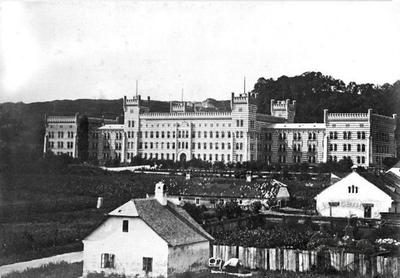
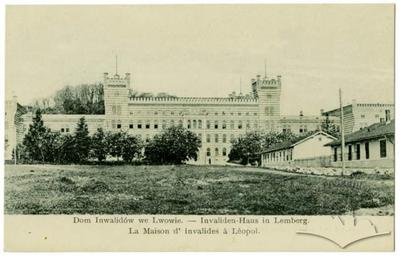
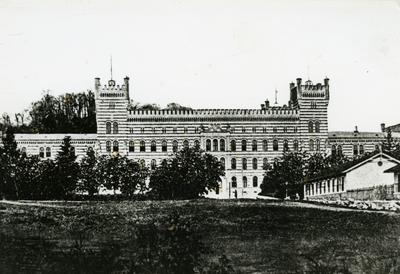
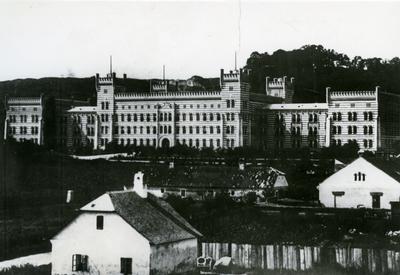
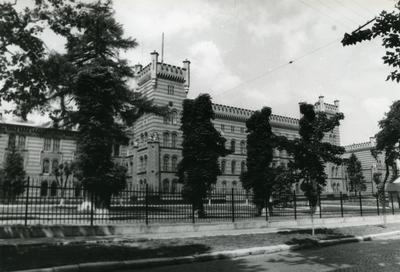
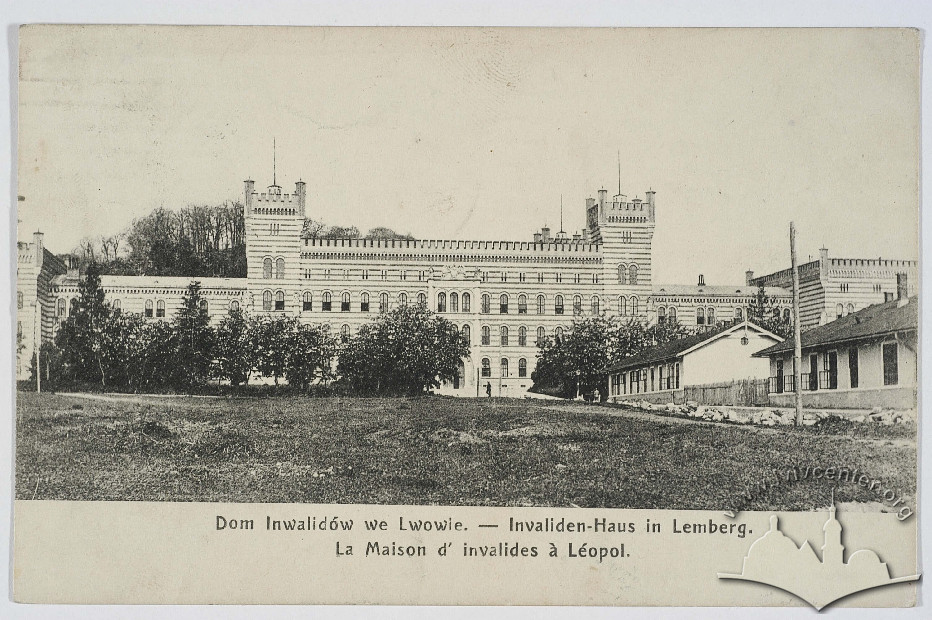
The former House of Invalids (1855–1863, architect Theophil (von) Hansen). The building's style is Historicism (Round-arched style). The ensemble of the former House of Invalids is a valuable architectural monument of early Historicism in Lviv. Today (2009), it serves as a campus building for the Lviv Fire Safety Technical School.
Story
The House of Military Invalids operated in Lviv from 1863 to 1918. Military invalids and veterans who lacked the means to support themselves resided in the institution at state expense. The House of Military Invalids was built by order of Emperor Franz Joseph I dated December 12, 1851, as a shelter for disabled military veterans, following an 1855 design by Danish architect Theophil Edvard Hansen (the building was modeled after the Vienna Arsenal, which was also designed by T. E. Hansen). A budget of 700,000 guldens was allocated for the construction, alongside lands in the Pylykhivska Valley featuring an oak forest. At that time, this territory in the area of Mount Kortumivka in Klepariv belonged to the military.
The construction permit for the building was signed in December 1851 by Franz Joseph I. The building works, conducted under the supervision of Edward Keller, began in the spring of 1856. In 1858, work commenced on the decoration of the façades, executed by sculptor Cyprian Godebski and his pupil Abel Maria Pérat. The main building works were completed in 1860, and the construction was fully finished in 1863. The grand opening of the building took place on October 4, 1863, on the name day of Emperor Franz Joseph I. The newly established institution originally functioned as a branch of House of Invalids No. 3 in Tyrnau.
In the late 1870s, the Lviv branch was transformed into the independent House of Invalids No. 4 (one of four similar institutions remaining in Austria-Hungary). The facility's building was designed to accommodate and provide full board for 500 invalids and veterans.
During the interwar period, the buildings were used for the needs of invalids and veterans of the Polish Army; it housed a shelter for military veterans and a surgical hospital (a branch of the 6th District Military Hospital).
During the Soviet era, the building was at the disposal of the Red Army. Between 1939 and 1941, the 233rd Regiment of the NKVD (military unit 7480) was stationed in the building. The same unit returned to the building on August 10, 1944. At that time, the sculptural decoration was partially destroyed, and the chapel building — which had been used as a clothing depot since 1939 — suffered damage and vandalism.
Pursuant to a decision by the Ministry of Internal Affairs of the USSR, the Kyiv Fire Safety Technical School of the MIA of the USSR was relocated to the building's premises in May 1954. Until 1972, military unit 7480 and a militia battalion were located on the ground floor of the main building's left wing.
Since the 1990s, the former house of invalids has accommodated the Lviv State University of Life Safety of the Ministry of Emergencies and Affairs of Population Protection from the Consequences of the Chornobyl Catastrophe.
Architecture
This monumental structure in the northern part of the city is located on a large urban site, set back from the street. The building is constructed of unplastered yellow and red brick and is designed in forms resembling a fortress in a Neoromanesque style. It is symmetrical in floor plan, featuring a central block of prismatic configuration complemented by four massive corner towers and a large inner courtyard. Extending from the central block are two wings with lateral risalits. The windows are semi-circular. The internal layout structure is of a corridor type.
The principal and rear elevations are decorated with allegorical sculpture (crafted by C. Godebski and A.-M. Pérat).
On the principal elevation, figures of War (Mars) and Peace (Venus) are positioned on either side of the coat of arms of the Austrian State. Above the opposing gates — both on the exterior and from inside the courtyard — are four bas-reliefs symbolizing the Warrior and Victory. A total of 26 sculptural elements and 8 bas-reliefs were installed on the façade (which remain in satisfactory condition to this day). Many elements of the sculptural decor, primarily on the inner side, have been lost. Specifically, these include the statues of four celebrated Austrian field marshals and generals: Archduke Charles, Count Radetzky, Prince Schwarzenberg, and Count Schlik. The hall featuring frescoes has also not survived.
The complex includes a chapel built to the northwest of the main building, erected in Romanesque-Byzantine forms. Wall paintings have been preserved fragmentarily within it.
An identical complex of structures was executed according to a design by T. Hansen in the city of Graz (Austria).
The ensemble of the former House of Invalids stands as a valuable architectural monument of early Historicism in Lviv.
Sources
- Oпис чacткoвo опрацьований в межах проекту "Галіціана", 2001-2002
- Львів. Туристичний путівник. – Видавницво: Центр Європи. – Львів, 1999. – C. 253.
- Lwów. Ilustrowany przewodnik. – Lwów: Centrum Europy. – Wrocław: Via Nowa, 2001. – S. 145.
- Materiały do dziejów sztuki sakralnej na ziemiach wschodnich dawnej Rzeczypospolitej. – Część I. Kościoły i klasztory rzyskokatolickie dawnego województwa ruskiego. – Tom 12. – Kościoły i klasztory Lwowa z wieków XIX i XX. – Kraków, 2004. – S. 67-76.