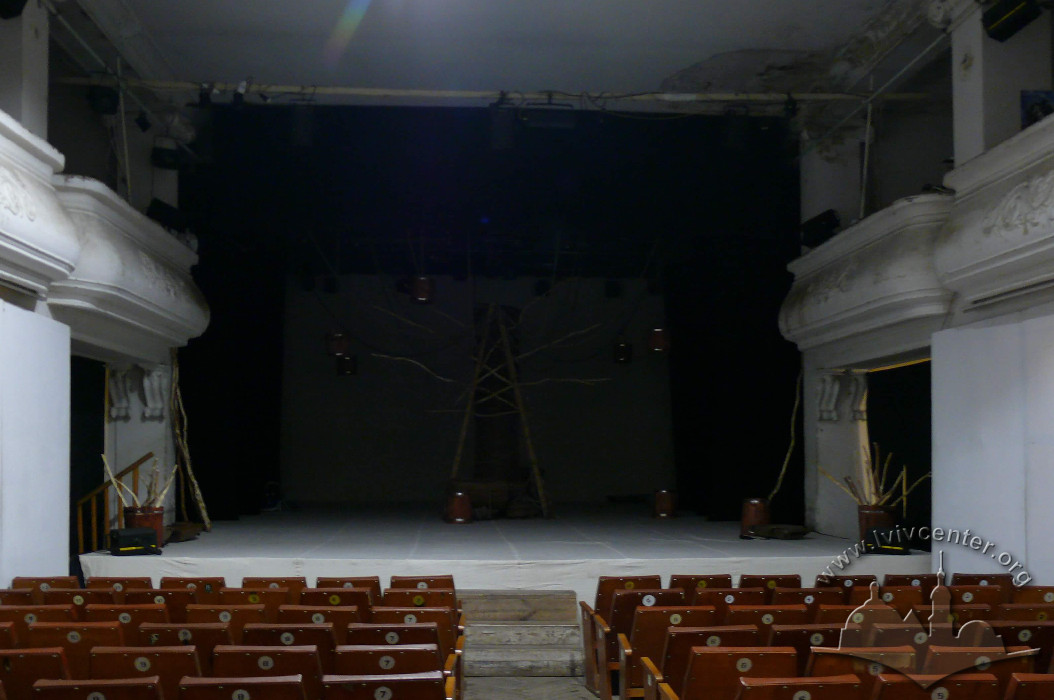
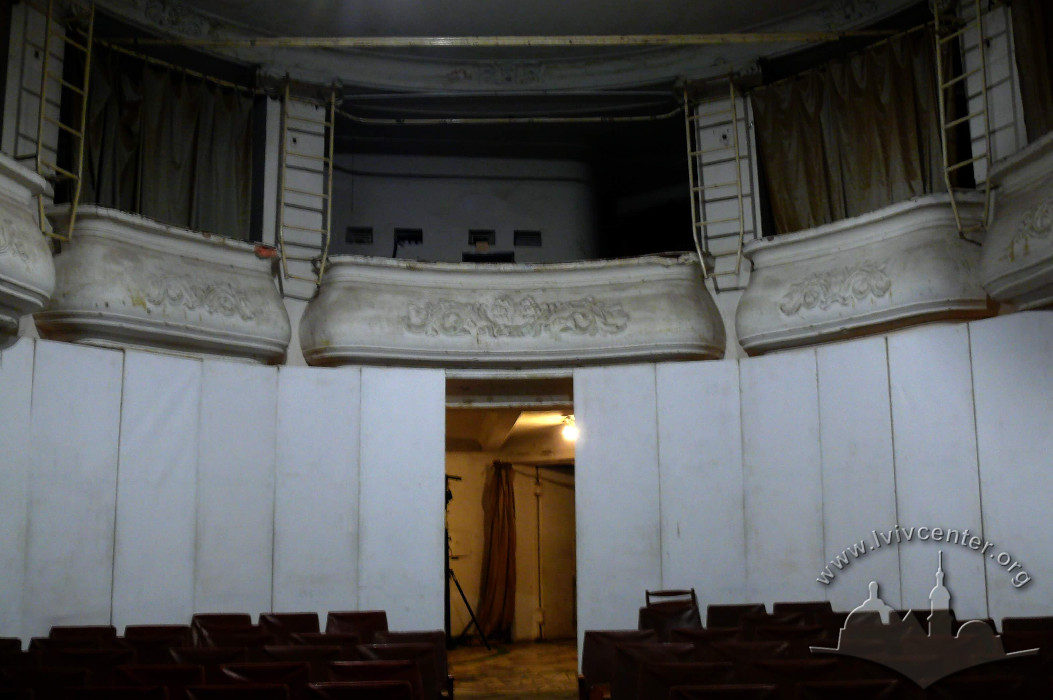
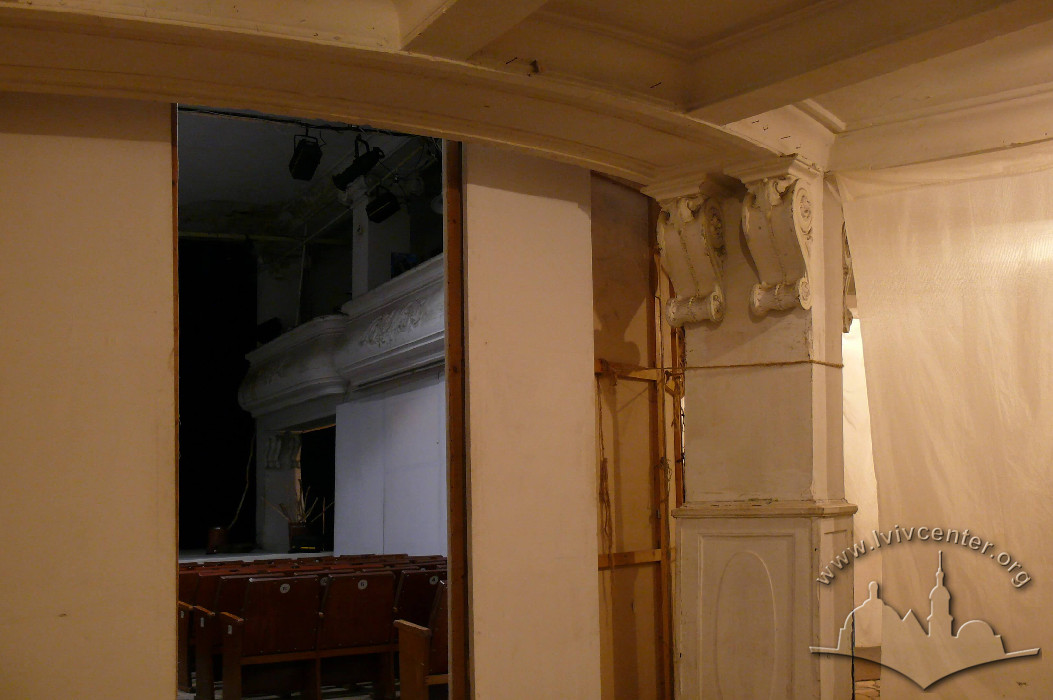
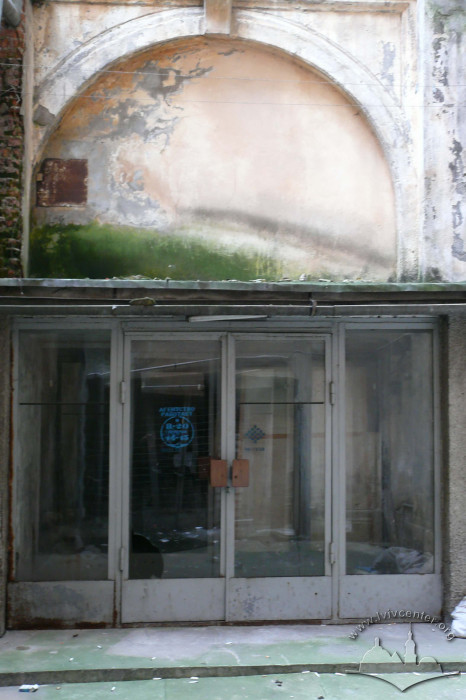
Pl. Henerala Petra Hryhorenka, 5 – cinema (no longer in operation) ID: 1775
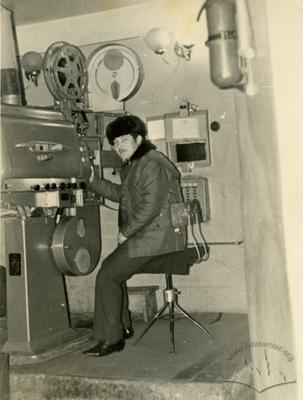
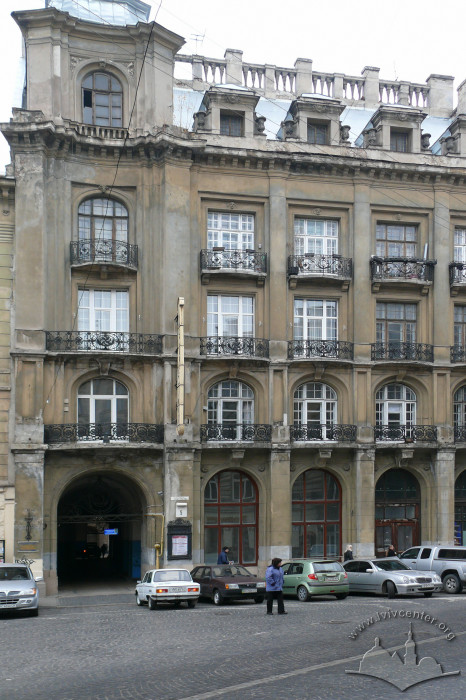
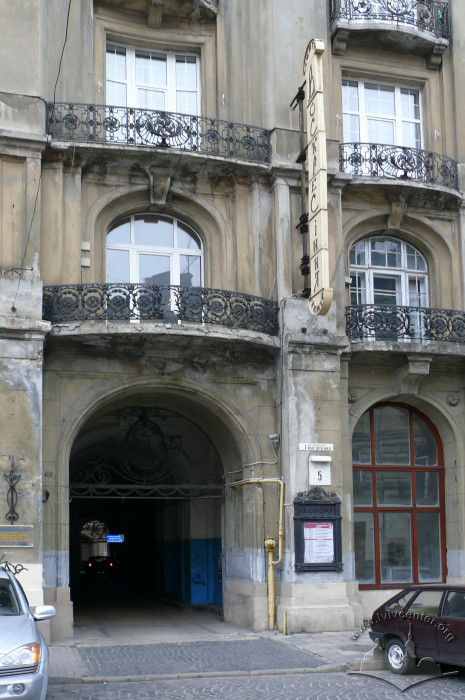
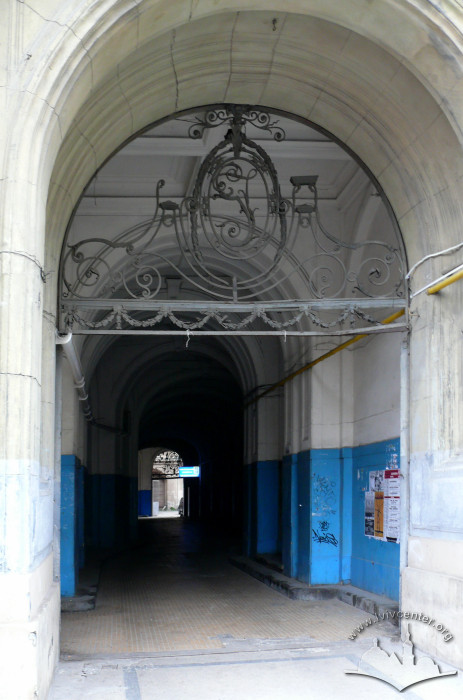
The building at pl. Henerala Hryhorenka 5 housed a cinema that operated under several different names and owners over the years: "Marysieńka" (1918–1941), "Moskva" (1944–1948), and the "Pioner" children's cinema (1965–1990). In 1941, the State Theater of Miniatures operated here, and during the German occupation, it served as the SS and police theater. As of 2013, the building is home to the Lviv Academic Spiritual Theater "Voskresinnia".
Story
The Marysieńka Cinema (also known as "Królowa Marysieńka") opened on March 31, 1918, at plac Franciszeka Smolki 5 (now pl. Henerala Hryhorenka). The theater was named in honor of Marie Casimire Louise de La Grange d'Arquien, the wife of King Jan III Sobieski of Poland. Considered quite comfortable, the cinema featured an auditorium with a 600-seat capacity. It was owned by Edward Burnatowicz and managed by Konrad Lisowski, an engineer and war veteran.
The first films screened at the Marysieńka were A Song with a Chord of Love (Pol. Pieśń akordem miłości) and the comedy She Was the Dream of His Sleepless Nights and the Star in the Sky of His Love (Pol. Była marzeniem jego bezsennych nocy i gwiazdą na niebie jego miłości).
In 1926, the engineer Tadeusz Kuchar (son of Ludwik Kuchar), who owned several other Lviv cinemas, took ownership of the Marysieńka.
In 1928, architect Tadeusz Wróbel designed a reconstruction project for the ground-floor lobby and the auditorium balcony.
Over time, the repertoire shifted toward a school-aged audience, frequently hosting educational films. Students could attend screenings at the Marysieńka at significantly discounted rates: tickets for parterre seats cost 70 gr., while balcony seats were 90 gr.. Thanks to the efforts of the parent committee from Szajnocha Gymnasium No. 2 (now Specialized Secondary School No. 8 at vul. Pidvalna 2), a screening of Journey to the North Pole (Pol. Podrоż do bieguna północnego) was held for students on December 9, 1931, with tickets priced as low as 50 gr..
In 1930, the cinema acquired Gaumont-Chronophon 1929 sound equipment, making the Marysieńka the fourth theater in Lviv to begin showing sound films.
In 1938, architect Jan Silber designed a stage for the theater.
By 1939, when Leon Schlechter owned the establishment, the cinema was considered moderately successful.
The theater operated regularly through 1941, even during the early stages of World War II. In 1941, the premises housed the State Theater of Miniatures, and during the German occupation, it served as the SS and police theater.
Between 1944 and 1948, the building operated as the Moskva Cinema, with a capacity of 360 viewers. It was subsequently transferred to the USSR Ministry of State Security to serve as the Border Guard Culture Club.
From 1965 to 1990, the building functioned as the Pioner children's cinema. As of 1966, it had 338 seats, held approximately seven screenings per day, and employed 28 people. Attendance at the Pioner was average; while it saw 518,908 viewers in 1966, that number dropped to just 244,628 by 1989.
Related buildings and spaces
-
Pl. Henerala Petra Hryhorenka, 5 – "Voskresinnia" Theater

People
Edward Burnatowicz — one of the cinema's owners.
Tadeusz Kuchar — an engineer and one of the cinema's owners.
Konrad Lisowski — an engineer and war veteran who served as the cinema's manager.
Marie Casimire Louise de La Grange d'Arquien (1641–1719) — the wife of King Jan III Sobieski, in whose honor the Marysieńka cinema was named.
Leon Schlechter — one of the cinema's owners.
Jan Silber — an architect who designed the theater's stage.
Tadeusz Stanisław Wróbel — an architect and representative of the Lviv architectural school of the interwar period; he was also one of the co-founders of the Wrocław University of Science and Technology. In 1928, he designed the reconstruction of the ground-floor lobby and the auditorium balcony for the building at pl. Henerala Hryhorenka 5.
Sources
- Gazeta Lwowska, 1933, №90, 7.
- Kurjer Lwowski, 1918, №117, 5.
- Kurjer Lwowski, 1918, №144.
- Kurjer Lwowski, 1918, №150, 4.
- Słowo Polskie, 1931, №337, 6.
- Taschenjahrbuch 1943: Für den deutschen Generalgouvernement (Krakau: ZKW Druck, 1943).
- Вільна Україна, 1946 р.: № 227, 232.
- Вільна Україна, 1949 р., №105.
- Вільна Україна, 1958 р., № 260.
- Вільна Україна, 1965 р., №57.
- Державний архів Львівської області (ДАЛО) 1/56/158.
- ДАЛО 1/56/3976.
- ДАЛО 7/3/638.
- ДАЛО Р-1339/1/32.
- ДАЛО Р-1339/1/603.
- ДАЛО Р-1339/1/625.
- З постанови Ради Народних Комісарів УРСР про організацію театрів (19.12.1939).
- Львов: Справочник (Львів: Вільна Україна, 1949).
- Львовская Правда, 1948 р., № 112.
- Львовская Правда, 1955 р., №111.
- Львовская Правда, 1958 р., №170.
- Радянський Львів: 1939–1955. Документи й матеріали (Львів: Книжково-журнальне видавництво, 1956).
- Справочник Львовской АТС (Львов, 1954).
- Станіслав Лем, Високий Замок (Львів: Піраміда, 2002), 161.
- Barbara Gierszewska, Kino i film we Lwowie do 1939 roku (Kielce: Wydawnictwo Akademii Świętokrzyskiej, 2006), 428.
- Збірка І. Котлобулатова.