Vul. Leonida Hlibova, 12 – residential building ID: 420
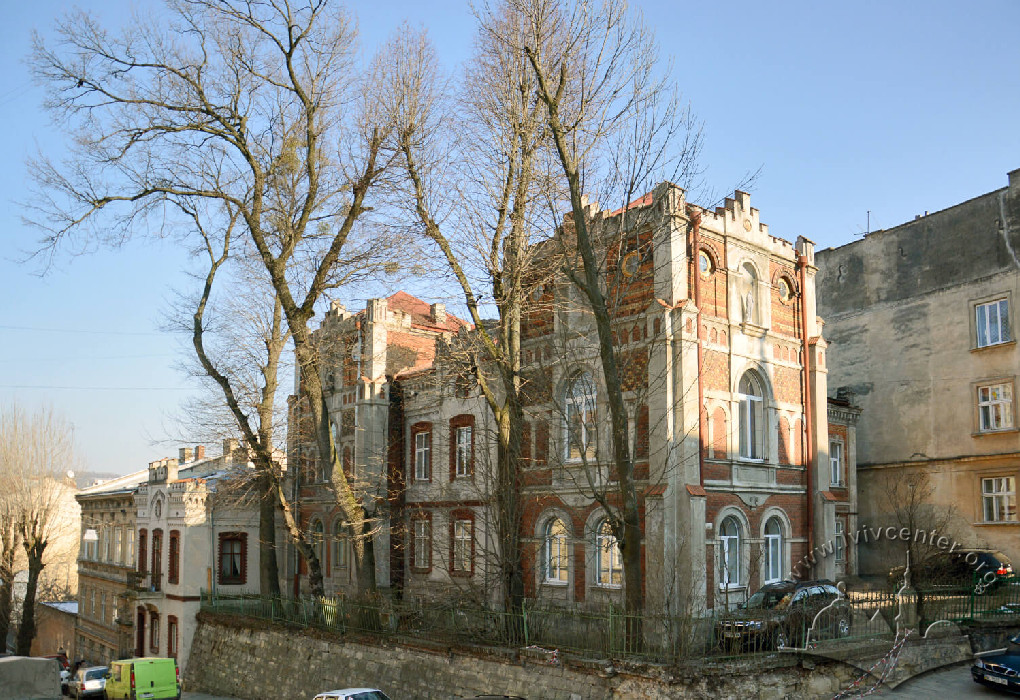
The villa is one of the characteristic landmarks of Neogothic architecture in Lviv, featuring Neoromanesque elements. Built in 1875 according to the design of Edmund Köhler for the family of Wladyslaw Czarnowski, it was originally named "Zacisze". In 1893, the villa was remodeled by architect Alfred Kamienobrodzki at the request of Olimpia Wyszyńska. The building has largely preserved its historical appearance and is an Architectural monument (ID No. M-722). Today, it is used as an apartment building.
Story
The villa was constructed in 1875 according to the design of Edmund Köhler in the Neoromanesque style for Wladyslaw Czarnowski and was originally named "Zatyshok" / "Zacisze" (Архітектура Львова, 2009, 348). This picturesque asymmetrical villa was distinguished by its corner tower with an observation platform on the fourth level and exposed polychrome brick masonry.
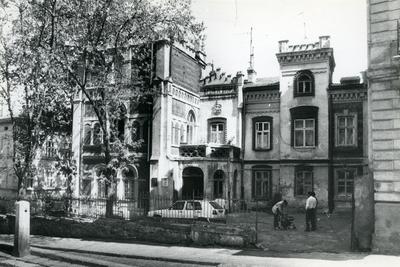
Later, starting at least from 1889, Olimpia Wyszyńska became the owner of the house. On July 3, 1893, a reconstruction project designed by the prominent Lviv architect Alfred Kamienobrodzki was approved at Wyszyńska's request (ДАЛО 2/1/4842). The house was expanded: two corner towers were added, along with a western wing. The stylistic treatment of the façades was preserved and enhanced with the application of decorative stylized Neogothic elements. The villa's name was changed to "Palatyn". The choice of this name was not accidental. On one hand, "palatyn" is a title in medieval Europe equivalent to "voivode", and on the other, it is the name of the hill in Rome where the city's development began (Lwów po polsku, 2012, 66). This Lviv villa is situated on sloping terrain near Kalicha Hill, where, according to archaeological research, a settlement existed even before the founding of Magdeburg Lviv (Оконченко, 2004). Furthermore, its stylistic treatment emulates a medieval castle.
From 1910 to 1915, Tadeusz Rutowski — a journalist, writer, economist, and Vice-President of Lviv (from 1905), who served as the acting Mayor of Lviv during the Russian occupation (1914–1915) and was taken hostage when Russian troops retreated from the city — resided in the house.
During the twentieth century, the villa underwent some changes on the garden side: the decorative brick masonry was covered with cement plaster, the brackets under the cornice were removed, and the exit to the rear courtyard was walled up.
Architecture
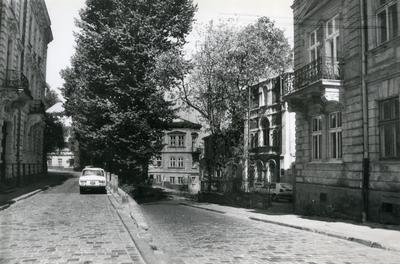
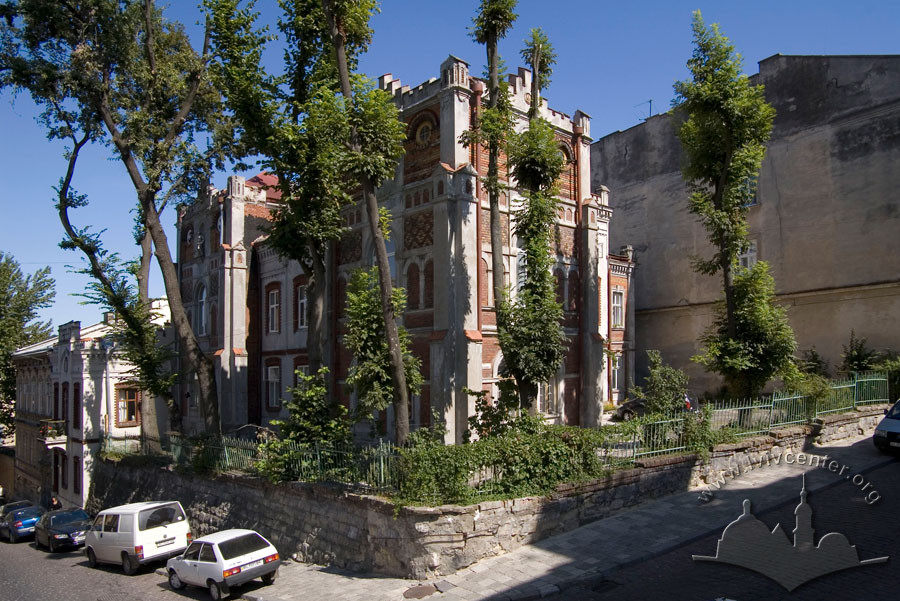
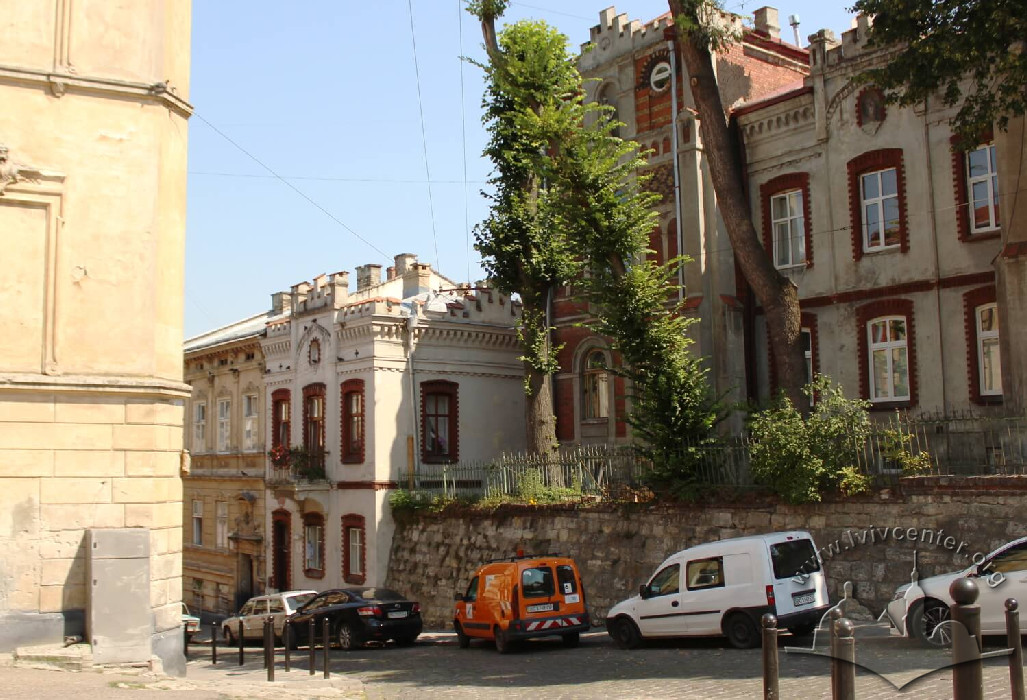
Villa "Palatyn" is situated somewhat in isolation amidst the residential development of the late nineteenth and early twentieth centuries, to the south of the city center. The northwestern façade faces the steep slope of vul. Kalicha Hora, while the southwestern façade faces vul. Hlibova. The territory is enclosed by a fence which, due to the significant elevation change between the street and the site, serves as a retaining wall.
The villa's plot was trapezoidal in shape, as indicated in the site plan. There is a marked elevation change between the site and the street level. In terms of placement, the villa is detached and situated closer to the street frontage. The recreational area near the villa is divided by paths and includes a front garden, an orchard area, and a utility zone.
According to the 1875 record drawings, one could enter Villa "Zacisze" through the first floor, leading into a spacious rectangular vestibule. This space housed a staircase, around which several rooms were grouped, including: a kitchen and a dining room (in the right, southwestern part of the building), and two large rooms — salons (in the left, northeastern part). From the kitchen and the salon, there were exits to another room with additional spaces located to the northwest, which had an exit to the garden. The stairwell connected the semi-basement, first, and second floors. The second floor contained bedrooms. There were also stairs leading to the attic from the second-floor hallway. Cellars were located in the semi-basement.
After the 1893 reconstruction, the layout of Villa "Palatyn" was preserved from Villa "Zacisze" supplemented by an entrance vestibule and large corner halls in the northeastern and northwestern parts of the building. Additionally, an auxiliary stairwell, bathrooms, and another room were added to the southwestern section. On the second floor, the number of rooms and auxiliary spaces increased corresponding to the first floor. In the semi-basement, in addition to the existing cellars, a group of rooms appeared, which were likely used as a laundry and service rooms.
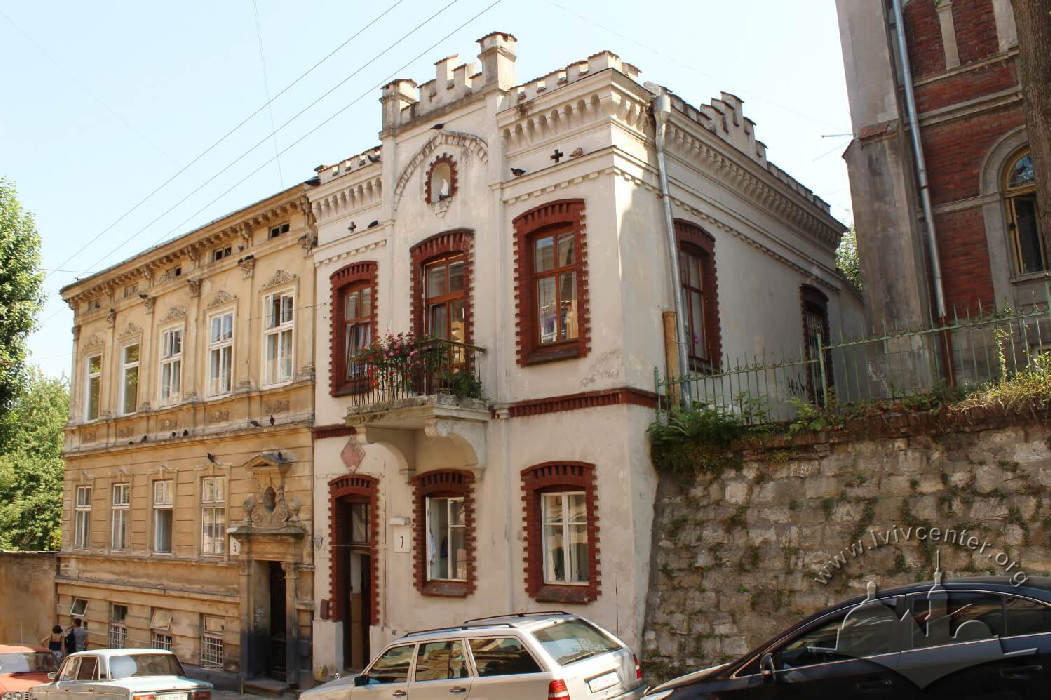
Concurrently with the villa's reconstruction, a two-story gatehouse was built on the site. Its design utilized a combination of forms from both Villa "Zacisze" and Villa "Palatyn." It is located to the north of the villa itself, abutting the adjacent terraced building at vul. Kalicha Hora 5a. Today, it is a separate residential building at vul. Kalicha Hora 7.
According to the project drawings, the load-bearing walls and partitions were made of brick. The floor between the semi-basement and the first floor consists of segmental vaults. The floor between the first and second floors is supported by wooden beams. The attic floor is wooden. The roof structure is made of wooden rafters, and the roofing is made of ceramic tiles.
The villa has varying heights due to the sloping terrain. The architectural composition of the building is characterized by a dynamic and asymmetrical combination of two- and three-story volumes. The corner volumes are designed in the form of towers. Authentic ceramic tile roofing has been preserved on the villa's gables.
Initially, Villa "Zacisze" had a square configuration in plan, featuring an octagonal tower on the southwestern corner. The building was two stories high with a terrace on the northeastern elevation. The articulation of the façades featured exposed diamond-shaped brickwork and banded patterns of red and light yellow colors. The windows were segmental with trimmings made of exposed red brick. The tower was four levels high, featuring an observation terrace and a tented roof finish with a spire, divided by horizontal string courses. The tower windows were circular, with semi-circular biforia on the third level.
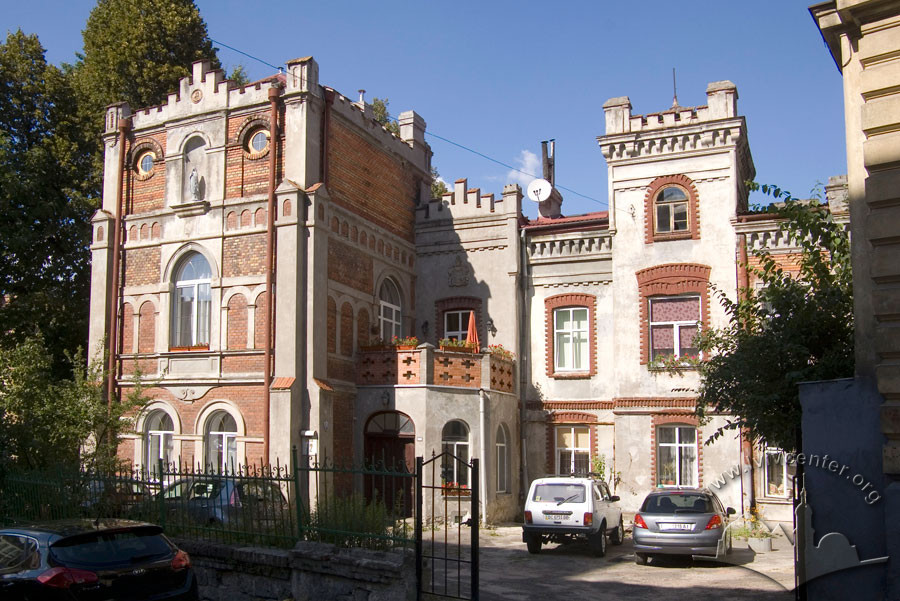
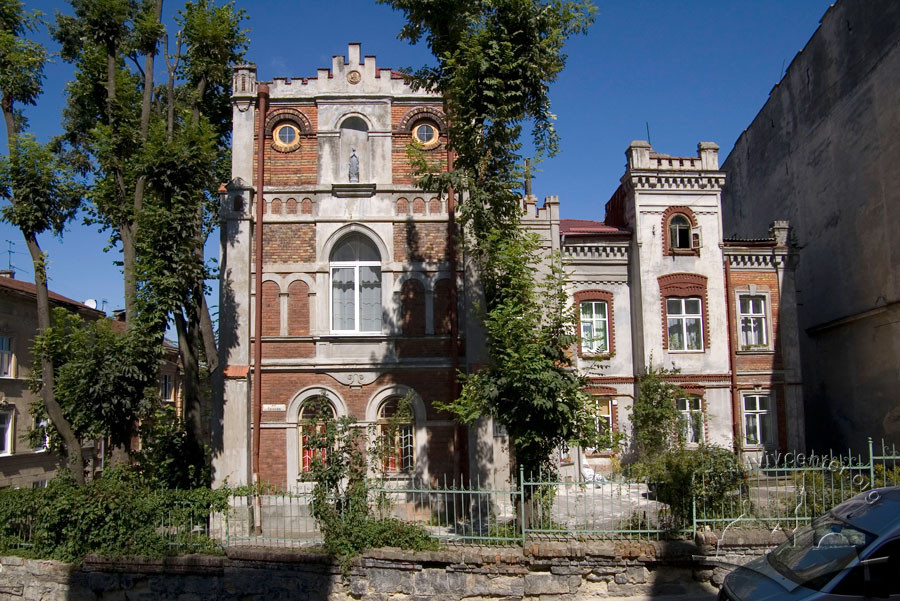
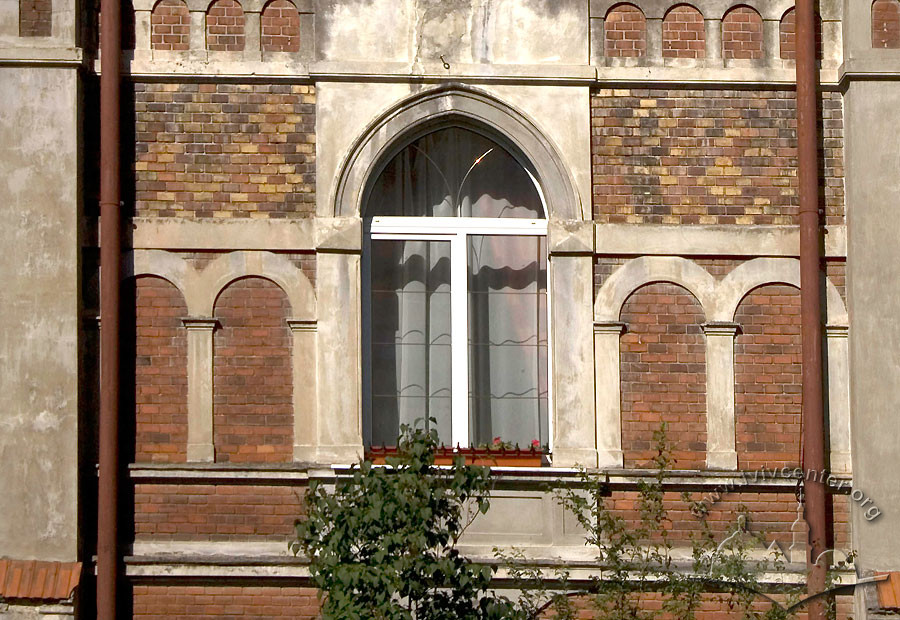
During the 1893 reconstruction, two more corner towers and a western wing were added. The stylistic treatment of the façades was preserved and enhanced with decorative stylized Neogothic elements, specifically towers, buttresses, pinnacles, profiled window frames and lancet arches, doors, cornices, and arcatures.
Façades
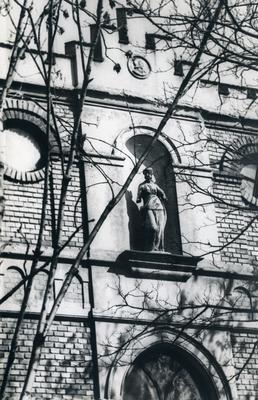
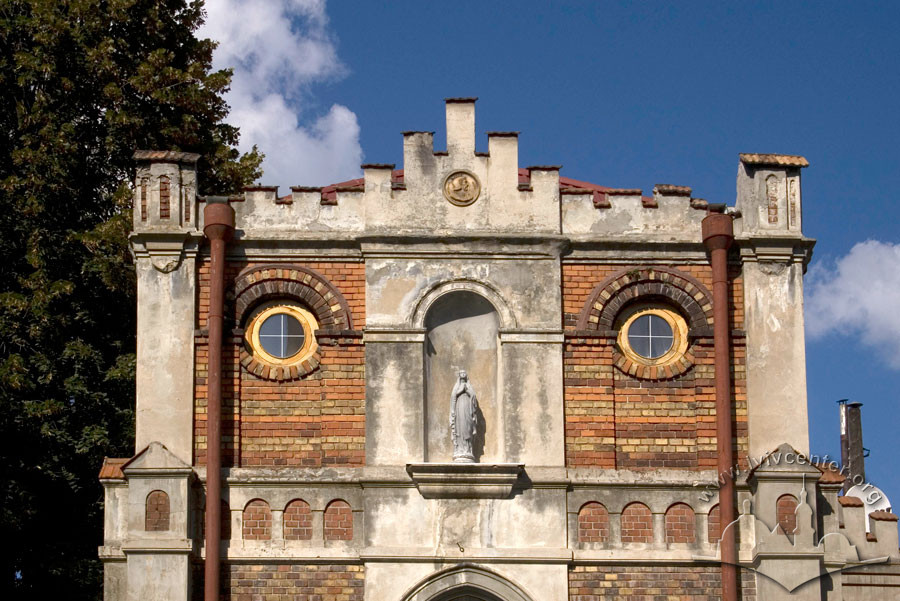
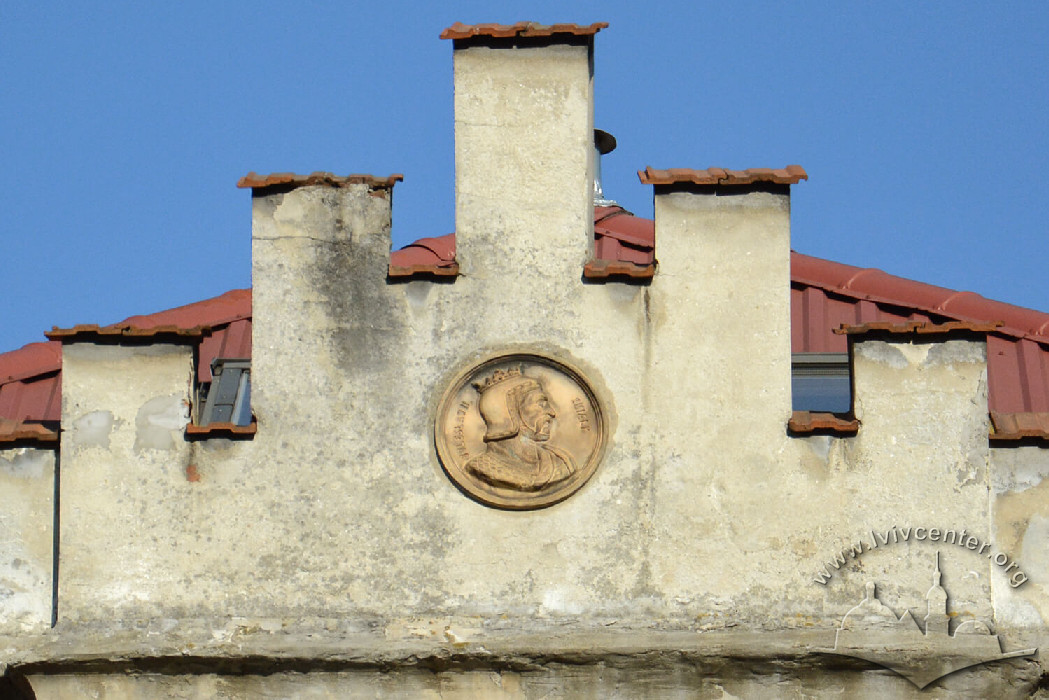
The corner towers are square in plan, three stories high with hip roofs, serving as focal points of the villa's compositional design. The corners of the towers are supported by stylized three-step buttresses. The articulation of the façades combines exposed diamond-shaped brickwork and banded patterns of red and light yellow, along with smooth plastered surfaces. The windows are semi-circular and lancet-shaped with profiled trimmings, imposts, and parapets, while the third-floor windows are circular and symmetrically placed around a semi-circular niche containing a figure of the Virgin Mary. Large arcature bands are located between the buttresses, and horizontal string courses run between the floors. The towers are crowned by a stepped gable, featuring a bass relief medallion in the center depicting the Polish King Bolesław II the Bold. Similar medallions were located on the other sides of the towers, but they have mostly not been preserved. On the southeastern elevation, the western tower has an exit from the second floor onto a terrace above the main entrance.
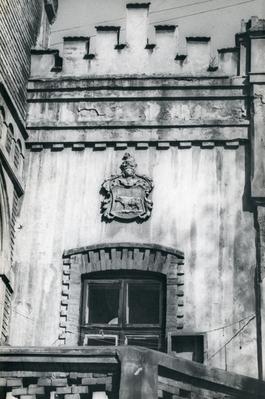
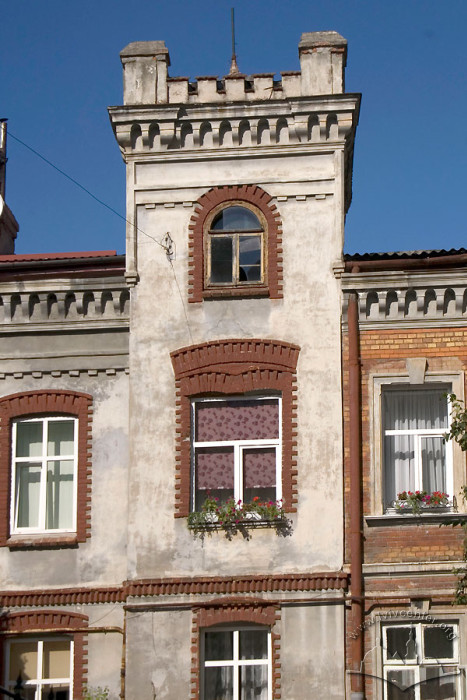
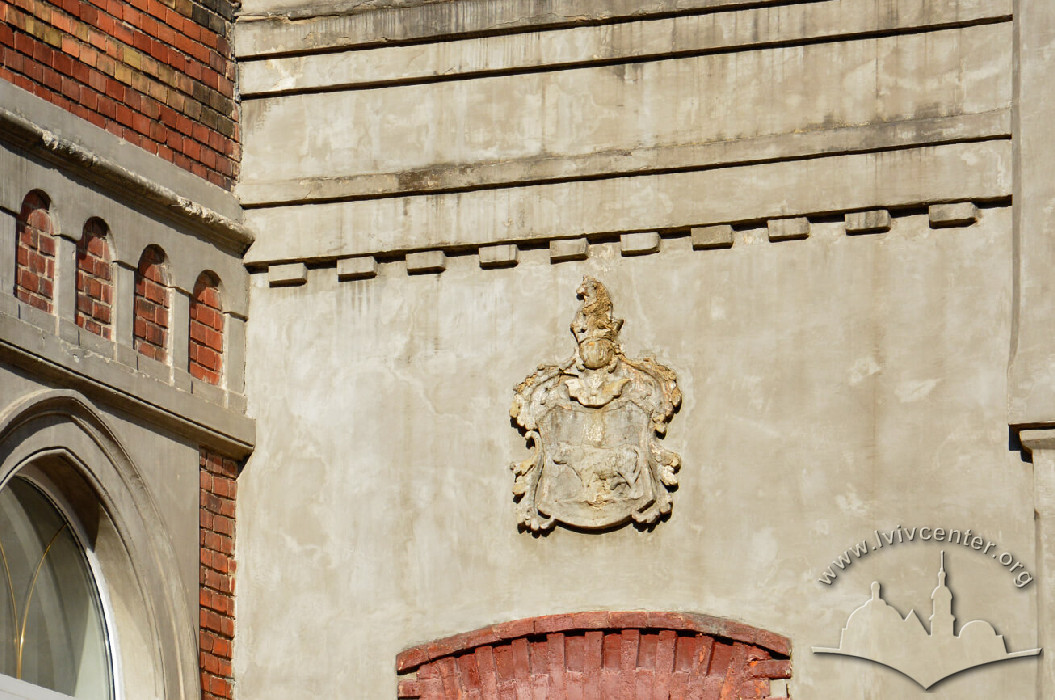
The southwestern façade of the two-story volume features a three-level plastered tower topped with an arcature cornice and crenellations. All windows are framed with exposed red brick, contrasting with the smooth plastered wall. A horizontal string course runs between floor levels. The corners of the tower are topped with stylized pinnacles. The main entrance to the villa is also located on this façades through a veranda. Above the second-floor window of the main entrance axis is a family coat of arms depicting a crown and a bull. The façades is finished with an arcature cornice and a stepped pediment with a stylized pinnacle.
The southeastern façade of the two-story volume is executed in a concise manner, typical of rear façades. The wall section is divided by smooth plastered pilaster strips on the first and second floors and is finished with a profiled cornice on brackets. The ground floor level features exposed red brick masonry, while the second floor has banded yellow-and-red masonry. The smooth frames of the rectangular windows stand out against the colored wall section. Modern reconstructions have marred part of the façades: the decorative brickwork has been plastered over, the brackets under the cornice have been removed, and the exit to the rear courtyard has been walled up.
Currently, the building is partitioned into apartments for several families.
Wood and wrought iron are used in the interior decoration. Inside the building, there is a wooden stairwell, the railing of which consists of carved wooden profiled balusters. The handrail is made of profiled wood.
Related buildings and spaces
-
Vul. Leonida Hlibova, 15 – residential building
People
Alfred Kamienobrodzki — architect; he implemented the remodeling project for Villa "Palatyn" in 1893.
Afner Hessel — building co-owner in 1935.
Edmund Köhler — architect; he designed Villa "Zacisze" in 1875.
Gustawa Hessel — building co-owner in 1935.
Jan Silnicki — building owner in 1900.
Jan Ewa — building owner in 1916.
Leopold Chodacki — pharmacist, building owner in 1902.
Olimpia Wyszyńska — owner of Villa "Palatyn" from 1889 to 1897.
Tadeusz Klemens Rutowski — resident of Villa "Palatyn", journalist, writer, economist, Vice President of Lviv starting in 1905, and Mayor of Lviv from 1914 to 1915.
Wladyslaw Czarnowski — the first owner of Villa "Zacisze".
Sources
2. Світлана Лінда, "Архітектура історизму", Архітектура Львова: Час і стилі ХІІІ–ХХІ ст., ред. Ю. Бірюльов (Львів: Центр Європи, 2008), 348–349.
3. Львів: Туристичний путівник, ред. Ю. Бірюльов (Львів: Центр Європи, 2004), 282.
4. Ksenia Borodin, Iwanna Nowak, Lwówpoposku. Imię domuorazinnenapisy (Lwów, 2012), 66.
5. Ігор Оконченко, "Львівська цитадель як прояв мілітарної політики Австрії середини ХІХ ст.", Вісник НУ "ЛП", №505: Архітектура, ред. Б.С. Черкес (Львів: Видавництво Львівської політехніки, 2004), 208.
6. Skorowidz król. stoł. miasta Lwowa (Lwów, 1889).
7. Skorowidz król. stoł. miasta Lwowa (Lwów, 1916).
8. Księga adresowa król. stoł. miasta Lwowa (Lwów, 1897).
9. Księga adresowa król. stoł. miasta Lwowa (Lwów, 1900).
10. Księga adresowa król. stoł. miasta Lwowa (Lwów, 1902).
11. Księga adresowa król. stoł. miasta Lwowa (Lwów, 1910).
12. Księga adresowa król. stoł. miasta Lwowa (Lwów, 1913).
13. http://haidamac.org.ua/2013/02/ln-palatyn/