Vul. Halytska, 9 – residential building ID: 2324
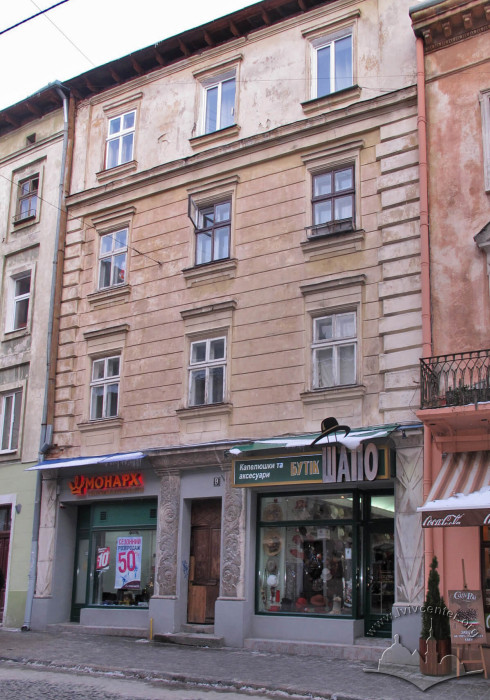
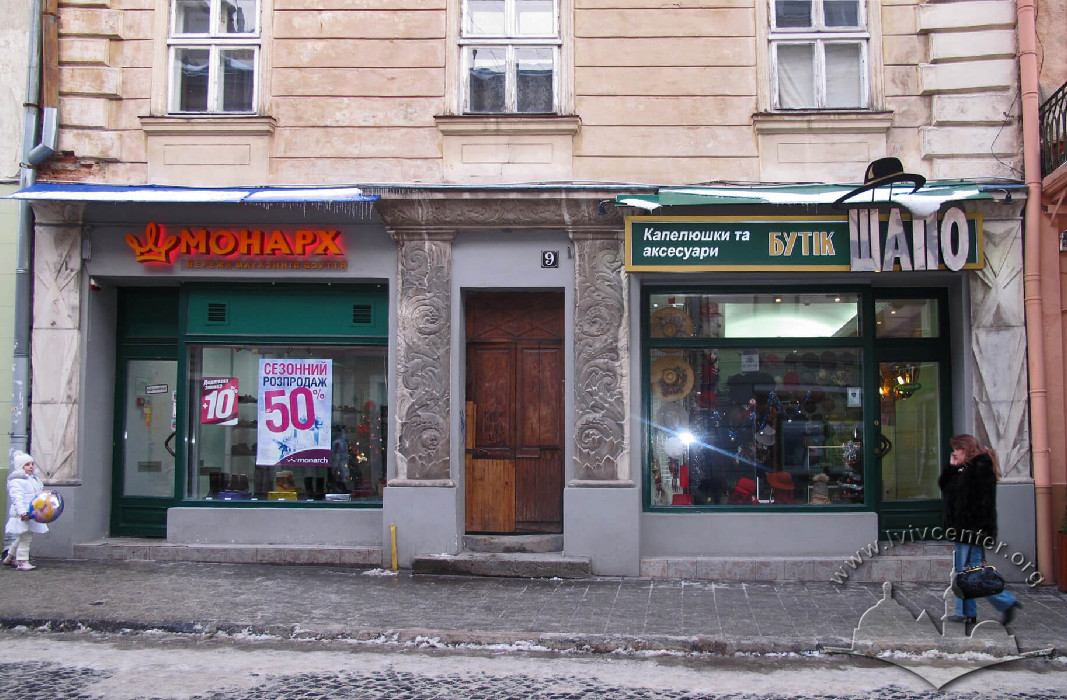
The townhouse (old conscription no. 231, new no. 243) was built in 1786 in the Baroque style by Trefliński, constructed upon the foundations of the seventeenth-century two-story Majdaszewicz Townhouse. In 1988, the building was added to the Local Register of Monuments under protection number 875. From 1910 until the era of Independence, the ground floor housed various shops and a confectionery, while tailors, barbers, and other professionals lived and worked within the building. As of 2014, it is home to the "Shapo" headwear boutique and the "Monarch" shoe store.
Story
Early seventeenth century — construction of a two-story townhouse.
1712 — the two-story building was demolished and replaced by a new three-story structure.
1784 — the main façade of the townhouse is recorded as being in a state of ruin.
1786 — construction of a new four-story townhouse by the owner, Trefliński.
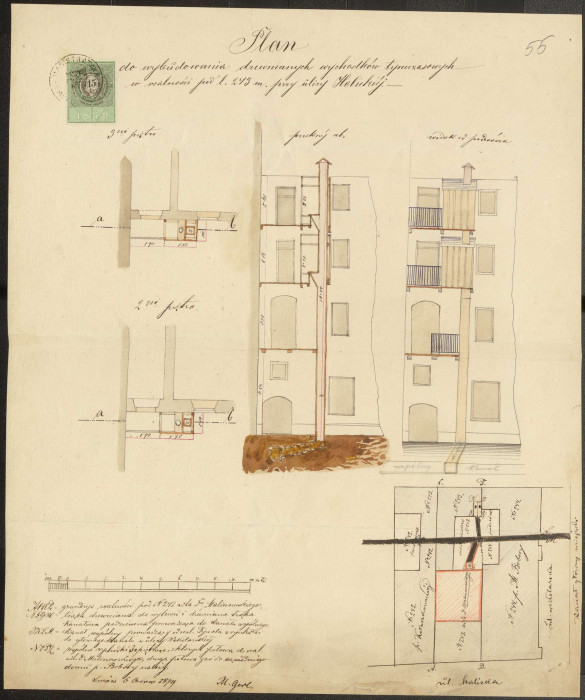
1879 — addition of a fourth floor to the rear wing (owner — Józef Mańkowski, builder — Wojcech Haar).
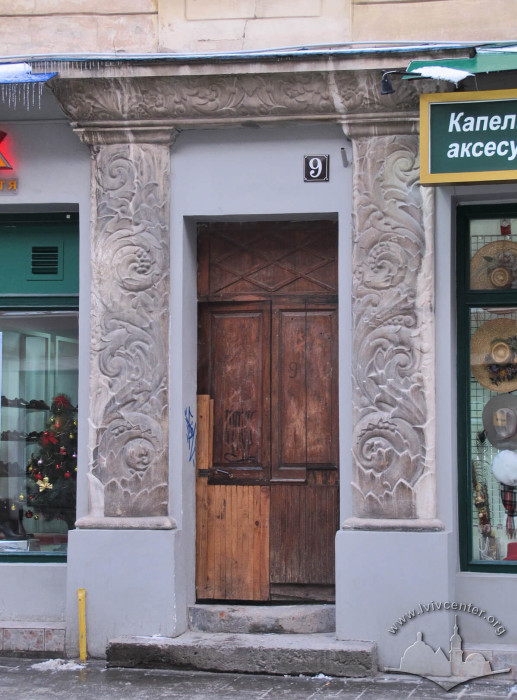
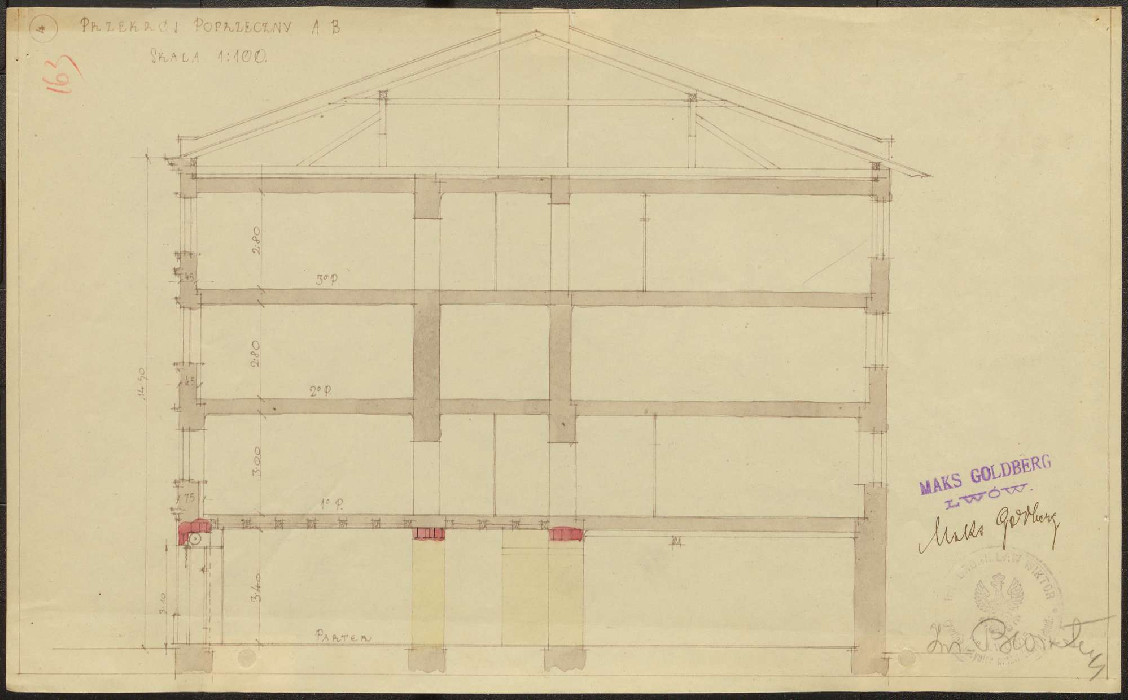
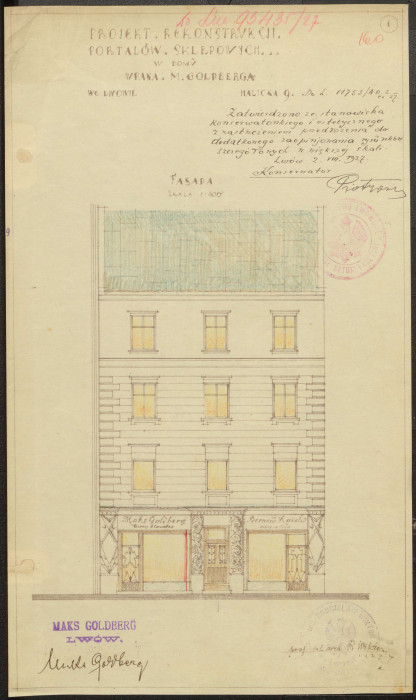
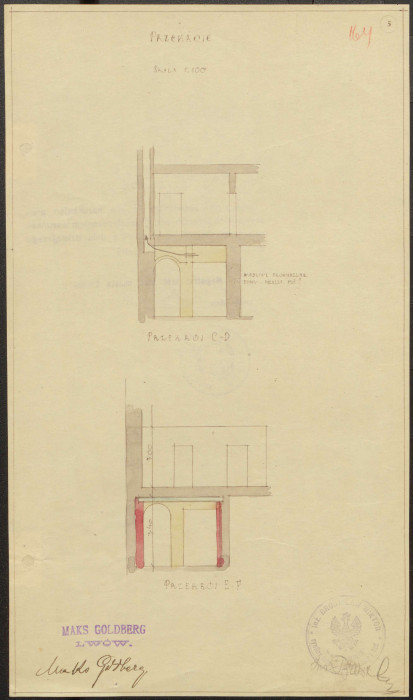
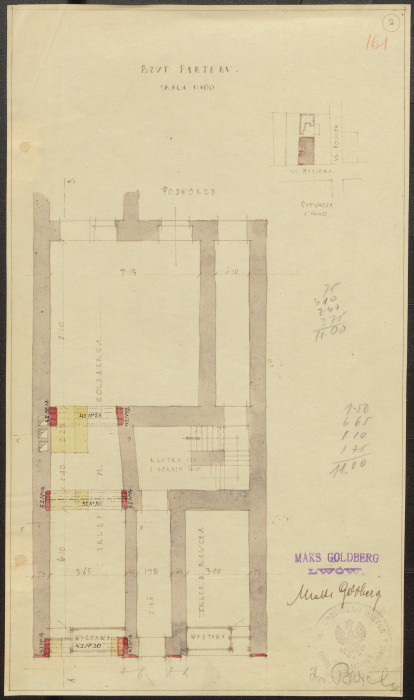
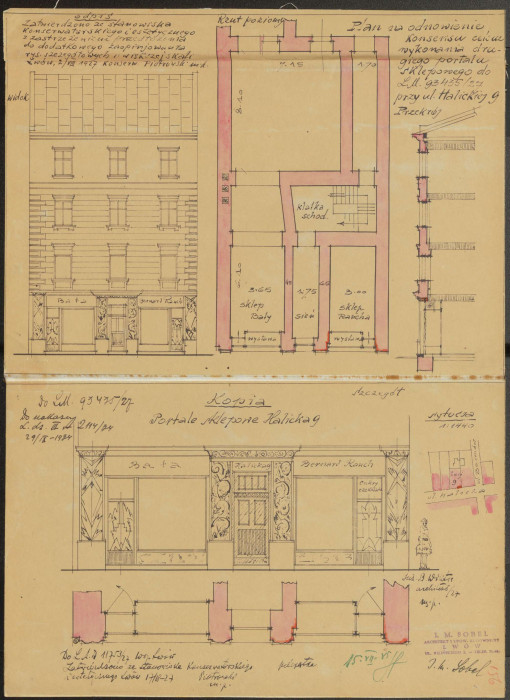
1927 — the portal is decorated in the Art Deco style (architect — Bronisław Wiktor).
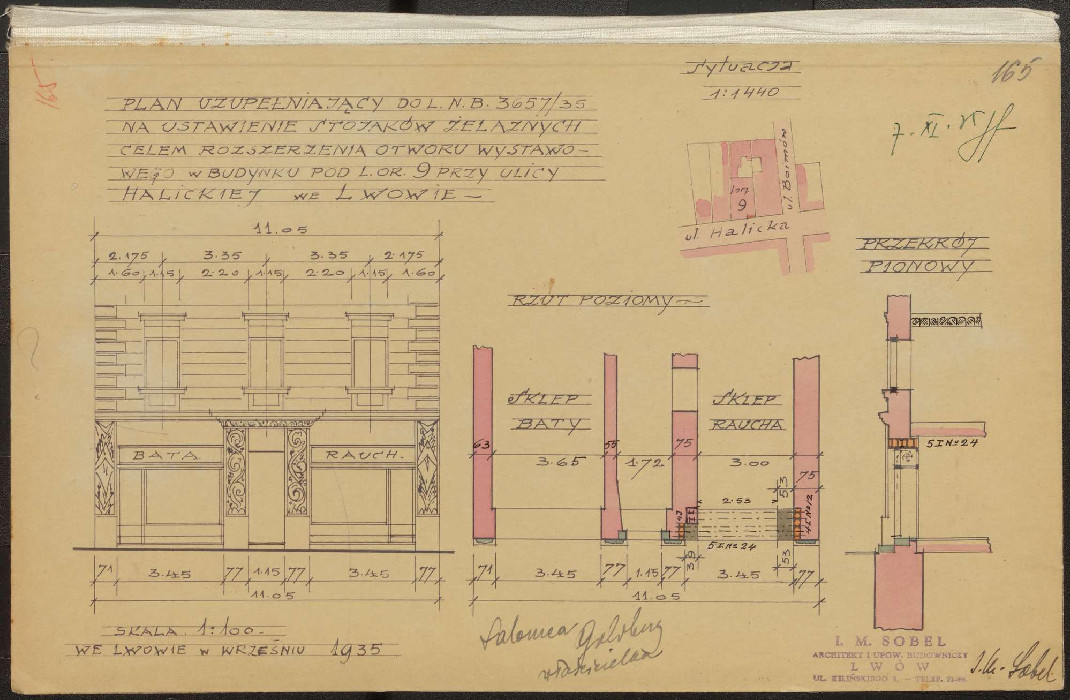
1935 — installation of shop windows (architect — J. Sobel).
From the first half of the seventeenth century, the townhouse (old conscription no. 231, new no. 243) was owned by several families: the Biesiadowski (1630–1634), Majdaszewicz (1668), Jaślikowski, Tomicki, Reich, and Trefliński. Between 1640 and 1653, a portion of the building — then owned by Wojcech Huz (1639–1677) — was leased by the Ukrainian painter Ivan Koronka (Korónka). Later, in 1703, while the house belonged to Tomicki, it was home to the painter Niedbałowicz. A tax register from 1712 notes that the original two-story townhouse had been demolished and was being rebuilt. By 1740, the Tomicki Townhouse passed to the shoemaker Jan Reich, who lived there for over a quarter of a century. The Reich family was linked to Martin Urbanik, the architect and builder of Lviv's Dominican Church, who married Reich's daughter, Agnes, on January 25, 1750. That same year, when Urbanik was summoned to the advocate's court by Dr. Jakób Moruński for a breach of contract during the restoration of the townhouse at Market Square 2, Jan Reich stepped in to defend his son-in-law. Martin Urbanik, in turn, was related to the architect Klemens Ksawery Fesinger, who married Urbanik's daughter, Antonela.
In 1774, architect Klemens Fesinger purchased a portion of the Reich townhouse, which at the time belonged to the sworn surveyor Wincenty Urbanik, son of Martin. Slightly earlier, a share of the building was owned by the Lviv woodcarver Marcin Fesinger.
In 1748, part of the Tomicki house belonged to the Basilian Fathers of St. George's Monastery. After Jan Reich's death, the house was inherited by his daughter Magdalena, who was married to the Lviv shoemaker Ivan Mukhnytskyi. In 1766, the Mukhnytskyis sold the house to Khristian Rechemberg. From Rechemberg, the property passed to Józef Trefliński, who initiated an inspection of the building's condition in 1784. The report stated that the main "façade requires dismantling and new masonry". Records from 1786 confirm that Trefliński funded the construction of a new townhouse: "...muri noviter per se proprio sumptu erecti" (walls newly erected by him at his own expense).
In the first half of the nineteenth century (1841), the portrait painter Bogumił Żychowicz lived in the townhouse. During the second half of the century, the main section underwent further changes. In 1879, the owner at the time, lawyer Józef Mańkowski, added a fourth floor to the rear wing, designed by builder Wojcech Haar. In 1927, according to a design by architect Bronisław Wiktor, the ground floor received decorative Art Deco ornamentation. The current shop windows were installed in 1935 under the direction of architect J. Sobel.
By 1910, the ground floor housed Baruch Leinwand's textile shop, Laizor Pocher's women's clothing store, and Maks Goldberg's fashionable men's clothing shop. Residents and workers included the tailor Ernest Jakubowicz and seamstress Sabina Metall, barber Dawid Radler, modiste Sally Kitz, waiter Józef Grządziel, and saddler Władysław Roman. Other occupants included Maria Romani (a merchant's wife), the widow Katarzyna Roman, Herman Grenzbauer (administrator of "Yednist"), trade agent Adolf Grüber, the widow Klementyna Pańkiewicz, entrepreneur Mozes Weichel, merchant Chaim Korkes, and the building's owner, Jakób Lendes. During the interwar years, the building housed Rauch's confectionery; after the war, it became a furniture store, and later a shop for knitwear and ties. Since Ukraine's independence, it has housed the "Shapo" headwear boutique and the "Monarch" shoe store.
Architecture
The building is situated on a plot within the southern block adjacent to Rynok Square, bounded by Halytska, Staroievreiska, and Serbska streets.
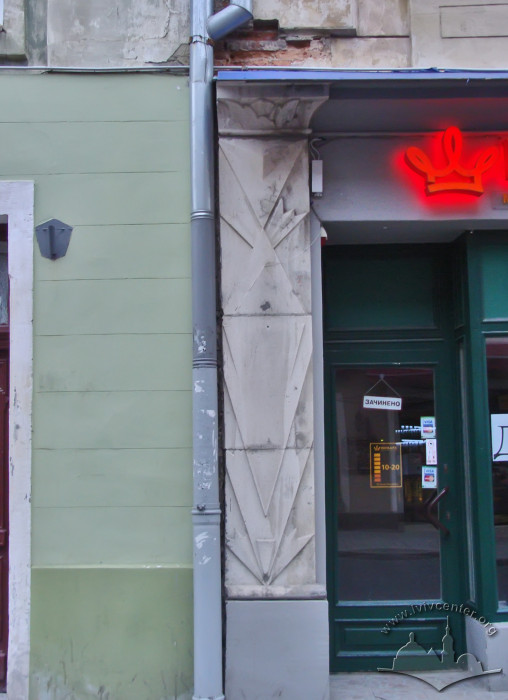
This four-story townhouse is a three-axis structure with a centrally located entrance. The façade of the second and third stories is finished with banded rustication, while the corners are accented with rusticated lesenes. The fourth floor, set off by a stringcourse, has a smooth surface. The windows feature modest, profiled trimming with pediments. The first floor is emphasized by a cornice, and both the portal and the corners are decorated with ornamental pilasters.
People
Agnesa Reich — daughter of Jan Reich and wife of Martin Urbanik.
Adolf Grüber — trade agent and resident of the townhouse.
Antonella Fesinger — daughter of Martin Urbanik and wife of Klemens Ksawery Fesinger.
Baruch Leinwand — owner of a textile shop.
Biesiadowski family — a burgher family who owned the townhouse from 1630 to 1634.
Bogumił Żychowicz — portrait painter who lived in the townhouse during the first half of the nineteenth century (1841).
Bronisław Wiktor — architect who designed the decorative ornamentation for the ground floor in 1927.
Wincenty Urbanik — sworn surveyor, son of Martin Urbanik, and owner of a portion of the Reich townhouse until 1774.
Władysław Roman — saddler and resident of the townhouse.
Wojcech Haar — builder who added the fourth floor to the rear wing of the townhouse in 1879.
Wojcech Huz — owner of the townhouse from 1639 to 1677.
Herman Grenzbauer — administrator of "Yednist" and resident of the townhouse.
Dawid Radler — barber who lived and worked in the townhouse.
Ernest Jakubowicz — tailor who lived and worked in the townhouse before World War I.
J. Sobel — architect who designed the current shop windows in 1935.
Jan Korónka — ukrainian painter who leased a portion of the townhouse from 1640 to 1653.
Ivan Mukhnytskyi — Lviv shoemaker.
Józef Trefliński — owner of the townhouse as of 1784, who constructed the current building in 1786.
Katarzyna Roman — widow of Władysław Roman's brother and resident of the townhouse.
Klemens Ksawery Fesinger — architect and owner of a portion of the Reich townhouse as of 1774.
Klementyna Pańkiewicz — resident of the townhouse.
Leizor Pocher — owner of a women's clothing shop.
Magdalena Mukhnytska — daughter of Jan Reich and wife of Ivan Mukhnytskyi, who inherited the Reich townhouse.
Majdaszewicz family — a burgher family who owned the townhouse in the seventeenth century.
Maks Goldberg — owner of a shop for fashionable men's clothing.
Marya Roman — wife of Władysław Roman and resident of the townhouse.
Martin Urbanik (†1763) — architect and builder of the Lviv Dominican Church.
Marcin Fesinger — Lviv woodcarver and owner of the townhouse.
Mozes Weichel — private entrepreneur and resident of the townhouse.
Niedbałowicz — painter.
Reich family — a burgher family who owned the townhouse in the seventeenth century.
Sabina Metall — seamstress who lived and worked in the townhouse.
Sali Kitz — modiste.
Tomicki family — a burgher family who owned the townhouse from the late seventeenth century until 1740.
Trefliński family — a burgher family who owned the townhouse in the seventeenth century.
Chaim Korkes — merchant and resident of the townhouse.
Khristian Rechemberg — owner of the townhouse as of 1766.
Józef Grządziel — waiter who lived in the townhouse.
Józef Mańkowski — lawyer and building owner who added the fourth floor to the rear wing.
Jakób Moruński — doctor of medicine and owner of the townhouse at Rynok Square 2.
Jakób Lendes — private entrepreneur and owner of the townhouse.
Jan Reich — shoemaker who lived in the townhouse for twenty-five years starting in 1740.
Jaślikowski family — a burgher family who owned the townhouse in the seventeenth century.
Sources
- Державний архів Львівської області (ДАЛО) 2/1/2108. Справа перейменована: ДАЛО 2/1/1975. URL: https://e.archivelviv.gov.ua/file-viewer/228754#file-839506
- Księga adresowa król. stoł. miasta Lwowa (Lwów, 1913).
- Володимир Вуйцик, Leopolitana II (Львів: Класика, 2012)