Vul. Petra Doroshenka, 37 – residential building ID: 2458
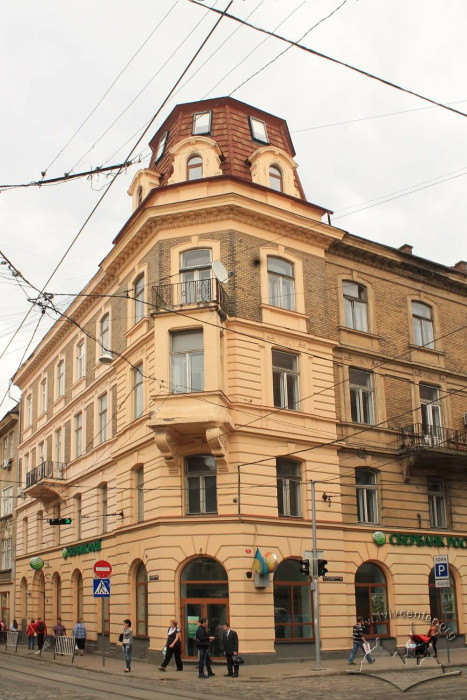
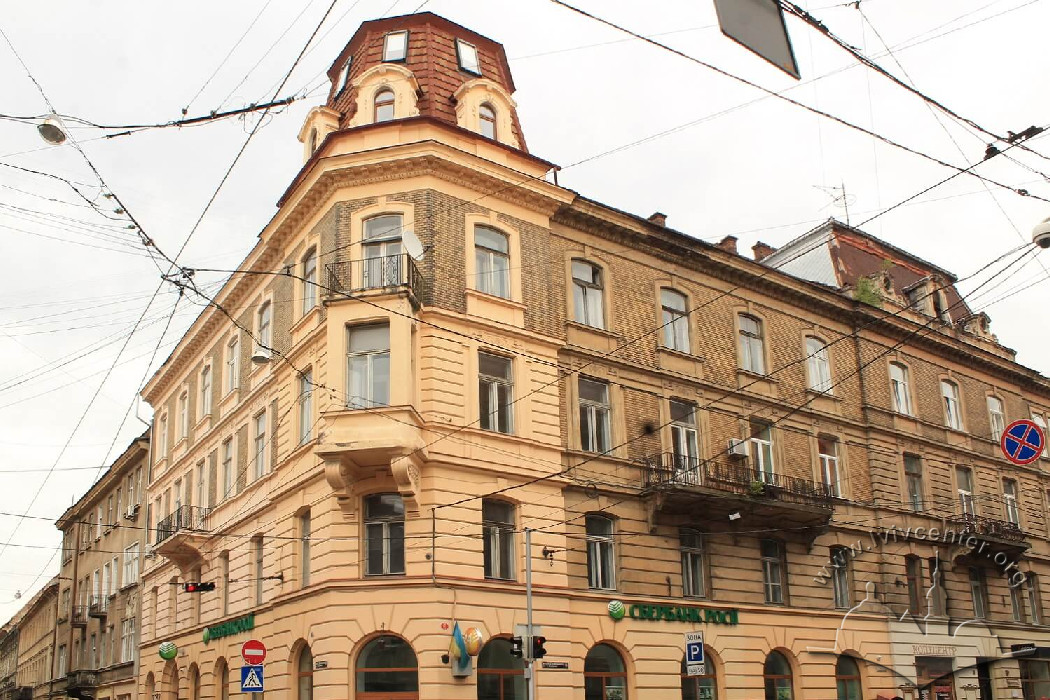
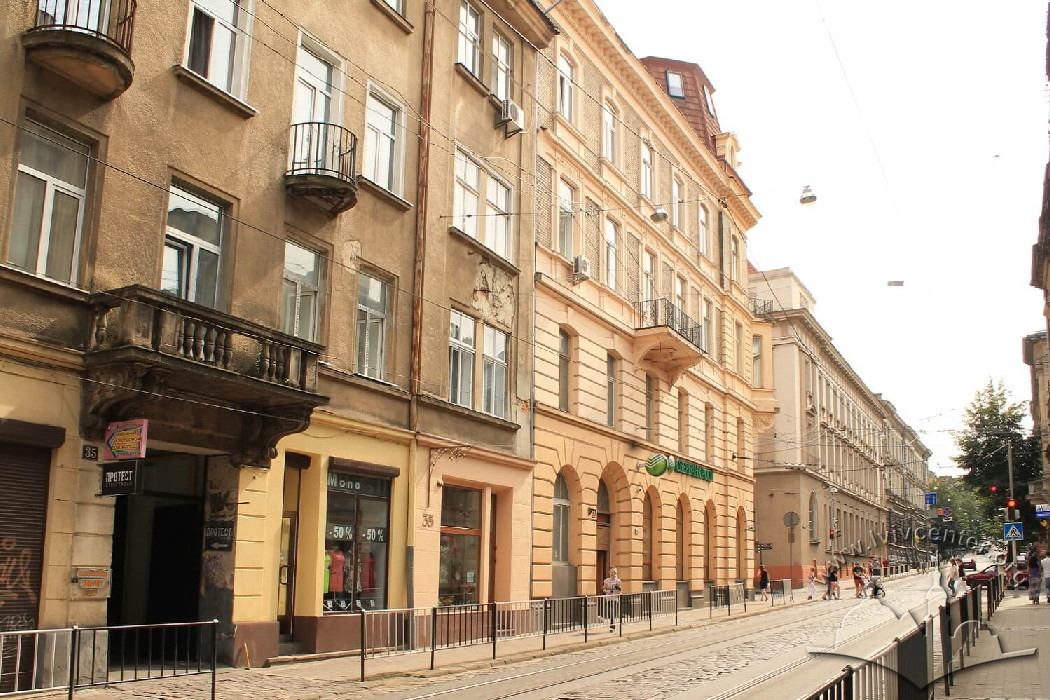
This large corner tenement house, dating from the late nineteenth century, is a significant example of late Historicism with a stylistic character gravitating toward the Neo-Baroque. Designed by architect Jan Tomasz Kudelski and built between 1892 and 1894, it was originally owned by the Baczewski family, proprietors of the renowned Lviv distillery.
Story
By the end of the nineteenth century, the southwest end of the block , defined by the routes of Sykstuska (now vul. Doroshenka), Słowackiego (Slovatskoho), Kopernika (Kopernyka), and Szajnochy (Bankivska) streets, was occupied by a rectangular urban site (conscription No. 550 2/4). It contained an old house with a wide courtyard surrounded on all sides by the building's shoulders. (ДАЛО 2/1/3756:47).
In 1870, Zofia Frankenbusch purchased the property from its previous owner, Franciszek Sidorowicz (ДАЛО 2/1/3756:1) , and carried out several renovations during the 1870s and 1880s. These included establishing a separate entrance for a first-floor workshop in 1878, adding storage rooms in the courtyard in 1887, and replacing the roof in 1888 (ДАЛО 2/1/3756:6, 47, 48). However, in the early 1890s, the plot №550 2/4 was divided into three parts and the old building was demolished. Between 1892 and 1894, a four-story tenement house (No. 37) was constructed on the newly formed corner lot at Słowackiego and Sykstuska streets, while tenements No. 6 and No. 8 were built on the other two plots on ul. Słowackiego.
The first owners and investors of the building at ul. Sykstuska 37 were Leopold Baczewski, a prominent alcohol manufacturer, and his wife Stefania. They commissioned architect Jan Tomasz Kudelski to design the project, which was approved by the Lviv magistrate on October 10, 1892 (ДАЛО 2/1/3756:49-57). Construction was likely completed in the first half of 1894. The tenement at ul. Sykstuska 37 was designed and constructed in tandem with the neighboring property at ul. Słowackiego 8, owned by Henryk Kopecki.
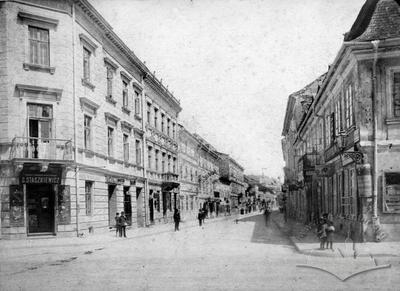
The Baczewski family eventually sold the property. Records from 1918 list Ignacy Jäger as the owner; he conducted extensive renovations on the first through third floors and removed a secondary staircase (ДАЛО 2/1/3756:38). In 1936, the property administrator, Rozalia Blumenkranz, commissioned a remodel of the ground-floor store interiors based on a design by builder Zygmunt Schlager (ДАЛО 2/1/3756:41, 43, 60). Prior to World War II, these premises housed the office of the "Cunard White Star" steamship company (ДАЛО 2/1/3756:61, 62). Today, the building at vul. Doroshenka 37 serves a multifunctional purpose, containing private apartments, a radio network technical center, and a large bank office on the ground floor.
Architecture
This four-story building, integrated into a continuous perimeter block development, occupies a corner site at the southwest end of the block, bounded by Doroshenka, Slovatskoho, Kopernyka and Bankivska streets. It forms a pair with the adjacent tenement at vul. Slovatskoho 8, sharing identical decorative elements on façades and a common courtyard.
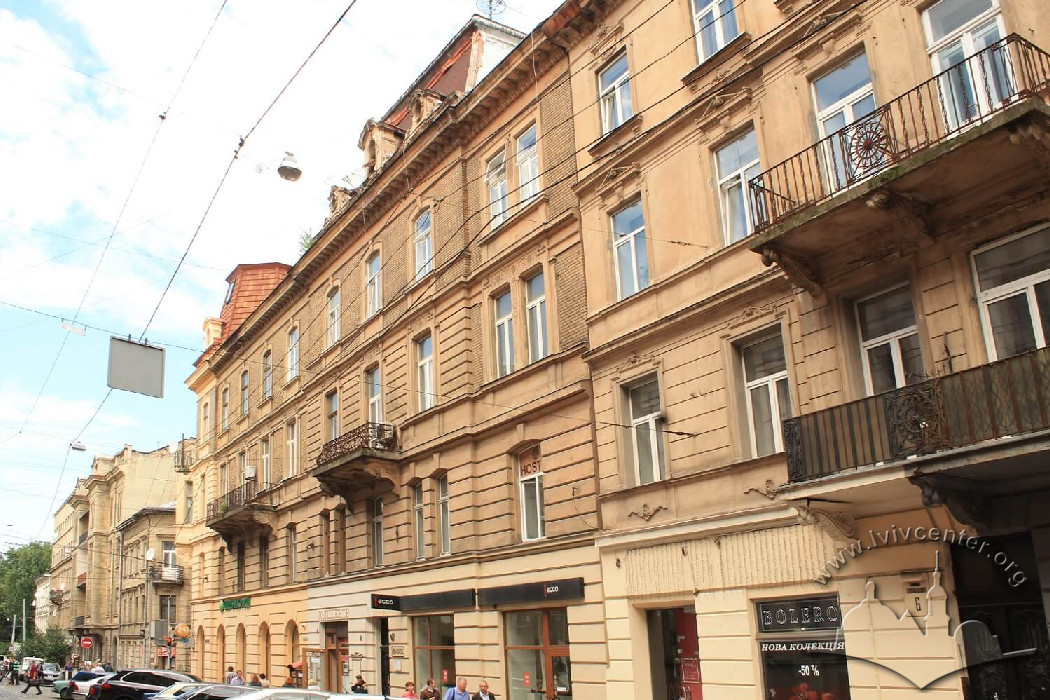
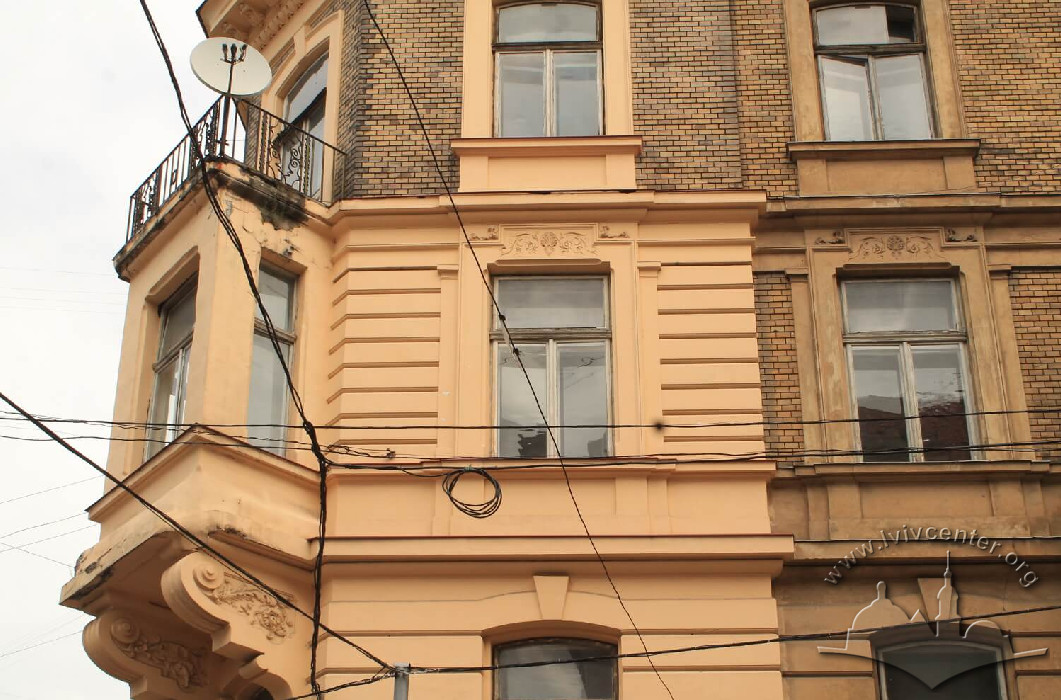
The building features two external façades joined at a right angle. The north façade, from vul. Doroshenka, spans six window axes and includes a balcony on the third floor and a carriage entrance to the courtyard on the left. The west façade, from vul. Slovatskoho St., spans five axes and features a wide balcony on the right. At the corner, flanked by narow protruded wall sections , sits a prismatic bay window supported by consoles with plasterwork volutes and topped with a terrace, oriented at a 45-degree angle to the façades.
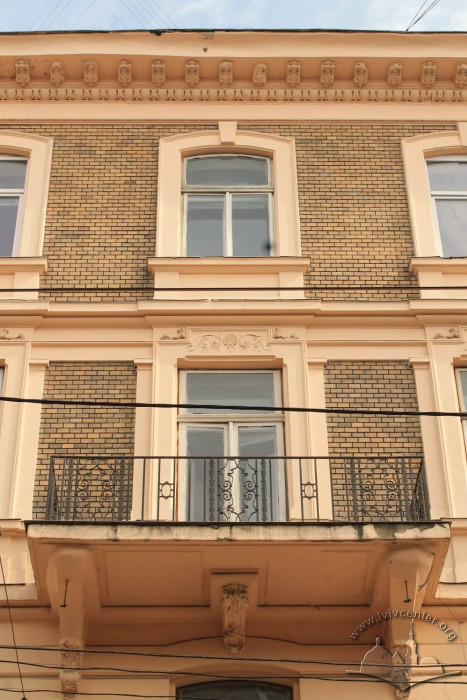
The window openings on the second and fourth floors have arched tops, while the upper floors feature wide, profiled trimming with ornamental relief inserts on the third floor. The lower level of the façade consists of arched store window openings. The façades are horizontally divided by cornices and decorated with rustication up to the third floor. The two upper stories are finished in yellow facing brick. The prominent upper cornice is accented by a band of egg-and-dartmolding and plasterwork consoles.
The building is topped with a high roof. An octagonal mansard structure at the corner, decorated with Neobaroque dormers and originally covered in polychrome roof tiles, serves as a landmark from both Doroshenka and Slovatskoho streets. Based on its decorative features, the house can be classified as belonging to the Late Historicist architectural style, which leans toward the Neobaroque.
The core of the structure is an L-shaped block with two wings — the north and west wings — set at an angle. The interior follows a traditional double-row room layout connected on an enfilade-corridor principle. The staircase is situated in the corner between the wings. A small lateral wing is attached to the edge of the north wing, and balcony galleries run along the perimeter of the rear façade.
Originally, the Baczewski tenement featured two large apartments per floor, though the interior has since been reconfigured.
People
Leopold Baczewski –– co-owner of the building and owner of the Baczewski distillery.
Stefania Baczewska –– wife of Leopold Baczewski and co-owner of the building.
Rozalia Blumenkranz –– property administrator.
Zofia Frankenbusch –– one of the owners of the previous building on this site.
Ignacy Jäger –– one of the subsequent owners of the building.
Zygmunt Gorgolewski –– architect and builder; designer of the Lviv Grand Theater (now the Solomiya Krushelnytska Lviv State Academic Theater of Opera and Ballet). He resided in this building during his time in Lviv.
Jan Tomasz Kudelski –– architect and designer of the building.
Henryk Kopecki –– owner of the adjacent building at vul. Slovatskoho 8.
Franciszek Sidorowicz –– a previous owner of the site.
Zygmunt Schlager –– builder and designer of the interior store remodels.