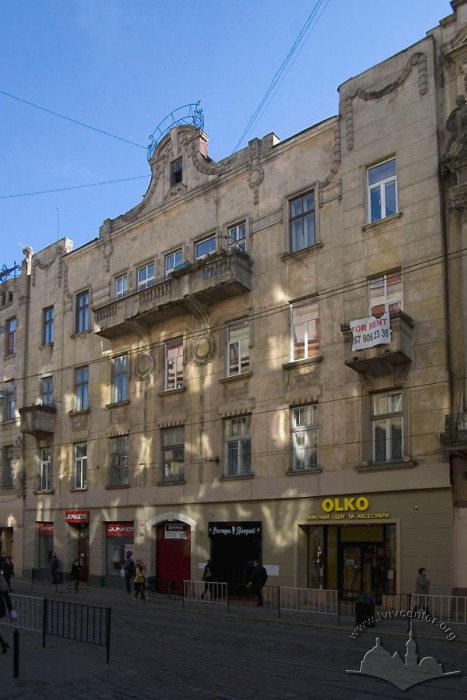
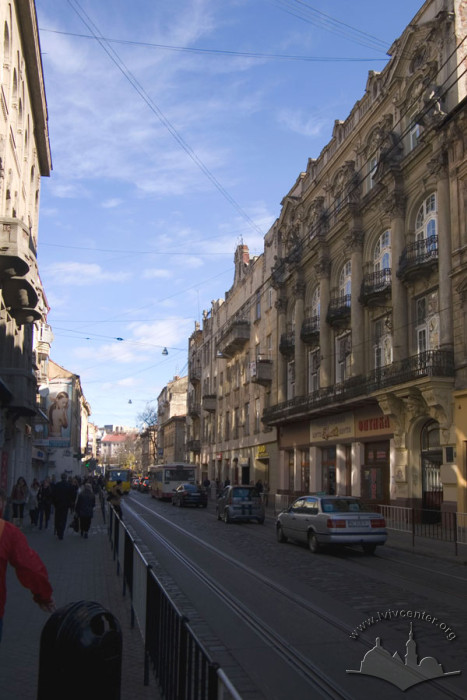
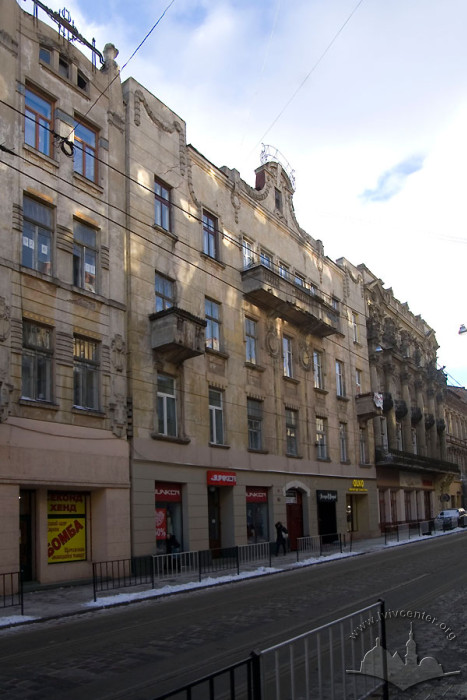
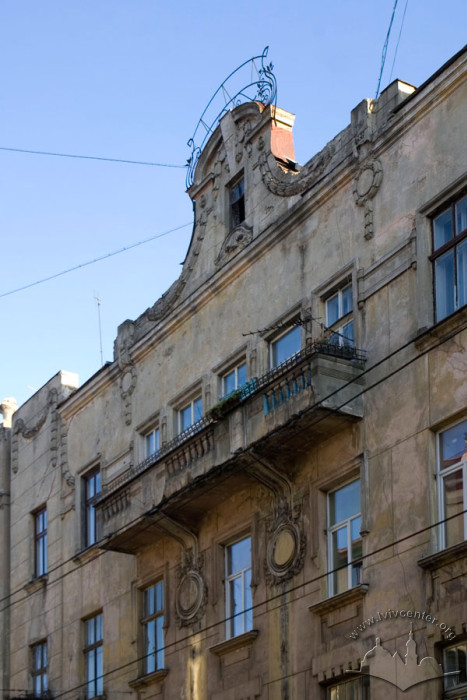
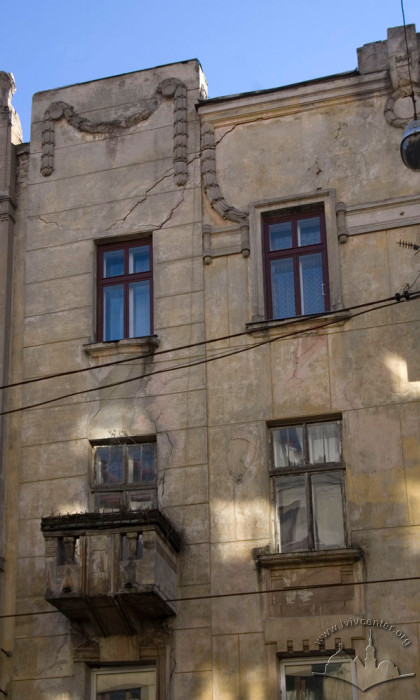
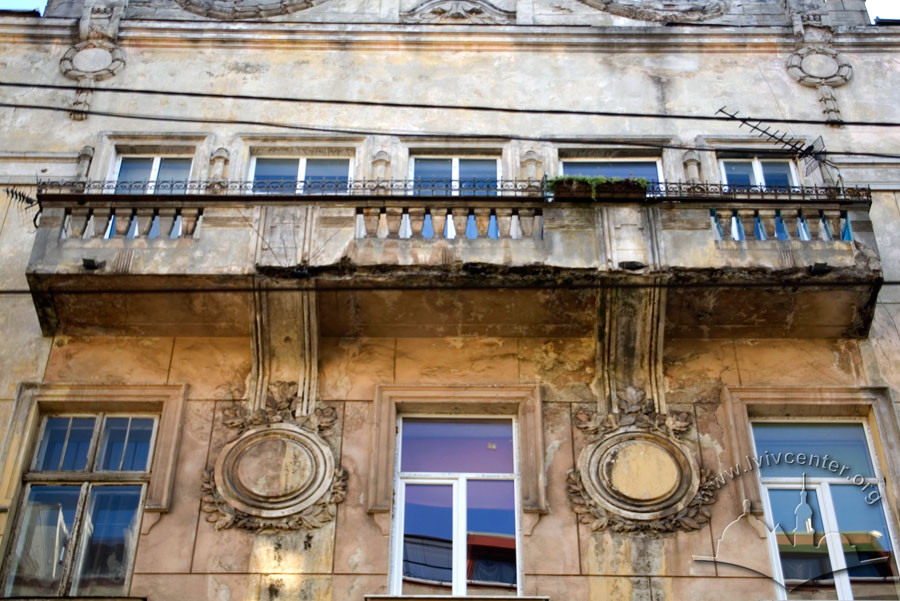
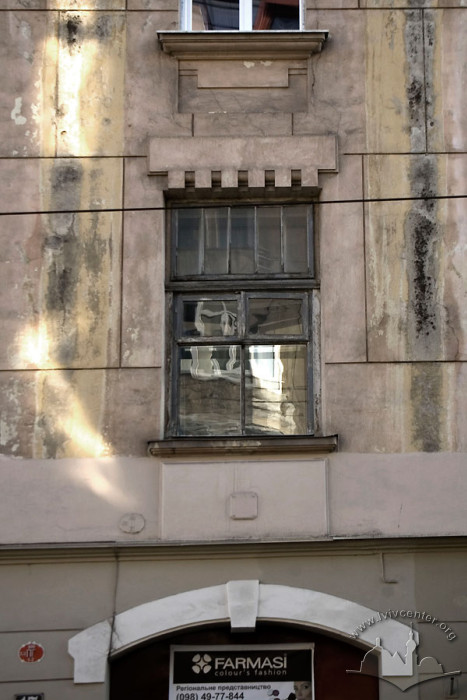
Vul. Petra Doroshenka, 17 – residential building ID: 719
A residential building within the street's terraced development, constructed in 1895. The design author is unknown. Starting in 1905, the building was owned by Dawid Abrahamowicz (1839–1926), a prominent politician who served as the Minister for Galician Affairs from 1907 to 1909. Stanisław Zarewicz, a well-known collector and curator at the Historical Museum, also resided in the building.
Architecture
The four-story, brick, and plastered building has a rectangular plan. The composition of the principal elevation is symmetrical, featuring two side protruded sections at the level of the second, third, and fourth floors, with a driveway situated on the central axis. The side sections are decorated with light banded rustication. The windows of the central section on the second and third floors feature profiled trimmings. At the third-floor level, two symmetrically placed balconies project, featuring plasterwork railings on matching brackets; at the fourth-floor level, a similar balcony is centered on the façade, its brackets transitioning into cartouches. The central portion of the building is topped by a pediment with a smooth silhouette, while the side sections feature attic walls. The pediment is crowned with wrought iron grilles.
Related buildings and spaces
-
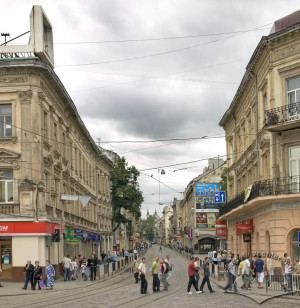
Vul. Petra Doroshenka
Sources
- Державний архів Львівської області (ДАЛО) 2/1/3737
- Lwów. Ilustrowany przewodnik (Lwów: Centrum Europy – Wrocław: Via Nova, 2001), 101.