The Ukrainian Pedagogical Society ID: 104
The Ukrainian Pedagogical Society (until 1912, the Ruthenian Pedagogical Society; from 1926, Ridna Shkola — Ukrainian Pedagogical Society) was a public organization that was based in Lviv and supported Ukrainian education from 1881 to 1939.
This Ukrainian public organization was based in Lviv and engaged in the creation and support of Ukrainian educational institutions, the publication of educational and pedagogical literature, the training of Ukrainian teaching staff, and their supervision. To this end, a network of Ukrainian educational institutions (from kindergartens to vocational schools) was created and expanded, a publishing house for educational literature was founded, the magazines Uchytel, Dzvinok and Ridna Shkola were published, a network of local study groups was created, and teacher seminaries (training colleges) were established. The society operated from 1881 to 1939. During this period, it changed its name several times: before 1912 it was known as the Ruthenian Pedagogical Society; in 1912-1926, as the Ukrainian Pedagogical Society; in 1926-1939, as the Ridna Shkola — Ukrainian Pedagogical Society.
The society's office was located in various places: in the early 20th century, before 1904, it was in the townhouse at pl. Strzelecki 6 (now vul. Lesi Ukrainky 43); from 1904 to 1909, in the building of the Theater Committee at ul. Sykstuska 47 (now vul. Doroshenka, this building no longer exists), and in 1909 it moved to its own building at ul. Mochnackiego 12 (now vul. Drahomanova) (Melnyk, 2015, 254; Yasinchuk, 1931, 55).
The society was modeled after similar public associations of other nations, primarily Slavic ones. The successes of the Czech, Moravian, Slovenian, and German pedagogical societies, as well as the Polish takeover of the provincial pedagogical society and the Provincial School Board, prompted the leaders of the Galician Ukrainians to organize themselves.
The society began its activities in November 1880 in Lviv at a school conference initiated by Lviv University professors and gymnasium teachers: Omelian Ohonovsky, Anatol Vakhnianyn, Fr. Oleksandr Stefanovych, Omelian Partytsky, Roman Zaklynsky, Franz Kostek, as well as school employees Amvroziy Yanovsky, Kornyl Sushkevych, Dmytro Vintskovsky, editor of the newspaper Dilo Volodymyr Barvinsky, and Fr. Ivan Velychko, a canon. They created a temporary organizing committee, which developed the society's charter, approved by the governor's office on 6 August 1881 (Bilavych, 1999, 10; Yasinchuk, 1931, 14).
On 29 September 1881, a provisional (temporary) central committee was created and headed by Amvrosiy Yanovsky, a gymnasium director from Lviv, who compiled school textbooks and was a member of the Galician Sejm (1861-1884) and the State Council in Vienna. During the first five years, this body effectively represented the society’s activities. It was not until March 2, 1884, that a general meeting of the RPS was held where the first central committee was elected and headed by Fr. Vasyl Ilnytsky.
In the early years, the number of the RPS members grew rapidly: from 83 in 1881 to 342 as of February 1884. Later, however, this process slowed down: in its activities, the organization relied primarily on intellectuals and had not yet managed to expand its structure throughout the province. Too much attention was also paid to memorials and petitions to the authorities asking them to change the situation of discrimination in schools, to stop oppression, and to improve the situation of Ukrainian teachers. At the same time, the society achieved success in publishing, launching the publication of popular literature for young people in the Ukrainian language. By 1890, 12 books had been published with a print run of 1-3 thousand copies.
The structure of the society gradually changed towards decentralization. Initially, all power was in the hands of the central committee, which, including the chairman, was elected at the general meeting; it was located in Lviv and had the right to establish branches. The sources of funding for the society were determined by entrance and annual fees, "gifts and donations", income from publishing, as well as various cultural and educational events. Half of the branches' funds were to be transferred to the Central Committee. At the society’s 8th general meeting on 26 November 1891, amendments were made to the charter: branches were given the right to open educational and training institutions, i.e. schools, bursas (boarding schools), and institutes. In February 1898, a three-tier structure of the society was introduced. The branches were joined by "circles", which could be established in areas where there were at least five members. They were to become one of the main links in the society's activities (Bilavych, 1999, 11).
At the turn of the 20th century, the society transformed from a class-based teachers' organization into a mass provincial association with a ramified organizational structure. At that time, it established and supported Ukrainian educational institutions in Lviv and Galicia. In particular, the following institutions were established in Lviv: the St. Nicholas Institute (1889) on ul. Teatyńska (now vul. Maksyma Kryvonosa), the RPS boarding school at ul. Ormiańska (now vul. Virmenska, 1898), a peasant boarding school, whose management operated at ul. Kopernika 17 (1903), the St. Olha Girls' Institute (1899), located initially at ul. Kurkowa 10 (now vul. Lysenka) and later at ul. Sawy 3 (now vul. Myklukho-Maklaya), the Shevchenko Girls' School (1898), which was originally located at ul. Ormiańska 2 (now vul. Virmenska), later at pl. Strzelecki 6 (now pl. Danyla Halytskoho) and at ul. Sykstuska 47 (now vul. Doroshenka), and from 1909 in its own building at ul. Mochnackiego 12 (now vul. Drahomanova). In 1911, the Borys Hrinchenko Public School was opened in the Horodotske neighborhood. Also, in an effort to provide Ukrainian educational institutions with teaching staff, the society opened the first girls' teacher training college in Lviv in 1903. This institution was located at pl. Strzelecki 6 (the former building on the site of what is now house 43 on vul. Lesi Ukrainky facing pl. Danyla Halytskoho) (Yasinchuk, 1931, 100, etc.; Melnyk, 2015, 254).
During this period, the society actively expanded its influence in the province: branches were established in Kalush, Ternopil, Mykolaiv, Kolomyia, Przemyśl and other towns. The social composition also changed: from 1909, the majority of RPS members were peasants. Publishing activities gained momentum: in the pre-war period, the society issued more than 150 publications, including Shevchenko's Kobzar for young people and the children's geographical encyclopedia entitled A Journey Around the Earth. The print runs of publications increased to 3-10 thousand copies (Bilavych, 1999, 29). In 1912, the organization changed its name to the Ukrainian Pedagogical Society (UPS).
The First World War dealt a heavy blow to the UPS. During the Russian occupation of Galicia in September 1914 – June 1915, the society was closed, its property, literature, and documentation were destroyed, and the deputy head of the organization, Kostiantyna Malytska, as well as Volodymyr Okhrymovych and Mykola Shukhevych, were imprisoned and deported to Yeniseysk for "Mazepism". (Malytska, "On the Waves of the World War", Dilo, 1937, No. 68, 7).
After the end of the Polish-Ukrainian War, the UPT began to rebuild its structure. Despite obstacles from the Polish authorities (refusal to register cells, Polonization of the education system), the society retained both its centers and educational institutions. In 1926, the organization changed its name to Ridna Shkola — Ukrainian Pedagogical Society (abbreviated as Ridna Shkola).
Due to the displacement of the Ukrainian language from the Polish state education system, Ukrainians had fewer opportunities to receive education in their native language, and therefore the Ridna Shkola became focused on private educational institutions (schools, gymnasiums, courses, etc.). In a number of localities in Galicia, usually where it was not possible to open public schools, so-called "collective lectures" emerged — private lessons for students in the Ukrainian language, which were created by the Ridna Shkola study groups. The Ridna Shkola also oversaw the gymnasiums of the Basilian Sisters, two of them were located in Lviv. The society's educational institutions operated according to the programs it had created and were provided with textbooks and other teaching materials, mostly produced by the UPT publishing house.
The private institutions of the Ridna Shkola operated under difficult conditions. Their establishment was permitted by Polish law, but local authorities used any excuse to close them down. Thus, in the 1923/24 academic year, 19 UPT public schools were closed, and the main motive, according to the secretary of the society, L. Yasinchuk, was that "the existing public schools fully satisfied the cultural and religious needs of the Ruthenian community". At the same time, a men's vocational school in Stanislaviv (now Ivano-Frankivsk), which was supposed to provide professional education, was closed on the pretext that "the goal of the founders of these courses was to prevent Ukrainian youth from coming into contact with Polish youth and Polish culture, and be subjected to separatist influences" (Yasinchuk, 1931, 173,181). However, despite these obstacles, the society still tried to create and expand the existing educational network. In addition to public schools and gymnasiums, in the interwar period it also maintained vocational courses in weaving (Borshchiv), carpentry (Kosiv) and driving (Lviv), as well as merchant gymnasiums in Lviv and Stanislaviv, a cooperative school in Yavoriv, an agricultural school in Shybalyn, and other institutions (Bilavych, 129-131).
Maintaining and expanding the network of educational institutions (in the interwar period, kindergartens and vocational schools were added to them), as well as publishing activities, required considerable funds. In the interwar period, fundraising for the Ridna Shkola gained momentum. While in 1922 this campaign covered 35% of the communities of Eastern Galicia, by 1933, 95% were already donating to the Ridna Shkola. However, these funds were still not enough for the society: in 1931, its debt amounted to 191,000 zlotys. The organization was saved from complete collapse by a loan from the Land Mortgage Bank (3,300 dollars with an interest rate of 13% per annum), the Charitable Committee, which was created by the financial and economic institutions and collected up to 70,000 zlotys, and the assistance of 96 charitable members (Metropolitan Sheptytsky alone donated 10,000 zlotys). However, the society was unable to achieve financial stability: by the end of 1938, its debt grew again to 140,000 zlotys (Bilavych, 1999, 58-59).
After the Soviet occupation of western Ukrainian lands, the activities of the Ridna Shkola were suspended. Many of its members emigrated to Argentina, Brazil, Canada, and the United States, where they organized branches of the society among the Ukrainian diaspora.
Related buildings and spaces
-
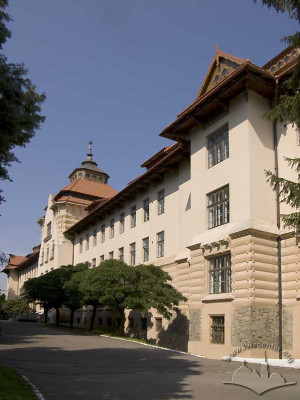
Vul. Henerala Chuprynky, 103 – forestry university
People
Amvroziy Yanovsky — director of the gymnasium in
Lviv, member of the Galician Sejm (1861-1884) and the State Council in Vienna,
compiler of school textbooks, the first head of the Ruthenian Pedagogical
Society.
Fr. Vasyl Ilnytsky — head of the Ruthenian Pedagogical
Society, elected in 1884.
Kostiantyna Malytska — writer, deputy head and activist
of the Society, deported to Yeniseysk during the Russian occupation of Galicia.
Sources
- Костянтина Малицька, "На хвилях світової війни", Діло, 1937, №68, с. 7;
- Лев Ясінчук, 50 літ Рідної Школи. 1881-1931, (Львів: Накладом т-ва "Рідна школа", 1931),270;
- Галина Білавич, Борис Савчук, Товариство "Рідна школа" (1881-1939 рр.), (Івано-Франківськ: Лілея-НВ, 1999), 208;
- Ігор Мельник, Львівське середмістя: всі вулиці, площі, храми й кам'яниці, (Львів: Апріорі, 2015), 320.