Provincial School Board of Galicia ID: 108
An institution supervising primary, secondary, and vocational education in the crown land. The Board was headed by the governor of Galicia or his appointed deputy and operated from 1868 to 1921.
The idea of creating a provincial education authority arose in the mid-19th century. On February 12, 1851, the Ministry of Religion and Education issued a decree establishing a separate Provisional Provincial School Board for Galicia. It was to be a subdivision of the governor's office headed by the governor himself. However, its activities were generally subordinate to the aforementioned ministry and did not differ much from those of the provincial school councils of the other crown lands throughout the Austrian Empire (Moriak-Protopopova, 2011, 73).
In 1865, the Galician Provincial Diet (Sejm) approved a project to create a permanent Galician Provincial School Board. It was to consist of a director appointed by the emperor, two school inspectors, two priests, a member of the provincial commission, two representatives from the city councils of Krakow and Lviv, and two teachers appointed by the emperor at the suggestion of the provincial commission. On June 28, 1867, the Austrian authorities gave their consent to the creation of the board. At the same time, this decree gave the institution less authority than the Sejm's draft law. Specifically, only elementary and secondary schools remained within its jurisdiction. The solemn inauguration of the Galician School Board took place on January 24, 1868, in the Roman Catholic Cathedral of Lviv. At the same time, its first meeting was held and the main directions of its activity were determined (Lukaniuk, 2007, 143; Szematyzm, 1879, 8; Moriak-Protopopova, 2011, 74).
At its initial stage, the Galician Provincial School Board had limited capabilities. In 1875, it lost the right to appoint teachers and professors in secondary schools. It was not until 1907 that its powers were significantly expanded: the board was granted the right to submit candidates for the positions of provincial school inspectors to the Ministry of Culture and Education and to propose candidates for the positions of directors in secondary, industrial, and higher commercial schools; the right to supervise pedagogical, didactic, economic, and administrative affairs in elementary, secondary, commercial, and industrial schools; the right to approve school textbooks and auxiliary teaching materials, draw up scientific plans and school regulations; the right to draft and approve draft laws. However, it could only exercise its powers within the framework of imperial laws and under the supervision of the Ministry of Culture and Education (Lukaniuk, 2007, 144).
The membership and structure of the Provincial School Board changed over time. According to the 1867 statute, it was headed by the governor or his appointed deputy. On April 18, 1890, a law was passed introducing in the provincial administrations of Prague, Vienna, and Lviv the position of deputy governor, who actually headed the school boards. Usually, the practical management of the provincial school board was carried out by its vice-president (most often one of the professors of Lviv University), appointed by the monarch on the recommendation of the Minister of Religion and Education. The members of the board were as follows: the governor's representative for school affairs, two clergymen invited by the governor, one representative of the Provincial Department (the executive body of the Galician Provincial Sejm), two representatives of Lviv and Krakow elected by the city councils, and two well-known scholars, whose candidacies were submitted by the Provincial Department and approved by the governor. Each time, the governor invited two school inspectors to the meeting. Under the 1905 law, the board composition changed slightly. The number of the Provincial Department representatives was increased to three, and the number of the clergy representatives to five (three priests of the Roman, Greek, and Armenian Catholic rites, an Evangelical priest, and a representative of the Jewish community). Poles constituted the majority in the board. According to Professor Volodymyr Kulchytsky, in 1910, only five of the thirty-three members of the board were Ukrainians, and in 1913, their number decreased to three (Lukaniuk, 2007, 144; Moriak-Protopopova, 2011, 74).
Initially, the Provincial School Board consisted of three sections. The first dealt with public schools and seminaries, the second managed gymnasiums and real schools, and the third dealt with trade and industrial schools. On November 3, 1908, the council's presidium divided the first section into three departments. The competence of department "a" encompassed personal files of teachers (in particular, those retired), the assignment of qualifications, the appointment of assistants, promotions, transfers, vacations, disciplinary matters, temporary and permanent retirement, salary increases, salary deductions, benefits, overtime pay, religious education bonus, etc.
Department "b" was responsible for the organization and reorganization of schools and related legal issues (scholarships, right of presentation, language of instruction), the systematization of positions for teachers of religion and other subjects, the construction of schools, as well as the printing of school books at the publishing house of the governor's office.
Department "c" dealt with matters relating to teacher seminaries (training colleges), scholarships, boarding schools, district and local school boards, district school inspectors, conferences, courses, teacher and student examinations, exemption from the matriculation examination for admission to the qualifying examination, all matters relating to teaching and its sources, attendance and compulsory schooling, matters relating to school statistics, reports on the state of teaching and education, estimates and closing accounts of school provincial funds, supervision of schools and teacher seminaries. As of 1914, there were already six departments (Moriak-Protopopova, 2011, 75).
The provincial law (adopted on June 22, 1867) on the language of instruction in elementary and secondary schools replaced German with Polish, giving education a distinctly Polish national character. The legislative status of the Ukrainian language remained unregulated juridically, thus facilitating the process of Polonization of the education system. Formally, according to the above-mentioned law, the right to decide on the language of instruction in elementary schools belonged to the school's owner, which was usually the rural community. However, if the community was subsidized from the provincial budget, its decision had to be approved by the Provincial School Board. Most communities in Ukrainian villages lacked the funds to maintain their own schools, and therefore their rights to choose the language of instruction were significantly limited. As a result, all public elementary schools in the eastern part of Galicia were bilingual (Pakholkiv, 2014, 148).
In state secondary schools, the Ukrainian language was even more discriminated against. A Ukrainian gymnasium could only be established with the consent of the Galician Sejm, whereas no such consent was required for the establishment of a Polish gymnasium. This situation was unique to the Habsburg Empire, as in other provinces the introduction of a language of instruction in secondary schools was agreed only with the Ministry of Education in Vienna.
The efforts of Ukrainians to establish Ukrainian-language gymnasiums yielded little results: by 1895, only the Academic Gymnasium in Lviv was completely Ukrainian-speaking. On October 4, 1884, Julian Romanchuk, a Ukrainian Sejm member, proposed amendments to the provincial law on the language of instruction, which would allow parallel classes with Ukrainian as the language of instruction to be opened at the request of parents or guardians of at least 25 students. The provincial school board opposed this, arguing that it had not had the opportunity to study the issue. Finally, on January 24, 1887, at a meeting of the Sejm, it was decided that Ukrainian should remain the language of instruction at the Academic Gymnasium in Lviv, and that parallel Ukrainian-language classes should be introduced at the gymnasium in Przemyśl. In all other schools, the Ukrainian language was to be introduced only "within the limits of reasonable need" (Pakholkiv, 2014, 149-150).
In the late 19th century, the dissatisfaction of Ukrainian educators with the activities of the Provincial School Board reached such a level that in 1899, Teofil Okunevsky, another Ukrainian Sejm member, speaking at a meeting of the Galician Sejm, stated that he saw no other way to improve the state of education of the Ukrainian population of the province except to divide the council into two parts: "one for the Ruthenian people and the other for the Polish people, so that we could manage our own education and culture, rather than having strangers take care of us".
Considering Galicia to be the foundation for the revival of their state, the Poles sharply criticized the proposal. However, the board's activities also drew criticism from them. According to Kazimierz Bruchnalski, a Polish school inspector, who published a book in 1920 on the state of education in Galicia in 1909-1914, the conditions of education in the province's schools were appalling.
There still were schools located in dark, cramped huts, some without even a floor. Thirty to forty children studied in them in an area of 16-18 sq. m., the height of the room barely reaching 1.85 m. Only 3-10 percent of children reached the sixth grade; just 55 percent entered the first grade. The normal school year lasted only five winter months out of the planned ten. Even earlier, in 1909, the Galician Sejm recognized the activities of the Provincial School Board as unprofessional since 15 percent of local communities did not have their own schools (Moriak-Protopopova, 2011, 77).
The Provincial School Board existed until 1921, when the Polish government reorganized it into the Curatorium of the Lviv School District, which, in turn, operated until 1939 (ЦДІАЛ, 2001, 168).
Related buildings and spaces
-
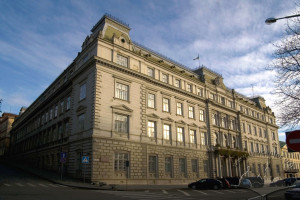
Vul. Vynnychenka, 18 – building of the Lviv Regional State Administration
-
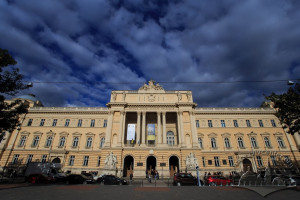
Vul. Universytetska, 1 – Lviv Ivan Franko National University main building
-
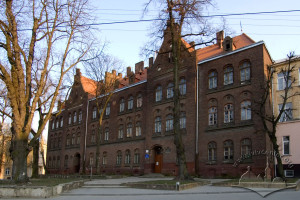
Vul. Bandery, 11 – School building
-
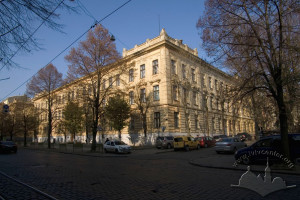
Vul. Bandery, 14 – Academic Gymnasium
-
Vul. Kalicha Hora, 5 – an abandoned building
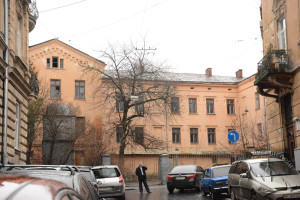
-
Pl. Soborna, 3a – Central State Historical Archive of Ukraine

People
Sources
- Сергій Луканюк, "Організація, завдання та значення діяльності крайової шкільної ради в багатонаціональній Галичині (1867-1918 рр.)", Наукові записки Тернопільського національного педагогічного університету. Серія: Педагогіка, 2007, №9, 143-147;
- Святослав Пахолків, Українська інтелігенція у Габсбурзькій Галичині: освічена верства й емансипація нації, (Львів, "Піраміда", 2014), 612;
- Христина Моряк-Протопопова, "Крайова шкільна рада у Галичині: повноваження, структура і вплив на розвиток шкільництва у 1867–1918 рр.", Вісник Львівського університету. Серія юридична, 2011, 54, 73-80;
- Центральний державний історичний архів України, м. Львів (ЦДІАЛ), Путівник, (Київ, 2001), 412.