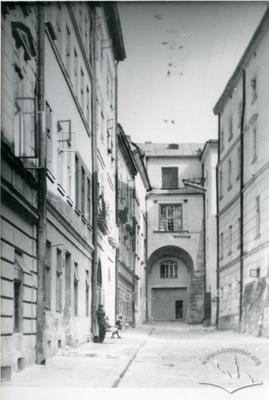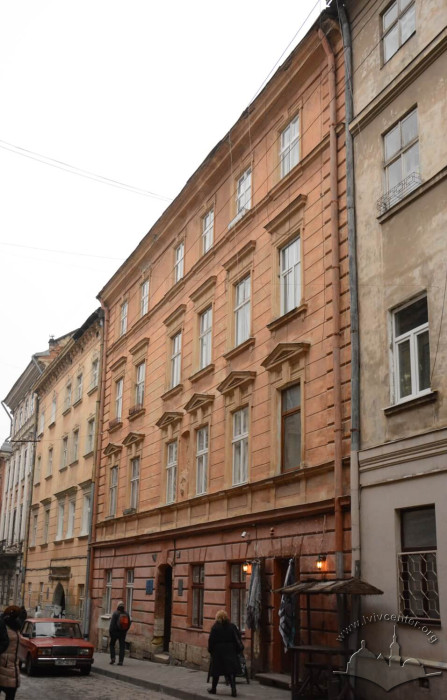
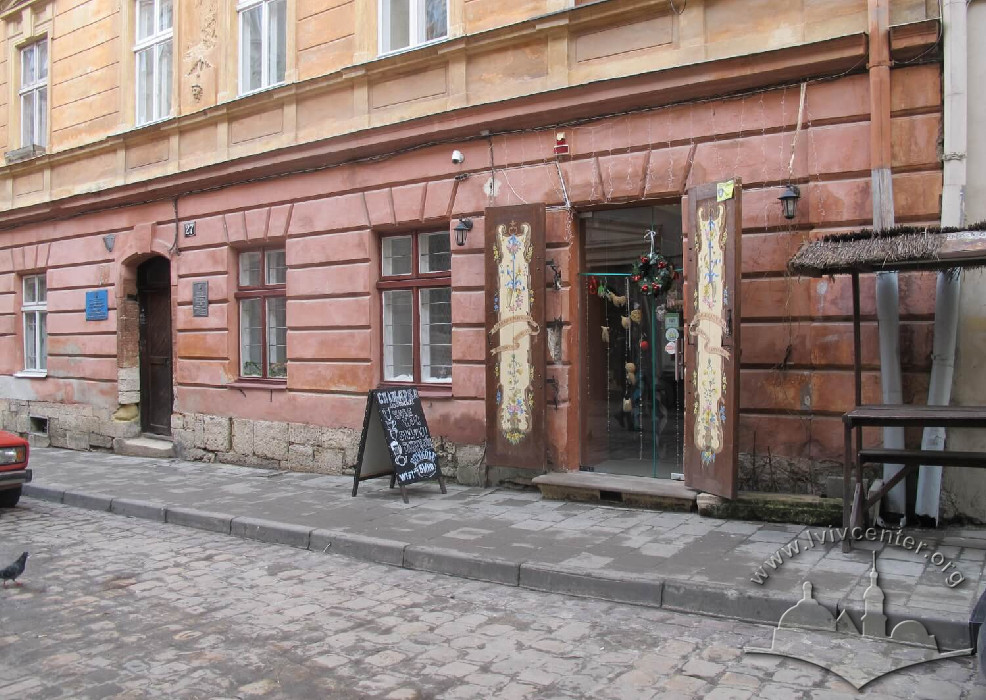
Vul. Virmenska, 27 – residential building ID: 2457
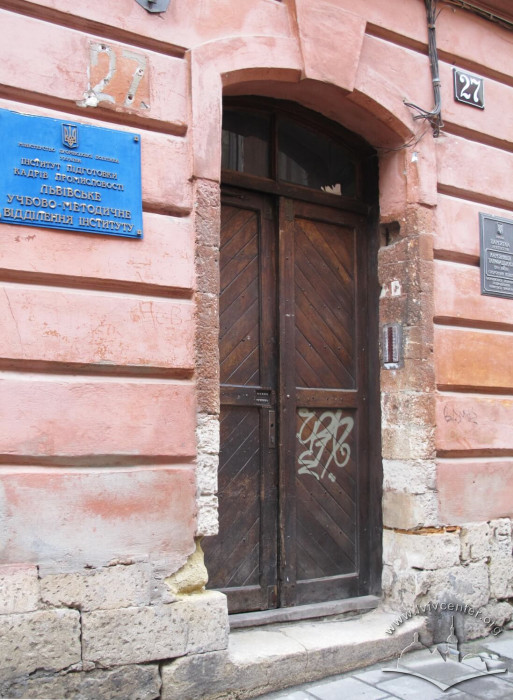
This is a late Baroque townhouse, constructed in 1783 on the site of two medieval buildings. During its reconstruction in 1807, designed by Fryderyck Pachmann, it acquired features of the Neorenaissance style. It is an Architectural Monument (Protection No. 25-M). Previously, it housed the Prosvita cultural society and a mirror factory, and today (2015) it houses the Lviv educational and methodological department of the Institute for Industrial Personnel Training and the Spizharka café.
Story
Seventeenth century — two Renaissance townhouses were constructed here: the two-story Tarafatska and the one-story Manchukivska.
1783 — a four-story Late Baroque townhouse was erected on the old foundations and cellars.
1807 — the building underwent a reconstruction, with the façade decorated in the Neorenaissance style.
1923 — the outhouses were renovated, and a window was converted into a doorway.
1950s — repairs were carried out, and the first-floor premises were converted into living quarters.
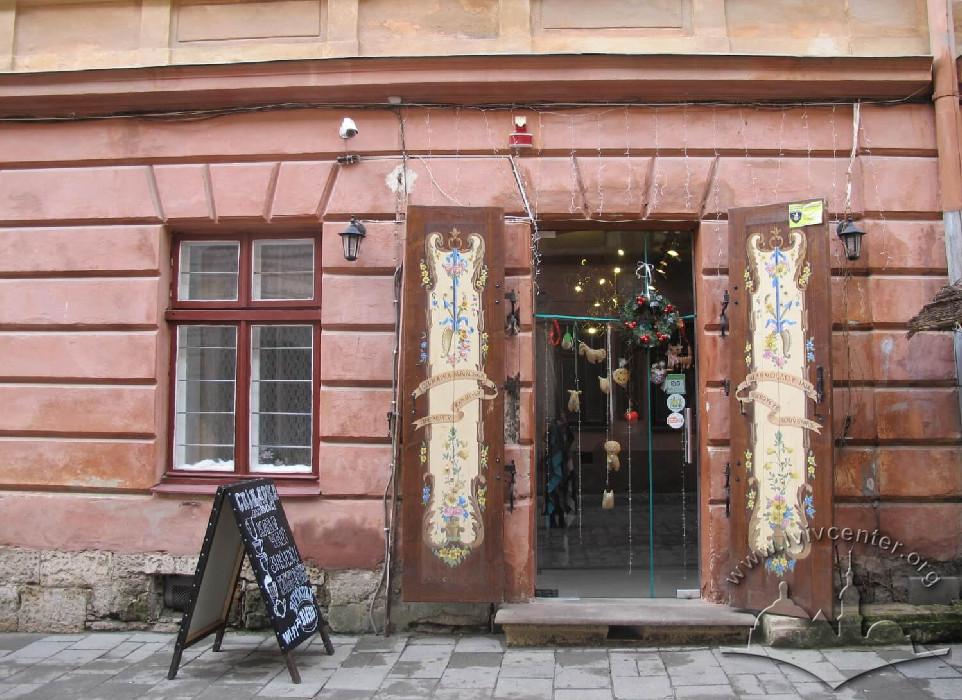
2012 — the Spizharka café was opened on the ground floor, and the far right window was converted into an entrance.
The building is located in the dense development of vul. Virmenska, one of the longest streets in the city center. The first mention of the Armenian district dates back to 1394. The modern building stands on the site of two smaller townhouses — Tarafatska (on the left), which had a 6.85 m façade, and the single-story Manchukivska/Manchukewicz (on the right), 11 m wide. The earliest archival references to both date back to the seventeenth century. The Manchukivska stone building is mentioned in the magistrate's book under the years 1630–1631 as the Manchukivsky House. Tarafatska is mentioned in 1640. In the 1767 cubit tax, Manchukivska and Tarafatska townhouses are noted on the site of the modern house No. 27 (Могитич, 2009, 29).
In the second half of the eighteenth century, the Tarafatska townhouse belonged to the Armenian judge Gabryel Arakełowicz. The wife of the late Gabryel Arakełowicz, Euphrosyna, sold her townhouse in 1773 to the Ostryna starost, armored captain of the crown army Ignacy Woronicz and his wife Cecylia z Rozwadowskich for 6,500 zł. In the same year, Woronicz bought the Manchukewicz townhouse from the widow of Elżbieta z Manchukewicz Jaśkiewicz, wife of Gabryel Yaskievich, for 11,500 zł. Elżbieta Jaśkiewicz had purchased this townhouse in 1764 from the Minsk deputy cup-bearer Wojciech Lachowski.
One of the Woronicz houses, the Tarafatska tenement, in 1780 "had a cellar and a small vault on the ground floor, one large room on the upper floor, and one room on the second floor with a second small room opposite it." In 1782 the buildings burned down during the fire of 1778 — the Manchukewicz building (conscription No. 115) and the Arakewicz Tarafatska building (conscription No. 116) — were purchased at a public auction by notary Franciscus Xaverius Jaśkiewicz for 8,105 zł. In the same year and for the same amount, Jaśkiewicz sold both destroyed tenements to fiscal assessor Grzegorz Uranowicz. Uranowicz, a member of the Lviv Stauropegion Brotherhood (since 1778), acquired two Woronicz houses and in 1783 built a new one on the original foundations in the Late Baroque style characteristic of that time. However, an undeveloped plot of land "extending to the city moat" (the northern stretch of the city fortifications) remained at the rear of the buildings. This vacant plot was offered to the Riflemen's Brotherhood to buy and build on. The 1788 city land registry (tabula) records that Grzegorz Uranowicz built one townhouse from the foundations on the site of two smaller ones. A stable for six horses was built in the basement at the rear. According to an estimate made by architect Klemens Fesinger and builder Jakób Piotrowski in 1788, the cost of the new construction totaled 52,130 zł.
The townhouse was reconstructed at the beginning of the 19th century. Since then, the project of architect Fryderyk Pachmann, dated 1807, has been preserved, presenting the modern architectural design of the building. At that time, the façade was clad in a distinctive Neorenaissance architectural style.
In 1887, the Prosvita society was located on the second floor of the building. In the interwar period, the co-owners of the townhouse were Maria Wołeńska and the Świsterski family: Kazimierz, Sofia Anna, and Stanisław. In 1923, the outhouses in the courtyard were reconstructed, and the window was converted into a door for Edmund Cybulski's candy workshop, located in a two-story building (now a separate building at vul. Lesi Ukrainky 30). In 1928, the co-owners of the building received a request from the magistrate to restore the damaged and dirty front and courtyard façades and wings. This also applied to the gate-porch and staircase. However, even in 1937, the requirements had not been met.
The building housed M. Byk's mirror factory, and today (2015) it houses the Lviv Educational and Methodological Department of the Institute for Industrial Personnel Training. In 2012, the far right window on the first floor was converted into the entrance to the new Spizharka café.
Architecture
The four-story building is situated within the terraced housing. Constructed on a deep, narrow lot, it rests on the foundations and cellars of two seventeenth-century Renaissance stone houses. Built of brick and stone, on stone foundations, the structure is plastered and features vaulted cellars, with a semi-basement floor made of hewn white stone blocks. Rectangular in plan, it includes a narrow four-story rear wing adjoining the western boundary wall.
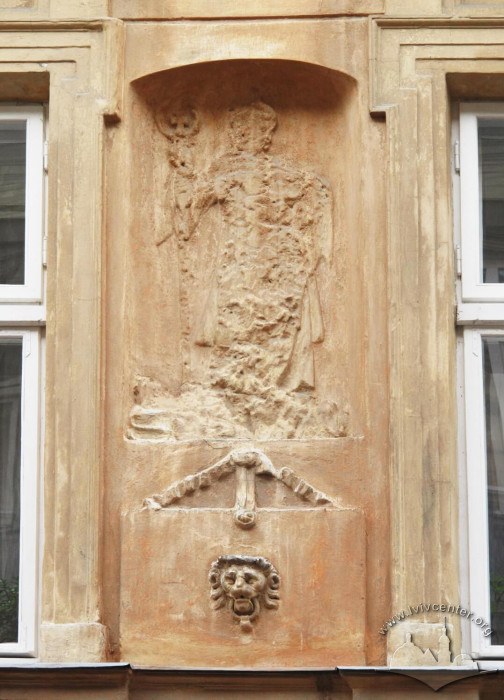
The main façade is designed in the Neorenaissance style. Spanning six axes,, it features an asymmetrical composition: a wider pier separating the second and fourth rhythmic window axes indirectly emphasizes the old townhouses (narrower and wider) rebuilt into one. The main entrance, located on the fourth axis on the right, is decorated with a simple white stone portal with a segmental lintel accentuated by a large keystone. In the space between the third and fourth windows of the second floor's right section, there is a segmented niche containing the remnants of a sculpture holding a small cross in its hand. A lion mascaron adorns the slab beneath the niche. The façade is finished with a profiled cornice, flanked on both sides by rusticated pilasters, with the first to third floors featuring rustication. Inter-tier cornices emphasize the ground, second, and fourth floors. The windows are trimmed with profiled frames: on the 2nd floor with triangular pediments, on the third floor with linear ones, and on the fourth floor with keystones.
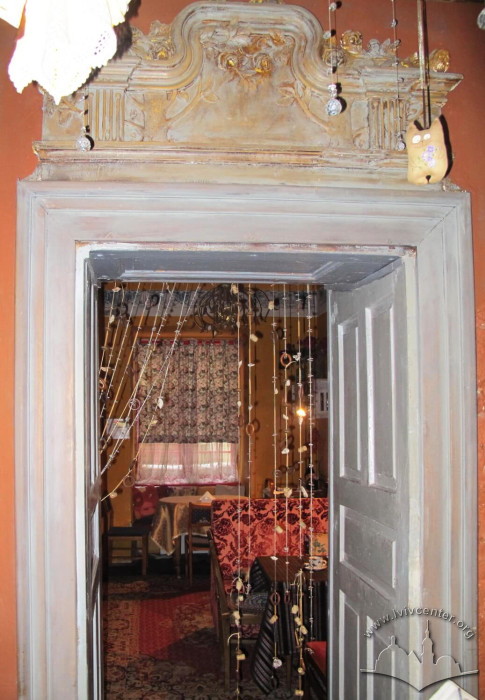
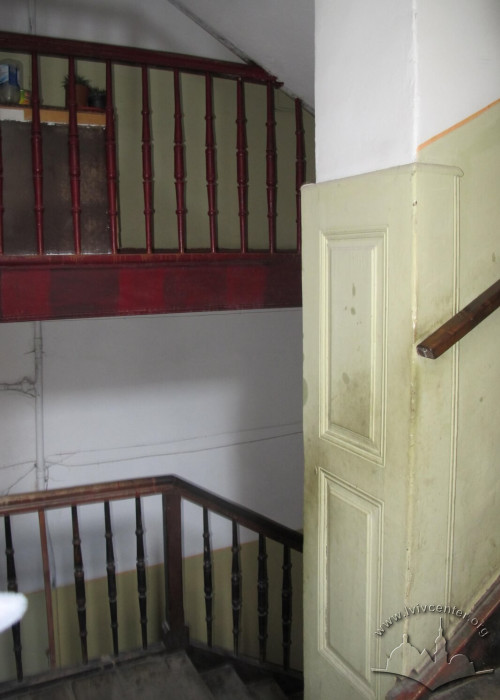
The building has retained its spatial layout characteristic of the late eighteenth century, featuring a narrow gatehouse and a narrow wooden staircase situated between the rear walls. The floor ceilings are flat timber-beam constructions, while the cellars are covered with stone vaults. The building has a gable roof with a wooden rafter system, covered in sheet metal.
The structure preserves the character of a Late Baroque townhouse, overlaid with Neorenaissance stylistic features from the early nineteenth century.
People
Wojciech Lachowski — Minsk deputy cup-bearer, owner of the Manchukewicz tenement house until 1764.
Gabryel Arakełowicz — Armenian judge, owner of the Tarafatska tenement in the second half of the 18th century.
Gabryel Jaśkiewicz — late husband of Elżbieta Manchukewicz Jaśkiewicz.
Grzegorz Uranowicz — imperial and royal fiscal assessor, member of the Lviv Stauropegion Brotherhood, who in 1783 built a new tenement house on the foundations of two acquired ruined buildings.
Edmund Cybulski — owner of a candy factory located in a two-story building at vul. Lesi Ukrainky 30 (formerly ul. Virmenska 27).
Euphrosyna Arakełowicz — wife of Gabryel, owner of the Tarafatska tenement house until 1773.
Elżbieta z Manchukewicz Jaśkiewicz — owner of the Manchukewicz tenement in 1764–1773.
Ignacy Woronicz — Ostryna starost, armored captain of the Crown Army, owner of the Tarafatska tenement house from 1773.
Kazimierz Świsterski — co-owner of the tenement.
Klemens Fesinger — Lviv architect of the late Baroque period, who assessed the new tenement house built in 1783.
M. Byk — owner of a mirror factory located in the tenement house at ul. Virmenska 27.
Maria Woleńska — co-owner of the tenement.
Sofia Anna Świsterska — co-owner of the tenement.
Stanisław Świsterski — co-owner of the tenement.
Franciscus Xaverius Jaśkiewicz — notary who, in 1782, purchased the Manchukewicz and Arakewicz tenement houses, destroyed by fire, at auction.
Fryderyk Pachmann — architect who designed the reconstruction of the tenement in 1807, giving it its modern appearance.
Cecylia z Rozwadowskich Woronicz — wife of Ignacy Woronicz, owner of the Tarafatska tenement house since 1773.
Jakób Piotrowski — builder who assessed the tenement house built in 1783.
Sources
- Державний архів Львівської області (ДАЛО) 2/1/1204. Справа перейменована: ДАЛО 2/1/1180. URL: https://e.archivelviv.gov.ua/file-viewer/227959#file-730600
- Центральний державний історичний архів у Львові (ЦДІАЛ) 186/8/829.
- Володимир Вуйцик, "З історії кам'яниць вулиці Вірменської. Будинок №27", Leopolitana II, (Львів: Класика, 2012).
- Мирон Капраль, Національні громади Львова ХVІ–ХVІІІ ст. (Львів, 2003).
- Ганна Кос, "З історії забудови Вірменської вулиці у Львові", Записки НТШ, 1998, Т. 127.
- Роман Липка, Ансамбль вулиці Вірменської (Львів: Каменяр, 1983).
- Богдан Мельник, Ніна Шестакова, "Кам'яниці Львівського середмістя", Наукові записки. Львівський історичний музей, 2008, Випуск XII, 133-158.
- Роман Могитич, "Архітектура і містобудування доби середньовіччя (XIII – поч. XIV ст.)", Архітектура Львова: Час і стилі. XIII–XXI ст. (Львів: Центр Європи, 2008).
- Роман Могитич, "Ліктьовий податок", Вісник ін-ту Укрзахідпроектреставрація, 2009, Ч. 19.