Vul. Konovaltsia, 8 – residential building ID: 1381
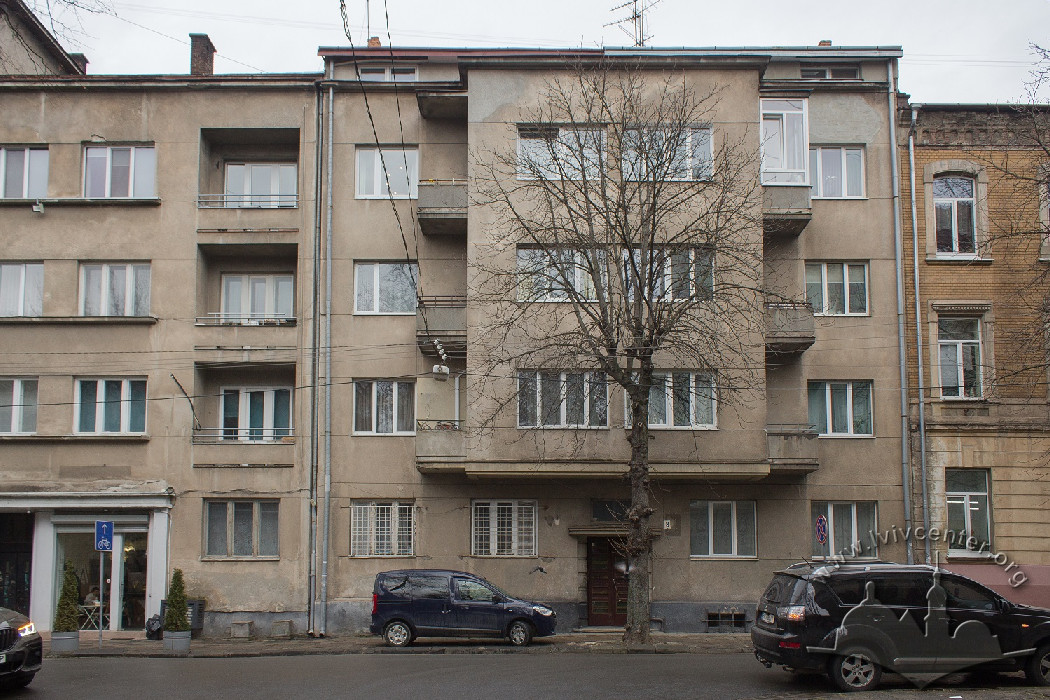
A four-story modernist residential building constructed in 1936–1937 under a project designed by Zygmunt Schmucker for pharmacologist Izydor Ginsberg.
Story
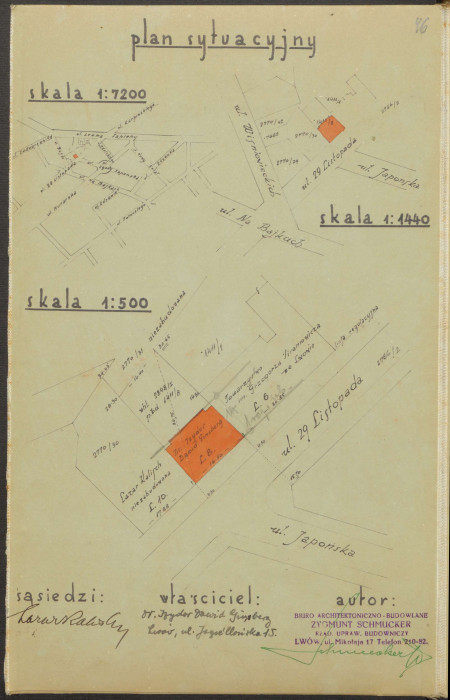
In the 19th century, the area between the present-day vul. Antonovycha, vul. Bandery, vul. Konovaltsia, and vul. Kyivska was occupied by a large plot of land with conscription number 82-83 ¼. In 1870, plot 925 ¼ was separated from it, corresponding to the current buildings at vul. Bandery 57 and vul. Konovaltsia 4, 6, and 8. The 1916 index of Lviv property owners names architect Julian Cybulski as the owner of the plots corresponding to the current buildings at vul. Konovaltsia 8 and 10 (Skorowidz, 1916). He may have purchased this land on the eve of the First World War but did not have time to build anything there.
This building’s archival file begins in 1935 (ДАЛО 2/1/3359). At that time, the undeveloped plot was owned by Ludwika Hoffman, who lived nearby at vul. Kyivska 18 with merchant Józef Hoffman. The City Council approached her with a request to replace the old fence with a new, more aesthetic one (ДАЛО 2/1/3359:1). Citing the fact that her neighbor had just planned a new construction project and that it would inevitably damage the fence, she asked to postpone the replacement for a year (ДАЛО 2/1/3359:4).
On July 16, 1936, Ludwika Hoffman signed a purchase and sale agreement. The plot was purchased for 29,500 zlotys by Dr. Izydor Dawid Ginsberg, a pharmacologist (ДАЛО 2/1/3359:6-8). At that time, he lived in Lviv at ul. Jagiełłońska 15 (now vul. Akademika Hnatiuka). The text of the contract states that Hoffman purchased the house in 1931 from the Society for the Care of the G. Piramowicz Boarding School, and that the society promised her that it would approve the construction of a taller building in the future, if the need arose.
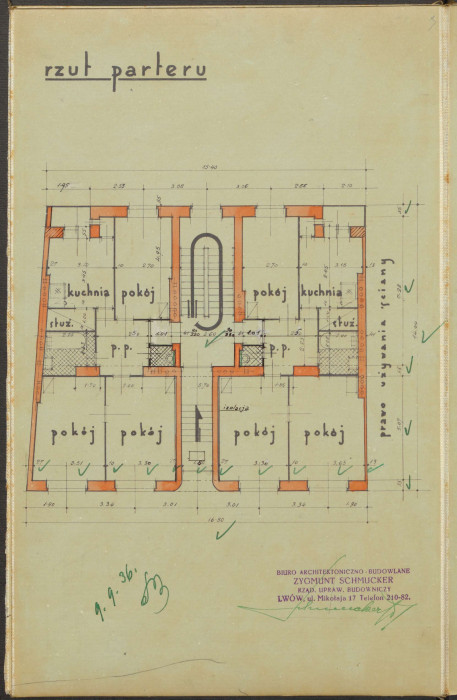
In August 1936, a project for a modernist four-story building designed by architect Zygmunt Schmucker was already ready (ДАЛО 2/1/3359:5). The building frontage line was clarified. The archive also contains static calculations of the building's load-bearing structures (ДАЛО 2/1/3359:10-15) performed by engineer Garfunkel.
During the review of the project by the City Council in early September 1936, the head of the construction supervision department, Marian Helm-Pirgo, made comments on the appearance of the building's bay window and demanded that it be redesigned (ДАЛО 2/1/3359:18). On September 16, 1936, a building permit was granted (ДАЛО 2/1/3359:19). In October 1936, a second set of drawings was approved. On September 28, the construction began under the supervision of Zygmunt Schmucker, and by December 17 the building was erected, although it was not yet finished either outside or inside (ДАЛО 2/1/3359:28).
In July 1937, Izydor Ginsberg requested permission to install a shaft for loading coal into the basement. Since the sidewalk was owned by the city, he was denied such a permission (ДАЛО 2/1/3359:30). In August, permission was granted to move into the fully completed building (ДАЛО 2/1/3359:41).
During the Holocaust, Izydor Ginsberg was a member of the Lviv Judenrat. He probably died in the Lviv ghetto.
Today (2025), the building is entirely residential.
Architecture
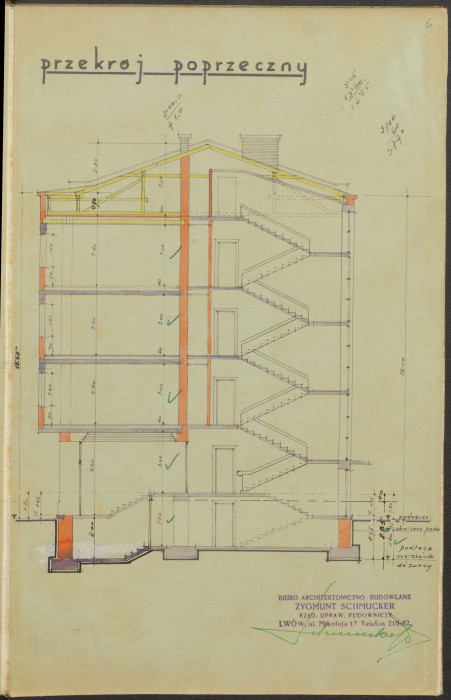
The four-story building is located in a row of houses on the street. The foundations and walls are made of brick. The floors, foundation pads, and stairs are made of reinforced concrete (according to drawings by Zygmunt Schmucker from 1936). The attic floor and the roof truss structure are made of wood. The roof is made of tin.
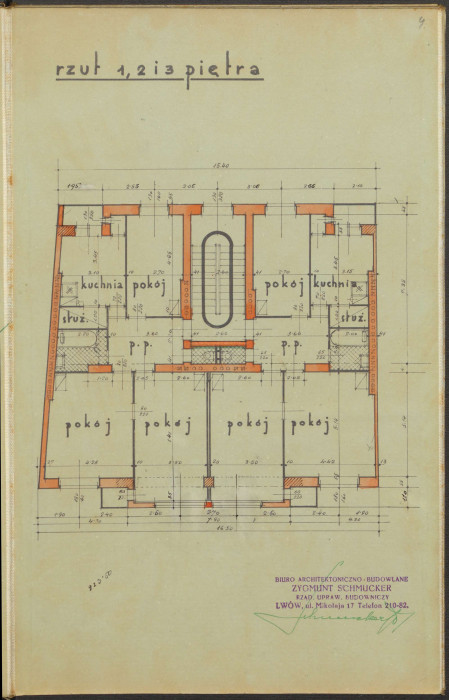
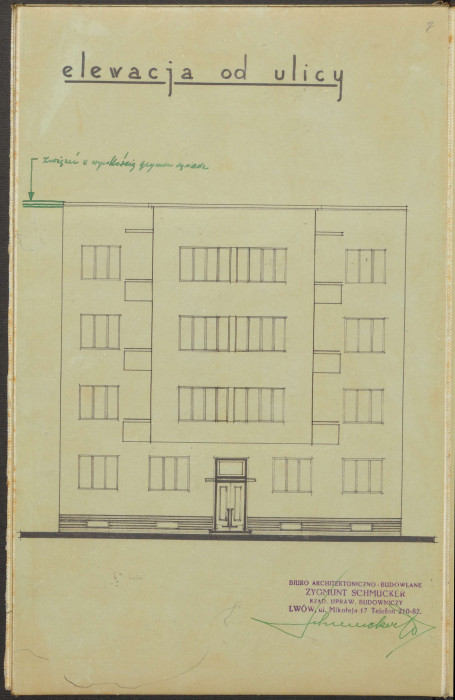
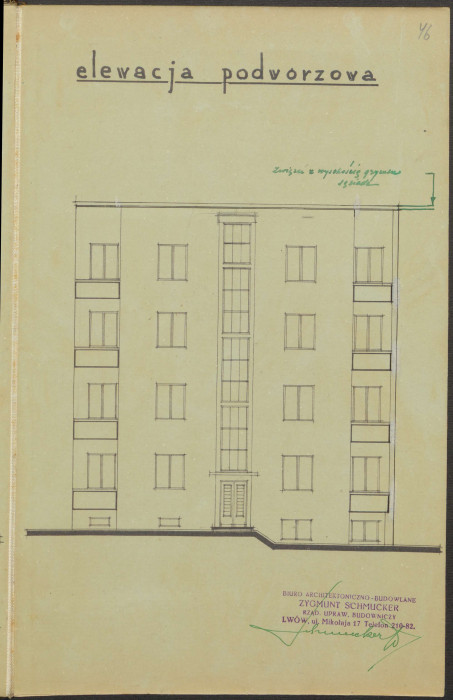
The building is close to rectangular in plan. The main entrance is located in the center of the façade and leads to a hallway with several steps. From there, there is access to two apartments. The main staircase is a typical two-flight one. According to the original design, there are two three-room apartments on each floor. Each of them has a small hallway, followed by an approximately square lobby from which there are entrances to all other rooms. Two living rooms have windows facing the street, and one has a window facing the courtyard. There are separate toilets and bathrooms. The kitchen has a window facing the courtyard and a small loggia. From the kitchen a maid's room can be accessed, just big enough to fit a bed. The apartments on the second to fourth floors differ in that one of the rooms is larger due to a bay window and has a small balcony.
According to the 1936 drawings, the basement was to be occupied by storage rooms for residents. It also housed a laundry room, a room for the caretaker, and a toilet.
The minimalist façade is symmetrical. In the center of the second to fourth floors, there is a wide bay with small balconies on either side. The entrance is decorated with rusticated rounded walls on either side, a small cornice at the top, and a transom light. The authentic door woodwork and original plasterwork have been preserved. Only two windows on the main façade have preserved their authentic woodwork (2025).
People
F. Waltuch — a resident of the building in
1938–1939.
Ludwika Hoffman — owner of the property in
1931–1936.
Józef Hoffman — a merchant, probably Ludwika
Hoffman's husband.
Izydor Dawid Ginsberg — the owner of the building in
1936–1939.
Dawid Ehrlich — a doctor who lived in the building
in 1938–1939.
Ludwik Zaturski — an intern who lived in the building
in 1938–1939.
Leon Chametznik — a resident of the building in
1938–1939.
Julian Cybulski — an architect and developer who
owned the plot around 1916.
Zygmunt Schmucker — a constructor who designed the building.
Sources
- Державний архів Львівської області (ДАЛО) 2/1/3359. URL: https://e.archivelviv.gov.ua/file-viewer/230138#file-1355190
- Ilustrowany informator miasta Lwowa (Lwów, 1939).
- Informator m. Lwowa i województwa lwowskiego (Lwów, 1938).
- Księga adresowa Małopołski, (Lwów. Stanisławów. Tarnopól, 1935–1936).
- Skorowidz król. stoł. miasta Lwowa, 1916.
- Spis abonentów sieci telefonicznych Państwowych i Koncesjonowanych w Polsce z wyjątkiem m. Warszawy na 1938 rok.
- Spis abonentów sieci telefonicznych Państwowych i Koncesjonowanych w Polsce z wyjątkiem m. Warszawy na 1939 rok.