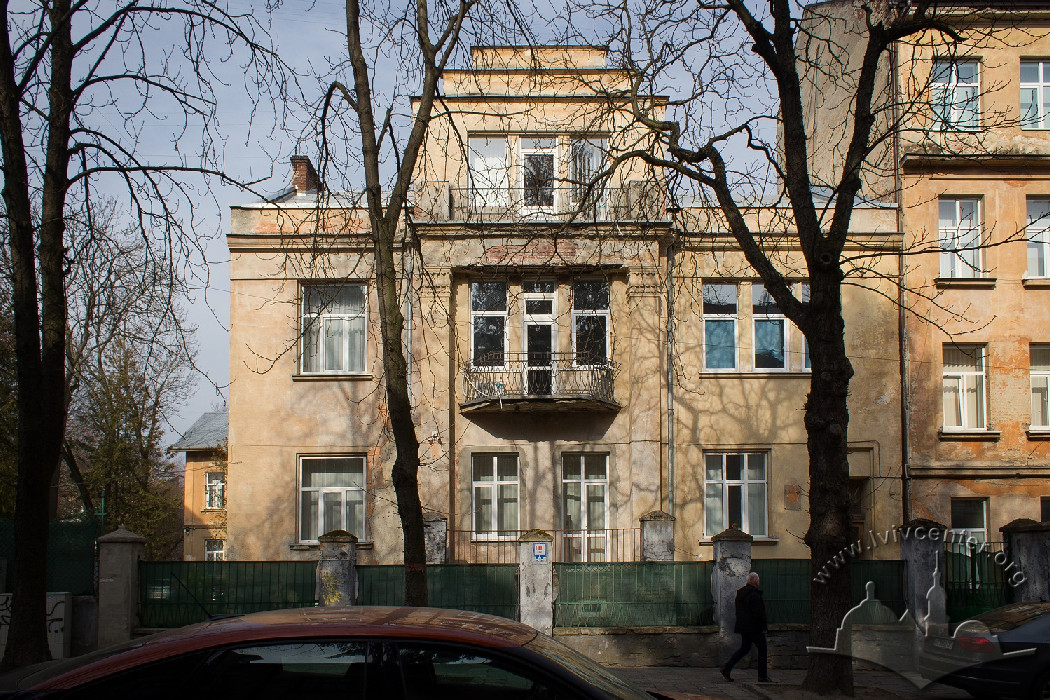
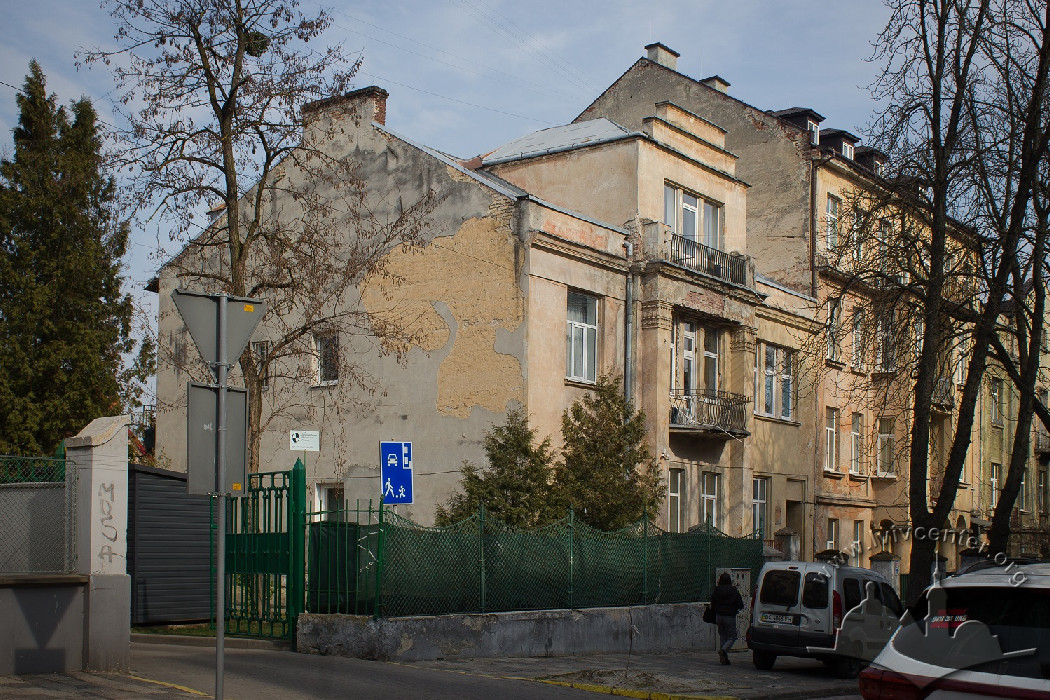
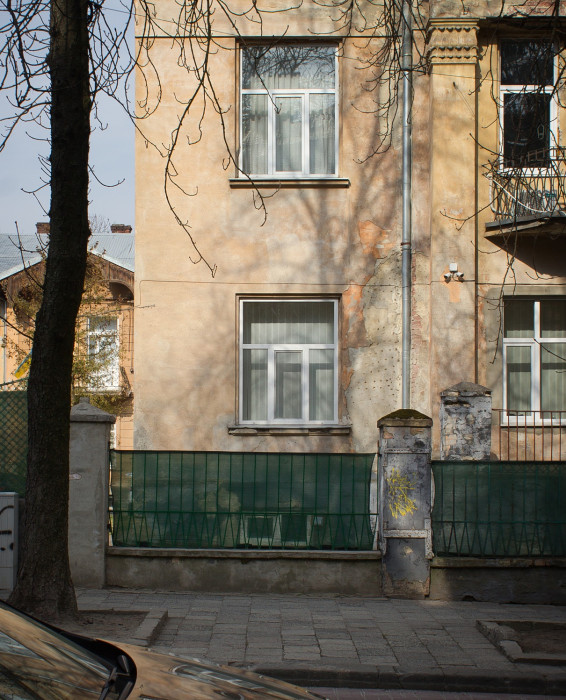
Vul. Konovaltsia, 24 – hospital building (former villa) ID: 2700
The villa was built according to a project designed by Michał Fechter in 1905–1906 for Mikołaj Rybowski, a school director. It was a single-story building with a mansard, featuring elements of Secession. In 1927–1929, it was reconstructed by commission from Dawid Vogel in the Art Deco style with an additional floor (designed by Jakób Silber). Today, it houses the 5th Municipal Hospital.
Story
This section of ul. 29 Listopada (now vul Konovaltsia) between what is now vul. Melnyka and vul. Kyivska was laid in 1892. However, since the late 18th century, there had been a four times larger plot of land here, which was assigned conscription number 128¼ in the early 1800s. It stretched from the present-day vul. Antonovycha to the present-day vul. Konovaltsia. In 1871, it had the address ul. Sadownicka 7 (now vul. Antonovycha; the number was later changed). At that time, it was owned by Elżbieta Wiche.
Half of this plot was purchased by Mikołaj Rybowski, director of the State Railways School (Lwowianin, 1894, No. 10, p. 103). He was also a public figure, a member of the Ethnographic Society (Towarzystwo ludoznawcze), the Animal Protection Society (Ochrona zwierząt), the Polish Pedagogical Society, and others. He collected folklore and published several books on folk songs, customs, and beliefs. In 1910, he retired (Kurjer Lwowski, 1910, No. 109, p. 6).
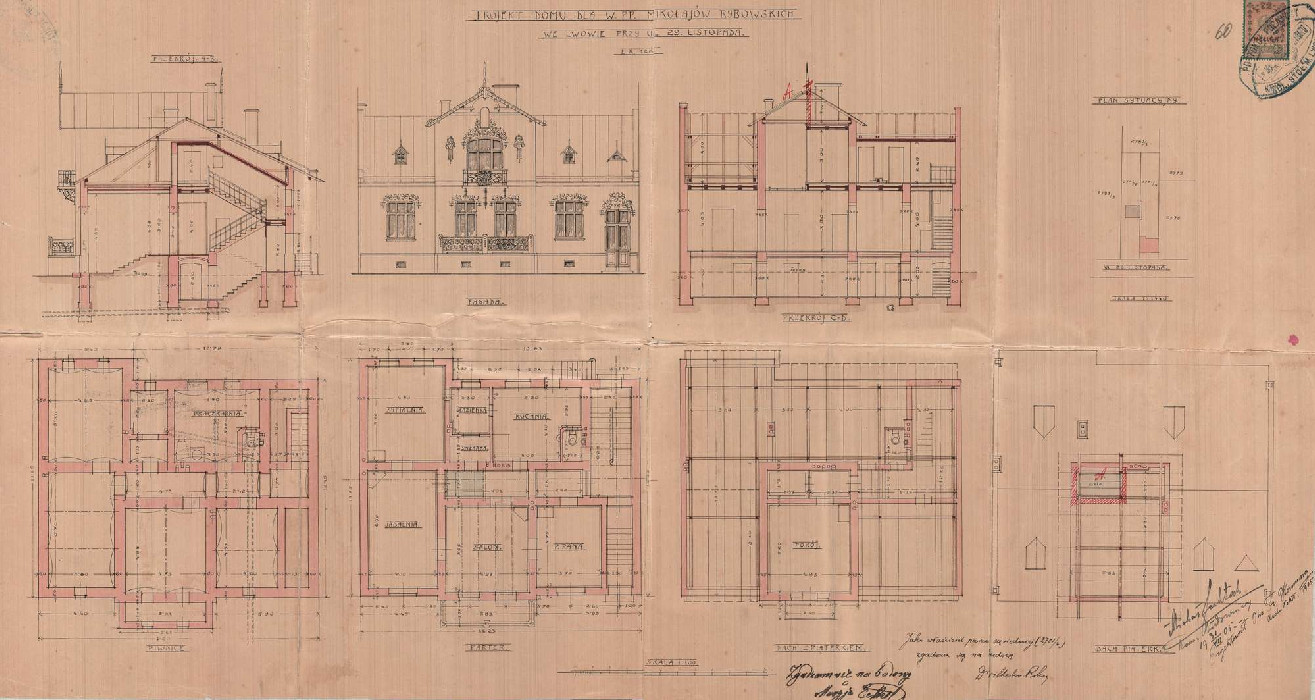
In 1894-1895, Rybowski built a villa on this plot at the contemporary address of vul. Konovaltsia 26, where he settled with his wife Rozalia. In 1905, he divided this plot into two narrower halves. He sold the villa to the Rolny family and commissioned a new, smaller villa for himself from the constructor Michał Fechter. It was a single-story building with five rooms and a small mansard. In August 1905, the project was approved by the Magistrate (ДАЛО 2/1/3376:1). Stanisław Krzyżanowski, an engineer and construction authority official, noted that the building did not comply with the provisions of the Lviv Building Statute of 1885. The issue was that the villa occupied the entire width of the narrow plot and that there was no passageway to the rear. Krzyżanowski expressed his expert opinion that the project could be approved given that the plot was located in "the suburbs, where there are many gardens" and that the neighboring houses also did not have gates — but only on the condition that any future construction in the depths of the plot would be impossible (ДАЛО 2/1/3376:2). The project was signed by neighbors: Dr. Wilhelm Rolny and Marya Eckert.
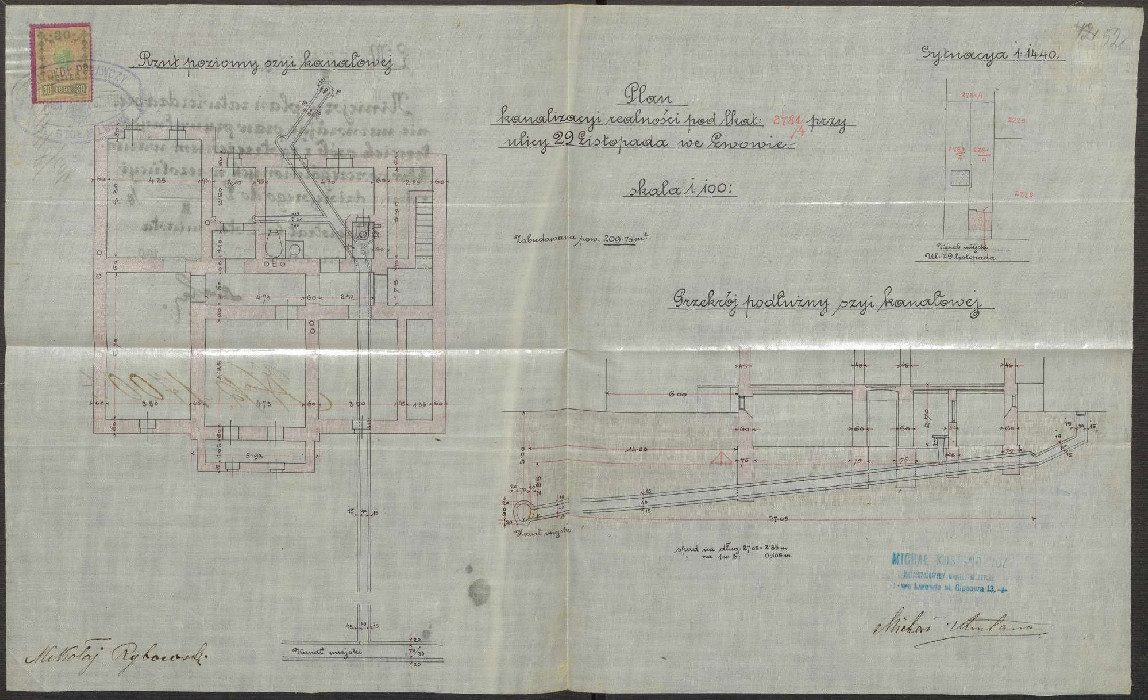
After receiving permission in August 1905, Rybowski completed construction the following summer. He separately approved the sewage project, which was carried out by Michał Kustanowicz, a master builder (ДАЛО 2/1/3376:5, 52). In August 1906, the plot was assigned a new conscription number 1700 ¼ (ДАЛО 2/1/3376:10). Permission to move into the house was given with a delay until October 1906 on the grounds that "the walls are not yet completely dry".
Mikołaj Ryboński lived in the villa with his wife Rozalia. In 1927, the villa was purchased from the heirs of the late Mikołaj by Maurycy and Adolf Gerner, as well as Dawid Vogel.
They worked in private companies and were, in particular, co-owners of the Atlantic cinema (Monitor polski, 1934). In 1924, they co-founded the Poltyp, a company that sold sewing and printing machines manufactured in Czechoslovakia (Polski przemysł, 1930). They commissioned architect Jakób Silber to design the reconstruction of the villa with the addition of a second floor. In early 1928, they received a building permit (ДАЛО 2/1/3376:15-17).
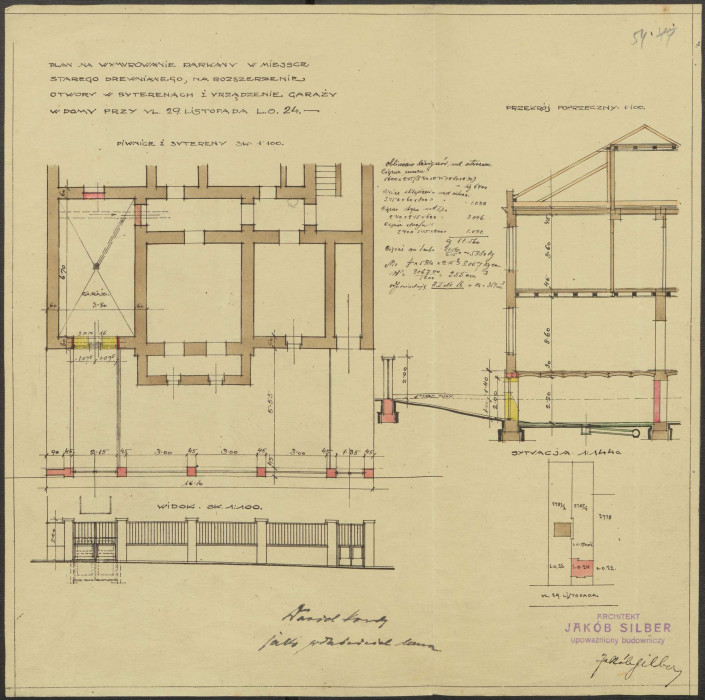
During construction in the summer of 1928, the co-owners decided to convert one of the basement rooms into a garage, to build a driveway from the street, and to construct a fence. However, the matter was delayed for two years. The co-owners carried out this work without permission, while the papers (according to a later explanation by Maurycy Gerner) were "lost" in the Magistrate's office (ДАЛО 2/1/3376:49). The case reached the provincial administration and reports of violations were filed against the co-owners and the architect, but in the end, in January 1930, the garage was approved (ДАЛО 2/1/3376:46).
After the reconstruction, Dawid Vogel lived in the house with his family. In 1932, while he was abroad, the house was robbed. According to a journalist from the newspaper Chwila, the theft was carried out "in true Chicago style": they put the maid to sleep, emptied the safe, and took jewelry, stock papers, cash, the painting "Jew in a Tallit" by Kaufman and expensive alcohol (Chwila, 1932, No. 4680, p. 4).
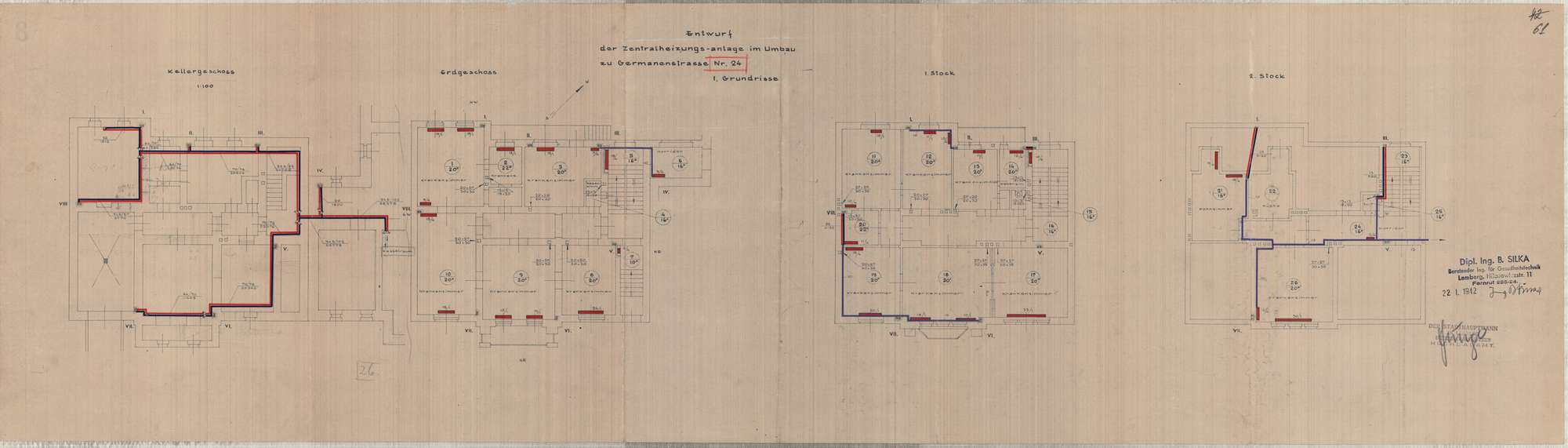
After the outbreak of the Second World War, Dawid Vogel remained in Lviv — his surname appears at this address in the Soviet telephone directory from 1940. His further fate is unknown. In early 1942, this building, together with No. 26, was attached to the hospital located at No. 22. In particular, according to the design of certified engineer B. Silka, central heating was installed here (ДАЛО 2/1/3376:61). After the war, it housed a tuberculosis dispensary (Reference Book, 1949), and then a pulmonology department.
After 2020, the doors of the former garage were bricked up, the driveway was removed, and the gate was replaced with a fence.
Architecture
In 1906–1927, it was a single-story villa with a small mansard. The ground floor had four rooms, a kitchen, a separate bathroom and toilet, and a storage room. In the center, there was the living room with a terrace. The kitchen had a separate entrance from the rear façade. A double staircase led to the mansard, which contained one habitable room with a balcony and a toilet. In the basement, one room was intended for a laundry, next to which there was also a service toilet.
The building was built of brick, its basements covered with brick vaults; the other ceilings, stairs, and roof structures were wooden.
The main façade was almost symmetrical in its composition. In the middle, there was a thin avant-corps with a terrace on the ground floor and a balcony on the mansard. According to Michał Fechter's design, it was to be decorated in the Secession style: with stucco flowers above the windows and doors and two wreaths. The windows did not have profiled trimmings, only thin chamfers. The terrace had a brick fence with molded floral ornamentation, and the balcony was to have openwork metal brackets and railings. Above the balcony door, there was to be a niche, possibly for a statue of the Virgin Mary.
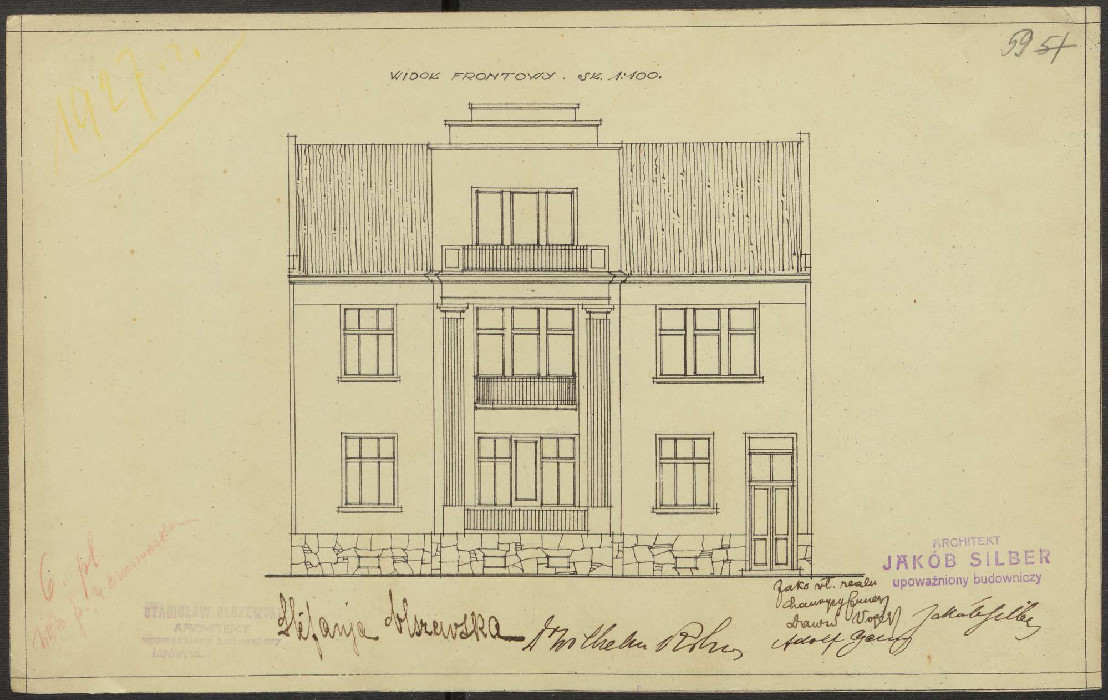
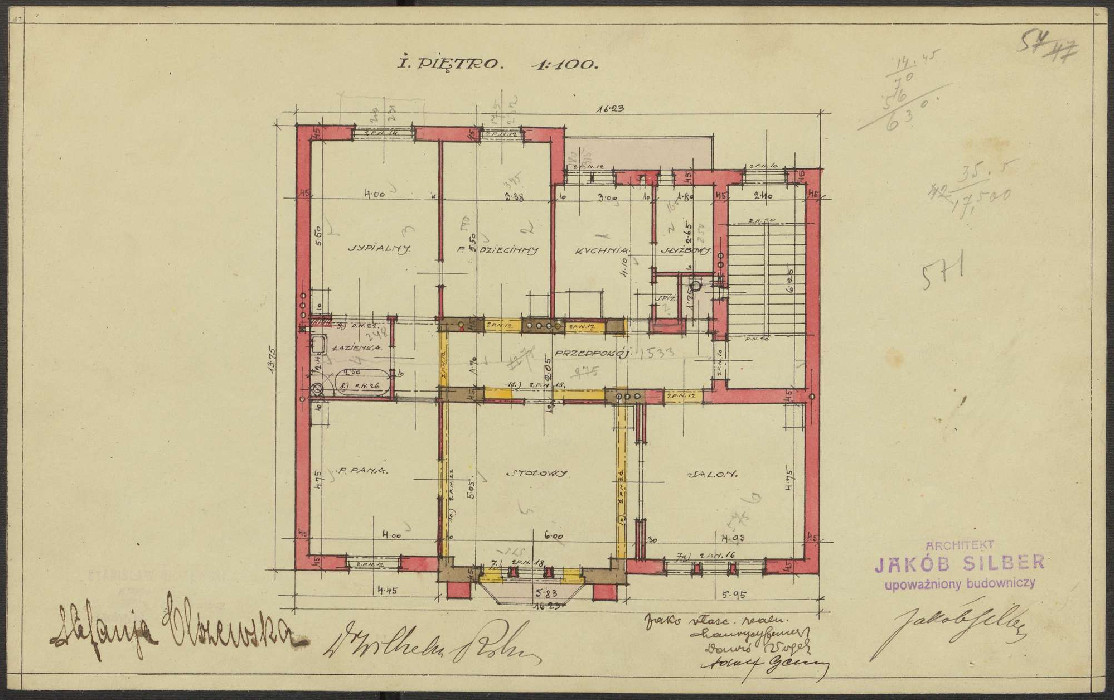
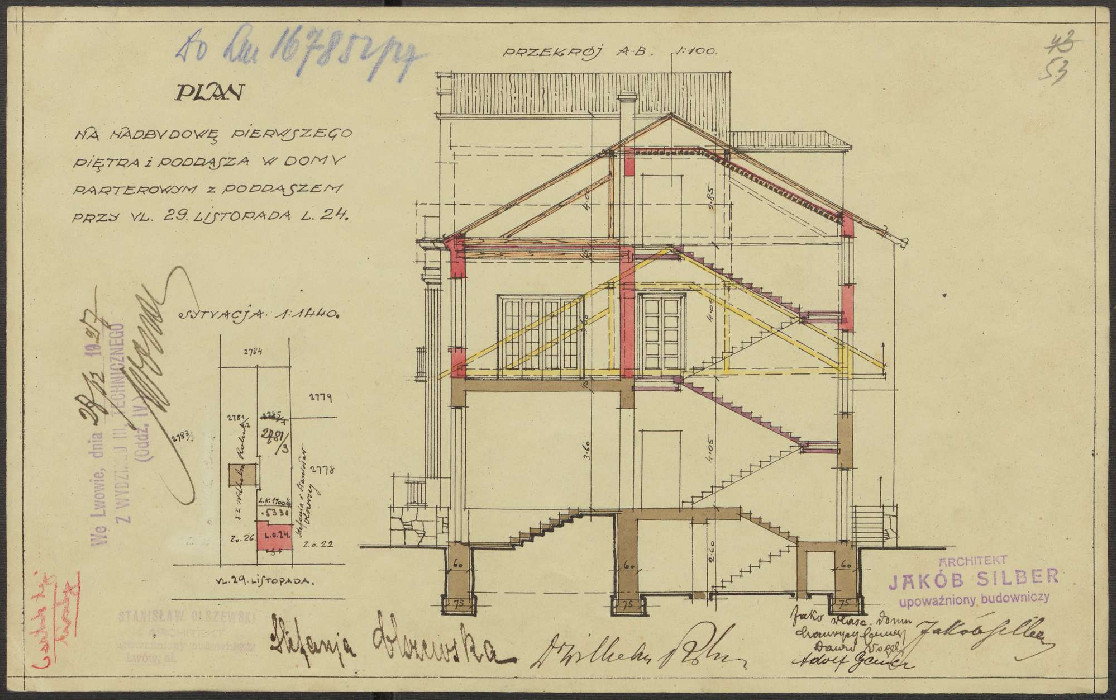
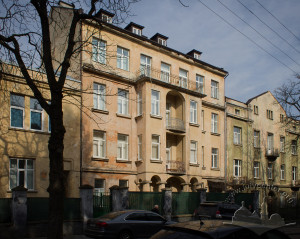
The reconstruction designed by Jakób Silber in the late 1920s included the addition of a floor. Thus, the building became a two-story building with an attic. The ground floor composition remained unchanged, while the second floor windows are different. Instead of the Secession style, the façade became more restrained, an Art Deco one. The avant-corps was decorated with fluted neoclassical pilasters, and the attic was given a stepped shape. As before, the terrace and balcony remained on the avant-corps, and a second balcony was added to the mansard. The layout of the house remained largely the same. In addition to one room, another kitchen was added to the new attic. Thus, the house became large enough for two families to live in.
Today, the house has probably been significantly redesigned for the needs of the hospital.
Related buildings and spaces
-
Vul. Konovaltsia, 22 – hospital building (former residential)
People
Eugenja Weissberg — a dentist who lived in the house
in 1933 and 1940.
Adolf Gerner — a civil servant and entrepreneur
who co-owned the house in 1927-1939.
Maurycy Gerner (1884–?) — a civil servant and
entrepreneur who co-owned the building in 1927–1939.
Jakób Silber (1889–?) — a Lviv architect who
lived at ul. Sykstuska 40 (now vul. Doroshenka) in 1930 and designed the villa
reconstruction project.
Michał Kustanowicz — a master builder who designed the
project to connect the villa to the sewage system in 1906.
Stanisław Krzyżanowski — an architect and employee of the
construction authority in Lviv in the early 20th century.
Józef Landesberg — a lawyer for the Gerners and Vogel;
died during the Holocaust in Lviv.
Mikołaj Rybowski (1839–1914) — a school director,
ethnographer and public figure who co-owned and lived in the villa.
Rozalia Rybowska — a co-owner of the villa who lived
there in 1905–1927 (?).
Jan Rybowski — owner of the villa in the 1920s.
Michał Fechter (1843–1908) — a Lviv constructor
who designed the project of the villa in 1905.
Dawid
Vogel (1887–after 1940) — an entrepreneur who was born in
Deliatyn and lived at ul. Goląba 10 (now vul. Verkhratskoho) in 1927. Around
1930, he moved into this house and lived on the second floor there.
Sources
- Державний архів Львівської області (ДАЛО) 2/1/3376: 61.
- ДАЛО 2/1/3378:42.
- "Drobne ogłoszenia", Chwila, 1933, Nr. 5303a, s. 15.
- "Wielkie włamanie kasowe przy ul. Listopada", Chwila, 1932, Nr. 4679, s. 5.
- "We Lwowie a la Chicago", Chwila, 1932, Nr. 4680, s. 4.
- I.R. Warchałowska, "Pożegnanie", Kurjer Lwowski, 1910, Nr. 109, s. 6.
- Księga adresowa Małopolski (Lwów, 1935).
- "Obwieszenia sądowe. Z rejestru handlowego", Monitor Polski, 1934, Nr. 182, s. 4.
- Polski premysł i handel (Warszawa, 1930), s. 817.
- Skorowidz król. stoł. miasta Lwowa, 1871.
- Skorowidz król. stoł. miasta Lwowa, 1879.
- Skorowidz król. stoł. miasta Lwowa, 1889.
- Skorowidz król. stoł. miasta Lwowa, 1916.
- Zbiór ogłoszeń firmowych trybunałów handlowych, Z. 2, 1935, s. 3.